Best Music Streaming Service for Artists: Top Picks & Tips
Discover the best music streaming service for artists—compare payouts, reach, and analytics to grow your career.
December 23, 2025
Music Marketplace Advisor
Buying & SellingThere's no single "best" music streaming service for artists. The real secret is building a smart, multi-platform strategy. True success comes from matching your goals—whether that's maximizing revenue, reaching a global audience, or getting your hands on powerful promotional tools—with the right mix of services. Think of this guide as your roadmap to doing just that.
How to Choose the Right Music Streaming Platform
Trying to navigate the streaming world can feel like a lot, but it gets much simpler once you understand the core strengths of each major service. The digital music scene isn't a one-size-fits-all game anymore. It's a collection of distinct ecosystems, each offering unique perks for different kinds of artists. Your choice needs to be a strategic one, not just a blind upload to every platform you can find.
This shift has completely reshaped the industry's finances. Streaming now accounts for a massive 67% of total global music revenue. In the U.S., that number jumps to an incredible 84% of the industry's income, while physical sales have dwindled to just 11%. It's clear where the audience—and the money—is.
Understanding the Key Players
Before we get into the nitty-gritty, let's start with a high-level look at what each platform is known for. This is your quick reference guide to the major players and their biggest selling points for artists.
- Spotify: Still the king of user numbers and algorithmic discovery. It's an essential tool for emerging artists who need to get seen and heard.
- Apple Music: Delivers a higher per-stream payout and taps into a huge, engaged audience that's already part of the Apple ecosystem.
- TIDAL: Built its reputation on high-fidelity audio and an artist-centric model with better payouts. It’s a great fit for established artists with a dedicated fanbase that values quality.
- Amazon Music: Its power lies in its deep integration with the massive Amazon ecosystem, opening up another major channel for revenue and discovery.
The most effective approach isn't about picking one winner. It’s about understanding how to use each platform's unique strengths to build a comprehensive release strategy that grows your audience and your income simultaneously.
To see how these platforms stack up at a glance, the table below provides a quick snapshot. We'll dive much deeper into these numbers and features later on. You can also learn more about why these platforms are crucial for exposure in our other articles.
At a Glance: Key Streaming Platform Strengths for Artists
This table offers a quick snapshot of what each major streaming service does best, helping you immediately identify which platforms align with your primary goals.
| Platform | Primary Strength for Artists | Typical Payout Per Stream | Global Monthly Listeners |
|---|---|---|---|
| Spotify | Algorithmic Discovery & Massive Reach | $0.003 - $0.005 | 615 Million+ |
| Apple Music | High User Engagement & Higher Payouts | ~$0.01 | 100 Million+ |
| TIDAL | Artist-First Model & HiFi Audio | $0.012 - $0.015 | ~5 Million |
| Amazon Music | Integration with Prime & Alexa | ~$0.004 | 82 Million+ |
As you can see, the numbers tell different stories. An artist focused on pure reach might prioritize Spotify, while someone aiming to maximize earnings from a loyal fanbase could see better results from TIDAL or Apple Music.
The Core Metrics Artists Need to Understand
Picking the right streaming service is about more than just chasing the highest per-stream payout. That single number, while important, is just one piece of a much larger puzzle that shapes your career and your bank account. To really get this right, you have to understand the key metrics that actually define success on these platforms.
Let's start with the most basic concept: the royalty model. This is the formula that determines how you get paid. Most of the big players, like Spotify and Apple Music, operate on a pro-rata system. Think of it like a giant pot: all the subscription and ad money for a certain period gets dumped into it. That total pot is then divided by the total number of streams on the entire platform, and you get paid based on your slice of that pie.
What this really means is that your payout isn't a fixed rate. It fluctuates based on where your listeners are, whether they pay for a premium plan, and how much ad revenue the platform pulls in. A stream from a paid subscriber in the U.S. will always put more money in the pot than a stream from a free-tier user in a country with lower ad rates.
Beyond the Payout Per Stream
While the pro-rata model is the industry standard, fixating on royalty rates alone can be a real trap. You need to look at the other data points that give you a complete picture of your career's momentum.
- Audience Demographics: Who's actually listening? Your artist dashboard is a goldmine of data on your fans' age, gender, and location. This isn't just trivia; it's essential for booking tours, running targeted social media campaigns, and truly knowing your audience.
- Algorithmic Discovery: How does the platform help new fans find you? Getting your music onto algorithmic playlists like Spotify's Discover Weekly can be a game-changer, often more valuable than a slightly higher payout. For an emerging artist, one great placement can introduce you to thousands of new listeners overnight.
- Listener Engagement: Are people just hearing your music, or are they connecting with it? Pay close attention to metrics like saves, playlist adds, and shares. These actions are powerful signals that someone has gone from being a passive listener to an active fan—and that’s what algorithms and the industry really care about.
A high stream count is great, but a high engagement rate is the real proof of a dedicated fanbase. It shows your music is resonating, not just playing in the background.
Integrating Your Music Ecosystem
The best platform is one that sees you as a multi-faceted artist, not just a collection of audio files. The streaming services that truly support careers are becoming central hubs for your entire brand, and you need to evaluate how well they integrate all your revenue streams.
Your artist-specific dashboard is your command center. Look for platforms that give you powerful tools to do more than just track streams. You want to be able to push merch, promote tour dates, and talk directly to your fans. A service that lets you seamlessly link your new single to a pre-order for a limited-edition t-shirt is one that helps turn listeners into paying supporters.
And while streaming royalties are a major focus, don't forget how your audience interacts on visual platforms. Using tools like YouTube engagement calculators can give you a clearer picture of how your music videos and other content are performing, which complements the data from audio-only services. This holistic view is what allows you to build a stronger connection with your community and, ultimately, a more sustainable career.
Comparing Platform Payouts and Audience Reach
As an artist, you're constantly weighing two things: how much you earn and how many people you reach. The entire debate over the best streaming service boils down to finding the sweet spot between those two priorities. You might find a platform with a colossal audience that pays pennies per stream, or another that offers a much better royalty but to a smaller, more niche group of listeners.
There's no single "perfect" platform. The real skill is in building a smart distribution strategy—knowing which service to push for immediate income versus which one to use for long-term fan growth. It's a classic trade-off, and understanding it is crucial.
This is where the relationship between your payouts, audience size, and the analytics that connect them comes into focus.
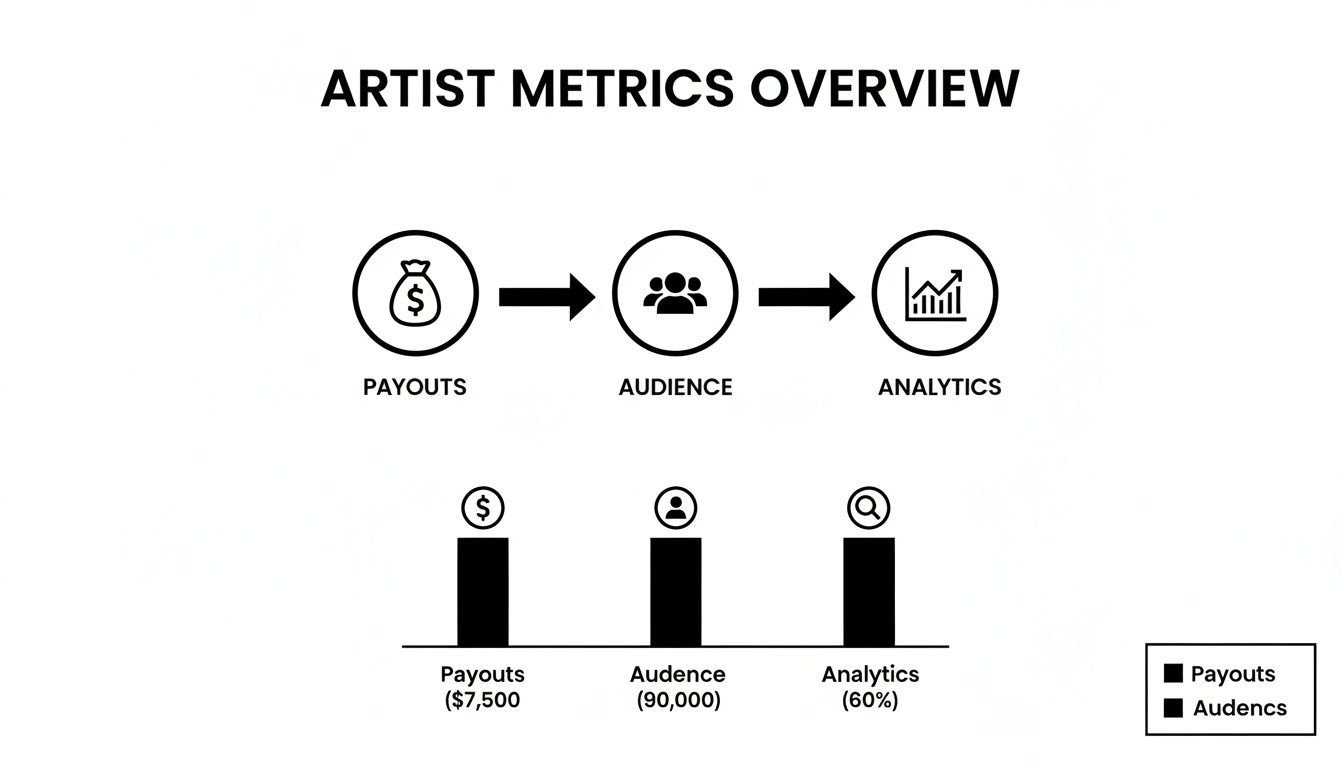
A sustainable career really hinges on keeping these three pillars in balance.
Spotify: The Audience Giant
When it comes to sheer numbers, Spotify is in a league of its own, with over 615 million monthly active users. This scale makes it an unparalleled engine for discovery. Getting your music onto one of its powerful algorithmic playlists, like Discover Weekly or Release Radar, can literally introduce you to thousands of new fans overnight.
But that incredible reach comes with a well-known catch. Spotify’s per-stream payout is notoriously low, hovering between $0.003 and $0.005. Of course, a viral hit can still rake in serious cash from the massive volume, but on a stream-for-stream basis, you'll earn less here than almost anywhere else.
For an emerging artist, Spotify’s real value isn't the direct paycheck—it's the audience-building potential. Landing on a major editorial playlist can be a career-defining moment that no other platform can match at that scale.
Apple Music and Amazon Music: The Balanced Contenders
Apple Music and Amazon Music sit in a comfortable middle ground. They both offer a solid mix of a large audience and respectable payouts. With over 100 million subscribers, Apple Music's user base is highly engaged, and artists see a payout of around $0.01 per stream—often double what Spotify pays.
Amazon Music is a similar story. It taps into its massive Prime ecosystem to bring in 82 million listeners and pays a competitive rate of about $0.004 per stream. Neither has the algorithmic discovery power of Spotify, but both give you access to huge, established audiences that are used to paying for music, making them reliable sources of revenue.
TIDAL: The High-Payout Specialist
If your primary focus is on maximizing the value of each stream, TIDAL is where you want to be. It has built its reputation on being one of the most artist-friendly platforms out there, paying out an estimated $0.012 to $0.015 per stream. This rate completely dwarfs what the larger services offer.
The trade-off is straightforward: each stream on TIDAL is worth a lot more, but you'll have far fewer of them. The platform has a more niche audience of around 5 million subscribers, which means its discovery potential is limited. TIDAL is an excellent choice for established artists who can bring their existing fanbase over to a platform that compensates them more fairly.
Ultimately, deciding where to invest your time and promotional energy comes down to your career stage. A broad distribution strategy is always a good start, but knowing the financial reality of each platform helps you make smarter choices. If you're looking for more direct control over what you earn, exploring your artist pricing options on a platform like OohYeah can offer a compelling alternative to the old-school streaming models. It’s all about creating a financial ecosystem where your music can thrive.
Leveraging Artist Tools for Career Growth
Forget just counting streams—real, sustainable growth comes from understanding your audience. The best platforms give you a free, powerful analytics dashboard that basically hands you a roadmap for your career. Learning to use these tools is as crucial as nailing your performance.
Think of these dashboards as your mission control. They show you who’s listening, where they live, and how they found your music in the first place. You can move past surface-level numbers and start spotting trends, finding opportunities, and making smart decisions that actually fuel your growth. The data tells the story of what happens to your music after it leaves your hands.

Comparing the Core Analytics Dashboards
While nearly every major platform has an artist portal, the quality and depth of the data can be worlds apart. Knowing the differences helps you figure out where to focus your energy and marketing budget.
Spotify for Artists: The Discovery Engine Spotify's dashboard is the industry benchmark, and for good reason. Its data is tied directly to the platform's famous discovery algorithms.
- Key Features: You get real-time stream counts, deep listener demographics (age, gender, location), and detailed tracking of every playlist you land on—both algorithmic and editorial. Plus, it has the all-important tool for pitching unreleased tracks to editors.
- Best For: Any artist focused on growing their audience from the ground up. The playlist data is pure gold for figuring out what makes the algorithm notice you.
Apple Music for Artists: The Engagement Hub Apple Music's platform offers clean, insightful data that often feels more focused on genuine listener engagement, a holdover from its iTunes sales days.
- Key Features: It tracks Shazams, daily listeners, and top cities. A standout feature is seeing which playlists are truly driving your streams. The Shazam integration is unique—it shows you where your music is being discovered out in the real world.
- Best For: Artists who want to understand how people are engaging. Knowing your song was Shazamed 20 times at a coffee shop in Berlin is a level of insight you just can't get elsewhere.
Amazon Music for Artists: The Voice-Activated Insight Amazon's dashboard gives you a unique window into its ecosystem, especially how people use voice commands with Alexa.
- Key Features: The "Daily Voice Index" is a fascinating metric that shows how often people ask Alexa to play your music. You can also identify your most dedicated fans and see how you’re doing on Amazon's curated stations.
- Best For: Artists curious about how fans listen in their day-to-day lives, particularly with the rise of smart speakers.
Turning Data Into Actionable Strategy
Numbers on a screen don't mean much without a plan. The real magic happens when you translate analytics into real-world actions that build a loyal fanbase and, ultimately, increase your income. For a more detailed breakdown, check out our guide on how to use data analytics to grow your music fanbase.
The goal isn't just to get more streams; it's to get the right streams. Use your analytics to find the cities, playlists, and demographics that make up your core audience, then go all-in on connecting with them.
Here’s how this looks in practice:
- Planning a Tour: Your Spotify for Artists dashboard shows a sudden listener spike in Chicago and Dallas. Boom—those are the first two cities you should book for your next run of shows. You already have an audience waiting.
- Refining Your Sound: You notice your new instrumental track is getting added to tons of user-created "study beats" playlists. That’s the market telling you what it wants. Your next track could lean into that vibe to build on the momentum.
- Targeting Your Ads: Apple Music shows your biggest audience is men aged 25-34 in the UK. Now you have the exact demographic to run hyper-focused, cost-effective social media ads for your next single or merch drop.
By actively using these free tools, you stop passively waiting for a break and start actively building your own. Every stream is a data point, and every data point is another clue to building a long-lasting career in music.
Putting It All Together: Real-World Scenarios
Alright, let's move from theory to practice. Knowing the numbers is one thing, but figuring out how they apply to your career is what really matters. There's no single "best" platform; the right choice is always about your specific goals and where you are on your musical journey.
To make this crystal clear, I've broken down three common artist profiles. Think of these as roadmaps. Find the one that feels most like you, and you'll have a solid starting point for building a distribution strategy that actually works.
Scenario One: The Emerging Indie Artist
If you're just starting out, your biggest battle isn't monetization—it's obscurity. Your number one job is to get heard. Forget about pennies per stream for a moment; your focus should be on discovery, pure and simple. You need to get your music in front of people who have no idea you exist.
Your game plan should be built around platforms with the strongest discovery engines.
Primary Platform: Spotify This is non-negotiable. With nearly 700 million monthly active users and a staggering $10 billion paid out to rights holders, its scale is unmatched. But for a new artist, the real gold is in its algorithmic playlists. Getting your track on Discover Weekly or Release Radar can be like winning the lottery, exposing your sound to thousands of potential fans overnight. You can dive deeper into Spotify's recent growth and payout trends on ArtistPush.me.
Secondary Focus: Social Media Integration Make sure your distributor gets your music onto TikTok and Instagram. A 15-second clip of your song going viral is one of the most powerful promotional tools available today. It creates a direct pipeline, driving curious listeners from a quick video right to your full-length track on Spotify.
Think of it this way: at this stage, streaming platforms are your best promotional tool. A new listener from a playlist isn't just a stream—they're a potential ticket-buyer, a future merch customer, and your next dedicated fan.
Scenario Two: The Established Niche Musician
Okay, so you've got a core audience. It might not be massive, but it's loyal. These are the people who follow you on social media, show up to your shows, and buy your merch. For you, the game changes from broad discovery to maximizing the income you get from the fans you already have.
It's time to guide your audience toward the platforms that will put more money in your pocket.
Primary Platforms: TIDAL and Apple Music This is where you can cash in on that loyalty. Don't just drop a link—launch a small campaign around your next release. Tell your fans why it helps you when they listen on TIDAL, where a single stream can be worth three or four times what you'd earn on Spotify. You’d be surprised how many are happy to switch over to support you directly.
Secondary Focus: Bandcamp For any artist with a dedicated fanbase, Bandcamp is essential. It's your digital merch table. You can sell high-quality downloads, vinyl, and exclusive content, and the platform's artist-friendly revenue share means most of that money goes straight to you.
The key here is open communication. Your fans want to support you. A simple post in your newsletter or on Instagram explaining how they can make a real difference is often all it takes.
Scenario Three: The Global Pop Act
When you're aiming for mainstream success and a global audience, your strategy shifts again. It's no longer about just discovery or maximizing niche revenue; it's about being absolutely everywhere. Your goal is total saturation and cultural relevance on a massive scale.
This means a laser focus on the platforms with the biggest global footprints.
Primary Platforms: Spotify and YouTube Music These two are the undisputed heavyweights of global streaming. Spotify is your key to breaking into international markets, from Europe to Latin America. Meanwhile, YouTube Music is plugged into the world's largest video site, making it the undeniable hub for music videos, lyric videos, and other visual content that drives global hits.
Secondary Focus: Region-Specific Services A truly global strategy means looking beyond the usual suspects. If you're targeting specific markets, you need to be on their preferred platforms. That could mean getting your music on QQ Music for a push in China or Yandex Music to reach listeners in Russia.
For an artist at this level, it's a numbers game. The per-stream payout might be lower on some of these platforms, but the sheer volume of plays generates enormous revenue and solidifies your place on the world stage.
Got Questions About Music Streaming? We've Got Answers.
The world of music streaming can feel like a maze. Just when you think you have a handle on it, a new question pops up. Let's tackle some of the most common questions I hear from artists trying to build a real career in music.
Getting these details right is a huge part of crafting a release strategy that actually works.
Can I Just Upload My Music Directly to Spotify?
I get this one all the time. The short answer is no, you can't. Platforms like Spotify and Apple Music don't have a direct upload portal for artists. Instead, you need to go through a digital music distributor.
Think of distributors like DistroKid, TuneCore, or CD Baby as the essential middlemen. They take your tracks and metadata, format everything correctly, and deliver it to all the major streaming services for you. They also collect your royalties, which is pretty important. Picking the right distributor is one of the very first decisions you’ll make.
How Do I Actually Get on Playlists Like Discover Weekly?
Landing on a big algorithmic playlist can feel like winning the lottery, but it's less about luck and more about strategy. The most powerful move you can make is pitching your track directly through your Spotify for Artists dashboard at least a week before it comes out.
That pitch flags your song for both Spotify's human editors and its algorithms. But here's the real key: you need a surge of activity in the first 48 hours of release. When your core fans save the track, add it to their own playlists, and share it, you're sending a massive signal to the algorithm that this song is worth paying attention to.
Algorithmic playlists are fueled by early data. Strong day-one and day-two engagement from your core fanbase is the best signal you can send that your track deserves a wider audience.
Should I Go All-In on One Platform or Be Everywhere?
For almost every artist out there, casting a wide net is the way to go. Your fans are scattered across a dozen different services, and you can't predict where your next big listener will come from. Making your music available everywhere removes any barriers for someone trying to check you out.
Of course, you can still run a focused promo campaign on a single platform, like a Spotify pre-save. But the music itself? It needs to be on every major service. This strategy maximizes your potential reach and prevents you from losing listeners just because they prefer a different app.
Do I Really Get Paid for Every Single Stream?
Yes, but it's complicated. The cash value of a single stream is tiny and fluctuates wildly based on a few key things: the listener's subscription (premium pays more than ad-supported), their country, and the specific deals each platform has with rights holders.
On top of that, platforms are cracking down on streaming fraud. Some are introducing minimum thresholds, meaning a song might need to hit a certain number of streams or listeners before it even starts earning royalties. It's a move to ensure the money flows to real artists with genuine listeners.
Ready to take full control of your music, merchandise, and revenue? OohYeah provides the tools you need to build a direct relationship with your fans and maximize your earnings without intermediaries. Start building your artist-first ecosystem today at https://oohyeah.app.