Best Distributor for Independent Artists in 2024
Discover the best distributor for independent artists. We compare top services like DistroKid and TuneCore to help you choose the right partner for your music.
November 16, 2025
Music Marketplace Advisor
Buying & SellingFinding the best distributor for independent artists really comes down to your career goals and how often you plan to put out new music. It's not a one-size-fits-all situation.
If you’re constantly in the studio and dropping tracks, a service like DistroKid with its unlimited upload model is a game-changer. On the other hand, if you’re more focused on one-time releases and need solid publishing support, you might lean towards CD Baby or TuneCore. The trick is finding that sweet spot between cost, features, and where you see your music going long-term.
How to Choose Your Music Distribution Partner

Picking a music distributor is one of the most critical decisions you'll make as an artist. Think of them as the essential link connecting your finished songs to listeners on Spotify, Apple Music, TikTok, and everywhere else. This isn't just about uploading a file; it's about partnering with a service that fits your budget, release schedule, and creative vision.
The independent music scene is absolutely booming. The global market was valued at around USD 160.6 billion in 2025 and is on track to hit nearly USD 219.93 billion by 2030, according to Mordor Intelligence. With that kind of growth, making smart business moves is more important than ever to make your voice heard.
The first step is to figure out what you truly need. Are you a prolific artist who drops a single every month? Or do you spend years crafting an album? Your answer is the first clue that will lead you to either a subscription plan or a pay-per-release service.
Define Your Primary Goals
Before you get lost comparing every single feature, take a step back and think about what you need right now. Your immediate priorities will quickly tell you which platform will give you the most bang for your buck from day one. For a more detailed walkthrough, our guide on https://oohyeah.app/posts/how-to-choose-the-right-music-distribution-service can help you map out your needs.
Every artist is different, and so are their priorities. Here are a few common scenarios:
- Frequent Releases: If you're constantly putting out new music, an annual flat fee for unlimited uploads is almost always the most economical path.
- Publishing & Sync: For songwriters who want to earn from their compositions or get their music placed in TV, film, or ads, a distributor with a strong publishing arm is a must.
- Collaborator Payouts: If you're in a band or collaborate often, a platform with automatic royalty splits will save you from endless spreadsheets and headaches.
This bit of self-reflection is crucial. It helps you cut through the marketing noise and zero in on the partners who can actually help you grow.
To make things a little easier, I’ve put together a quick table that matches common artist goals with the platforms that serve them best. It's a great starting point before we dive deeper into the specifics of each one.
Quick Distributor Comparison for Key Artist Goals
| Artist Goal | Primary Recommendation | Key Feature |
|---|---|---|
| Frequent, unlimited releases | DistroKid | Low-cost annual subscription for unlimited uploads. |
| Comprehensive royalty collection | TuneCore | Robust publishing administration services. |
| One-time fee, no subscriptions | CD Baby | Pay-per-release model with physical distribution options. |
| Starting on a tight budget | Amuse | Free tier available for basic distribution needs. |
This high-level view should give you a good idea of where to start your search. Now, let’s get into the nitty-gritty of what each of these top distributors has to offer.
What to Look for in a Music Distributor
Before you even start comparing platforms, you need to know what you're actually paying for. It's easy to get caught up in marketing slogans, but the real value is in a handful of features that are the foundation of your digital music career. These are the things that directly affect your workflow, your income, and your ability to grow.
At its core, a distributor’s main job is to get your music the essential codes it needs to be tracked online. That means an ISRC (International Standard Recording Code) for every single track and a UPC (Universal Product Code) for the whole release, like an album or EP. Think of these as the digital fingerprints for your music, making sure every stream and sale is tracked and credited back to you.
Without a unique ISRC, platforms like Spotify would have no idea who to pay when someone plays your song. A good distributor makes this whole process invisible and automatic.
Looking Past the "100% Royalties" Promise
One of the biggest selling points you'll see is the promise of keeping "100% of your royalties." While that sounds great, you have to read between the lines. This almost always means the distributor passes on 100% of the money they get from stores like Apple Music and Spotify—after those platforms have already taken their share.
The real costs often show up somewhere else. Sometimes, they're hidden in fees for services that should be included from the start.
A perfect example is YouTube Content ID. Watch out for distributors that charge you an annual fee for every release and take a 20-30% cut of any ad revenue your music earns on YouTube. That can take a huge bite out of your earnings from one of the biggest music platforms on the planet.
Another thing to dig into is how they handle payments for your collaborators. Automatic royalty splitting is an incredible feature that can save you countless hours of accounting headaches. But some services will charge your collaborators an annual fee just to get paid, or they'll skim an extra commission off payouts to anyone who isn't a member. These details are usually buried in the terms of service but can seriously affect your income and your relationships with your team.
Why Speed and Analytics Matter
How fast your music gets delivered to stores is more than just a convenience. A quick turnaround gives you the agility to plan last-minute releases and provides a buffer to catch and fix any mistakes before your big launch day. The best distributors can get your music live on major platforms in just 2-5 business days.
But getting your music online is only half the battle. A truly great distributor gives you a powerful analytics dashboard. This is your command center. It shouldn't just show you how much you've earned; it should give you a deep dive into who's listening and where.
- Geographic Hotspots: Pinpoint the cities and countries where your music is most popular. This is gold for planning a tour or targeting your social media ads.
- Playlist Performance: See which playlists are sending you the most streams so you can focus your pitching efforts.
- Audience Demographics: Get to know the age and gender of your listeners to make your marketing much more effective.
This kind of data turns you from just an artist into a smart business owner. Once you understand these core functions, you can see past the flashy ads and judge each distributor on what really matters. To see how these features affect what you'll actually pay, it's helpful to explore different artist pricing structures and what they cover.
Comparing the Top Music Distributors
Choosing the right distribution partner is one of the most critical decisions you'll make in your music career. Think of it less like picking a service and more like choosing a business partner. While they all perform the same core job—getting your music onto Spotify, Apple Music, and other platforms—the way they operate can drastically affect your workflow, your finances, and your long-term strategy.
We’re going to put five of the biggest names in the game head-to-head: DistroKid, TuneCore, CD Baby, Amuse, and Ditto Music. This isn't just a surface-level look at features; we're digging into the mechanics that really matter, like their pricing models, how they handle royalties, how fast they get your music live, and what extra tools they bring to the table.
To get started, this chart gives you a quick snapshot of how these distributors stack up on the essentials, from ISRC/UPC codes to royalty collection.
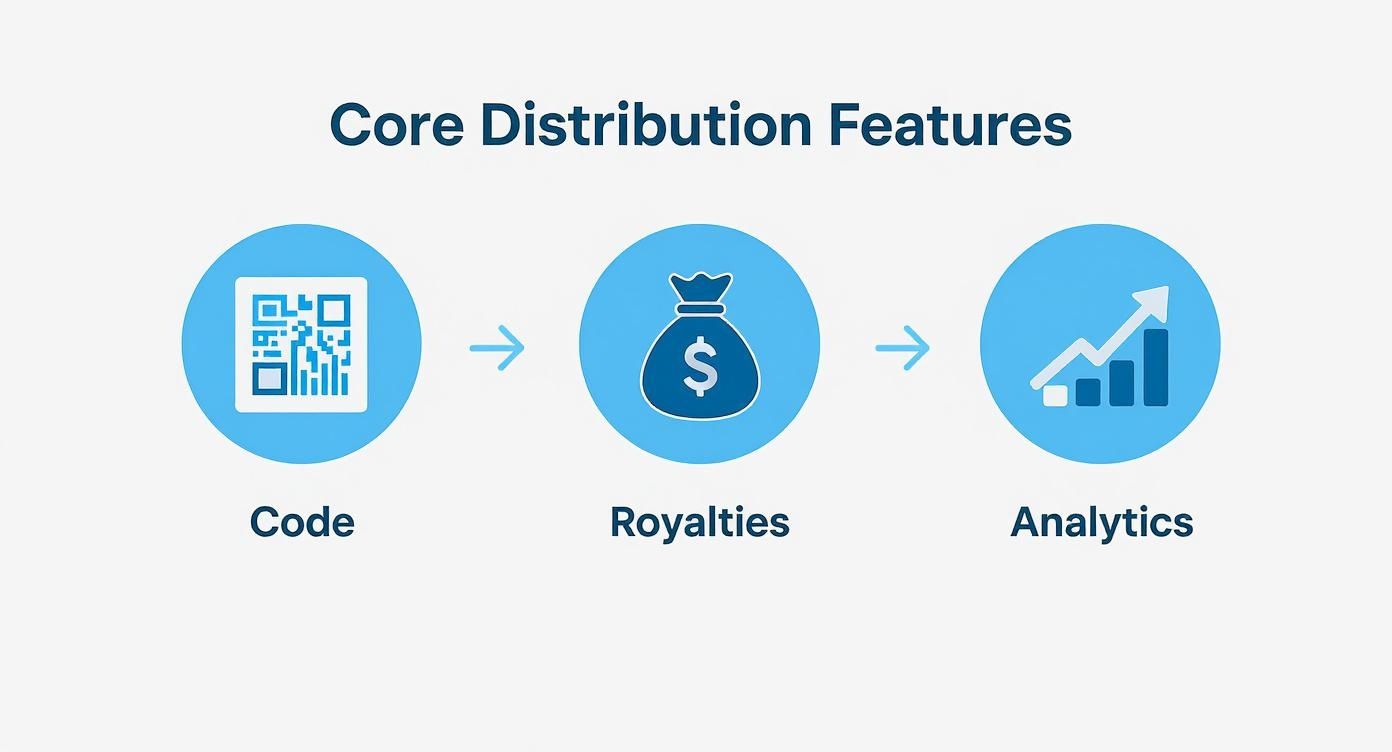
As you can see, everyone covers the basics. The real differences are in the details—the depth of their analytics, how they manage your money, and how accessible their more advanced services are.
Feature and Pricing Deep Dive
Let's break down the core offerings. This table gets straight to the point, comparing what you pay, what you keep, and who benefits most from each platform's unique approach.
| Distributor | Pricing Model | Royalty Split | Key Feature | Best For |
|---|---|---|---|---|
| DistroKid | Annual Subscription | 100% to artist | Unlimited uploads & fast delivery | Prolific artists releasing music constantly |
| TuneCore | Annual Subscription | 100% to artist | Robust publishing administration | Songwriters focused on all revenue streams |
| CD Baby | One-Time Fee Per Release | 91% to artist (9% commission) | Music stays online forever, no recurring fees | Artists who release music infrequently (e.g., one album) |
| Amuse | Subscription (with free tier) | 100% to artist on paid plans | Mobile-first workflow & data-driven label services | Artists looking for potential label deals & advances |
| Ditto Music | Annual Subscription | 100% to artist | Global reach & label-focused tools | Independent labels or artists comfortable with self-service |
This comparison highlights the fundamental divide in the market: pay-per-year for unlimited uploads versus pay-per-release for lifetime distribution. Your choice here will likely come down to your release schedule and budget.
DistroKid: The Prolific Creator's Choice
DistroKid completely changed the game with a simple, powerful offer: pay one annual fee, upload all the music you want. This is a dream come true for producers dropping weekly singles or artists who maintain a constant stream of new content. They’re also known for being incredibly fast, often getting tracks live on platforms quicker than anyone else.
But that simple pricing has some nuances. Many features that are standard on other platforms are paid add-ons here. Want to make sure your music stays up if you ever cancel your subscription? That'll be a one-time "Leave a Legacy" fee for each release. Need YouTube Content ID to monetize user-generated videos? That's an annual fee plus a 20% commission on any ad revenue it generates.
DistroKid's Primary Advantage: Unmatched value for hyper-prolific artists. If you release a dozen or more tracks per year, the flat-fee model is almost impossible to beat financially, even with the add-on costs.
One of their best features, hands down, is the automatic payment splitting. You can tell DistroKid what percentage each producer, bandmate, or co-writer gets, and they handle the payouts directly. The catch? Each collaborator needs their own paid account (or you have to cover the cost), which adds another layer to the real-world cost.
TuneCore: The Songwriter's Publishing Powerhouse
TuneCore has been around for a long time and recently updated its model to compete head-on with DistroKid, offering unlimited uploads for a yearly fee. Their real ace in the hole, however, has always been their comprehensive publishing administration service, making them an excellent choice for serious songwriters.
This service goes far beyond what you earn from streams. It's designed to collect the money you're owed as a composer from sources like radio airplay, live performances, and TV placements. It's an add-on service with its own fee, but it's one of the most robust and accessible publishing solutions out there for independent artists.
- Social Media Integration: TuneCore Social is a handy tool included in their plans, giving you a dashboard to schedule and manage posts across your social platforms.
- Detailed Analytics: Their reporting is generally more insightful than DistroKid's, offering a clearer picture of where your streams are coming from and who your audience is.
- Subscription Dependency: Just like DistroKid, if you stop paying your annual subscription, your music comes down. It's a long-term commitment.
For an artist who is just as focused on earning from their compositions as they are from their recordings, TuneCore offers a powerful, all-in-one solution.
CD Baby: The Legacy One-Time Fee Model
CD Baby is one of the OGs of independent distribution, and their model is totally different. You pay a single, one-time fee for each release, and it stays online forever. No annual bills, no recurring charges. This is perfect for artists who work on a more traditional album cycle, releasing new music every few years.
That "pay once, live forever" model offers incredible peace of mind, but it comes at a cost. CD Baby takes a 9% commission on your digital distribution royalties. They also take a 30% commission on YouTube Content ID revenue—one of the highest cuts in the business.
CD Baby's Critical Limitation: The lack of an automatic royalty splitting feature. For bands or collaborative projects, this means one person gets all the money and is responsible for manually calculating and paying everyone else. It's a huge administrative headache.
On the flip side, CD Baby's other major strength is its physical distribution. If you want to sell CDs and vinyl, they offer warehousing and fulfillment services, making them a true one-stop shop for both your digital and physical releases.
Amuse: The Mobile-First Innovator
Amuse came onto the scene with a slick, mobile-first platform, letting artists upload and manage everything straight from their phones. They initially made waves with a free distribution tier, but their focus has clearly shifted to their paid plans, which promise faster releases and better support.
What truly sets Amuse apart is its data-driven approach. The company actually uses its own streaming data to find promising artists on its platform and then offers them label deals and royalty advances. This positions them as more than just a service; they're a potential talent incubator. You can find out more about how independent artists are winning with these tools and retaining 100% ownership of their work.
- Sync Licensing: Amuse actively pitches its artists' music for sync opportunities in TV, film, and commercials, opening up a valuable potential revenue stream.
- Commission on Splits: Their royalty splitting feature is convenient, but be aware that they take a 15% commission on payouts to any collaborator who isn't a paid Amuse subscriber.
- Limited Network: When compared to giants like TuneCore or CD Baby, Amuse distributes to a smaller network of stores, which might limit your reach in some international markets.
Ditto Music: The Global Contender with a Caveat
Based in the UK, Ditto Music offers an unlimited distribution model that's right in line with DistroKid and TuneCore. They have a strong global footprint and famously helped launch the careers of artists like Ed Sheeran and Sam Smith.
Their plans are competitive, with options for independent labels that need to manage multiple artists. The feature set is solid, including pre-save links, chart registration, and even playlist pitching opportunities for select artists.
However, the company has been dogged by persistent complaints about its customer support. Artist forums and review sites are filled with stories of slow response times, payment problems, and frustrating technical issues. While many artists use the service without a hitch, the sheer volume of these complaints points to a potential risk.
Ditto's Potential Pitfall: Customer service reliability. The platform offers a powerful feature set for a great price, but the risk of hitting a support wall is a significant factor you need to weigh.
If you're comfortable with a largely self-service platform and don't anticipate needing much hands-on help, Ditto is still a very viable option. But for anyone who values responsive and reliable support, it might feel like a gamble.
Finding the Right Distributor for You
Picking the best music distributor isn't about finding a one-size-fits-all winner. It’s about finding the service that fits you—your workflow, your career stage, and what you’re trying to achieve. Forget the feature lists for a second. The right choice is deeply personal and hinges entirely on what kind of artist you are.
To cut through the noise, I’ve broken it down into four common artist profiles. Find the one that sounds most like you, and you'll get a clear recommendation that makes sense for your specific journey in the music industry.
The Prolific Producer or Frequent Releaser
Are you always in the studio? Dropping a new single every few weeks or juggling collaborations? If you're constantly creating, the last thing you need is a per-release fee bleeding you dry. That model just isn't sustainable when your output is high.
For this type of creator, DistroKid is the undeniable frontrunner. Its entire business is built around a simple, powerful idea: pay one low annual fee for unlimited uploads. This completely removes the financial barrier to releasing music, letting you focus on what matters—creating and keeping your momentum going without worrying about the bill.
- The Big Win: Your distribution costs are fixed. Whether you release one track or fifty in a year, you pay the same price.
- A Practical Note: The automatic payment splitting for collaborators is a huge time-saver, but remember you’ll need to factor in the cost of adding them to the system.
If you're a high-volume creator, the value you get from unlimited uploads easily beats the cost of DistroKid’s extra add-on features.
The Singer-Songwriter Focused on Long-Term Revenue
If you’re a songwriter first, your thinking needs to go beyond just streaming royalties. You're not just a performer; you're a composer. Your goal should be to capture every penny your original compositions earn, from sync placements in film and TV to mechanical and performance royalties.
This is where TuneCore really shines. While their distribution service is rock-solid, their secret weapon is the comprehensive publishing administration they offer. This add-on is designed to track down and collect all the songwriting royalties you're owed from sources all over the world—money that standard distribution simply doesn't touch.
Choosing a distributor with a strong publishing arm is a strategic investment in your songwriting career. It ensures you're not leaving money on the table as your catalog grows and finds new audiences through different media.
For any serious songwriter, TuneCore offers an integrated way to manage both your recording and composition royalties under one roof. It's a powerful financial tool for your career.
The DIY Band with a Physical Presence
For a lot of bands, the music life isn't just digital. It’s about selling merch at shows, connecting with fans face-to-face, and having something tangible like CDs and vinyl to offer. If your strategy involves physical products and you release music less often—maybe an album every couple of years—a subscription model just doesn't make sense.
CD Baby is built for this exact scenario. You pay a one-time fee per release, and your music stays online forever without any recurring charges. Even better, they offer integrated physical distribution and warehousing. This lets you sell CDs and vinyl directly through their platform and into major retailers, making it a true one-stop shop for your digital and physical strategy.
The Emerging Artist on a Budget
Everyone has to start somewhere, and that start usually involves a shoestring budget. The financial reality can be tough. A recent survey from Ditto Music found that a staggering 75% of independent artists rely on personal savings to fund their careers. With touring becoming incredibly expensive, digital income is more vital than ever. You can read more about the financial realities facing independent artists on Ditto Music.
For artists in this spot, Amuse offers the perfect on-ramp. Their free distribution tier gets your music onto all the major platforms without you spending a dime. Of course, the free plan has its limits, but it’s a completely risk-free way to get your music out there, start building an audience, and see what works. Once your career starts gaining traction, you can always upgrade to a paid plan for more features and faster support. Amuse effectively tears down the financial barrier to entry, making sure money doesn't stop you from sharing your music.
Using Artist Services and Growth Tools
Choosing a music distributor isn’t just about getting your tracks onto Spotify anymore. The game has changed. Today, the best platforms function more like all-in-one career hubs, packed with services to help you market your music, manage your money, and genuinely grow your audience. These extra tools are often the real deciding factor, offering a return on your investment that goes far beyond simple distribution.
A successful release strategy starts well before your music goes live. This is where tools like pre-save campaign builders really prove their worth. A good distributor will give you the ability to create a professional-looking pre-save page, which can dramatically increase your first-day streams. Nailing those initial numbers is crucial for getting noticed by platform algorithms, potentially landing your track on discovery playlists like Spotify’s Release Radar.
Many distributors also offer a helping hand with playlist pitching. Instead of just dropping your music and wishing you luck, they might provide a dedicated portal to submit your tracks to independent curators or offer clear guidance for pitching to official editorial teams. This alone can save you dozens of hours of grunt work.
Leveraging Promotional and Social Integrations
Once your music is out, modern distributors help you keep the momentum going on social media. Look for platforms that make it easy to create and upload assets like Spotify Canvas, those short looping videos that play with your songs. A great Canvas can boost track shares by up to 200% and streams by over 5%, effectively turning listeners into your promotion team.
To get a broader picture of what's out there, it's worth exploring various marketing and growth tools that can work alongside what your distributor provides.
Key Differentiator: The real power isn't just having these tools, but how they work together. A platform that seamlessly integrates pre-save campaigns, playlist pitching, and social content creation in one place gives you a unified and powerful command center for every release.
This kind of integrated support is what turns your distributor from a simple delivery service into an active partner in your career.
Essential Financial and Business Management Tools
Marketing is only half the battle; managing the business side is just as important. Two of the most valuable financial features a distributor can offer are royalty advances and automated split payments. These services professionalize your operation and give you crucial financial breathing room.
- Royalty Advances: Some services, like Amuse, analyze your streaming data to predict future earnings and offer you an advance on that income. This cash can be exactly what you need to fund a music video, a marketing push, or a small tour, all without giving up 100% ownership of your master recordings.
- Automated Split Payments: This is a non-negotiable for bands, collaborators, and producers. Instead of one person collecting all the money and dealing with the headache of manual payouts, the platform automatically divides the royalties based on the percentages you set. It ensures everyone gets paid correctly and on time, preventing awkward conversations and saving a ton of admin time.
When you're trying to find the right distributor, don't just stop at the core delivery features. Dig into the entire ecosystem of tools they offer. These artist services are what truly empower you to not just release your music, but to build a sustainable career around it.
Making Your Final Choice and Next Steps
Picking the right distribution partner is all about matching a service to your actual career, not just the one you hope to have tomorrow. Before you pull the trigger, take a moment for a quick reality check.
Start with your release schedule. Be honest—are you a single-a-month artist, or are you focused on crafting one perfect album over the next year? This single factor will immediately tell you whether a flat-fee subscription or a pay-per-release model makes more sense for your wallet.
Then, dig into the features you know you’ll need. Things like YouTube Content ID and automatic royalty splits for your collaborators can be deal-breakers. Make sure to check the fine print for any hidden commissions tied to these services, as they can eat into your profits down the line. Think about where you want to be in a couple of years and ask if the platform has the tools to get you there.
Don't Fear the Switch
I see a lot of artists get analysis paralysis, terrified they'll be stuck with their first choice forever. The good news is you're not. Moving your music from one distributor to another is totally doable, and it’s a smart move if you outgrow your initial partner. The main goal is to do it without losing your hard-earned stream counts and playlist spots.
The secret to a smooth transition is meticulous data management. When you re-upload your tracks through a new distributor, you have to use the exact same metadata: the same audio file, artwork, song title, and, most critically, the original ISRC code. That code is like a social security number for your track—it's how stores identify it.
If you transfer all that information correctly, the new release will seamlessly replace the old one, and all your stats and playlist placements will carry over. This gives you the flexibility to adapt as you grow. Your first choice is a big step, but it’s not a life sentence.
For a deeper dive into this, check out our guide on the best strategies for independent music distribution. It’ll give you even more context to make sure your distribution strategy is always working for you.
Got Questions? We've Got Answers
Stepping into music distribution for the first time? It's natural to have a few questions. Getting the right information upfront is one of the most important things you can do for your career.
Can I Switch My Music Distributor Later On?
Absolutely. Artists move between distributors all the time for various reasons. The trick to a seamless switch, without losing your hard-earned stream counts or playlist spots, is meticulous data management.
When you re-upload your music with a new service, you have to use the exact same metadata. We're talking identical audio files, artwork, and—most crucially—the original ISRC codes. Most distributors have step-by-step guides to help you make the move without a hitch.
Will I Lose Ownership of My Music?
You should never, ever lose ownership. A legitimate music distributor is a service provider, not a record label that takes a piece of your masters. They are simply licensing your music to get it onto platforms like Spotify and Apple Music on your behalf.
You should always retain 100% ownership of your master recordings and your compositions. Before you sign up for anything, read the terms and conditions carefully to confirm this.
Choosing the best distributor for independent artists means finding a partner, not a boss. Your ownership should never be on the table. A good service works for you, ensuring your music reaches its audience while you maintain full creative and financial control over your art.
How Long Does It Take for My Music to Go Live?
While many top-tier distributors can get your music live on major platforms within 2-5 days, you should never cut it that close.
The industry standard is to upload everything at least 3-4 weeks ahead of your planned release date. This buffer is critical. It gives you time to resolve any unexpected technical issues and, more importantly, allows you to properly pitch your songs to the editorial teams at Spotify, Apple Music, and others for playlist consideration.
Ready to take full control of your music career? OohYeah offers a direct-to-fan platform where you retain full ownership and sell your music, merch, and more, commission-free. Start building your artist ecosystem today.