Artist Discovery Platform: How It Works and How to Use One
Learn what an artist discovery platform is, how its recommendations work, which features matter for artists and industry pros, and how to get found.
October 26, 2026
Music Marketplace Advisor
Buying & SellingA listener hears a short clip of your song on their phone and wants to hear the rest. They find a repost without your artist name, a streaming profile missing your latest release, and a merchandise page somewhere else. By the time they've searched across several apps, they've lost the impulse to keep listening.
For an independent artist or manager, that's more than an untidy online presence. It's a missed connection between someone liking the music and choosing to support the person who made it.
What an Artist Discovery Platform Does
An artist discovery platform connects emerging and independent musicians with listeners and industry professionals. A well-designed service combines searchable artist profiles, music, recommendations, audience information, communication, and purchasing options. Not every platform offers all of those functions, so the category describes a purpose rather than a fixed feature list.
Think of a streaming service as a library. A social feed is a crowded street corner where someone might catch your attention. A discovery platform should work more like a record shop with a listening booth and a clerk who remembers your taste: you can explore, get context, and decide what to take home.
Who uses it and why
The same artist page needs to serve different intentions:
- Artists need listeners to find the right profile, hear their work, and take a useful next step.
- Fans want unfamiliar music that fits their interests, without having to investigate every recommendation.
- Managers, labels, and promoters need enough context to judge whether an act deserves a closer look.
Those needs overlap, but they aren't interchangeable. A fan might care about the song playing now. A promoter needs to know whether interested listeners live near a suitable venue.
Why discovery needs more than a feed
Attention no longer sits neatly inside one channel. According to MIDiA Research's analysis of changing discovery habits, nearly half of consumers included radio among their top three music-discovery methods in 2022, compared with slightly more than one-third in its fourth-quarter 2024 survey.
That shift doesn't mean an artist should replace radio ambitions with dependence on a single social app. Listeners arrive through different routes, and each route gives them different information.
Practical rule: Treat the place someone encounters your music as the entrance, not necessarily the destination.
A useful platform helps the listener move from an interesting sound to an identifiable artist and an accessible catalog. For the artist, the important question isn't whether the service generates exposure. It's whether someone who arrives curious can leave knowing who you are and how to stay connected.
Key Features Artists and Industry Pros Use
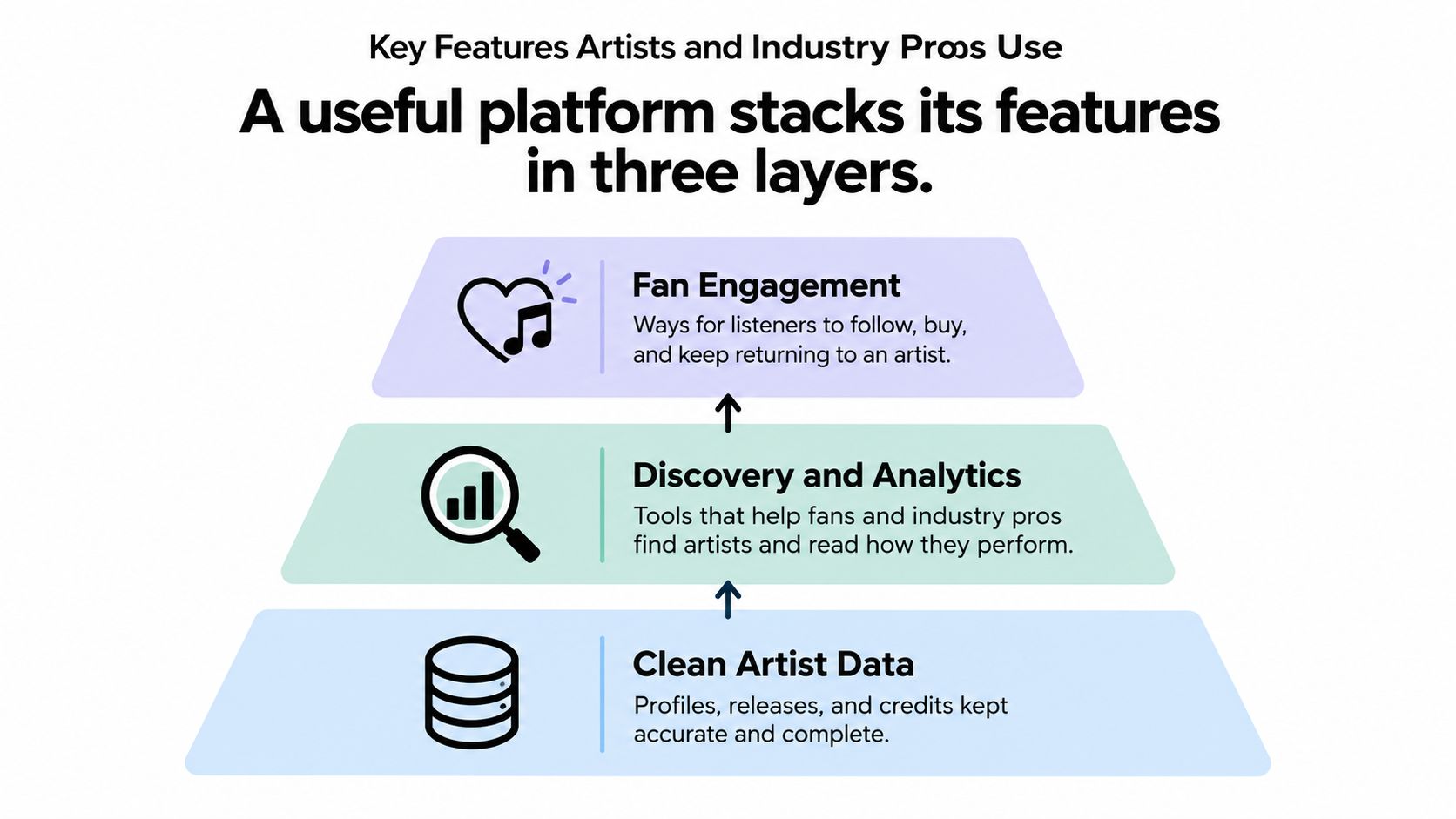
A useful platform stacks its features in three layers. The foundation is clean artist data: profiles, releases, and credits. Above that sit discovery and analytics. The final layer helps people act, through fan engagement, commerce, and professional workflows.
The feature stack below shows why accurate information needs to come before polished promotion.
Match the feature to a decision
A dashboard isn't useful just because it contains graphs. It becomes useful when an artist, manager, or scout can make a better decision from it.
Platform features, users and the decisions they support
| Feature | Main users | What it shows | Decision it supports |
|---|---|---|---|
| Discovery feed and search | Fans and artists | Artists matched by genre, location, and listener overlap | Which new acts to follow or support |
| Streaming and performance analytics | Artists and managers | Plays, listener counts, listener geography, and growth trends | Where to tour and which markets to target |
| A&R scouting filters | Labels and A&R teams | Artists filtered by growth rate, audience region, and genre | Which artists to contact or develop |
| Fan messaging and community posts | Artists and fans | Replies, voice notes, post engagement, and active fans | Which fans to nurture into superfans |
| Networking profiles | Producers, DJs, and managers | Credits, collaborators, and availability | Who to collaborate with on the next release |
| Event promotion tools | Promoters and venues | Local fan base and event interest | Which city or venue to book |
| Sales and monetization data | Artists and labels | Downloads, merchandise, and subscription revenue | Which products to promote next |
These are feature families to evaluate, not capabilities to assume every service provides. Ask to see the actual workflow, including what information is available before you pay or upload a catalog.
For example, listener geography might help a manager shortlist a tour market. It doesn't establish ticket demand by itself. The manager should also check local event interest, mailing-list responses, and whether listeners actively engage with the artist.
Choose for your role
Artists need a clear view of releases, audience behavior, and sales. Managers need comparable growth periods and practical contact tools. Labels need filters that produce a manageable shortlist, while promoters need local evidence rather than an impressive worldwide total.
A unified app can reduce administration by keeping streaming, selling, marketing, messages, and community activity together. The trade-off is that a broader service may not offer the depth of a specialist analytics or ticketing tool. Test the function you'll actually depend on, not the longest feature list.
Before joining, write down the features you'd use this month and the decision attached to each. If you can't name the decision, that feature probably shouldn't determine your choice.
How Recommendations Decide Who Gets Seen
Recommendation engines can use collaborative signals, content similarity, and metadata. Collaborative signals connect artists through shared listening behavior. Content similarity compares musical characteristics such as instrumentation, tempo, and vocal style. Metadata supplies context, including language, location, and collaborators.
A good analogy is a DJ reading a room. Familiar listeners give the DJ clues through their reactions. With an unfamiliar crowd, the DJ needs another starting point: musical relationships, context, and informed experimentation.
Why new artists need a different starting point
A new artist has little behavioral history. That's the cold-start problem, and it also affects listeners who haven't interacted much with a service. A platform should be able to use musical and descriptive information rather than treating missing history as evidence of missing appeal.
Switching recommendation methods can help, but no method produces a perfect list. A published music-recommendation study used error measures, precision, and recall to select dynamically between recommendation procedures, and reported maximum recommendation-list coherence of 35%.
That result describes the study's evaluation, not a universal discovery success rate.
Evaluation metrics for artist recommendations
| Metric | What it measures | Why it matters for discovery |
|---|---|---|
| Precision@10 | Share of the top ten recommended artists that listeners find relevant | Shows whether the first suggestions feel right |
| Recall@50 | Share of all relevant artists appearing within fifty suggestions | Tests whether relevant niche and emerging artists are reachable |
| F1 score | Harmonic balance of precision and recall | Helps compare model versions |
| RMSE and MAE | Prediction error between expected and actual preference scores, with different weighting of larger errors | Useful when predicting how strongly someone will like an artist |
| Recommendation-list coherence | How consistently a list hangs together under the evaluation's definition of similarity | Helps assess consistency, not commercial potential |
| Long-tail exposure share | Portion of recommendations assigned to artists outside the most popular group | Tests whether exposure extends beyond familiar acts |
Ask what the platform optimizes
Clicks alone can favor recognizable names. A stronger evaluation separates known-artist recommendations from genuinely new-artist discovery, then examines results by listener tenure, genre, geography, language, and popularity.
Platforms should also test emerging-artist placements against a popularity-only baseline. Saves, follows, messages, and purchases help reveal whether unfamiliar recommendations create meaningful interest.
For a useful comparison with social ranking, PostSyncer's guide to understanding Instagram feed rankings offers context for thinking about feed visibility. Don't assume the same signals or weights apply to music discovery.
Ask for an explanation beside recommendations: shared listeners, related instrumentation, a common city, or a credited collaborator. Artists need to understand the connection, not guess which promotional ritual might please an invisible system.
Signals Industry Professionals Read Before Signing
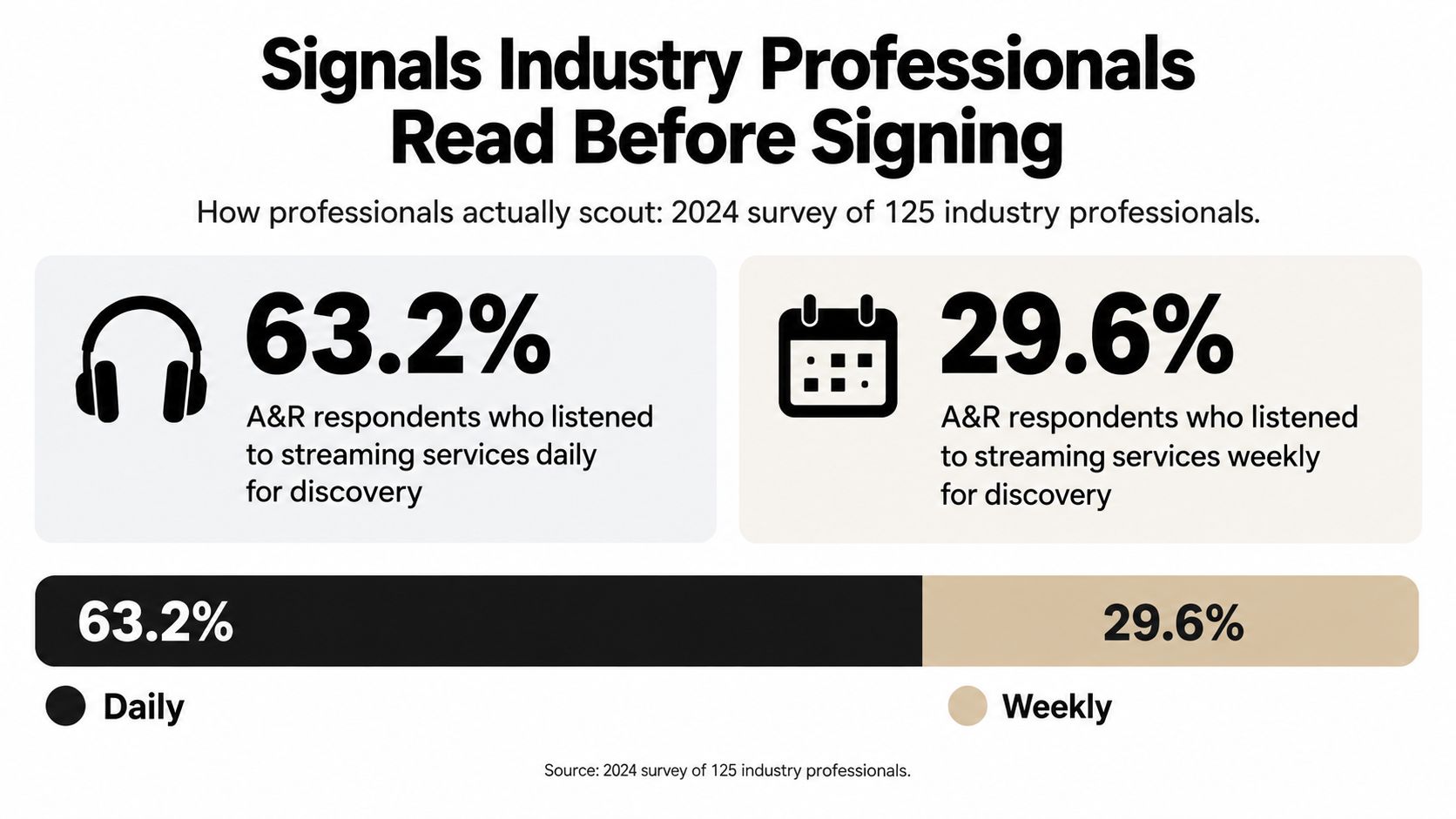
Professionals listen before they inspect dashboards. In a 2024 survey of 125 music-industry professionals, reported by Music Business Worldwide, 63.2% of A&R respondents said they listened to streaming services daily for discovery, while 29.6% did so weekly.
The survey display makes that listening habit easy to compare.
The practical lesson is to make your music accessible and your evidence interpretable. A scout shouldn't need to reconstruct your identity, locate missing releases, or guess whether audience activity came from a sustained campaign.
Read behavior in context
Artist signals and how to read them
| Signal | What it suggests | Check before trusting it |
|---|---|---|
| Weekly listener growth | Momentum that may last beyond a moment | Is growth steady across several weeks or a single spike? |
| Listener geography | Whether the act reaches beyond its home market | Concentration in one city may indicate a strong local scene rather than wider reach |
| Saves and follows | Intent to return | Check the denominator and separate saves from follows |
| Repeat listens per listener | Depth of catalog attachment | Examine catalog-level activity, not just a single track |
| Playlist or editorial adds | Curator endorsement | Check whether placements are sustained or one-off |
| Direct messages and merchandise purchases | Active interest, with purchases showing willingness to pay | Separate conversation from spending and inspect the context |
Say an artist gets a sudden burst of plays from a viral clip, but listeners rarely return. Another act has a smaller audience that keeps listening, asks about shows, and buys merchandise. A scout investigating durable fan attachment has a reason to examine the smaller act closely.
That isn't an automatic signing decision. Musical identity, live performance, rights, team readiness, and the label's development capacity still matter.
A spike earns attention. Repeated audience action gives a professional something to investigate.
When assessing a creator partnership alongside the music, Social Cloud's guide to influencer ratings provides a separate resource for considering the partner's audience. Keep that assessment distinct from the artist's own fan demand.
The following video provides an additional viewing resource alongside the scouting checklist.
Managers, labels, and promoters exploring platform-based workflows can review the available music-professional resources. Before making contact, ask whether growth persists, whether geographic spread fits the opportunity, and whether listeners do anything beyond pressing play.
Why Discovery Often Fails to Become Fandom
Reach isn't necessarily the bottleneck. An artist can attract attention without giving interested listeners a compelling, convenient reason to return. Increasing impressions won't fix an unclear next step.
The distinction is visible in MIDiA Research's analysis of young listeners' social habits: TikTok was a major discovery source for 51% of 16–24-year-olds, yet only 19% of young listeners who discovered an artist they loved went on to listen to more music from that artist.
Give the listener somewhere to go
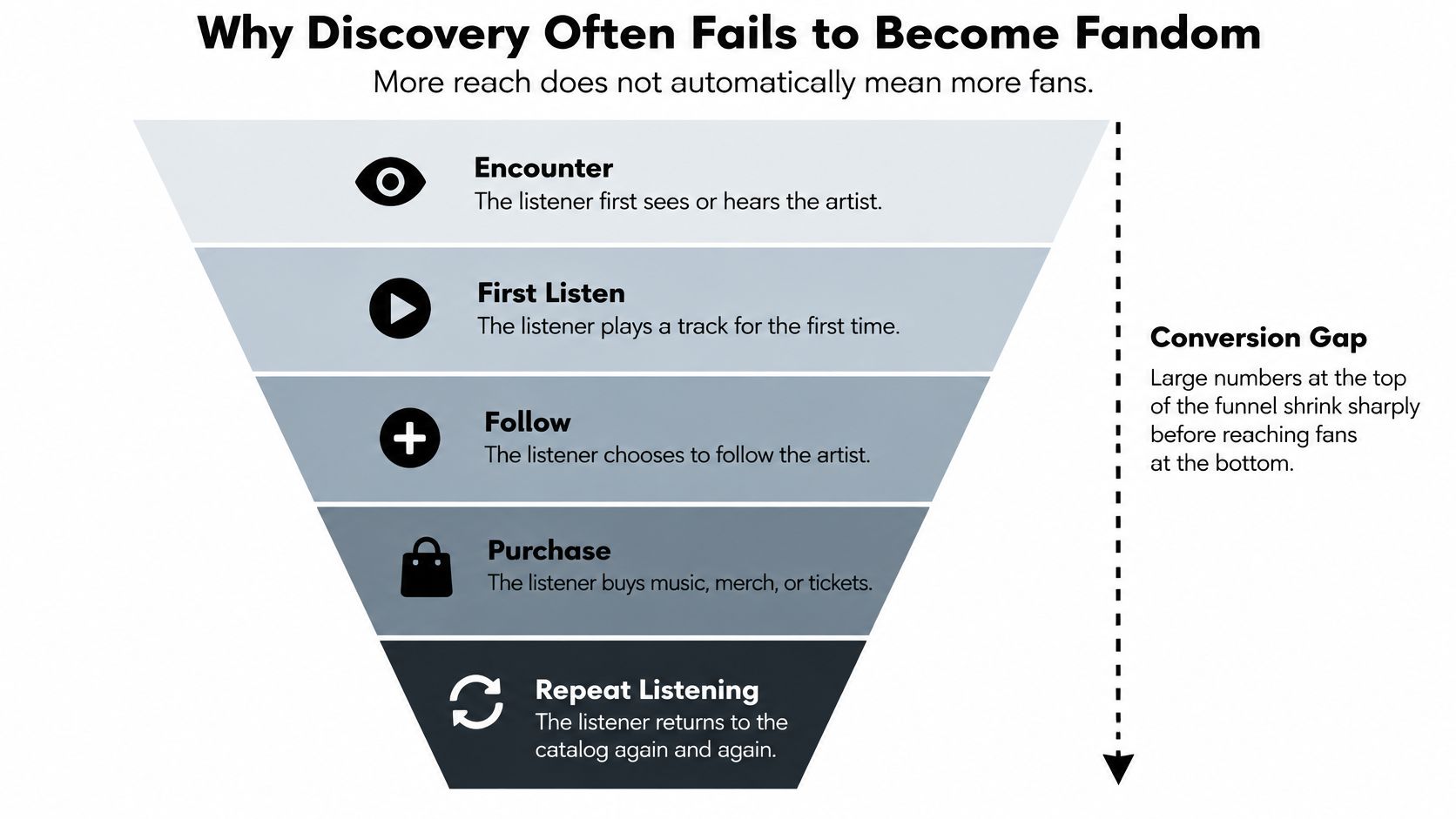
A useful planning model follows encounter, first listen, follow, purchase, and repeat listening. It isn't a compulsory order: someone can become a devoted listener without buying, and another person might buy a record before following an account.
The funnel illustrates the decisions an artist needs to make easier.
Start with the moment immediately after discovery. Does the clip identify the track? Does its destination open the relevant release, or a confusing menu? Can a listener sample another song without searching again?
Then consider the relationship. An artist story gives context, a community post invites participation, and a direct reply can answer a real question. Fans interested in that experience can explore the platform's fan access and interaction options.
Conversion test: Give each discovery placement one obvious next action, rather than asking a new listener to stream, follow, subscribe, and shop simultaneously.
Measure movement rather than applause
Track discovery-to-follow, follow-to-purchase, and purchase-to-retention with explicit definitions. Decide what counts as a discovery, whether purchases include merchandise, and what returning behavior qualifies as retention.
Use consistent observation windows and distinguish new listeners from existing supporters. Otherwise, a campaign reaching established fans may appear to convert better only because those people already know the artist.
Compare results within relevant genres and career stages. A catalog-rich act and a debut artist offer different reasons to stay, while merchandise availability changes the purchasing opportunity. The point isn't to force every listener toward a sale. It's to identify where interested people stop, then remove the obstacle or improve the invitation.
How to Build a Profile That Gets Found
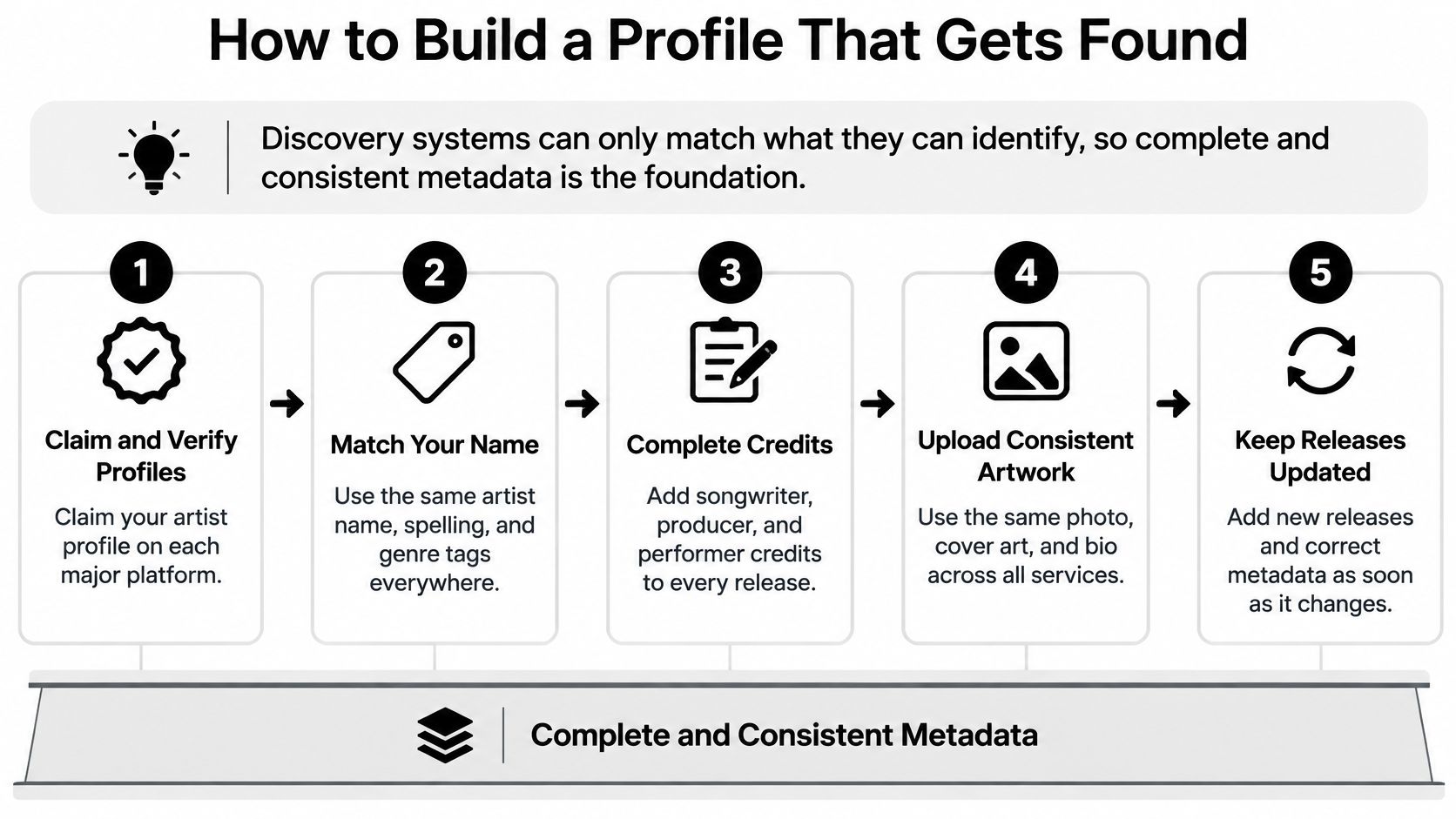
Discovery systems can only match what they can identify. Complete, consistent metadata helps a platform distinguish you from similarly named artists and connect your releases with the right credits.
The MusicBrainz API documentation describes separate lookup, browse, and search functions, including retrieval through stable artist identifiers and access to connected recordings and releases. That distinction matters: matching a name isn't the same as confirming an identity.
The visual guide summarizes the profile foundations.
Build an identifiable catalog
Claim and verify the profile. Use the platform's ownership process and an official contact address. Verification helps visitors distinguish an artist-managed page from an unclaimed or incorrectly assembled listing.
Record your name and aliases. Enter the current stage name consistently, then add former names and relevant group memberships in their designated fields. Don't cram aliases into the display name, where they can make search results confusing.
Describe the music accurately. Add genres, instrumentation, city or region, and lyric language where supported. Choose descriptors that fit the recordings rather than unrelated tags intended to attract extra impressions.
Connect collaborators and credits. Link producers, performers, and writers to their correct profiles. Check the identity before accepting an automatic match, especially when collaborators share common names.
Complete the release history. Add releases with accurate dates, artwork, track lists, and any catalog identifiers you hold. Distinguish alternate versions clearly so listeners don't mistake a live recording for the studio release.
Connect official destinations. Add your streaming, video, and social profiles, then test each destination on a phone. Remove obsolete pages and make sure links open your work rather than a similarly named artist.
Write a concise, usable bio. State your sound, origin, and current release in plain language. A promoter should be able to understand the act without decoding a page of abstract adjectives.
Maintain a manageable publishing rhythm. Update releases and availability when they change, and use tags consistently. For supporting social posts, an optional social media scheduler such as iHatePosting can help organize publishing, but catalog corrections still need attention inside the music platform.
Resolve ambiguity before promoting
If a service flags a possible duplicate, provide a distinguishing detail such as location, release title, or collaborator, then request human review. Don't merge profiles solely because their names match.
Accurate descriptive fields also give a newly uploaded artist something useful to match against before listening activity accumulates. That's a practical reason to complete the less glamorous fields.
Use the artist registration page when you're ready to assemble your profile. After the initial publishing period, inspect profile views and first-time listeners together: visits without listening suggest a different problem from a profile that nobody reaches.
Choose a Platform You Can Measure
Choose an artist discovery platform by the evidence it lets you inspect, not the audience size it promises. You need to know how recommendations work, what fans can control, what selling costs, and whether you can understand the results.
The Ireland Music Report provides context for examining algorithmic transparency and the range of routes through which audiences encounter music. For an artist, the practical response is to request visible controls and usable reporting rather than accept fairness as a slogan.
Request evidence before committing
Platform checklist criteria
| Criterion | Question to ask | Evidence to request |
|---|---|---|
| Transparent recommendations | Can you see why an artist is shown? | Explanation of the signals behind each recommendation |
| Fan control over discovery | Can fans switch between personalized, human-curated, local, and non-personalized modes? | Settings screen and description of each available mode |
| Exposure reporting | Is exposure split by artist size, geography, language, and genre? | Exposure report by segment |
| Fee transparency | How much of each sale does the platform keep, and do intermediary fees apply? | Published fee schedule per sale type |
| Analytics and fan tools | Can data be exported, and can messaging and community posts support purchasing? | Sample export and clearly defined conversion figures |
Exposure reporting deserves particular scrutiny. Ask whether the service distinguishes organic visibility from paid placement and whether artists without promotional spending receive meaningful opportunities. A global catalog alone doesn't establish that listeners encounter artists across languages and regions.
For fees, inspect the transaction rather than the headline. Clarify platform commission, payment processing, fulfillment responsibilities, refunds, and payout conditions. Commission-free downloads and the removal of intermediary fees are specific propositions to verify, not a reason to skip the terms.
Run a controlled trial
Record your starting audience, available products, and conversion definitions before promoting the profile. Keep a simple campaign log noting the release, destination, audience, and intended action.
Change deliberately. If you rewrite the bio, replace the featured track, and launch merchandise simultaneously, you'll struggle to identify which change helped. Keep enough consistency to compare outcomes, while recording outside events such as press coverage or a live show.
The right service should make your next decision clearer: improve the profile, develop a market, nurture interested listeners, or reconsider the offer. If it supplies activity totals without helping you distinguish those choices, don't confuse a busy dashboard with progress.
OohYeah offers streaming, selling, marketing, direct fan interaction, and industry resources in one platform, with creators controlling pricing and distribution. Visit OohYeah, complete your artist profile, and record your starting results before promoting your next release. Use those results to test whether new listeners become followers and supporters, not just additional plays.