Commission free music streaming platforms for independent artists
Explore commission free music streaming platforms for artists, compare distributor fees and payout estimates, and find ways to grow income through fan support.
November 2, 2026
FRANKLY with Frank Lee
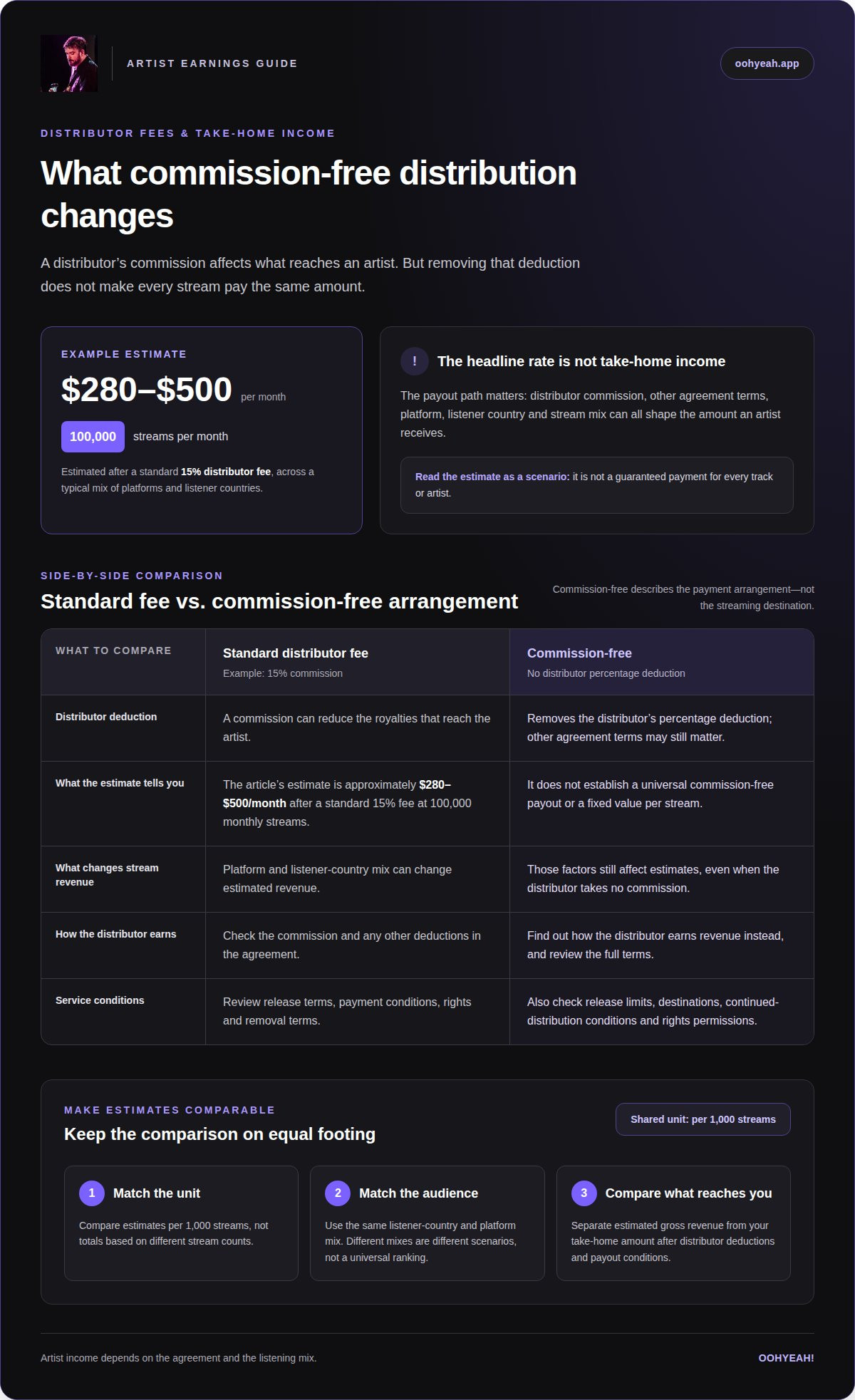
At 100,000 streams per month, an independent artist is estimated to earn approximately $280-$500 per month after a standard 15% distributor fee across a typical mix of platforms and listener countries. That estimate shows why commission-free music streaming platforms for artists deserve a closer look: a headline royalty rate doesn’t automatically equal take-home income. The revenue path matters, too.
Streaming payouts matter, but the rate alone can hide deductions between a play and money in your account. This guide explains how distributor commissions affect estimated earnings, why payouts vary by platform and listener mix, and what to compare when weighing commission-free options. It also covers how downloads, merchandise, and exclusive content can complement streaming, so you can assess a platform by how it supports artist income and fan connection, not just its per-stream figure.
Key Takeaways
- Compare platforms by how they handle artist earnings, not just by the payout figure they promote.
- Use consistent assumptions when comparing per-stream estimates, since platform and listener mix can shape the result.
- Check what “commission-free” applies to, so you can distinguish streaming payouts from other artist revenue.
- Consider downloads, merchandise, and exclusive content as additional ways to build direct fan support.
Distributor fees and artist take-home income
A streaming royalty rate is only one part of an artist’s take-home income. The distributor’s commission and the agreement’s other terms also affect how much reaches the artist.
Commission-Free Distribution Options
Commission-free distribution describes a payment arrangement, not a streaming destination. A distributor delivers releases to streaming services, then collects royalties under its agreement with the artist. The research estimate for 100,000 streams per month is approximately $280-$500 per month after a standard 15% distributor fee, across a typical mix of platforms and listener countries. That illustrates the effect a commission can have. To compare commission-free music streaming platforms for artists, identify which services receive the release and how the distributor earns revenue instead.
Artist Royalty Shares
There’s no single percentage of streaming royalties that artists keep across platforms. Your share depends on your distributor agreement, including whether it deducts a commission and how it handles other deductions. Compare what you’ll receive after those terms, rather than treating a headline rate as your final income. A commission-free arrangement can remove the distributor’s percentage deduction, but it doesn’t make every stream pay the same amount. Listener country, platform, and stream mix all affect estimates.
Free Distribution Limits
Free distribution means there’s no upfront payment for the distribution service, not that every feature or release is included. Compare release limits, streaming destinations, royalty terms, and conditions for continued distribution. Timing varies by service and release process, so plan around the distributor’s stated delivery steps rather than assuming a standard turnaround. Review rights terms, too: check whether you retain ownership and what permission the distributor receives to deliver and monetize your recordings.
For a US release, prepare your audio and release details, choose destinations, then follow the distributor’s upload process. Add the requested payment and tax information so royalties can be routed to you. Before submitting, read the agreement for rights, deductions, payment conditions, and removal terms. This lets you compare what you retain, where your music can reach listeners, and the conditions attached to the arrangement.
Per-stream payout comparisons
A per-stream figure can help compare streaming revenue, but it is not a fixed price for every play. Duetti’s 2024 Music Economics Report is cited as a basis for estimated revenue per 1,000 streams. Use that shared unit to compare estimates, then account for the listening mix behind your own audience. The report’s comparison is a reference point, not a guaranteed payment for each track or artist.
For a useful comparison, keep your assumptions consistent. Use the same stream count, period, and listener-country mix across platforms. Then distinguish estimated gross revenue from the amount you receive after any distributor share or other agreement terms. Estimates based on different audience mixes may not be directly comparable. The platform name alone won’t explain the difference.
- Match the unit: compare estimates per 1,000 streams, rather than mixing totals for different stream counts.
- Match the audience: listener location and platform mix can change estimated revenue.
- Compare what reaches you: account for distributor deductions and payout conditions.
For example, if two estimates use the same 1,000-stream baseline but different listener mixes, treat them as different scenarios, not a universal ranking. A smaller audience concentrated on one service may produce a different result from the same stream count spread across several services. Your own analytics can help identify which scenario better reflects your listeners.
Use per-stream comparisons to test assumptions, not to forecast income from a single headline rate. Track plays by service and listener location, then compare those patterns with the estimates. Revisit the comparison when your audience mix changes. That gives you a clearer view of how streaming contributes alongside other fan-supported activity. For a separate way to deepen fan relationships, consider exclusive content access as part of your broader artist offering.
Supporting independent artists through platform choice
Royalty timing and platform priorities both shape the artist experience. Streaming royalties reach artists after services report usage and distributors process the resulting payments.
Royalty Payment Timing
The payment sequence has three steps: a streaming service records plays, reports them to the distributor, and the distributor processes royalties under its payment terms. Reporting and processing schedules determine when earnings appear. Before release, review the distributor’s payout terms, including how it reports earnings and what information you need to receive payment.
Keep your release records and payment details consistent. For example, check that your artist name, track information, and payment account details match across the distributor’s dashboard. If a payment differs from your expectations, compare the reported period and stream records first. This can help identify whether the difference comes from reporting, processing, or your release setup.
Artist-Focused Platform Choice
A platform can support independent artists in ways beyond payment terms. Consider how its audience connects with your music, which artist tools it provides, and whether its approach fits your goals. If you’re building a core fanbase, you may value profile features and direct audience relationships. If you’re focused on reach, you may prioritize broad streaming access or a straightforward release process.
Compare platforms based on what you need them to do. A practical review can include:
- Audience fit: identify where your listeners already engage with music.
- Artist presence: assess profile options and how fans discover your releases.
- Release control: review the steps for uploading, updating, and managing tracks.
- Payment clarity: read the reporting and payout terms before distribution.
Choose the strongest overall match, not just the one with an appealing feature. A clear payment process matters, for example, but it can’t replace a platform that helps your intended listeners find and follow your work. Revisit your choice when your release strategy or audience priorities change.
Which music streaming platforms let artists distribute music without commission?
Distinguish streaming services from distributors. Spotify, Apple Music, and other streaming services are listening destinations; distributors deliver releases to them. Whether you pay commission depends on your distribution agreement, not simply on where listeners play your track. Compare distributor terms and destination coverage as separate decisions.
To find a commission-free route, read the distributor’s royalty and payment terms. Check how it defines commission, which deductions apply, and whether the terms cover every release and destination. “Commission-free” should describe the actual payment arrangement, not just the headline. Other conditions, such as release eligibility or account requirements, may still apply.
- Check delivery: confirm which streaming services the distributor sends music to.
- Read the earnings terms: identify commissions, deductions, and payment conditions.
- Review release rules: understand what applies to uploads, updates, and takedowns.
- Keep records: save the agreement and compare its terms with royalty statements.
Free distribution and commission-free distribution aren’t interchangeable. A distributor may charge nothing upfront but take a commission later. Another agreement may avoid commission but set different conditions for access or payment. Compare the full arrangement rather than relying on either label. If an offer says “free,” for example, find out whether that refers to uploading, ongoing distribution, or the distributor’s share.
Artists also have options beyond sending every release to streaming services. An artist profile can give fans a place to find your work, while digital downloads offer another way to access music directly. These options complement streaming; they don’t replace distribution to listening services. If a direct fan connection fits your release plan, create an artist profile alongside your streaming strategy.
Choose an arrangement that fits your priorities: destination reach, clear royalty terms, and a release process you can manage. Compare the written terms before uploading, then keep the agreement handy when reviewing future statements.
No streaming platform is identified as commission-free; commission depends on the distributor’s agreement, not the listening destination. Review the distributor’s royalty and payment terms.
A distributor may offer distribution with no upfront charge but still take a commission later. Conditions may include release eligibility, account requirements, or other access and payment terms.
Commission-free distributors may deliver music to Spotify, Apple Music, and other streaming services, depending on their destination coverage. Check which services are included and whether the commission-free terms apply to every release and destination.
OohYeah!: Artist Profile Hosting
OohYeah! helps independent artists build direct connections with fans through Artist Profile Hosting. It complements streaming distribution rather than replacing delivery to streaming services. Bring your music, downloads, merchandise, and exclusive content together in a profile for supporters.
Artists can offer Digital Music Downloads, use the Merchandise Marketplace, and share Exclusive Content Access. OohYeah! enables artists to retain 100% of sales revenue from music and merchandise. This can suit artists who want to pair streaming reach with direct fan support and more ways for listeners to engage.
Ready to build a direct-to-fan presence alongside your streaming strategy? Visit oohyeah.app.
Build your next release around the connection you want
Your next decision is about more than choosing where a track appears. Decide what you want listeners to do after they hear it, then shape your release around that relationship. A profile, download option, or place for fans to explore your work can give each release a clear next step. Focus your plan on the audience you want to grow and the kind of support you want to invite.
The strongest choice among commission free music streaming platforms for artists is one that fits your creative direction and gives you room to build connections with listeners. Refine your approach with each release, learning which paths make sense for your music and community.
Explore how OohYeah! can support your artist presence and fan connection. Explore OohYeah! Keep building on your own terms, one release and one meaningful fan connection at a time.
Frequently Asked Questions
Do headline royalty rates reflect what independent artists actually take home?
No. A displayed royalty rate describes a calculation basis, not necessarily the artist’s final account balance. A traditional label deal typically returns 12-18% of recording revenue after recoupable costs are repaid from the artist’s share. That’s separate from a distributor’s commission. Before comparing offers, identify whether the quoted rate is gross or net, and which deductions or recoupment terms apply.
Which Music Platform Pays Artists Better?
No single platform pays every artist more in every situation. Results depend on where your listeners play music and how your release performs there. A service that performs well for one artist’s audience, for example, may contribute less for another artist whose listeners favor different services. Compare your royalty statements across the same release periods, then prioritize the platforms that best fit your audience.