
Choose Ethical Streaming Alternatives With Artist-Focused Royalties
Explore ethical streaming alternatives for conscious music listeners, compare royalties and discovery tools, and learn how to support independent artists.
November 20, 2026
FRANKLY with Frank Lee
A streaming platform’s ethical record depends on its choices: how it allocates royalties, helps listeners discover artists, and explains recommendations. Choosing ethical streaming alternatives for conscious music listeners means looking beyond labels to compare how services support artists and independent music. No single feature tells the whole story.
It makes sense to want your listening habits to support the artists behind the music. But royalty models and discovery tools vary from one platform to another, so the details matter. This guide compares services across artist discovery, recommendation transparency, royalty models, and support for independent music. You’ll have a clearer basis for deciding which approach fits your values and how you want to support creators.
Key Takeaways
- Compare royalty models by how they allocate revenue, and consider whether fan-powered listening can better connect your support to the artists you choose.
- Explore niche catalogs and Creative Commons music to find independent work, while understanding the permissions that come with each license.
- Assess subscriptions and free plans by their limits and features, not price alone, to find a listening option that fits your habits.
- Look for clear policies on AI-generated music, artist consent, and moderation; direct downloads offer another way to support artists.
Fan-powered and user-centric royalty models
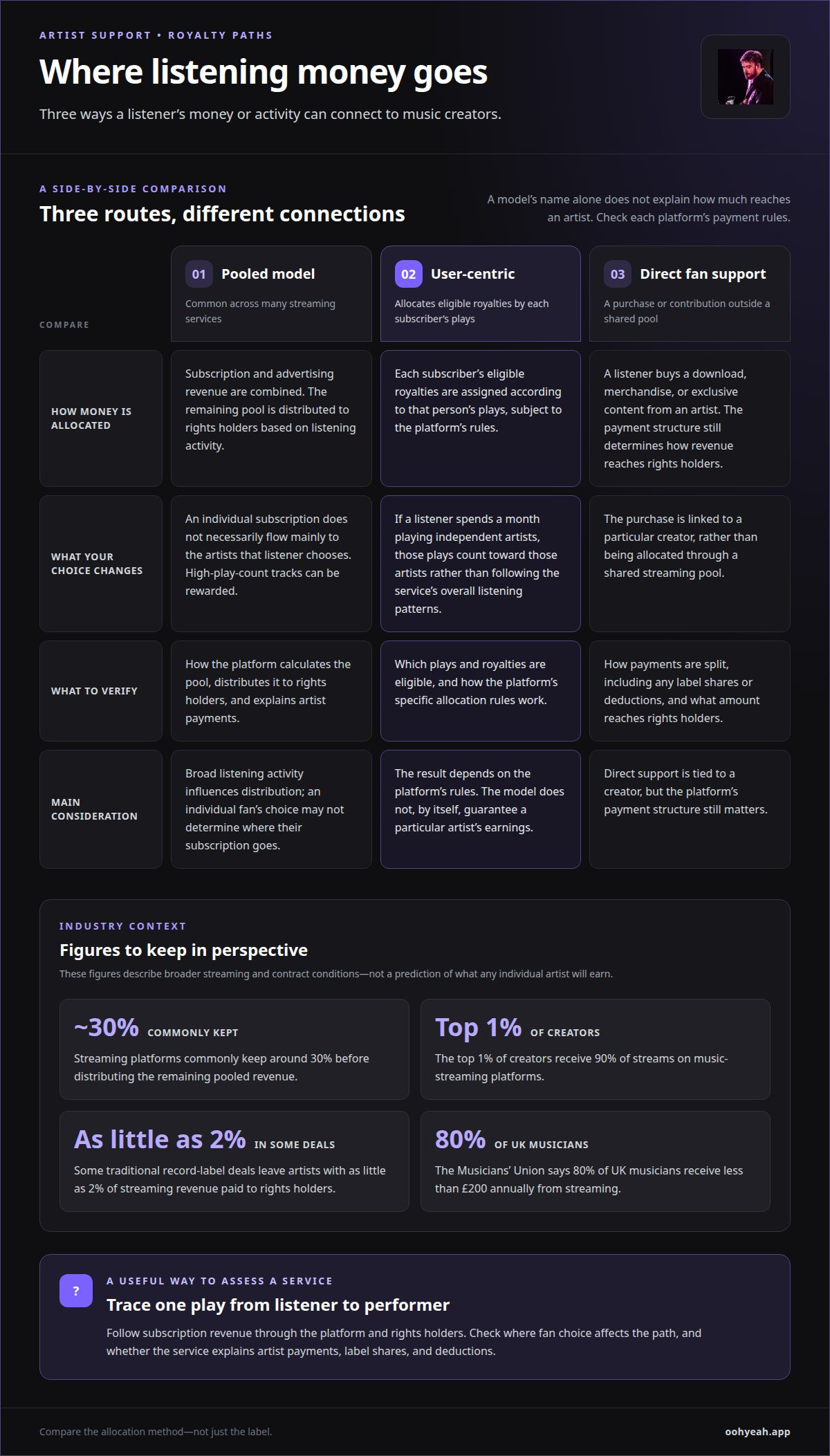
Most streaming services use a pooled model. They combine subscription and advertising revenue, then distribute the remaining pool to rights holders based on listening activity. Platforms commonly keep around 30% before distributing that pool. This approach can reward tracks with high play counts, while an individual listener’s subscription doesn’t necessarily flow mainly to the artists they choose.
A user-centric model changes how royalties are allocated. Instead of pooling everyone’s listening first, it assigns each subscriber’s eligible royalties according to that person’s plays. For example, if a listener spends a month playing independent artists, their activity would count toward those artists rather than being allocated according to the service’s overall listening patterns. The outcome depends on each platform’s rules.
Fan support can also happen outside a shared royalty pool. A listener may buy a download, merchandise, or exclusive content directly from an artist. This links the purchase to a particular creator, though each platform’s payment structure determines how revenue reaches rights holders. Check whether the platform explains artist payments, label shares, and any deductions.
Look at distribution as well as the model’s name. The top 1% of creators receive 90% of streams on music-streaming platforms. A catalog can be broad, yet playlists and discovery systems may still concentrate listening around mainstream acts. Compare how a service surfaces independent artists and whether recommendations explain why a track appeared.
Artist earnings also depend on contracts beyond the platform. Some traditional record-label deals leave artists with as little as 2% of streaming revenue paid to rights holders. The Musicians’ Union says 80% of UK musicians receive less than £200 annually from streaming. Use these figures as context, not a prediction for any one artist. To assess a service, trace one play from subscription revenue through rights holders to the performer, and identify where fan choice affects that path.
Niche platforms and Creative Commons music
Niche platforms focus on scenes or formats that broad catalogs may overlook. A service centered on electronic music, experimental sound, or local performers can make discovery more intentional. Independent artists may reach listeners actively seeking their style instead of competing for placement in mainstream playlists. The trade-off is a narrower catalog, so these services often work best alongside a broader listening option. Focused discovery can be part of the appeal of ethical streaming alternatives for conscious music listeners.
Creative Commons music offers another way to find independent releases. Artists choose whether to share tracks under specific license terms, which determine how listeners may use the music. A download page might allow personal listening while setting conditions for reuse, adaptations, or commercial projects. Don’t assume every Creative Commons track has the same permissions. Read the license attached to the recording, especially before sampling it, adding it to a video, or sharing a modified version.
Assess a niche service in three steps. First, search for artists or genres you already enjoy. Next, explore how the platform presents new releases, labels, and playlists. Then, check how listener support reaches creators: a subscription fee may fund a service-wide pool, while a direct purchase or fan contribution can support a specific artist. These models differ, so look for a clear explanation of payments and artist-support features. The best ethical streaming alternatives for conscious music listeners make their approach to discovery and artist support easy to understand.
Also consider how digital access affects your listening habits. If you want to support a musician beyond streams, an artist profile can bring their music and updates together. Artist profile hosting gives creators a focused place to share their work. Pair that kind of direct connection with niche discovery, and your listening can support independent artists while helping you find music beyond familiar recommendations.
What are the subscription prices and free-plan limits for artist-friendly music streaming services in the United States?
Artist-friendly services in the United States don’t share one price or free-plan limit. Each platform sets its own subscription terms and access rules. Compare current plan details side by side rather than assuming a low subscription fee means stronger artist support. The royalty model and free tier are separate parts of the decision.
Start with the paid plan. Note its billing period, included listening features, and whether it removes ads or access limits. Then read how the platform describes artist payments. A subscription can provide access to a catalog without sending your payment directly to each artist you play. The revenue-allocation model determines how listening activity connects to rights holders.
Next, inspect the free plan’s actual limits. Note whether it includes the full catalog, allows on-demand track selection, and supports playlists or offline listening. For example, if you need to choose specific tracks, distinguish that option from a free tier with limited playback. Don’t assume “free” means unrestricted access or direct artist compensation.
Use the same steps for each service: record its subscription terms, free-plan restrictions, and royalty explanation. Then decide which trade-off matters most. If you want uninterrupted listening, you may prioritize paid access. If you’re exploring a niche catalog, you could start with free access and then support favorite artists through available direct-purchase options.
Compare value, not just the amount charged. Check whether the platform explains how subscription revenue reaches rights holders, how advertising supports free access, and what limits apply to listeners. A clear plan page makes those differences easier to assess. Consider access terms alongside artist-payment information to judge both your listening experience and the support your choice provides.
Prices and free-plan limits vary by service. Compare each platform’s billing terms and features, and check whether its free tier limits catalog access, track selection, playlists, offline listening, or ad-free playback.
Which music services have the best policies on AI-generated music, artist consent, and content moderation?
The strongest policy explains what happens before and after a track appears. Compare services on three points: AI disclosure, artist consent, and moderation. A policy that says only “we support artists” leaves practical questions unanswered. Look for specific rules, clear reporting steps, and an explanation of how decisions are made.
For AI-generated music, check whether a service requires uploaders to identify AI-created or AI-assisted recordings. Clear labels help listeners understand what they’re hearing. Also look for rules on cloned voices, imitation of identifiable performers, and misleading artist names. A useful policy explains how artists can report a disputed track and what information the platform considers when reviewing the report.
Consent deserves its own test. Does the policy explain how artists authorize the use of their recordings, name, image, or voice? Can an artist object if a release appears to imitate their identity? Read the process, not just the promise. A practical consent policy tells creators where to raise concerns and how the platform communicates its decision.
Content moderation matters beyond AI. Check whether the rules describe prohibited uploads, review criteria, and ways to challenge a removal. For example, an artist whose track is taken down needs a clear route to appeal and understand the decision. Transparency also means explaining whether artists, listeners, or rights holders can submit reports.
Compare services with a simple scorecard: AI labeling, consent protections, reporting steps, moderation explanations, and appeal options. Mark each item as clearly explained or difficult to find. This avoids declaring a platform “best” based on a broad ethical slogan alone. A service with a narrow catalog may still offer clearer creator safeguards than a larger platform, while policies can change over time. If artist control matters in your listening choices, explore ways to support artist-led releases.
OohYeah!: Digital Music Downloads
OohYeah! gives listeners a direct way to support artists through digital music downloads and merchandise. Choose this option when you want to purchase a release or item from a specific creator rather than rely on streaming alone. Artists can also share exclusive content through their profiles, giving fans another way to connect with music they value.
OohYeah! offers artist profile hosting, a merchandise marketplace, and exclusive content access alongside downloads. Artists retain 100% of sales revenue from music and merchandise, and the platform doesn’t take commissions. These options suit fans who want their support tied to an artist or purchase, rather than only to plays in a shared streaming model.
For independent artists, these direct channels can complement streaming and help fans find releases, merchandise, and exclusive work in one place. Contact OohYeah! to explore direct ways to support artists.
Make Your Listening Choices Count
Choosing ethical streaming alternatives for conscious music listeners is an ongoing practice, not a one-time switch. Let your priorities guide each choice: who gets visibility, how artists retain control, and whether your support reaches the creators whose work stays with you. Keep exploring, adjust your listening habits, and support musicians directly when a release matters to you.
For artists, a stronger connection with listeners can start with a clear home for their music and work. For fans, supporting an artist directly turns appreciation into a deliberate act. Small choices can help shape a music culture where creators have more ways to share their work and connect with the people who value it.
Contact OohYeah! to discuss your music and take the next step toward a more direct connection with your audience. Keep listening with intention, and keep making room for independent voices.
Frequently Asked Questions
What makes a streaming platform “ethical” for artists?
An ethical platform makes its artist-support practices understandable and gives creators meaningful control. Look for clear explanations of royalty allocation, how artists authorize uploads, and how they can challenge impersonation or content removal. Consider discovery too: does the service explain why a track appears in recommendations? Transparency around payments, consent, and moderation gives you practical criteria beyond a platform’s mission statement.
Does switching platforms mean losing access to my favorite artists?
Not necessarily. Catalogs differ, and a particular artist may not appear on every service. Before switching your main listening option, search for your regular artists and albums on the platform you’re considering. You can also keep a list of releases to revisit. If an album isn’t available to stream, the artist’s profile or digital download may offer another way to find it.
How much do musicians receive?
There’s no single amount that applies to every musician or stream. Payments can pass through rights holders and be divided according to contracts, ownership, and the platform’s royalty rules. An independent artist who controls their recordings may have a different arrangement from an artist signed to a label. To understand a specific case, distinguish the amount paid to rights holders from what the performer ultimately keeps.
Is music streaming broken?
Streaming makes large catalogs easy to access, but its economics and discovery systems can leave artists with limited visibility or unclear earnings. That doesn’t make every feature useless. Listeners can use streaming to explore while supporting a favorite musician through direct purchases, merchandise, or exclusive content. The key question is whether a service’s rules give artists clear ways to share, earn, and connect with listeners.
Which music streaming services pay artists the most per stream, and how reliable are those estimates?
No single per-stream ranking reliably predicts what an artist will receive. Estimates often divide reported or estimated platform payouts by play counts, but results vary with subscription revenue, listening patterns, territories, and rights agreements. Treat a quoted rate as an approximation, not a guaranteed payment. For a fair comparison, examine how each service calculates distributions and what portion reaches the artist.
Which music streaming platforms use user-centric or direct-to-artist payment models?
These are different approaches. User-centric systems allocate a subscriber’s eligible royalties based on that person’s listening, while direct-to-artist support can come from purchases or fan payments. OohYeah! lets fans support artists through digital downloads, merchandise, and optional access to exclusive content. Artists retain their sales revenue from music and merchandise, so these purchases connect support to the creator or item chosen.
