Commission-Free Band Merchandise Storefronts: A 2026 Buying Guide
Find the best commission free band merchandise storefront in 2026. Compare true costs, fulfillment workflows, and music features to maximize merch sales.

October 5, 2026
FRANKLY with Frank Lee
Your merch storefront should do more than take orders. It should help protect your margins and make it easy for fans to support your music. Choosing a commission free band merchandise storefront can help, but “commission-free” doesn’t always mean cost-free: subscriptions and payment processing fees can still affect what you keep.
To compare storefronts, look at their sales terms, how they connect merchandise with your music, and what work your band must handle after an order comes in. OohYeah! brings artist profiles, music downloads, merchandise, and exclusive content together in one marketplace, with no sales commission and a recurring artist subscription. This guide explains what to look for in product listings, costs, and order workflows so you can choose a setup that fits your band and audience.
Key Takeaways
- Compare a commission free band merchandise storefront by looking beyond per-sale deductions to recurring subscription costs and other operating expenses.
- Prioritize a clear route from artist discovery to merchandise, with music and fan content easy to find in the same place.
- Compare sales terms, artist profiles, merch display, and fan access to identify a storefront that fits your audience.
- Plan product details, order handling, and fulfillment as separate parts of your merch workflow before sharing your storefront.
- OohYeah! brings artist profiles, music downloads, merchandise, and exclusive content together, with no sales commissions and a recurring artist subscription.
What makes a commission-free band merchandise storefront worth choosing?
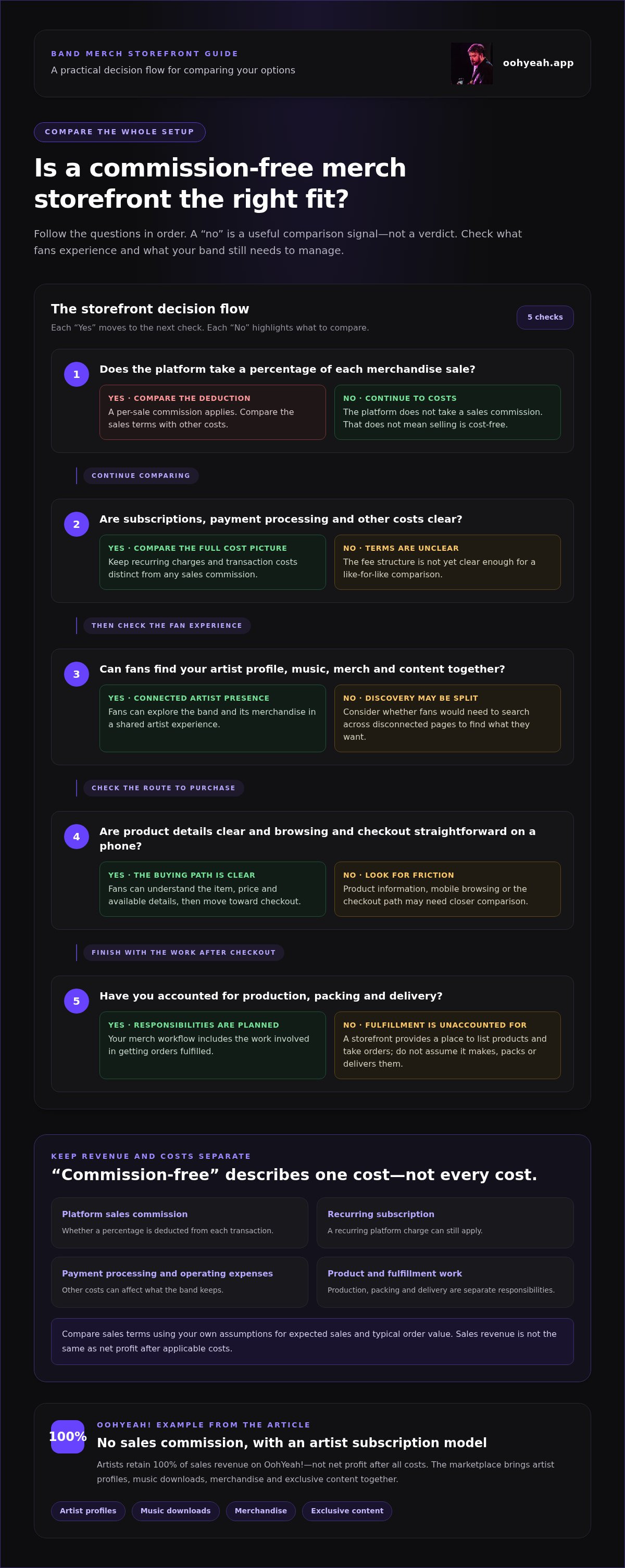
A commission-free storefront doesn’t deduct a percentage of each merchandise sale as a platform commission. That can make the sales terms easier to understand and help bands retain more of their sales revenue. But “commission-free” doesn’t mean “cost-free.” A platform may charge a recurring subscription, and payment processing fees and other operating expenses can also affect what the band keeps.
Commission-free describes the platform’s cut of each sale, not every cost involved in selling merch. Production, packing, and delivery are separate parts of the work. A storefront gives fans a place to discover products and place orders, but don’t assume it makes, packs, or delivers merchandise. Include those responsibilities in your sales plan.
How does commission-free merch selling work for a band?
A fan finds a product page, chooses an item, and places an order through the storefront. The platform’s sales terms determine whether it deducts a commission from the transaction. With a commission-free model, the platform doesn’t take a percentage as a sales commission. Subscriptions, payment processing, and other expenses may still affect the band’s overall finances.
Compare the recurring charge as well as the per-sale terms, then account for production and fulfillment. OohYeah!, for example, charges no sales commissions and uses an artist subscription model. Artists retain 100% of sales revenue, which is not the same as net profit after all costs.
What should a band storefront connect in one fan experience?
A storefront can help fans understand who the band is, not just what it sells. An artist profile can introduce the group, while merchandise displayed alongside music downloads and artist content gives fans a natural way to explore and support the band. This reflects the direct-to-fan business model, where artists build a direct connection with their audience.
Keep the path simple: a fan discovers the artist, finds the merch, and can move toward a purchase without hunting across disconnected pages. A commission free band merchandise storefront is most useful when its sales terms are clear and the buying journey makes it easy for fans to support the band.
Which storefront features matter most when selling band merch directly?
The best storefront isn’t the one with the longest feature list. It’s the one that helps fans move from discovering your band to understanding what you’re selling and making a purchase. Look for clear product pages, mobile-friendly browsing, and a straightforward checkout path. Strong product photos, readable descriptions, and visible pricing help fans understand what they’re choosing.
Consider whether the storefront presents merch in the context of your music and artist presence. A profile can introduce the band, while music downloads and exclusive content give fans more ways to connect. Berklee College of Music’s guide to designing a revenue model offers useful context for considering income streams beyond performances. A connected artist experience can make merchandise feel like part of supporting the band, rather than a disconnected product listing.
Can fans discover music and merchandise in one place?
Yes, a storefront can bring the band’s profile, music, and merchandise together. A fan who arrives to explore a release can also find merch, while someone browsing products can learn about the artist behind them. That context makes discovery feel more personal and gives fans a straightforward way to support the band.
Prioritize a coherent artist presence over a long list of tools. For example, OohYeah! combines artist profiles, music downloads, merchandise, and exclusive content in one direct-to-fan marketplace. Explore OohYeah!’s artist marketplace.
Which sales terms should bands compare before choosing?
Separate the costs into clear categories. Check whether the platform deducts a commission from each transaction, charges a recurring subscription, or involves payment processing costs. Then estimate revenue using your own assumptions, such as expected sales and typical order value, and account for the expenses your band handles. This won’t predict every result, but it gives you a consistent basis for comparing fee structures.
A “commission-free” label matters less than the full fee structure and what your band keeps after applicable costs. Don’t treat sales revenue as net profit; product expenses and other operating costs still matter.
- Product pages: Can fans quickly understand the item, price, and available details?
- Mobile experience: Is browsing and purchasing straightforward on a phone?
- Artist context: Can fans find your profile, music, merch, and content together?
- Sales terms: Are commissions, subscriptions, and payment costs clearly distinguished?
- Buying path: Can fans move from discovery to checkout without unnecessary steps?
How to compare commission-free storefronts for your band
Compare the full setup, not just the commission label. Your audience, release cadence, and merch range shape what you need. A band with occasional releases and a small catalog may value a simple artist profile and easy merch discovery. A band sharing music and exclusive content regularly may benefit from bringing those parts of the fan experience together. Research on e-commerce business models also frames merchandise as one way music artists can earn revenue online.
Use a comparison table to separate platform features from tasks your band manages itself. Record the terms for each option and note which parts of the sales workflow remain your responsibility.
| Factor | What to compare | OohYeah! details |
|---|---|---|
| Commission policy | Does the platform deduct a percentage from each sale? | No sales commission; artists retain 100% of sales revenue. |
| Recurring fees | Is there a subscription or another recurring platform charge? | Artists use a recurring subscription model. |
| Artist profile | Can fans learn about the band in the storefront? | Artists can host profiles. |
| Merch display | Can merchandise appear alongside music or other artist content? | Merchandise sits within a marketplace that also includes music downloads and exclusive content. |
| Fan access | What can fans discover or access, and are there charges for access? | Fans can access music, downloads, and merchandise without charge. |
The table describes storefront and access features, not who makes, packs, or delivers physical merchandise. Keep those responsibilities separate when comparing options.
Is commission-free always the best deal for a band?
Not automatically. The right model depends on expected sales, subscription terms, and the tools your band needs. Compare recurring fees with estimated per-sale deductions using your own sales assumptions. For a simple break-even check, multiply expected sales by the commission rate, then compare that estimate with the subscription cost for the same period. Include other applicable costs in your broader budget.
The best deal is the fee structure that fits your sales pattern and leaves room for the tools you’ll use.
When does an artist-focused storefront fit better than a general shop?
A standalone catalog can suit a band that mainly needs a place to present products. An artist-focused storefront may fit better if fans should be able to move between the band’s profile, music downloads, merchandise, and exclusive content. Choose based on the journey you want to create, not the number of features advertised. A commission free band merchandise storefront should support the way your audience discovers and supports your music.
How to plan merch listings, orders, and fulfillment before launch
A storefront makes merchandise easier to find and buy, but the band still needs a plan for handling physical orders. Before you publish a commission free band merchandise storefront, decide who tracks stock, prepares packages, arranges delivery, and keeps customers informed. Assigning those responsibilities ahead of time helps prevent a sale from becoming a scramble.
What should a band prepare before adding merchandise?
Start with a manageable product range that you can describe and track. Gather accurate details for each item, including its name, price, available sizes or options, and relevant product information. Use clear photos and descriptions to show fans what they’re ordering. Avoid promising details your band hasn’t arranged, such as delivery timing.
Agree on an internal process before orders arrive. Decide who records available stock, checks new orders, and handles customer questions or updates. If several band members share the work, make each person’s responsibilities explicit.
How can a band make the purchase journey easy for fans?
Share a direct storefront link wherever fans already encounter the band, such as artist profiles, release announcements, and social posts. Keep product descriptions consistent across those channels, and make the route from the post to the product page easy to follow. Clear information helps fans decide without searching for basic details.
Help fans discover the merch, give them clear product details, make the buying steps easy to follow, then assign someone to manage order updates and fulfillment.
Use this launch checklist to turn the plan into action:
- Select products: Begin with items your band can describe and manage confidently.
- Prepare listings: Gather photos, sizing or option details, pricing, and concise descriptions.
- Assign responsibilities: Name who tracks stock, reviews orders, packs items, and arranges delivery.
- Plan communication: Decide how the band will share order updates and respond to customer questions.
- Test the fan journey: Follow your shared link and check that the product information and purchase steps are clear.
- Share and monitor: Publish the link in relevant artist and release channels, then follow the band’s agreed order workflow.
A storefront and a fulfillment process are separate parts of selling physical merch. Keep that distinction clear as you prepare listings and decide how the band will handle each order. Set up an artist profile and merchandise storefront to give fans one place to discover your music and merch.
Why OohYeah! fits bands building a commission-free merch storefront
A band’s storefront can be more than a place to display products. It can give fans one artist-centered destination to discover the music, explore merchandise, and connect with the people behind it. OohYeah! brings those pieces together through Artist Profile Hosting, Digital Music Downloads, a Merchandise Marketplace, and Exclusive Content Access.
For bands looking for a commission free band merchandise storefront, OohYeah!’s sales model is clear: artists retain 100% of merchandise and music sales revenue without sales commissions. Artists pay a recurring subscription, so commission-free doesn’t mean there are no platform costs. Sales revenue also isn’t net profit after every expense.
How does OohYeah! support direct-to-fan merchandise sales?
Artist Profile Hosting gives a band a place to introduce itself, while the Merchandise Marketplace lets it offer merch alongside music downloads and exclusive content. Fans can explore these parts of an artist’s presence in one destination, making it easier to move from listening to supporting the band. Fans can access music, downloads, and merchandise without charge.
This setup supports the artist-fan relationship, but it doesn’t replace the band’s plans for physical merchandise. Tracking inventory, packing orders, and arranging delivery remain part of the band’s sales workflow.
What is the next step for a band ready to sell?
Start by deciding what role you want the storefront to play. If your goal is to bring your artist profile, music, merch, and exclusive content together, consider how OohYeah!’s marketplace fits those priorities. Before launch, prepare accurate product listings and assign responsibility for stock, order follow-up, packing, and delivery.
Then give fans a clear route to your artist presence. Share its link where they already discover your releases and updates, and make product details easy to understand. A focused storefront helps fans see what’s available and how to support your music.
Take control of how fans discover and support your band. Explore OohYeah!’s artist marketplace and start planning a direct-to-fan home for your music and merch.
Build a storefront that brings fans closer
The right commission free band merchandise storefront does more than display products. It makes sales terms easier to compare, gives fans a clear path from discovering your music to finding your merch, and supports a practical plan for listings and order fulfillment.
OohYeah! brings artist profiles, music downloads, merchandise, and exclusive content together in one direct-to-fan marketplace. Artists retain 100% of sales revenue without commissions through a recurring artist subscription model. That’s sales revenue, not net profit after every expense, so factor the subscription and your operating costs into your decision.
Choose a setup that fits your band’s goals and gives fans a straightforward way to support your work. Explore OohYeah! and build a direct connection with your fans. Your music, your merch, and your community can move forward together.
Frequently Asked Questions
What does commission-free mean for a band merchandise storefront?
Commission-free means the platform doesn’t deduct a sales commission from each merchandise transaction. It doesn’t automatically mean the band has no costs. A subscription or payment processing fees may still apply, and the band has separate expenses for making and fulfilling physical products. Compare each cost category to understand how the platform’s commission policy affects sales revenue without mistaking it for net profit.
Can bands sell merchandise without paying commissions?
Yes. Some platforms let artists sell merchandise without taking a percentage of each sale as a commission. OohYeah! is a direct-to-fan marketplace where artists retain 100% of sales revenue without sales commissions through a recurring artist subscription model. That describes sales revenue, not net profit after every expense. Compare the subscription and any applicable transaction costs with your sales plans to understand how the arrangement fits your band.
Is a commission-free merch storefront completely free to use?
No, commission-free doesn’t necessarily mean free to use. A platform may charge a recurring subscription instead of taking a commission from each sale. Payment processing and the band’s own operating expenses may also affect the money left after a sale. OohYeah! charges artists a recurring subscription for hosting and sales tools. Account for your product and fulfillment costs when planning.
How should a band choose a merch storefront?
Choose based on your sales terms, audience, and workflow. Compare commission policy, recurring charges, payment costs, artist profile options, merchandise display, and how easily fans can move from discovery to purchase. Consider whether you want merch alone or a connected space for music downloads and artist content. Estimate costs using your band’s expected sales rather than relying on the “commission-free” label by itself.
Does a band merchandise storefront handle shipping and fulfillment?
Not necessarily. A storefront provides a place for fans to discover merchandise and place orders, but physical fulfillment is a separate part of selling. Before launch, decide who will track stock, pack orders, arrange delivery, and communicate with customers. Don’t assume those tasks are included just because a platform hosts product listings. A clear team workflow helps connect the online purchase with the band’s next steps.
Can bands sell music and merchandise from one artist profile?
Yes, platforms built for artists can bring a profile, music, and merchandise together. OohYeah! offers Artist Profile Hosting, Digital Music Downloads, Merchandise Marketplace access, and Exclusive Content Access. That gives fans one artist-centered destination to explore music and merch. Fans can access music, downloads, and merchandise without charge, while artists use a recurring subscription model and retain sales revenue without sales commissions.
What should an independent band prepare before launching an online merch store?
Prepare a manageable product range, accurate product details, clear photos, sizing information, and concise descriptions. Set prices and decide how the band will track stock, pack orders, arrange delivery, and send customer updates. Then test the fan journey from the link you share to the product information and checkout steps. Assigning responsibilities before launch helps the band handle orders consistently as fans begin buying.