Bandcamp vs Patreon: 2026 Direct-to-Fan Revenue Guide
Choosing between Bandcamp vs Patreon for musicians? Our 2026 guide reveals how to bypass high fees and own your fan relationships for maximum revenue.

September 13, 2026
FRANKLY with Frank Lee
The standard debate over Bandcamp vs Patreon for musicians is a false choice that keeps you stuck in a cycle of renting your own success. You've spent years building a community only to watch 15% to 20% of your revenue vanish into platform fees and commission tiers. It's exhausting to manage disconnected fan data across multiple logins while worrying about how ownership changes might shift the ground beneath your feet. You deserve a stable home for your work that treats you like a partner, not a profit margin.
This 2026 guide delivers the definitive comparison you need to maximize your music revenue and build a sustainable independent career. You'll discover which platform yields the highest ROI for your specific goals and how to create a streamlined workflow for selling digital downloads and merch. We're moving past the outdated models of commission-based "renting" toward a future of flat-fee ownership. By the end of this article, you'll have a clear roadmap to 100% revenue retention and a direct connection with the fans who fuel your journey.
Key Takeaways
- Identify whether a digital record store or a recurring fan club model fits your release schedule to maximize audience engagement.
- Break down the complex fee structures of Bandcamp vs Patreon for musicians so you don't lose a massive chunk of your hard-earned income to platform cuts.
- Use a simple audit of your fan data to find where your superfans live and which platform converts them most effectively.
- Evaluate the benefits of a commission-free marketplace that combines digital downloads and exclusive content access into one streamlined workflow.
Bandcamp vs Patreon for Musicians: Choosing Your Strategy in 2026
Surviving as an independent artist in 2026 requires a radical shift in thinking. You can't rely on streaming fractions to pay your rent. The direct-to-fan (D2F) model isn't just an option anymore; it is the foundation of your career. When looking at Bandcamp vs Patreon for musicians, you aren't just choosing a tool. You are choosing how you interact with your supporters and how much of your hard-earned money you actually keep. Recent ownership shifts, including the acquisition of Bandcamp by Songtradr, have made platform stability a primary concern for every creator. Trust is the new currency in a landscape where corporate priorities can change overnight.
The core identity of these platforms defines your daily workflow. Bandcamp operates as a digital record store. It is a destination for listeners who want to own a piece of your art. Patreon functions as a fan club. It is a space for people who want to support your process. This distinction impacts everything from your revenue potential to the way fans experience your brand. You must decide if you are selling a product or selling a relationship. Both paths offer value, but they require different levels of commitment from you and your audience.
The Bandcamp Model: Digital Storefront Dominance
Bandcamp remains the gold standard for independent album sales. It simplified the process of selling music and physical merch directly to listeners without a middleman. The "Bandcamp Friday" initiative created a massive cultural shift, encouraging fans to buy music on specific days to maximize artist payouts. This platform excels at discovery through fan collection tagging and offering high-quality audio formats that audiophiles crave. Understanding Bandcamp's business model helps you see why it remains a powerhouse for one-off sales and high-intent buyers. It is a professional storefront where your work is the primary product. Your fans get a sense of ownership as their digital libraries grow with every purchase.
The Patreon Model: The Recurring Revenue Revolution
Patreon flipped the script by focusing on the artist rather than the individual release. It introduced the concept of Monthly Recurring Revenue (MRR) to the music industry. Instead of hoping for a big launch every two years, you build a steady stream of income that supports you while you create. This is the recurring revenue revolution. You stop selling products and start selling access, community, and exclusive experiences. The strength of this model lies in its predictable income and tiered rewards. It allows for direct communication with your most dedicated supporters without an algorithm standing in the way. It is a powerful tool for touring musicians who need a financial safety net between shows.
The Real Cost of Commissions: Comparing the Fee Structures
Commissions are more than just line items on a monthly statement. They are a direct tax on your creative labor. When you weigh Bandcamp vs Patreon for musicians, you must look past the flashy interfaces and calculate the long-term impact on your bank account. These platforms don't just host your music; they take a permanent seat at your table. Every dollar they collect is a dollar you can't reinvest in your next tour or studio session. This cycle of revenue leakage stunts independent growth and keeps you dependent on corporate infrastructure.
Bandcamp's Revenue Cut: Is Discovery Worth 15%?
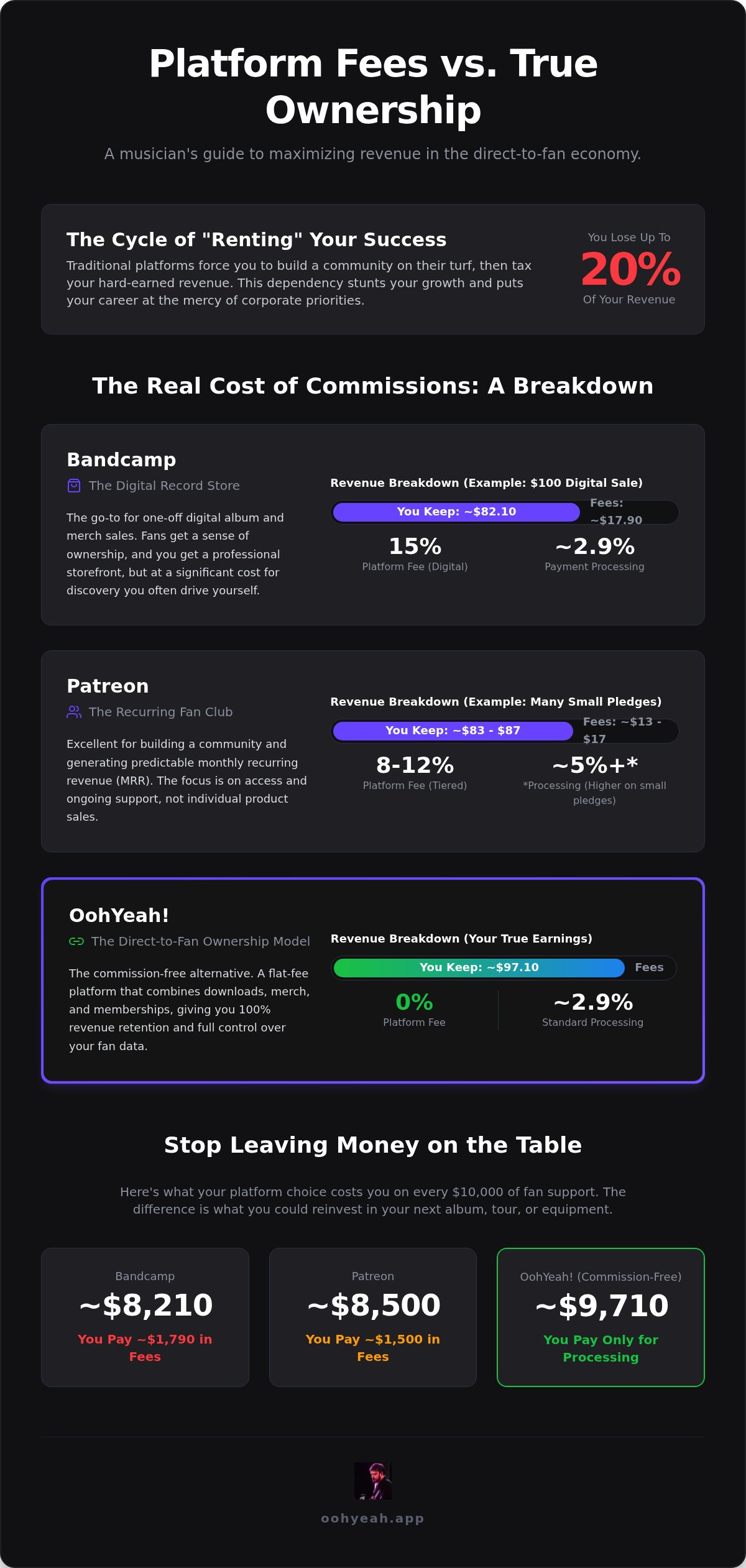
Bandcamp takes a 15% cut of digital sales and 10% of physical merch. You also pay payment processing fees to PayPal or Stripe, which typically add another 2.9% plus a fixed transaction fee. Many artists accept this because they believe the platform provides discovery. By 2026, this marketplace is incredibly crowded. Most fans arrive at your page through your own marketing efforts, not through a random search on the site. After all platform cuts and processing costs are settled, selling a $10 digital album on Bandcamp leaves you with roughly $8.20 in actual profit. You are essentially paying a 18% premium for a storefront you still have to drive traffic to yourself.
Patreon's Tiered Fees: The Price of Membership
Patreon operates on a tiered system, taking 8% for Pro accounts and 12% for Premium users. While these numbers look lower than Bandcamp's digital cut, the "per-pledge" processing costs are the real profit killers. High-level success in understanding the creator economy requires recognizing how micro-transactions impact your bottom line. If you have hundreds of fans at a $3 monthly tier, the processing fees on those small amounts can push your total loss well above 15%. This is why high-earning creators are moving toward flat-fee models that offer predictable costs regardless of how large their community grows.
Consider the math for an artist generating $50,000 a year. Between platform commissions and transaction fees, you could lose $8,000 to $10,000 annually. Over a five-year career, that is a $50,000 "Hidden Tax." That money could have funded a professional music video, a new van, or a full year of living expenses. If you want to stop the drain on your finances, switching to a commission-free marketplace allows you to claim 100% of your revenue and regain control of your financial future.
Marketplace vs. Membership: Understanding the Fan Experience
Choosing between Bandcamp vs Patreon for musicians often comes down to how you want your fans to feel. Do they want to own a digital object or belong to an exclusive community? One model is a transaction. The other is a commitment. Understanding this psychological divide helps you decide where to invest your energy. If you misread your audience, you risk building a platform that nobody visits.
The "Buy Now" button on Bandcamp offers instant gratification. It taps into the "Collection" psychology. Fans love seeing their digital library grow. They feel a sense of pride in owning a high-quality version of your work. In contrast, the "Join My Club" model on Patreon creates an "Inner Circle" vibe. These fans aren't just buying a song. They are buying access to you. They crave the behind-the-scenes updates and the raw, unpolished content that casual listeners never see.
Fragmentation is the silent killer of fan engagement. Your supporters don't want to manage five different music apps just to follow your career. If they have to jump between platforms to find your latest track or merch drop, they might just stop clicking. Consolidating these experiences is the only way to reduce friction and keep your audience focused on your music.
The Discovery Factor: Where Do New Fans Come From?
Bandcamp has a massive advantage in discovery. Its tag-based search and editorial features like Bandcamp Daily put your music in front of people already looking for new sounds. It acts as a lighthouse in a crowded market. Patreon is a different beast. It is a walled garden. It offers almost zero internal discovery tools. You must bring your own audience from social media or your email list. If you don't already have a dedicated following, the membership model can feel like performing in an empty room.
Retention and Engagement: Keeping the Lights On
Patreon wins on long-term retention. It facilitates deep relationships through interactive tools like polls, comments, and direct messaging. It keeps the lights on by making fans feel like active participants in your journey. Bandcamp is much more limited. It relies heavily on traditional email lists to reach your buyers. While email is still effective, it lacks the immediate community feel of a dedicated fan club. Beware of platform fatigue. When you constantly send fans to different corners of the internet, they eventually tune out. A unified approach ensures your fans stay connected without the headache of multiple logins.
Building a Sustainable Music Business: Strategic Implementation
Success in the digital economy isn't an accident. It is a calculation. To move beyond the standard Bandcamp vs Patreon for musicians debate, you need a concrete strategy that prioritizes your financial health. Most artists react to platforms instead of making platforms work for them. You must take the lead. Start with a rigorous audit of your existing fan data. Identify where your superfans live and how they prefer to spend. This data tells you exactly where to focus your energy.
- Calculate your Breakeven Point: Compare what you pay in commissions to a flat-fee hosting model. If you're moving significant volume, those percentages are costing you thousands of dollars every year.
- Consolidate your offerings: Stop sending fans to three different links. One central hub for music, merch, and exclusive content maximizes your conversion rates and simplifies the fan experience.
- D2F-First Schedule: Release your music to your direct supporters at least 14 days before it hits streaming services. This rewards your most loyal fans and drives immediate revenue when excitement is highest.
The Hybrid Strategy: Can You Have It All?
Some industry veterans suggest running both platforms at once. While this seems like it covers all bases, it often leads to content cannibalization. When your audience is split between two different membership or sales sites, they get confused about where the "real" action is. Confusion leads to inaction. You also double your administrative work. Managing two sets of logins, two fan databases, and two payout schedules takes time away from your music. You are better off choosing a unified path that offers both sales and membership features in one place.
Ownership vs. Renting: The Importance of Your Fan List
Followers are not fans. A follower count is just a number on a corporate server. Your email and fan list is the only asset you truly own. Platform stability is a myth in 2026. Ownership changes can happen in an instant, often bringing new fees or restrictive terms. You must have the ability to export your fan data at any time. This protects your career from platform lock-in. 100% revenue retention is the only way to fund professional recording in 2026. If you are ready to stop renting your career and start owning it, you can launch your commission-free artist profile today and keep every cent you earn.
OohYeah!: The Commission-Free Alternative for Independent Artists
OohYeah! exists to end the forced compromise of the traditional direct-to-fan landscape. You shouldn't have to choose between a digital storefront and a membership hub. We built this platform to give you both without the predatory commission rates that slow your momentum. It is a bold alternative for musicians who are tired of watching their profits shrink every time they make a sale. Our mission is simple. We provide empowerment through 100% revenue retention. You do the work. You keep the money. It's a refreshingly direct approach to a complex problem.
The standard debate over Bandcamp vs Patreon for musicians ignores the most important factor: your bottom line. We've replaced the percentage-based "tax" with a single recurring fee for the artist. This shift moves you from being a source of commission to being a true owner of your business. You get access to professional artist profile hosting, digital music downloads, and a dedicated merchandise marketplace all under one roof. It's time to stop renting your career and start building on ground you actually control.
Why 100% Revenue Retention Changes the Math
The math of the current industry is broken. If you have a $1,000 month on Bandcamp, you're actually walking away with roughly $820 after digital commissions and processing. On Patreon, the tiered fees and per-pledge costs eat into your growth just as fast. With OohYeah!, a $1,000 month means you keep $1,000 minus your flat recurring fee. That extra $180 isn't just pocket change. It's the deposit on your next tour van or the fee for a professional music video. Keeping your full revenue funds your next big project rather than a platform's corporate expansion. There is a deep sense of liberation in knowing your platform doesn't profit from your growth.
A Unified Fan Experience: Music, Merch, and Memberships
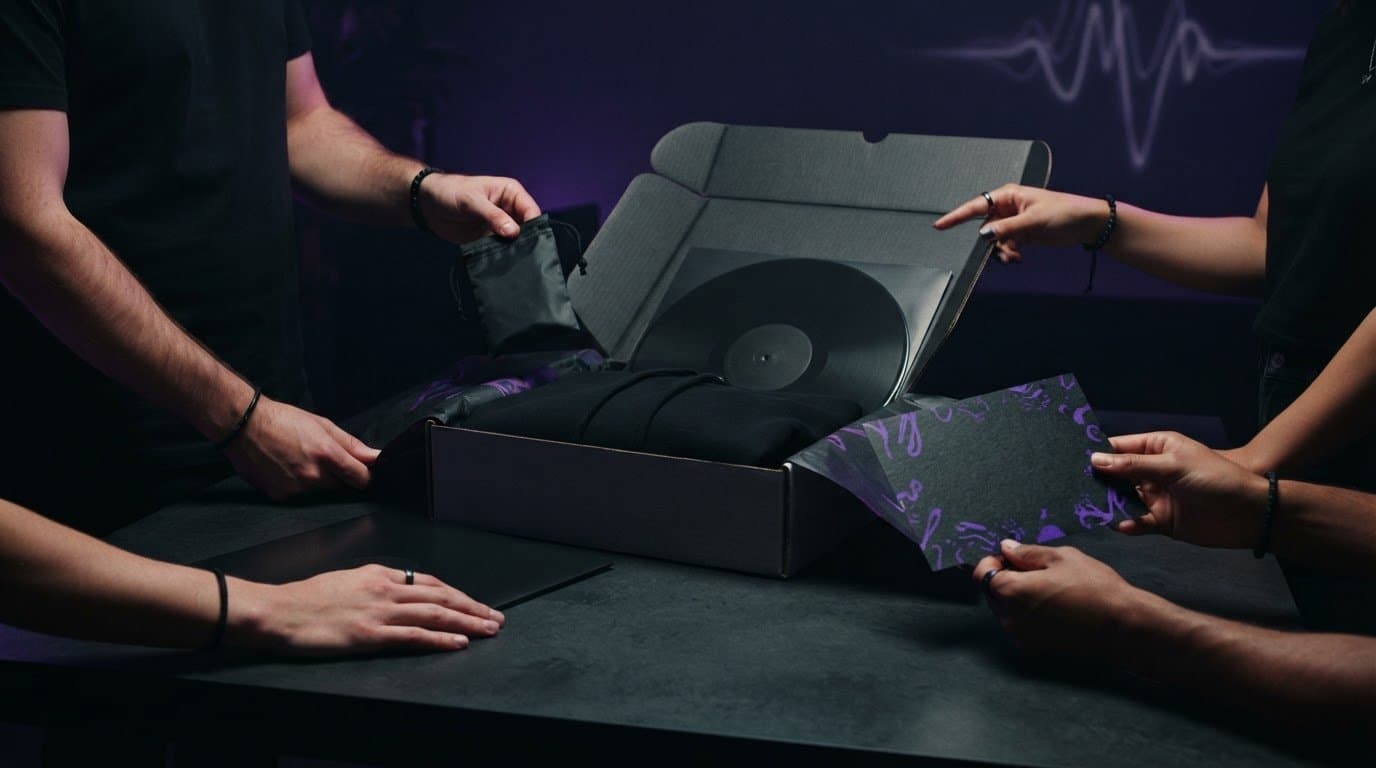
Confusion is the enemy of conversion. When you use multiple platforms, you force your fans to manage a mess of logins and disconnected apps. OohYeah! simplifies this journey for everyone. Your supporters find your digital music, merchandise, and exclusive content access in one unified space. This consolidation removes the friction that kills sales. You can sell a limited edition vinyl record and offer a monthly subscription to your "Inner Circle" on the same page. Best of all, your merch sales are also commission-free. You get a professional, high-impact artist profile that works as hard as you do. Stop splitting your audience and your income. You can start your commission-free artist profile on OohYeah! today and take back control of your musical future.
Take Control of Your Creative Economy
The landscape of 2026 demands more than just choosing between Bandcamp vs Patreon for musicians. It requires a fundamental shift toward independence and financial health. You've seen how commission-based models act as a permanent tax on your labor, draining the resources you need for recording and touring. By unifying your digital downloads, merch, and exclusive content in one place, you remove the friction that frustrates your fans and limits your growth. You deserve a partner that values equity over corporate equity cuts.
It's time to stop renting your career and start owning your success with a commission-free marketplace. You can build a sustainable future using powerful direct-to-fan sales tools and the industry's highest paying streaming alternative. Stop paying commissions and keep 100% of your music sales on OohYeah! Your music is your legacy. Don't let platform fees dictate your potential. Step into a fairer ecosystem where your hard work finally pays off in full. Your fans are ready to support you directly; make sure you're ready to receive it.
Frequently Asked Questions
Is Bandcamp or Patreon better for new artists with small fanbases?
Bandcamp is often easier for new creators because it functions as a searchable store where fans can find you through tags. Patreon requires an existing audience to justify a recurring monthly commitment. Both models take a significant cut of your early growth. A platform that allows you to sell digital downloads and host a profile for a flat recurring fee ensures you don't lose your first profits to commissions.
Can I sell physical merchandise on both Bandcamp and Patreon?
Both platforms support physical merchandise sales. Bandcamp integrates merch directly into your album pages; Patreon allows for merch rewards within specific membership tiers. The major difference lies in the cost. Bandcamp takes 10% of merch sales, and Patreon takes its tier percentage. Choosing a commission-free marketplace allows you to keep 100% of your merch revenue from the very first sale you make.
What are the hidden fees I should look out for on Patreon in 2026?
Watch out for micro-transaction processing fees that eat into small pledges. While the 5% to 12% platform cut is the headline, the per-pledge payment processing costs can be much higher for low-tier supporters. If you have many fans at a $1 or $3 level, transaction fees can consume nearly 20% of your total revenue. Flat-fee models eliminate this uncertainty by letting you keep the full pledge amount.
Does Bandcamp still have 'Bandcamp Fridays' after the Songtradr acquisition?
Bandcamp Fridays have continued sporadically under Songtradr, but their frequency is less predictable than in previous years. Relying on a platform to waive its commission for one day a month is a risky business strategy. It's better to build your career on a platform that offers zero commissions every day of the year. This ensures your financial stability regardless of corporate ownership changes or promotional schedules.
How do I move my fans from Patreon to a commission-free platform like OohYeah!?
Moving fans requires clear communication and a direct incentive for the switch. Export your mailing list and notify your supporters that their contributions will now go 100% to your art. Offer exclusive content or a digital download discount for those who move to your new commission-free artist profile. Most fans are happy to switch when they know the money supports you directly rather than a platform middleman.
Which platform offers better SEO and discovery for independent musicians?
Bandcamp currently offers superior internal discovery through its tag-based search and editorial features. Patreon provides almost no internal discovery, forcing you to do all the marketing yourself. When evaluating Bandcamp vs Patreon for musicians, remember that discovery comes at a 15% cost. A unified marketplace that combines SEO benefits with commission-free sales tools provides the best long-term ROI for your independent growth.
Is it worth paying a monthly subscription for a platform instead of a commission?
Bandcamp currently offers superior internal discovery through its tag-based search and editorial features. Patreon provides almost no internal discovery, forcing you to do all the marketing yourself. When evaluating Bandcamp vs Patreon for musicians, remember that discovery comes at a 15% cost. A unified marketplace that combines SEO benefits with commission-free sales tools provides the best long-term ROI for your independent growth, especially when paired with an automated solution like AutoSEO to drive organic traffic.
Most platforms offer some level of integration through embeddable players or widgets. However, sending fans away from your site to a third-party store often creates friction and lost sales. The most efficient solution is a consolidated artist profile that acts as your primary digital home. This allows you to manage digital music downloads, merch, and exclusive content access in one central location without complex external integrations.