Fan Subscriptions for Musicians: A Launch Guide
Learn how to set up fan subscriptions for musicians. Discover how to price benefits, pick platforms, and build recurring revenue without creative burnout.

September 30, 2026
FRANKLY with Frank Lee
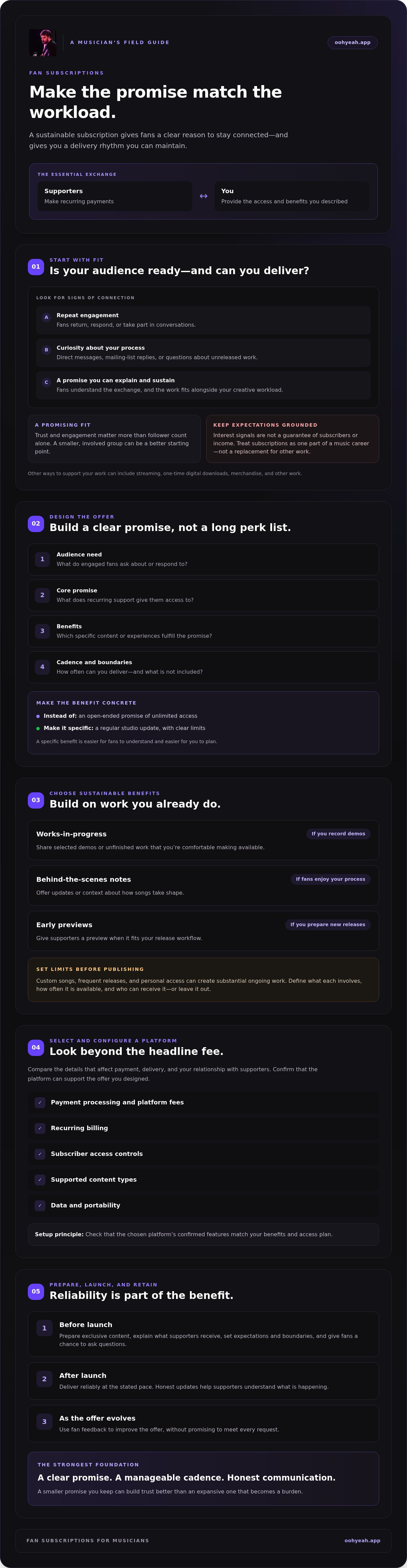
A fan subscription works best when the promise and the workload match. If you’re wondering how to set up fan subscriptions for musicians, decide what fans will receive, how often you’ll deliver it, and how they’ll access it. A clear, sustainable offer builds trust. A schedule you can’t maintain can weaken it.
You may be unsure which benefits fans will pay for or whether you’ll run out of ideas after launch. Payment processing, platform fees, recurring billing, and subscriber access can also make setup feel complicated. You don’t need an endless stream of new content. You need an offer that fits your creative workflow and gives supporters a reason to stay connected.
This guide walks through designing your offer, choosing benefits and a delivery rhythm, comparing platforms, and checking the details before launch. You’ll also learn how to set expectations so fans understand what they’re joining and you can build a stronger direct relationship with the people who support your music.
Key Takeaways
- Build your offer around what fans value and what you can deliver consistently, with clear benefits and boundaries.
- Learn how to set up fan subscriptions for musicians by matching the content, cadence, and access plan to your creative workflow.
- Compare platforms beyond headline fees. Check payment processing, access controls, supported content, data, and portability.
- Prepare exclusive content before launch, explain the offer clearly, and give supporters a chance to ask questions.
- Support retention with reliable delivery and honest updates. Use fan feedback to improve the offer without promising to meet every request.
Why set up fan subscriptions, and are they right for your music career?
A fan subscription turns ongoing support into a clear exchange: supporters make recurring payments, and you provide the access or benefits you’ve described. It can bring you closer to listeners and create a more consistent source of support, but it doesn’t guarantee income. Treat it as one part of your music career, alongside streaming, one-time digital downloads, merchandise, and other work.
This direct relationship is part of the wider creator economy, where creators earn from work shared with their audiences. A large follower count isn’t the only sign that a subscription could fit. Look for trust and engagement: fans who return, respond, and want to be part of your creative world. A smaller, involved group may be a better starting point than a broader audience that rarely interacts.
What does a fan subscription give musicians and supporters?
A subscription is an ongoing commitment on both sides. Supporters know what they’re paying for, such as exclusive content, early previews, or a closer look at your process. You agree to provide those benefits at a pace you can sustain. Streaming lets listeners access released music, while downloads and merchandise are usually one-time purchases. Membership benefits add ongoing access; they don’t replace those other ways to support your work.
Make the exchange specific. “A regular studio update” is easier to understand and plan than an open-ended promise of unlimited access. Clear limits protect your creative time and help supporters know what to expect.
How can you tell whether your audience is ready?
Look beyond passive listening for signs of interest: repeat engagement, thoughtful direct messages, mailing-list replies, or questions about your process and unreleased work. These signals don’t guarantee that people will subscribe, but they can show what your most engaged fans value. Ask them before designing benefits or estimating potential income.
Use this readiness check:
- Engaged fans: Do people regularly respond, return, or ask for a closer connection?
- A clear promise: Can you explain what supporters receive without relying on vague claims?
- Delivery capacity: Can you provide the benefit alongside your existing creative workload?
If any answer is no, keep listening and refine the idea before opening enrollment. Start with a small, clearly bounded offer. For musicians considering how to set up fan subscriptions, a promise that’s easy to understand and maintain is a stronger foundation than a long list of perks that becomes a burden.
How to design a fan subscription offer fans can understand
A strong offer connects what your audience wants with what you can reliably deliver. Build it in order: identify an audience need, define one core promise, choose benefits, set a delivery cadence, and state the boundaries. This keeps the membership focused on a reason to join instead of a growing list of perks that takes time away from your music.
- Audience need: What do engaged fans ask about or respond to?
- Core promise: What will their recurring support give them access to?
- Benefits: Which specific experiences or content deliver on that promise?
- Cadence: How often can you provide them without disrupting your work?
- Boundaries: What’s included, and what isn’t part of the offer?
Market growth can signal wider interest in direct creator support. Goldman Sachs has said the creator economy could roughly double in size. That forecast can’t predict demand for your membership. Ask fans what they value, test interest in the offer you have in mind, and don’t base income projections on audience size alone.
Which benefits can musicians offer consistently?
Choose benefits that build on work you already do. If you record demos, consider sharing selected works-in-progress. If fans enjoy hearing how songs take shape, offer behind-the-scenes updates or notes about your process. Early previews may suit artists who regularly prepare new releases. Match each idea to the time you have and the platform’s confirmed content and access features.
Set limits before you publish the offer. Custom songs, frequent releases, and personal access can create substantial ongoing work. Include them only if you can define what they involve, how often they’re available, and who can receive them. A smaller promise you keep is more valuable than an expansive one you can’t sustain.
How should you set expectations and subscription terms?
Describe the offer in plain language. Say what subscribers receive, how often they can expect it, and where they’ll access it. Explain whether benefits continue year-round, arrive seasonally, or relate to a particular release. Don’t describe occasional updates in a way that sounds like a guaranteed schedule.
Before launch, check the platform’s billing, cancellation, refund, and access terms. Distinguish recurring subscription payments from one-time downloads or merchandise purchases, too. A platform’s commission or revenue-share policy for sales may not apply to subscriptions, so check those fees separately. To explore artist profiles and exclusive content access, consider OohYeah!’s artist profiles and exclusive content.
How to choose a platform and configure subscriptions without surprises
The right platform supports the offer you’ve designed without adding unnecessary friction for you or your fans. Compare the practical details before committing. Berklee’s resources on modern music business strategies can also help you consider how direct-to-fan income fits into your wider music plans.
Use this checklist to compare platforms side by side:
| Area | What to check |
|---|---|
| Access controls | Can supporters reach the right content after joining? Can you limit access as promised? |
| Supported content | Does it handle the formats you plan to share, such as written updates, audio, or video? |
| Payments | How do recurring charges, payouts, cancellations, refunds, and failed payments work? |
| Fees | What applies to memberships, payment processing, payouts, and one-time sales? |
| Data | What supporter information can you access, and how can you use or export it? |
| Portability | Can you move your content or supporter information if you change platforms? |
Read fee labels carefully. A platform fee for creator tools is different from the recurring membership payment a fan makes. Both differ from payment processing charges and commissions on one-time music or merchandise sales. Compare the full fee structure, not just the headline rate, and check payout timing and cancellation terms before publishing your offer.
What should musicians check before choosing a subscription platform?
Start with the content and access model you need. Then review the platform’s current documentation for payment terms, fees, refunds, support, and what happens to access when someone cancels. If you want artist profiles, downloads, or merchandise alongside membership content, check that the platform supports those uses and how it treats each transaction.
OohYeah! supports artist profiles, exclusive content, digital music downloads, and merchandise. It states that artists retain 100% of music and merchandise sales revenue. That statement concerns those sales, so check subscription payment fees and terms separately rather than assuming the same arrangement applies.
How can you configure the offer and test it?
Before publishing, prepare the offer description, benefit schedule, access instructions, and boundaries. Preview the supporter journey on desktop and mobile. Test sign-up, confirmation, content access, and cancellation. Check each platform-specific setting against its current documentation. To set up fan subscriptions for musicians with fewer surprises, make the supporter experience as clear as the offer itself.
How to launch a fan subscription and keep delivery manageable
A smooth launch gives fans time to understand the offer before you ask them to join. Prepare the content and access instructions first, then communicate in a simple sequence: announce the membership, explain what supporters will receive, invite questions, and open enrollment. Clear information helps fans decide without pressure.
What should a musician prepare before announcing subscriptions?
Write the offer-page copy, prepare a sample benefit, and make the access steps easy to follow. Have at least one piece of exclusive content ready so new supporters can find something soon after joining. Before announcing, confirm that the platform currently supports every format and access promise in your offer.
Use a mailing list or social channel where you already connect with fans. Explain why you’re opening the membership and what it includes. Invite questions and answer them plainly. Don’t suggest that joining is the only way to support your music. Fans should be able to make an informed choice.
A practical launch sequence:
- Prepare: Check the offer, sample content, access instructions, and platform settings.
- Announce: Share that the offer is coming and who it’s designed for.
- Explain: Describe the benefits, delivery rhythm, and limits.
- Listen: Invite questions and clarify anything fans find confusing.
- Open enrollment: Make the offer available once the supporter experience is ready.
How can you keep delivery manageable?
Choose a repeatable publishing rhythm that fits your normal creative routine. For example, set aside time for a studio note or selected work-in-progress while you’re already reviewing a project. Build a small reserve of content before launch, too. It gives you breathing room when recording, releasing music, or touring takes priority.
Plan for busy periods. You might tell subscribers in advance that updates will arrive less often during a release cycle, or choose a benefit that doesn’t depend on producing new material every week. Communicate changes early. A realistic adjustment is better than silence or missed expectations.
How can you track engagement without overcomplicating the workflow?
Set aside time to review subscriber questions, feedback, benefit use, and cancellations when that information is available. Use platform reporting only if the platform provides it. You don’t need a complex dashboard to spot repeated questions or a benefit that takes more time than expected. If delivery becomes difficult to sustain, adjust the cadence or narrow the promise.
If you’re ready to bring your artist profile and exclusive content together, explore OohYeah! artist profiles and direct-to-fan options. As you consider how to set up fan subscriptions for musicians, check the platform’s current subscription terms and features before making specific promises to supporters.
How to grow and retain a musician fan subscription over time
Retention depends on a clear, dependable relationship. Subscribers don’t need a flood of exclusive posts. They need the benefits they joined for, communication they can trust, and a reason to feel connected to your music. Review your offer periodically. A benefit that once excited fans may become less relevant, while a small change in your routine could create a sustainable new way to share.
Keep the conversation open. Invite feedback and look for patterns in questions or requests, but don’t promise to fulfill every suggestion. Choose changes that fit your work and serve the community. If you share behind-the-scenes material, confirm you have permission to share it and that it doesn’t conflict with collaborators’ rights or release plans.
How do you keep subscribers engaged without constant content production?
Consistency matters more than volume. Build benefits around material you already create, such as a short note about a song’s development or a suitable studio update. Repurposing can make delivery more manageable, but check rights, collaborator expectations, and release plans first. If your schedule changes, tell subscribers what to expect next and when you’ll update them. A direct note about a delay is better than leaving supporters guessing.
Subscriptions can complement other ways fans support your work, but keep each exchange distinct. Exclusive content access is an ongoing membership benefit. A digital music download or merchandise purchase is a separate transaction. An artist profile can bring these parts of your direct-to-fan presence together while making the difference clear to supporters. If you use OohYeah!, check current subscription terms separately from its stated terms for music and merchandise sales.
When should you revise or pause a subscription offer?
Reassess the offer if delivery regularly slips, the workload crowds out your music, or feedback suggests the benefits no longer fit. You can adjust the cadence, replace a benefit, or pause the offer. Explain what’s changing, when it takes effect, and what supporters should expect. Before making changes, check the platform’s current subscriber-management, cancellation, refund, and account policies. Services may handle them differently.
Your next step: Choose one offer you can sustain, verify the platform terms that apply, and explain the benefits and limits plainly before launch. This gives you a practical starting point for how to set up fan subscriptions for musicians while protecting your creative capacity and your relationship with supporters.
Build a fan offer you can grow with
A lasting subscription starts with a clear promise, benefits that fit your creative routine, and a delivery rhythm fans can count on. Choose a platform after checking its access, payment, fee, and cancellation terms. Then launch simply, listen to supporters, and adjust the offer honestly as your music and community evolve.
OohYeah! supports artist profiles and exclusive content access, alongside digital downloads and merchandise listings. The platform states that artists retain 100% of music and merchandise sales revenue. That statement may not cover subscription payments, so check the current terms for recurring support before making assumptions.
Ready to take the next step in how to set up fan subscriptions for musicians? Explore OohYeah! and build a direct connection with your fans. Start with one sustainable offer, make the details easy to understand, and build from there. Strong supporter relationships grow through genuine connection, not an impossible content schedule.
Frequently Asked Questions
How do musicians set up fan subscriptions?
Musicians set up fan subscriptions by defining a clear offer, choosing a platform, and explaining the benefits and delivery schedule before inviting supporters to join. Decide what fans receive, how often you’ll provide it, and what falls outside the promise. Then check the platform’s access, recurring payment, fee, payout, cancellation, and refund terms. Test the supporter journey before launch so fans know how to join and find their exclusive content.
What should a musician offer in a fan subscription?
Offer benefits that fans value and you can reliably deliver. Options might include exclusive updates, selected demos, behind-the-scenes material, or early previews, if your platform supports the format. Make each benefit specific: explain what it is, how often it arrives, and where subscribers access it. Avoid open-ended promises such as unlimited personal access or frequent custom work unless you can set and maintain clear limits.
How much should a musician charge for a fan subscription?
Set a price that reflects the benefits, your audience’s feedback, and the time required to deliver them. Review comparable offers in your genre and account for platform charges, payment processing, and payout costs when estimating what you’ll keep. Ask fans what they value, then test a clearly described offer instead of relying on follower counts or projected income. Check current platform terms, since fees and payment arrangements can vary.
Can independent musicians offer subscriptions without a record label?
Yes. Independent musicians can offer fan subscriptions without signing to a record label by choosing a suitable platform and managing the offer themselves. The platform should support the content and access model they plan to provide, as well as recurring payments. Artists remain responsible for making the promise clear and sustainable. Before launching, review payment, fee, cancellation, refund, and content-access terms so you understand how the setup works.
How often should musicians post exclusive content for subscribers?
Choose a schedule you can maintain alongside recording, performing, and other work. There’s no single posting frequency that suits every musician. A dependable update at a manageable interval can be more valuable than frequent posts that become difficult to sustain. State the expected cadence plainly, prepare content ahead when possible, and tell subscribers if it changes. Match the schedule to your workflow and the platform’s supported content features.
What happens if a musician cannot deliver a promised subscription benefit?
Contact subscribers promptly, explain what changed, and tell them what to expect next. If you can provide a suitable alternative or revised delivery date, describe it clearly without making a new promise you can’t keep. Review the platform’s current refund, cancellation, and subscriber-access policies before deciding what to do. Repeated delays may mean the offer needs a more realistic schedule or narrower benefits.
Is fan subscription income different from music download or merchandise sales?
Yes. Fan subscriptions involve recurring payments for access to exclusive artist content or platform features, while downloads and merchandise are separate sales. Check how your platform handles fees for each type of transaction. OohYeah! states that artists retain 100% of music and merchandise sales revenue, but verify the current terms for fan subscription payments separately. Don’t assume the stated sales arrangement also applies to subscriptions.
Which platform features should musicians check before launching subscriptions?
Check that the platform supports your intended content formats and controls supporter access as promised. Review recurring billing, processing and platform fees, payout timing, cancellations, refunds, and customer support. Consider what supporter information you can access and whether content or data can be moved if you switch platforms. If you plan to offer downloads or merchandise alongside memberships, confirm how those sales are handled separately.