Songs Played Backwards: A Guide for Modern Artists
Explore the mystery of songs played backwards. Learn the history of backmasking, how to create reversed audio, and how indie artists can use it creatively.
June 15, 2026
Music Marketplace Advisor
Buying & SellingA friend once showed me how to drag a vinyl record backward under the needle, convinced we'd hear a forbidden sentence hiding inside the chorus. What we heard was a wash of strange consonants, breathy tails, and a lot of argument about what it “really” said.
The Enduring Mystery of Reversed Audio
People have been fascinated by songs played backwards for decades because reversed sound feels half-musical and half-linguistic. It's familiar enough to suggest meaning, but unfamiliar enough to feel uncanny. That gap is where the mystery lives.
In studio terms, the core idea is backmasking. That means recording a sound or message so it's intended to be heard when the track is played in reverse. It's not the same thing as a random backward artifact, and it's not the same thing as a listener imagining words in a swirl of reversed syllables. Those distinctions matter if you're an artist trying to use the effect on purpose.
Why people still care
Backmasking carries old cultural baggage. A commonly cited educational summary says the total number of known artists who have used it is “somewhere around seventy-five,” which suggests it has always been a niche but notable technique rather than a standard production habit. The same summary places the height of public concern in the 1980s, when people widely connected backmasking with alleged brainwashing or Satanic messages in heavy metal music, before that belief faded from fashion, as noted in Study.com's overview of backmasking examples and psychology.
That history still shapes how listeners respond today. If you bury a reversed vocal into a hook, some fans will hear it as clever sound design. Others will hear it through the lens of old myths.
Practical rule: Reversed audio isn't automatically controversial. But it does arrive with cultural memory attached.
Why artists should treat it as a tool
As a producer, I don't treat backward audio as occult or gimmicky. I treat it like reverse reverb, varispeed, tape saturation, or granular stretching. It's a texture first. Sometimes it's also a narrative device.
For indie artists, that's the useful reframing. Backward sound can do several jobs well:
- Create tension: A reversed cymbal swell or vocal inhale can pull the listener into the next phrase.
- Add symbolism: Reversal can suggest memory, regret, obsession, flashback, or a warped point of view.
- Reward close listening: A subtle backward phrase can become a fan discovery without dominating the whole song.
- Differentiate your sound: When used tastefully, reversed layers can make a production feel authored rather than template-built.
The trick is to separate folklore from craft. If you understand what reversed audio does acoustically, how listeners mishear it psychologically, and how to apply it with intention, the “dark art” becomes something much simpler. It becomes arrangement, texture, and storytelling.
A Hidden History of Backmasking Controversies
The history of backmasking is messy because two different stories got tangled together. One story belongs to recording studios, where musicians experimented with tape, reversal, and chance. The other belongs to public panic, where listeners searched for hidden meaning and often decided they'd found it.

From tape experiment to rumor machine
In the analog era, reversing tape was a natural experiment. Engineers already cut, spliced, slowed, and rearranged reels by hand. Once you physically turn tape around, you discover very quickly that attacks become decays, consonants smear into strange textures, and ordinary speech turns eerie.
That's part of why backward sound entered pop culture so easily. It didn't start as a grand theory. It started because studios were full of curious people with machines.
Then listeners brought their own interpretations. A backward phrase could be a joke, a sonic effect, a deliberate hidden message, or pure coincidence. The public rarely treated those as separate categories.
The controversy years
By the late 1970s and 1980s, the conversation hardened into a moral argument. According to Wikipedia's history of backmasking, backmasking became a major public controversy in that period, and Led Zeppelin's “Stairway to Heaven” and the Eagles' “Hotel California” became two of the most emblematic and frequently cited examples in the debate over hidden satanic messages in rock music.
Those songs became cultural exhibits. People played them backward, circulated claimed transcripts, and treated ambiguous sounds as proof of intention. Once a suggested phrase got planted in a listener's mind, many people “heard” it clearly, even when another listener heard something entirely different.
The public didn't just hear reversed audio. They heard a story about reversed audio.
That's why the controversy lasted. It wasn't driven only by sound. It was driven by framing, fear, and repetition.
What this history means for artists now
If you're making music today, you don't need to inherit that panic. You do need to understand it. Backward audio still triggers associations that newer production effects don't.
A few practical implications follow from that history:
- Context shapes interpretation: The same reversed whisper feels different in a dream-pop song than in a horror-themed visual campaign.
- Audience matters: Dedicated fans may read hidden details as world-building. Casual listeners may miss them entirely.
- Intent won't always be obvious: If you use reversal without a clear artistic frame, listeners may invent one.
- Legacy examples still dominate search results: When people look up songs played backwards, they often encounter sensationalism before they encounter craft.
That last point is important for indie artists. If you use reversed sound, you're not just making an audio choice. You're entering a conversation that has always mixed studio technique with cultural myth. Smart artists know the baggage, then use the tool anyway on their own terms.
The Science Behind Reversed Sounds and Messages
Reversed audio sounds eerie for a simple reason. Human speech and musical gestures are built to move forward in time. When you flip them, the envelope changes, syllables lose their normal shape, and your brain tries to force meaning onto material that no longer behaves like natural language.

What reversal does to sound
Think about a spoken word. In normal speech, consonants often prepare the mouth for a vowel, and the sound decays in a way your ear recognizes instantly. Reverse that recording and the tail arrives first. Breath comes before impact. Sibilants smear. Stops and plosives lose their usual logic.
In music production, that creates three especially noticeable effects:
| Effect | What you hear | Why it feels strange |
|---|---|---|
| Reversed attack | Sounds swell into existence | Our ears expect sounds to strike, then fade |
| Blurred consonants | Speech becomes slippery and ghostlike | Phonemes no longer arrive in a readable order |
| Artificial anticipation | Notes seem to suck the listener forward | The buildup happens before the source event |
That's why a reversed vocal often sounds more “haunted” than a reversed guitar. Speech carries stronger expectations, so breaking them feels more uncanny.
Why listeners hear messages that aren't there
The other half of the story is psychological. The brain hates ambiguity. When a sound sits between language and noise, listeners start searching for patterns.
A linguistic analysis reported that 85% of claimed “subliminal messages” in reversed pop tracks are statistically indistinguishable from random phonetic noise, highlighting how pattern-seeking drives perception in reversed listening, according to Adam Bernard's discussion of hidden messages in pop tracks.
That doesn't mean intentional backmasking never exists. It means many claims about secret messages come from patternicity, the habit of perceiving meaningful structure where none was deliberately placed.
If you tell a listener what phrase to expect, you often change what they hear.
That's expectation bias at work. It's the audio equivalent of seeing shapes in clouds after someone labels them for you.
A producer's way to separate fact from folklore
When I evaluate a supposed backward message, I ask a few blunt questions:
Does the phrase remain clear without prompting?
If someone must provide a transcript first, that's a warning sign.Does the sound behave like intentionally planned speech?
Intentional backmasking usually has stronger phonetic alignment than accidental reversal.Does it fit the song's writing and production choices?
A hidden layer often reflects theme, timing, and placement. Random artifacts usually don't.Would multiple listeners identify roughly the same phrase independently?
If every person hears a different sentence, you're likely dealing with coincidence.
For artists, this is liberating. You don't need mystical beliefs to use reversed sound effectively. You need ears, judgment, and a basic understanding of how listeners construct meaning out of unfamiliar audio.
How to Create and Analyze Your Own Backwards Audio
The technical side is much less dramatic than the folklore. If you can drag audio into a DAW, duplicate a region, and use a reverse command, you can work with songs played backwards in Audacity, Logic Pro, Ableton Live, FL Studio, Pro Tools, Reaper, or most phone-friendly editors that support waveform processing.

Workflow for analysis
If you're examining an existing track for curiosity, research, or arrangement study, keep the process controlled. Don't start with assumptions about what you're supposed to hear.
Use this order:
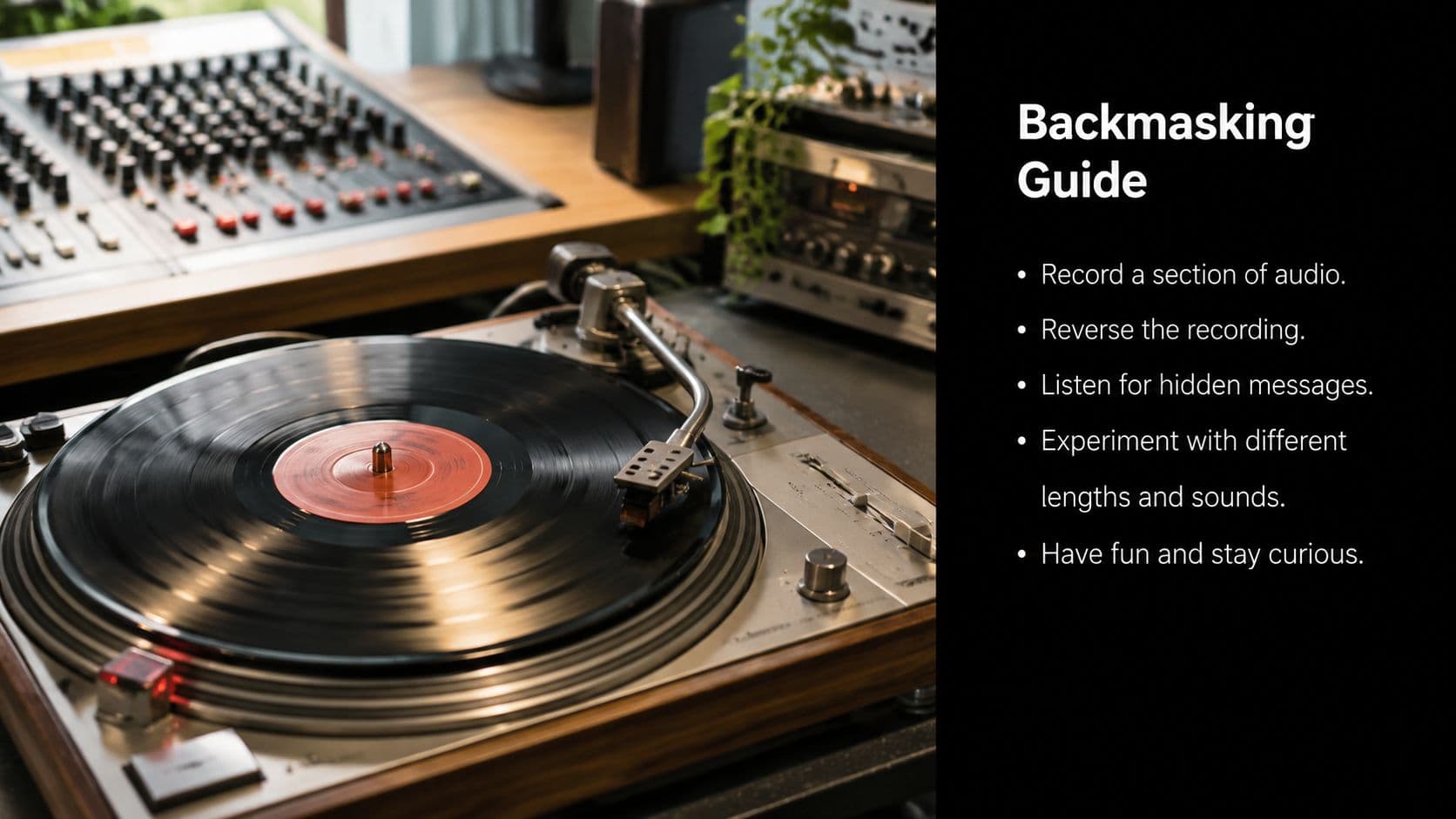
Import the audio
Put the file on a fresh track and label it clearly. Keep an untouched original.Duplicate the region
Never destructively process your only copy. Backward listening gets confusing fast.Apply reverse to the duplicate
Most DAWs offer this as a clip, region, or offline process.Listen without reading fan theories
Make your own notes first. Write impressions, not conclusions.Loop short sections
Reversed speech becomes easier to inspect when you isolate phrases rather than scanning an entire song.Compare spectral and timing cues
If you're hearing a “message,” check whether the timing and articulation seem repeatable or whether your brain is filling gaps.
A clean analysis session is less about finding secrets and more about hearing what reversal does to texture, timing, and intelligibility.
Workflow for creating intentional backmasking
Making your own hidden phrase takes more planning than beginners expect. If you reverse a normal sentence and drop it into a song, it may become mush. The better method is to compose for the effect.
Try this production approach:
- Write the intended backward message first: Keep it short. Fewer words usually survive reversal better.
- Record the phrase dry: Skip heavy effects at this stage so you can judge articulation.
- Reverse the recording: Place it where you want the hidden phrase to occur in the arrangement.
- Adjust timing by ear: You may need to trim silences or shift the region to make the reveal land musically.
- Layer subtly: Burying it under pads, transitions, or percussion often sounds better than exposing it naked.
- Test with and without a cue: If the effect only works after explanation, decide whether that's acceptable for your artistic goal.
Two different creative uses
Not every reversed element needs to be a “message.” In practice, artists usually use one of these two paths:
| Use case | Best source material | Typical result |
|---|---|---|
| Hidden phrase | Spoken or sung vocal | Easter egg, conceptual layer, fan discovery |
| Textural reversal | Reverb tails, cymbals, guitars, pads | Lift, tension, dreamlike motion |
Most songs benefit more from the second path. Reverse reverb before a snare, a backward guitar swell before a chorus, or a flipped vocal breath before a key lyric often has more musical value than a literal hidden sentence.
A quick visual walkthrough can help if you haven't done this before.
Mistakes that make backward audio sound amateur
A lot of weak backmasking comes from overexposure, not bad intent.
- Too loud in the mix: If the backward layer fights the lead vocal, it stops feeling mysterious and starts feeling messy.
- Too long: Reversed speech works best in fragments. Long passages lose impact.
- Too literal: If the hidden line says exactly what the main lyric already says, it adds nothing.
- Too effect-heavy too early: Distortion, modulation, and long delays can erase the articulation you need.
The best test is simple. If the reversed element still serves the song when nobody notices it consciously, it's doing its job.
Creative Applications and Ethical Guardrails for Artists
Backward audio deserves better than the old panic cycle, but it also deserves discipline. A clever effect can become a cheap stunt when the concept is thin. For indie artists, the strongest approach is to use reversed sound with artistic intent, clear boundaries, and enough self-editing to know when the trick is carrying the song and when it's distracting from it.

A practical reason for caution is uncertainty. According to a 2025 report by the Music Creators Guild, 60% of indie artists are hesitant to experiment with backmasking due to legal ambiguity and fear of triggering algorithmic bans on modern distribution platforms, as cited in the referenced video source about artist concerns and platform ambiguity. Since that claim is future-dated in relation to earlier controversy history, treat it as a reported concern about the modern platform environment rather than a timeless rule.
Strong creative uses
The most compelling backward audio usually supports the song's emotional logic.
Atmosphere in intros and transitions
Reverse pads, cymbals, piano tails, and vocal breaths can pull a listener toward the next section. This works especially well in alt-pop, ambient, trap intros, and cinematic electronic production.Narrative symbolism
If your song deals with memory, relapse, déjà vu, grief, or a fractured timeline, reversal can reinforce the concept without a line of exposition.Fan-facing Easter eggs
A short hidden phrase, a reversed ad-lib, or a backward vocal stack can give devoted listeners something to discover and discuss.Hook enhancement
A tiny flipped syllable before a chorus downbeat can make a section feel more expensive and dramatic, even when the listener can't identify why.
Use reversed audio the way a filmmaker uses lighting. It should shape meaning before it calls attention to itself.
Ethical guardrails that keep the effect from backfiring
Artists don't need to be afraid of experimentation. They do need standards.
Consider this checklist before release:
| Question | Why it matters |
|---|---|
| Does the effect serve the song? | Technique without purpose reads as gimmick |
| Could the phrase be reasonably misheard as harmful? | Ambiguity can create avoidable problems |
| Are you using any copyrighted source material? | Reversal doesn't erase ownership |
| Would you be comfortable explaining the choice publicly? | If not, the concept may not be strong enough |
A few principles keep things clean:
- Avoid deceptive framing: Don't market a track as mind control, secret persuasion, or a hidden psychological weapon.
- Use your own recordings or cleared material: A reversed sample is still a sample.
- Think about audience context: A horror project can tolerate more disorientation than a meditation release or a kids' record.
- Document your session choices: If a platform or collaborator questions an unusual layer, clear notes help.
Modern platform common sense
Platforms don't all evaluate audio the same way, and policies can shift. That doesn't mean backward sound is off-limits. It means artists should act like professionals.
Export clean masters. Keep lyric sheets accurate. If a hidden phrase matters to the concept, decide whether to disclose it in liner notes, a deluxe edition, or fan content. If it doesn't need explanation, let it live as texture.
The ethical line is straightforward. Use reversal to deepen expression, not to manufacture panic or confusion for attention.
Monetizing Your Artistry with OohYeah
Backward audio becomes commercially useful when it creates participation. Fans don't pay for a trick alone. They pay for access, interpretation, exclusivity, and the feeling that they're close enough to the work to notice what casual listeners miss.
That opens several artist-friendly formats:
Turn hidden details into premium content
A reversed phrase or hidden vocal layer can support paid extras without feeling forced.
- Offer a deciphered lyric sheet that reveals where a reversed line appears and why you placed it there.
- Release an alternate version with isolated backward stems for subscribers who enjoy process and production.
- Bundle a studio note pack with screenshots, annotations, and a voice memo explaining how you built the section.
These are small assets, but they work because they convert curiosity into collectible context.
Build fan interaction around discovery
Reversed audio is naturally participatory. It invites listening parties, theories, comments, and replays.
A smart direct-to-fan rollout might include:
- A fan challenge asking listeners to identify a hidden phrase.
- A members-only post revealing the original forward take behind the reversed layer.
- A limited download of a backward intro, interlude, or demo that won't appear on streaming services.
- A production breakdown for producers, DJs, and audio nerds who want session-level insight.
This works best when the hidden element is real, musically relevant, and tied to the song's identity.
Package the technique as part of your brand
If reversal fits your aesthetic, don't isolate it to one novelty single. Make it part of a larger creative language. Use it in transitions between tracks, teaser clips, visual captions, subscriber exclusives, or alternate masters.
That consistency matters. Fans learn your patterns. Once they know your work rewards close attention, every release gains more replay value.
The broader lesson is simple. A niche studio technique becomes monetizable when it creates a richer relationship between artist and audience. Reversed audio can do that well because it sits at the intersection of sound design, storytelling, and discovery.
OohYeah gives artists a practical place to turn that kind of creative depth into direct support. You can upload exclusive versions, sell subscriber-only releases, share behind-the-scenes breakdowns, and build conversations around the details your biggest fans love. If you're ready to turn experimental production choices into real fan engagement, explore OohYeah.