Music Streaming Services Comparison: Find Your Perfect Platform
Explore our music streaming services comparison to discover the best platform for you. Compare prices, quality, and artist tools easily!
September 17, 2025
Music Marketplace Advisor
Buying & SellingWhen you stack up the major music streaming services, you'll see a clear divide. On one side, you have giants like Spotify and Apple Music, whose massive libraries and killer discovery algorithms are hard to beat. On the other, you have newer platforms like OohYeah that are built from the ground up to help artists connect directly with fans and actually make a living.
What's best for you? It really boils down to what you value more: endless content variety or direct support for the creators you love.
Decoding the Modern Music Streaming Landscape
The way we consume music today is completely different from just a decade ago. We've moved on from physical albums and curated playlists on our iPods. Now, almost any song ever recorded is just a few taps away, making streaming the undeniable king of music consumption.
This isn't just a trend; it's a total industry takeover. As of 2025, a staggering 84% of all revenue in the music industry flows directly from streaming platforms. That's a massive shift, and it’s powered by more than 600 million people worldwide who pay for a music subscription. You can dig into more of these stats over at explodingtopics.com.
Major Players and Key Differentiators
At first glance, services like Spotify and Apple Music seem almost identical, but when you look under the hood, you start to see their core philosophies are quite different. Getting a handle on these nuances is key, whether you're a listener trying to find the perfect service or an artist figuring out where to build a following.
The Big Guys (Spotify, Apple Music): These platforms are built for the listener who craves discovery and convenience. They offer gigantic catalogs, slick user interfaces, and incredibly smart recommendation engines.
The Artist-First Platforms (OohYeah): In response to the industry's flaws, a new wave of services is popping up. Their main goal? To fix the broken parts of the market, especially when it comes to paying artists fairly and fostering genuine connections with fans. They typically offer better revenue splits and more control for creators.
The real trick to choosing a service is to look beyond the monthly fee and the user interface. The meaningful differences are found in audio quality, how artists get paid, and the tools available for music discovery. That's where you find the true value.
Making a smart choice means going deeper than a surface-level comparison. And for artists, the stakes are even higher. Understanding these platforms is essential, which is why music streaming platforms are crucial for exposure and building a career that can actually last.
Setting the Stage: What Really Matters in a Music Service?
Choosing a music streaming service isn't just about picking the one with the most songs. The "best" platform is completely different depending on who you are. Are you a listener just looking for a great soundtrack for your commute, or are you an artist trying to build a career and connect with fans?
That’s why we’re breaking this comparison into two distinct paths. This isn’t a one-size-fits-all race; it's about finding the right fit for you. We'll look at this from both sides of the coin: the fan and the creator.
For the Listener: What's the Everyday Experience?
For most of us, a streaming service has to deliver on the fundamentals. It’s about value, sound, and a great user experience. Here's what we’re digging into:
- Subscription Costs and Tiers: We'll go beyond the headline $10.99/month price tag. What do you really get with a family plan, a student discount, or a bundle?
- Audio Fidelity: Let's be real—does lossless audio actually matter if you're listening through standard earbuds? We’ll translate the tech specs into what you can actually hear on your gear.
- Library Size and Diversity: A massive library is great, but can you find that obscure indie band you love? We’ll look at not just the total track count but how well each service caters to niche tastes.
- User Experience (UX): How easy is it to build a playlist? How smart are the recommendations? A clunky app can ruin the whole vibe, so we’re judging the day-to-day usability.
For the Artist: Is It a Platform or a Partner?
If you’re a musician, a streaming service is so much more than a media player—it's a critical part of your business. The focus shifts from what you can listen to, to what you can do.
- Royalty Structures: Getting paid is obviously a huge deal. We’ll break down how platforms like Spotify and Apple Music calculate your earnings and what that means for your bottom line.
- Distribution and Analytics: How easy is it to get your music on the platform? More importantly, what data can you get back? We’re looking for tools that give you real insight into who your listeners are and where they are.
- Fan Engagement Features: Beyond just streaming, which platforms help you actually build a community? We’ll compare things like direct messaging, merch shelves, and promotional tools.
This chart gives a quick snapshot of how the big players stack up on some of the key metrics for listeners.
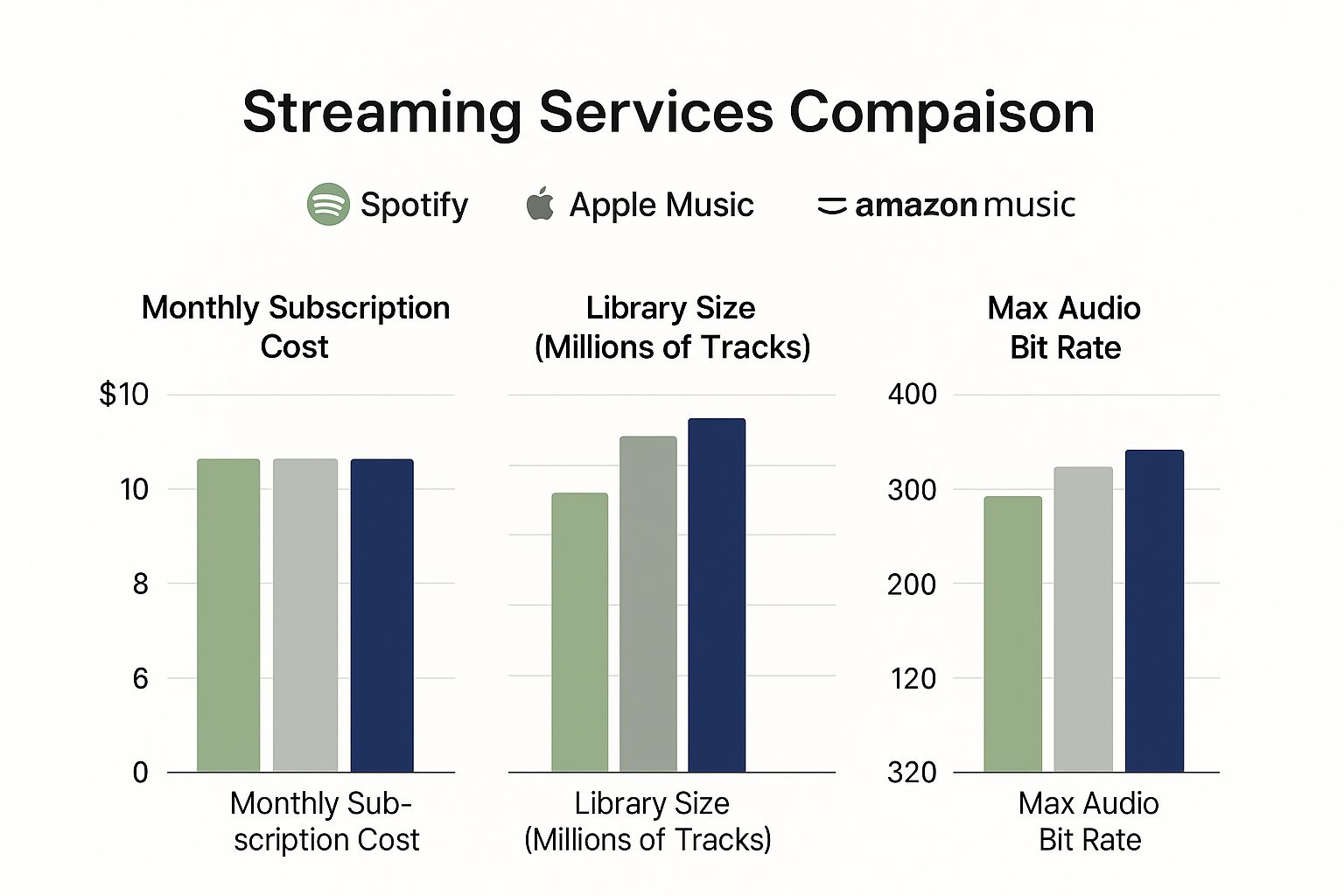
As you can see, while the monthly price is pretty standard across the board, the differences in library size and audio quality are significant. By laying out these separate benchmarks for listeners and artists, we can get a much clearer picture of where each service truly shines.
Quick Overview of Key Streaming Service Features
To get a high-level view, this table summarizes the core features that matter most to both listeners and artists across the major platforms.
| Feature | Spotify | Apple Music | Amazon Music | OohYeah |
|---|---|---|---|---|
| Listener Cost | Free (ad-supported), Premium starts at $10.99 | Starts at $10.99/mo | Included with Prime, Unlimited from $9.99 | Varies by plan, often bundled |
| Audio Quality | Up to 320 kbps Ogg Vorbis | Up to 24-bit/192 kHz (Lossless) | Up to 24-bit/192 kHz (Ultra HD) | High-fidelity options available |
| Artist Royalties | Pro-rata model, approx. $0.003-$0.005/stream | Pro-rata model, approx. $0.01/stream | Pro-rata model, rates vary | Artist-centric, direct payout models |
| Artist Analytics | Spotify for Artists (detailed dashboards) | Apple Music for Artists (listener demographics) | Amazon Music for Artists (basic insights) | Advanced fan analytics and engagement metrics |
| Fan Engagement | Merch, concert listings, Canvas loops | Limited native tools, relies on social links | Artist merch store, livestream integration | Direct messaging, exclusive content, community |
This gives us a solid foundation. Now, let’s dive deeper into how each of these services performs in the real world.
Comparing Price Tiers and Audio Fidelity
That standard $10.99 monthly fee you see everywhere is really just the tip of the iceberg when it comes to music streaming. The real value isn't in the sticker price—it’s hidden in the family plans, student discounts, and service bundles that can seriously cut down your monthly bill.
Take family plans, for instance. Both Apple Music and Spotify offer a family tier for around $16.99 that gives premium access to six different people. Do the math, and that brings the cost down to less than $3 per person. For any household with more than one listener, it's a no-brainer.
The Real Cost of a Subscription
While a solo plan is simple enough, the bundled deals are where things get interesting. Amazon Music Unlimited, for example, offers a small price break to Prime members, making it a pretty attractive option if you’re already part of the Amazon ecosystem.
Student plans are another huge money-saver, often knocking the price down to just $5.99 a month—a 50% reduction for the same exact features as a full-priced premium account. Always check if you’re eligible before you pay full price. And of course, there's the world of free streaming. If you're curious about ad-supported options, our guide on how to legally stream music for free breaks down what you can expect.
Choosing a plan isn't just about finding the lowest number—it's about getting the best value for your situation. A family of four will find a family plan unbeatable, while a solo listener might get more from a bundled service.
Is High-Fidelity Audio Worth It?
You’ll hear a lot of talk about lossless audio and Dolby Atmos, but what does that actually mean for your ears?
Essentially, lossless audio—which you'll find on services like Apple Music and Amazon Music—delivers the full, uncompressed sound of the original studio recording. It's a noticeable jump in quality from the standard premium streams on Spotify, which top out around 320 kbps.
But here's the catch: you'll only really hear that difference if you have the right gear. If you're listening through a pair of high-end headphones or a dedicated home stereo system, lossless audio will sound richer, clearer, and more detailed. For casual listening on earbuds or in the car? The improvement is subtle at best. Your hardware ultimately decides if paying for premium audio is a worthwhile investment.
A Look at Artist Tools and Revenue Models
For any artist today, a streaming platform isn't just a digital jukebox—it’s a business partner. The right one can fuel your growth, while the wrong one can hold you back. The real differences that matter to creators aren't the listener features, but the underlying revenue models and the quality of the tools they give you to build your career.
Most of the big names, like Spotify and Apple Music, run on what's called a pro-rata revenue model. Think of it like a giant pot: all the subscription and ad money for the month gets pooled together. That total is then divided by the total number of streams on the entire platform, and artists get paid based on their slice of that massive pie.
What Royalties Actually Look Like
The pro-rata system is notorious for its tiny per-stream payouts—we're talking fractions of a penny. While Apple Music tends to pay a bit more, hovering around $0.01 per stream, Spotify's rate is often somewhere between $0.003 and $0.005. It’s a model that heavily favors superstars with billions of streams, leaving a lot of independent and rising artists with pocket change.
This is where artist-first platforms like OohYeah are trying to change the game by experimenting with more direct payment models. The goal is to build a fairer system where an artist's income is directly connected to their own fans, not diluted in a global pool. It’s a huge deal when you’re wondering if you can make money from streaming services.
The fundamental difference isn't just the per-stream rate; it's the entire philosophy. Pro-rata models reward sheer volume and passive listening. Direct-to-artist models, on the other hand, give dedicated fan communities the power to financially support the creators they actually care about.
This conversation is only getting more important as the market explodes. Projections show the global music streaming market is set to grow by an astounding $53.49 billion between 2024 and 2029, thanks to smartphones and the endless demand for digital content. As the pie gets bigger, the debate over how to slice it fairly is heating up. For more on this, check out the music streaming trends on dataart.com.
A Closer Look at Artist Dashboards
Beyond how you get paid, the day-to-day tools you have access to are what really help you build a career. The quality of analytics and fan engagement features can vary wildly from one platform to another. A great dashboard turns anonymous streams into a real, understandable audience.
Here’s a quick rundown of what you can expect from the major players:
Spotify for Artists: This is pretty much the industry benchmark. It gives you incredibly detailed dashboards showing listener demographics, where in the world people are listening, which playlists you're on, and even real-time stream counts. You also get tools to customize your artist profile and pitch new music to their editorial teams.
Apple Music for Artists: Apple provides solid analytics, too, showing you listener trends and geographic hotspots. While many find its interface a little less granular than Spotify's, it has a killer feature: Shazam data. You can see exactly where your music is being discovered out in the wild, which is invaluable.
OohYeah's Creator Tools: This platform is built around direct fan connection. The analytics here are tied directly to fan actions—who’s buying your merch, who’s unlocking exclusive content. It draws a much cleaner line between the engagement you build and the revenue you earn.
So, which one is right for you? It really comes down to your goals. If you're chasing maximum reach and trying to get discovered, the powerful analytics from Spotify are tough to argue with. But if your focus is on nurturing a loyal community and maximizing your direct income, a platform like OohYeah gives you a set of tools built specifically for that purpose.
Diving Into Music Discovery and User Experience
A library of 100 million songs is impressive, but it’s worthless if you can't find anything new to listen to. The real test of a great streaming service is its ability to be your personal DJ, effortlessly surfacing your next favorite track. This is where user experience and the intelligence behind the recommendations become the deciding factors.
The app's interface is your entry point to all this music. A clean, intuitive design makes everything from building playlists to searching for artists feel simple and natural. A cluttered or confusing app, however, just gets in the way, turning the joy of listening into a frustrating task.
Algorithmic vs Human Curation
When it comes to music discovery, there are really two schools of thought: recommendations driven by algorithms versus playlists put together by actual people. Each one offers a different way to find new music, and the right choice for you boils down to how you like to explore.
Spotify's Algorithmic Powerhouse: Spotify is the undisputed king of data-driven discovery. Its legendary Discover Weekly and Release Radar playlists are built by complex algorithms that study everything you do—what you play, who you follow, even what you skip—to predict what you'll enjoy next. It's a fantastic system for finding artists and songs that are right in your sonic wheelhouse.
Apple Music's Human Touch: Apple Music, on the other hand, puts its faith in people. Its radio stations and featured playlists are often crafted by music experts, well-known DJs, and industry editors who bring a knowledgeable, human perspective to the table. This approach is perfect for deep-diving into a genre or finding music you never would have stumbled upon based on your listening history alone.
The core difference is simple: Spotify’s algorithm is exceptional at giving you more of what you already love, while Apple Music’s human curation is better at broadening your musical horizons with expert guidance.
Real-World Discovery Scenarios
Let’s put these approaches to a practical test. Think about creating a playlist for a very specific mood or activity. Good discovery tools are essential for this, letting you build the perfect soundtrack for anything from your daily commute to more specific needs like finding wedding music playlist ideas.
If you’re trying to build a high-energy workout mix, Spotify's talent for analyzing the tempo and mood of your liked songs usually gets you there faster. But if you're exploring a niche genre like Japanese city pop or neo-psychedelia, the curated playlists on Apple Music often provide a far more authentic and comprehensive introduction.
Ultimately, the best experience is a blend of a smooth interface and a discovery engine that matches your personal style. Some days you just want an algorithm to serve up the perfect focus music. Other days, you want an expert to guide you through a genre you've never heard before.
Making the Right Choice for Your Music
Choosing a music streaming service isn't about finding a single "best" platform—it's about finding the right one for you. In this crowded market, the perfect fit depends entirely on your listening habits, the gear you use, and what you're trying to accomplish, whether you're a casual listener or a career artist.
What a family of six needs is completely different from what a dedicated audiophile with high-end headphones is looking for. This is about matching the platform's strengths to your day-to-day reality, so let's break down which service excels for different types of users.
Recommendations for Different User Profiles
For the budget-conscious family, the decision often comes down to pure value. Platforms like Spotify and Apple Music offer fantastic family plans that provide up to six individual premium accounts for just $16.99 per month. That breaks down to less than $3 per person, a pretty unbeatable deal for keeping the whole household happy with ad-free music.
If you're an audiophile who demands lossless quality, your focus will be different. You've invested in great equipment, and you want to hear every detail. Both Apple Music and Amazon Music have you covered, offering high-resolution, lossless audio at no extra charge. This is a game-changer for anyone with a quality sound system or a serious pair of headphones, delivering a listening experience that standard streams just can't touch.
For the independent artist, the conversation shifts entirely from consumption to creation and connection. This is where a platform like OohYeah really stands out. It's built with artists in mind, offering monetization tools and direct fan engagement features that simply aren't the priority for the big, listener-focused services.
Finally, what about the casual listener who just wants to discover great new music? Spotify's reputation here is well-earned. Its algorithmic playlists, especially Discover Weekly, are second to none for surfacing new tracks and artists that align with your tastes. Its blend of powerful personalization and a super intuitive interface makes it a fantastic all-around choice for everyday listening.
To make things even clearer, here’s a quick guide matching user profiles with the best streaming services for their needs.
Situational Recommendations for Music Streamers
This table provides a snapshot of our recommendations, helping you see at a glance which service is the best match for your specific situation.
| User Profile | Best For... | Top Recommended Service(s) |
|---|---|---|
| Budget-Conscious Family | Sharing a single plan across multiple users at a low per-person cost. | Spotify, Apple Music |
| The Audiophile | Listening to high-resolution, lossless audio on quality equipment. | Apple Music, Amazon Music |
| Independent Artist | Monetizing their work and building a direct connection with fans. | OohYeah |
| Casual Listener | Effortless music discovery and personalized playlist recommendations. | Spotify |
Ultimately, the goal is to find a service that feels like it was made for you. By considering your priorities—whether that's cost, sound quality, artist tools, or discovery—you can confidently pick the platform that will bring the most value to your musical life.
Got Questions? We've Got Answers
Digging into the nitty-gritty of streaming services always brings up a few key questions. Whether you're a listener trying to pick the right app or an artist figuring out where your music lives, let's clear up some of the most common points of confusion.
It often boils down to your listening habits and what you value most—pristine audio quality, your hand-crafted playlists, or simply a free way to tune in.
How Much Data Does High-Fidelity Streaming Really Burn Through?
This is a big one. Streaming high-quality, lossless audio chews through a lot more data than the standard quality most of us are used to. To put it in perspective, a 320 kbps stream—what Spotify considers its premium quality—uses roughly 144 MB of data per hour.
But when you jump to true lossless audio on a service like Apple Music or Amazon Music, that number skyrockets. You could be looking at as much as 1.2 GB per hour. If you're not on an unlimited mobile plan, it’s a good idea to save the high-fidelity sessions for when you're connected to Wi-Fi.
Pro-tip: Almost every app lets you control your streaming quality. Dive into the settings and set a lower quality for cellular data and a higher one for Wi-Fi. It’s the best way to get great sound without a surprise on your phone bill.
Can I Take My Playlists With Me to a New Service?
Yes, you absolutely can, but there's a catch. The streaming services themselves won't help you do it. To move those playlists you’ve spent years perfecting, you’ll need to turn to a third-party tool.
Services like Soundiiz or TuneMyMusic are built for this exact job. They connect to your various streaming accounts and handle the transfer for you. Most have a free option that will move a certain number of songs, but if you have a massive library, you’ll likely need to spring for a one-time payment or a short subscription to move everything over.
Are the "Free" Plans Actually Worth Using?
For casual listening, ad-supported free plans are fantastic. You can explore massive catalogs of music and discover new artists without ever pulling out your credit card. If you just need some background noise while you work or drive, it's tough to beat free.
But for dedicated music lovers or artists who need to understand the listener experience, the limitations can get old fast. Think limited skips, lower audio quality, and no offline downloads. For an uninterrupted, high-quality experience, a premium subscription is almost always worth the investment.
Ready to join a platform that puts artists first? OohYeah gives you the tools to connect directly with your audience and keep more of the money you earn. See how we're different and start building your career at https://oohyeah.app.