How to Write Artist Bio That Gets Noticed in 2024
Learn how to write artist bio that connects with fans, press, and promoters. Our guide offers expert tips and examples to craft a compelling story.
September 23, 2025
Music Marketplace Advisor
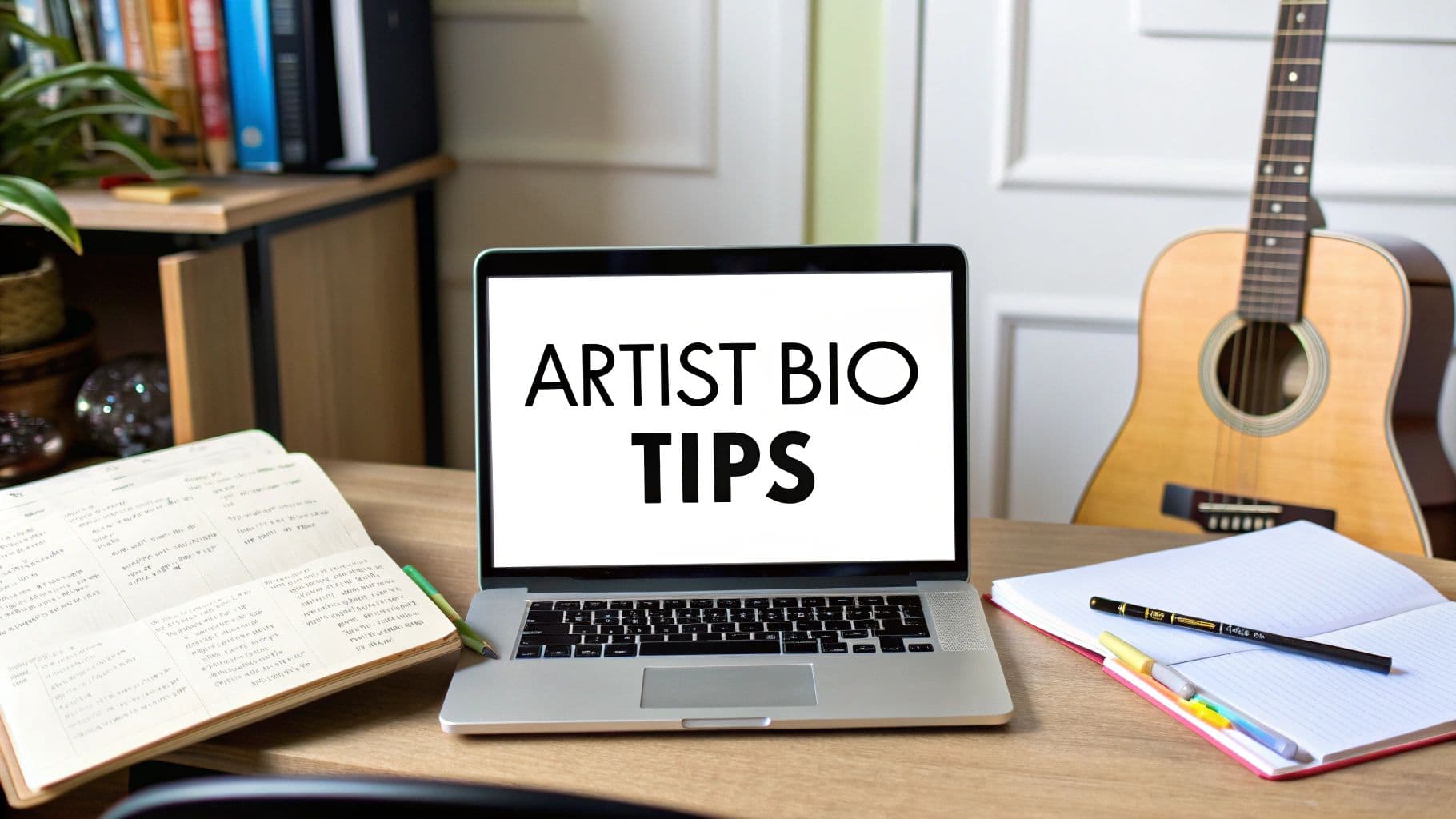
Buying & SellingKnowing how to write a killer artist bio is one of the most crucial, yet often overlooked, skills an artist needs. It’s more than just a summary of your career; it’s the professional story that introduces you to promoters, journalists, and potential fans.
Think of it as your narrative handshake—a concise, powerful tool designed to secure bookings, land press coverage, and forge genuine connections with new listeners. A great bio isn't just a list of facts; it's the story that sells your music before anyone even hits play.
Why Your Artist Bio Is Your Most Important Story

Let's be clear: your artist bio is a strategic asset, not just a paragraph for your "About" page. In a completely saturated creative world, it’s the story that pries open doors that talent alone can’t. It gives people the context they need to transform your art from just another track in a playlist into a meaningful experience.
A well-crafted bio works differently for different people. For a venue booker or a festival programmer, it’s a quick-glance tool that answers their most immediate questions: What’s their genre? What’s their track record? Will they be a good fit for my event?
For a journalist or blogger, your bio is the raw material for their next article. It hands them the unique angles and key details they need to tell your story to their audience.
Frame Your Narrative For Maximum Impact
When it comes to new fans, your bio acts as a bridge, connecting them to your music on a much deeper level. It’s their invitation to understand your "why"—the inspiration, the journey, and the vision behind the sounds they’re hearing. That connection is what turns a casual listener into a true fan. Getting this story right is a core part of your artist branding and image.
The music industry is a global game. With online art sales still a staggering 85% higher than pre-pandemic levels, having a strong digital presence anchored by a compelling bio is non-negotiable if you want to reach an international audience. Your story is what sets you apart.
Laying the Groundwork: Find Your Story's Ingredients
Before you even think about writing, you need to figure out what your story is actually about. This is where most artists get stuck, staring at a blank screen. The trick is to stop trying to write and start gathering your raw materials first. Think of it as creating a "story bank" you can draw from later.
This isn't just about listing your achievements. It's about digging into the core of who you are as an artist. What themes keep popping up in your music? What are those key moments—that one wild gig, a challenging collaboration that changed everything, a sudden flash of inspiration—that nudged you onto your current path?
What Are Your Core Story Elements?
To build a narrative that actually pulls people in, you need the specific details that make your journey real. Doing this prep work first means you'll have a rich collection of anecdotes, milestones, and quotes ready to go.
Before you start writing, pull together the key pieces of your story. I've found this checklist is a great way to make sure you have everything you need in one place.
Artist Bio Content Checklist
| Information Category | What to Include | Example |
|---|---|---|
| Origin Story | Where you're from and how that place shaped your sound. | "Grew up in the humid suburbs of Houston, where the slow, syrupy pace of life seeped into my downtempo electronic beats." |
| Defining Moments | The 2-3 biggest milestones that defined your career so far. | "Opening for The Lumineers at Red Rocks; my track 'City Lights' hitting 1 million streams on Spotify." |
| Artistic Influences | Who inspired you and how they influenced your sound or style. | "Inspired by the raw vocal delivery of Jeff Buckley and the atmospheric guitar work of The Edge." |
| Your "Why" | The core message or feeling you want your music to convey. | "To create a sonic space where listeners feel seen and can process complex emotions." |
| Key Achievements | Notable press mentions, awards, collaborations, or stats. | "Featured on Pitchfork's 'Best New Tracks'; won 'Best Indie Act' at the Local Music Awards." |
| Current Projects | What are you working on right now? An upcoming album, tour, or single? | "Currently in the studio finishing my sophomore LP, 'Northern Sky,' due out this fall." |
Having this information handy makes the writing process so much smoother. It's less about creating something from thin air and more about assembling the puzzle pieces of a story that's already there.
A great bio isn't just about what you've done; it's about why any of it matters. The magic happens when you connect your accomplishments to your artistic purpose—that’s what turns a boring resume into a story people remember.
Weaving Your Story: How to Write a Bio That Flows
Your bio is more than just a list of accomplishments; it's your story. The goal is to turn a collection of facts into a narrative that pulls people in from the first sentence. The secret lies in creating a natural flow that guides the reader through your journey as an artist.
Think of it like building a story arc. You need a strong opening that instantly captures your sound or artistic identity. From there, you can layer in your background and vision, weaving in key achievements not as standalone facts, but as crucial plot points that move your story forward.
This breakdown shows the core elements you need to build an engaging artist bio.
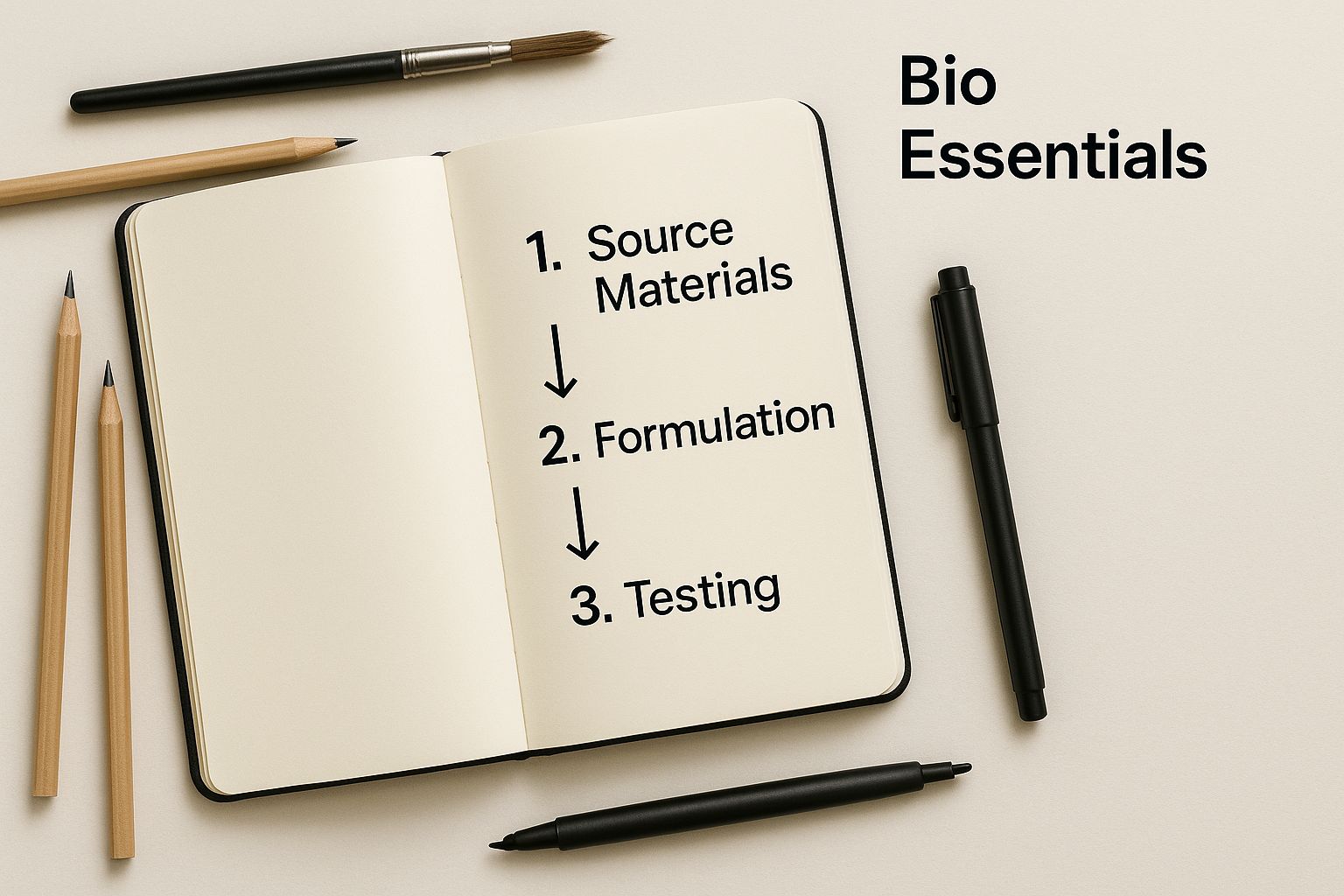
As you can see, a powerful bio is a blend of your unique story, your biggest wins, and your future plans, all wrapped up in a cohesive narrative. It’s about connecting the dots for your audience so they understand who you are and where you're headed.
Structuring Your Narrative
The best artist bios feel authentic and effortless. They move from one idea to the next without feeling clunky or forced. While you don’t need a rigid, paint-by-numbers formula, having a flexible framework can help you hit all the essential notes while keeping that story-like feel.
Here’s a simple flow to consider:
- The Hook: Start with a punchy opening line that grabs attention. Think of it as your one-sentence elevator pitch. For instance, "Fusing gritty blues-rock with modern electronic textures, Jane Doe creates a soundscape that is both timeless and immediate."
- The Context: Briefly touch on your background, what drives your art, and your biggest influences. This is where you establish your unique point of view.
- The Proof: This is where you naturally drop in your most impressive achievements. Did you open for a major act? Did a track go viral? Frame these as proof of your credibility and momentum.
- The Future: Always end by looking forward. Mentioning an upcoming album, a new tour, or a creative project shows that you are an active, evolving artist with more to come.
If you're looking for inspiration on how to tell a powerful story concisely, checking out examples of effective professional summaries can be surprisingly helpful. The core principles of creating an impactful narrative are the same, no matter the context.
A quick pro tip: The transitions between your sentences are just as important as the facts themselves. Use connecting phrases like, "This early exposure led to..." or "Building on that success, she then..." to guide the reader smoothly. A bio that flows is a bio that actually gets read.
Tailoring Your Bio for Every Platform
Your artist bio isn't a one-and-done document. The beautifully crafted, 500-word story on your website’s "About" page is perfect there, but it’s completely wrong for your Instagram profile or a tight-deadline festival application. You need a versatile toolkit of bios, each one shaped for a specific context, length, and audience.
Sticking with a single, static bio is a missed opportunity. Imagine a busy venue booker sifting through dozens of submissions—they need your key selling points in seconds. Contrast that with a new fan who just discovered your music; they might be ready to get lost in your full story. The key is to adapt your narrative to meet people where they are.
Distilling Your Story for Maximum Impact
This all boils down to creating different versions of your bio. The best way to start is by mapping out all the places your bio will live and figuring out what each one demands.
Here’s a practical breakdown of what you'll need:
- The Micro-Bio (1-2 sentences): This is for social media profiles like Instagram or Twitter. It's your elevator pitch, boiled down to its absolute essence—who you are and what your music sounds like. For instance: "Brooklyn-based songwriter crafting haunting indie-folk melodies inspired by Appalachian traditions."
- The Short Bio (80-150 words): Think of this as your go-to bio. It’s perfect for press releases, Spotify profiles, and most submission forms. It needs to be punchy, informative, and engaging right from the first sentence.
- The Long Bio (300+ words): Save this for your website's dedicated "About" page or your Electronic Press Kit (EPK). This is your space to really unpack your artistic journey, dive deep into your influences, and articulate your vision.
Interestingly, museum research has shown that visitor engagement plummets after about 150 words. This is a great reminder that keeping things concise is often the most powerful way to grab someone's initial attention. There are some valuable insights on Artsy.net that really drive this point home.
The goal isn't just to shorten your bio; it's to strategically reframe it. When applying for a grant, you should emphasize your artistic vision and community impact. For a festival submission, you’ll want to highlight your high-energy live shows and past festival appearances.
By taking a tailored approach, you ensure your bio always lands with the right impact. This is the same principle behind strong examples of online portfolios, where the presentation is just as important as the content. Get this right, and you'll be able to attract more fans to your music profiles no matter where they find you.
Making Your Bio Easy to Find Online

You can write the most compelling bio in the world, but it won’t do you any good if no one ever sees it. Writing the bio is just step one; making sure it shows up in search results is where the real work begins. This is all about simple, smart SEO.
The trick is to think like a fan or a booking agent. What terms would they use to find an artist like you? Weave these keywords naturally into your story.
Go beyond just your name. Think about including terms that paint a fuller picture for search engines and readers alike:
- Your sound: Are you "indie-folk," "experimental hip-hop," or "synth-pop"?
- Your roots: Maybe you're "a product of the Chicago house scene" or "based in Nashville."
- Your vibe: A simple phrase like "for fans of Bon Iver and The National" works wonders.
These aren't just descriptive words; they're signposts that help Google connect you with the right audience.
Connect Your Digital Footprint
Think of your bio as the central hub of your online world. It should be the place that connects all the dots for anyone who discovers you.
It's absolutely crucial to embed links to your most important platforms directly within the text. We're talking about your Spotify profile, official website, and the social media channels where you're most active. This makes it incredibly easy for a new fan to go from reading about you to listening to your music. It also shows search engines that all these profiles are part of one cohesive brand: yours.
Your bio isn't a static document sitting on a forgotten webpage. It's an active, living part of your online marketing strategy. Every keyword and link is a breadcrumb leading new listeners back to your music.
This kind of online visibility is a fundamental piece of the puzzle. For more strategies on building your presence, check out our guide on how to market your music as an independent artist.
Answering Your Lingering Artist Bio Questions
Even with a great template, you're bound to hit a few snags. It's totally normal to get stuck on the finer points when you're trying to get your story just right. Let's walk through some of the most common questions that pop up, so you can finish your bio with confidence.
Getting these details sorted out is what separates a good bio from a great one.
First Person or Third Person?
This is the big one, but the answer is pretty clear-cut. Your main, professional artist bio should almost always be in the third person. Think "Jane Doe is a songwriter..." instead of "I am a songwriter..." This is the industry standard for your website, your press kit, and pretty much any official use.
Why does it matter so much? A third-person bio comes across as more objective and professional. More importantly, it makes it incredibly easy for a journalist, blogger, or promoter to just copy and paste your info directly into their article or event listing. You're literally making their job easier.
Save the first-person perspective ("I," "me," "my") for more intimate, direct-to-fan communication, like a personal note on your blog or a heartfelt caption on Instagram.
For professional use, third person is non-negotiable. It signals that you get how the industry works and respects the time of the very people you're trying to impress.
How Often Should I Update My Bio?
Think of your bio as a living document, not a "set it and forget it" task. It should evolve as your career does. A good rule of thumb is to give it a quick review every six months or so, but you need to update it immediately after any major career milestone.
As soon as something new and exciting happens, your old bio is officially out of date. Jump in and refresh it when you:
- Drop a new single, EP, or album.
- Land a big gig, a support tour, or a festival slot.
- Win an award or get a significant nomination.
- Get a glowing review or a feature in a major publication or playlist.
Keeping your bio current shows everyone that you’re an active artist with momentum. It ensures that any industry contact who looks you up gets the latest, most impressive version of your story.
What Are the Biggest Mistakes to Avoid?
Honestly, the most common blunders come from trying a little too hard. We've all seen them. Avoid empty clichés like calling your music "genre-bending" or "one-of-a-kind." Don't tell people your sound is unique; use vivid, specific language to show them.
Another trap is writing a bio that's way too long or reads like a dry résumé. Your bio isn’t just a list of accomplishments; it's about weaving those achievements into a story that connects with the reader.
And the final, cardinal sin? Typos. Always proofread your bio. Then have someone else proofread it. A simple spelling or grammar mistake can instantly make you look unprofessional and careless.
At OohYeah, we know your story is just as powerful as your sound. Our platform is built to help you share your tracks and connect with fans through a narrative that’s all your own. Start building your artist-first presence and take control of your career today. Explore how OohYeah can support your journey at https://oohyeah.app.