How to Release Music Independently (A Practical Guide)
Learn how to release music independently with our practical guide. Get actionable advice on distribution, marketing, and collecting royalties.
September 18, 2025
Music Marketplace Advisor
Buying & SellingRelease Music Independently
So, you've poured your heart and soul into creating new music, and now you're ready to share it with the world. But what comes next? The old myth that you need a major label deal to succeed is just that—a myth. The entire music industry has been turned on its head, giving you, the independent artist, an unprecedented amount of power to build a career entirely on your own terms.
Putting your music out there is easier than ever, but making a real impact? That’s a different story. Cutting through the noise requires a solid, strategic plan.
Your Blueprint for a Successful Independent Release
Let's move past the theory and get into a real-world blueprint for releasing music as an independent artist. This isn't just about uploading a file; it’s about a deliberate process that covers everything from the final mix to connecting with listeners across the globe.
Think of your music career as your own business. It requires production, distribution, promotion, and monetization to thrive. When you handle these yourself, you gain complete creative and financial control.
The Modern Independent Artist's Toolkit
A successful release doesn’t happen by accident. It's the result of treating your project professionally from the very beginning. This means building your strategy around a few core components that all work in concert to give your music the launch it deserves.
Your game plan should be built on these essential pillars:
- Professional Polish: Your music has to sound incredible. This means investing in proper mixing and mastering. Pair it with high-quality artwork that looks just as good as it sounds.
- Strategic Distribution: You need a partner to get your music onto all the major streaming services. Choosing the right one, like OohYeah!, ensures your tracks are delivered efficiently and correctly.
- Pre-Launch Hype: Don't wait until release day to start talking about your music. Build anticipation with a smart marketing campaign on social media, through your email list, and anywhere else your fans hang out.
- Release Day Impact: Launch day should be a coordinated event. Plan your posts and announcements to drive as many streams, shares, and as much engagement as possible right out of the gate.
The independent route isn't the "alternative" anymore. For many artists, it's the preferred path. It gives you 100% ownership, a direct connection with your audience, and the freedom to move quickly in a fast-paced industry.
Why Independence Is a Viable Career Path
The financial potential for artists going it alone is growing at a staggering rate. With the old gatekeepers out of the picture, revenue flows much more directly to the creators who manage their own work. This shift is what's making it possible for so many artists to build sustainable careers.
Look at the numbers. Globally, Spotify paid out over $5 billion in royalties to independent artists and labels in a single year. That’s a $500 million jump from the year before. This isn't a fluke; it reflects the massive financial power of independent music today. You can find more insights about the indie label market and its recent growth to see just how big this movement has become.
This whole process is about more than just getting your songs online. It’s about building a real, sustainable business around your art. With the right tools and a solid plan, you can take the driver's seat of your music career and thrive.
To help you keep everything straight, here’s a quick-glance checklist of the entire release process.
Independent Music Release Checklist
| Stage | Key Action | Objective |
|---|---|---|
| Production | Finalize mixing, mastering, and artwork. | Create a professional, release-ready product. |
| Metadata | Compile all song credits, ISRCs, and track info. | Ensure accurate tracking, attribution, and royalty payments. |
| Distribution | Choose a distributor and upload your release. | Get your music onto all major streaming platforms. |
| Pre-Release | Plan and execute your marketing campaign. | Build hype and audience anticipation before launch. |
| Release Day | Promote heavily across all channels. | Drive initial streams, saves, and playlist adds. |
| Post-Release | Analyze data, engage fans, and plan next steps. | Maintain momentum and build a long-term career. |
Following these stages will give your music the best possible chance to find its audience and make a lasting impression.
Preparing Your Music for a Professional Release
Before your music ever reaches a fan’s ears, there’s a critical stage of prep work that separates the amateurs from the pros. It’s not just about writing a great song—it’s about packaging it to compete on a global stage. This is where the real work of releasing music independently begins.
Think of your final recording as an uncut diamond. It’s got all the raw potential, but it needs a final polish to truly sparkle. That polish comes from two essential, non-negotiable processes: mixing and mastering.
Mastering the Art of Mixing and Mastering
Let's clear up some confusion right away. Mixing and mastering are two very different things.
Mixing is all about balancing the individual elements of your song. It’s the art of taking the vocals, guitars, drums, and synths and making them sit perfectly together in one cohesive stereo file. A great mix creates clarity, space, and punch, ensuring every part of your arrangement can be heard.
Mastering, on the other hand, is the final coat of varnish. A mastering engineer takes that final mix and makes subtle tweaks to the overall loudness, EQ, and stereo width. The goal? To make your track sound incredible and consistent on any system, from cheap earbuds to a massive club PA.
Without a professional master, your song might sound weak or quiet next to other tracks on a Spotify playlist. Platforms use loudness normalization, and a properly mastered track holds its own, preserving the dynamics you worked so hard to create.
Why Metadata Is Your Music's Digital DNA
Once your audio is sounding perfect, it's time for the "paperwork." Your metadata is all the information attached to your music file, and it’s the absolute bedrock of getting paid and credited correctly. Seriously, getting this wrong is a surefire way to lose royalties.
Here's the essential data you need to lock down before you upload anything:
- Song Title and Artist Name: This seems simple, but be ruthlessly consistent. Make sure it matches your artwork and everything else, character for character.
- Writers and Publishers: List every single person who had a hand in the composition and lyrics. If you work with a publisher, their info goes here too.
- ISRC Codes: Think of the International Standard Recording Code as a unique fingerprint for your recording. It’s how every single play is tracked. Your distributor can usually assign these for you.
- UPC/EAN: This is the Universal Product Code, basically the barcode for the entire release (whether it's a single, an EP, or a full album). Again, your distributor will handle this.
Think of metadata as the address label on a package. If it's wrong or incomplete, your royalties will get lost in the mail. Spending 30 minutes double-checking this stuff can save you months of headaches trying to track down missing money.
This data is precisely what tells streaming services who to pay and what to display on the screen. Platforms like OohYeah! are built to simplify this, giving you a clear dashboard to manage your catalog and ensure every detail is locked in before your music goes live.
Designing Artwork That Stops the Scroll
In an endless feed of content, your cover art is your first and sometimes only chance to grab someone's attention. It has to be compelling enough to make someone stop scrolling and hit play.
But before you get creative, you have to get technical. Streaming platforms are incredibly strict about artwork specs, and a simple mistake can get your entire release delayed.
Artwork Technical Checklist
| Requirement | Specification | Why It Matters |
|---|---|---|
| Resolution | At least 3000 x 3000 pixels | Guarantees your art looks crisp on everything from phones to 4K TVs. |
| Format | JPG or PNG | These are the universal standards that every platform accepts. |
| Color Mode | RGB | This is the required color profile for all digital screens. |
| Content | No URLs, social media handles, or pricing info | The platforms want clean, timeless artwork free of promotional text. |
Beyond the specs, your artwork needs to be a visual echo of your music. It should capture the vibe of your release and be iconic enough to stand out as a tiny thumbnail. Great cover art doesn't just represent the song; it elevates the entire experience and is a cornerstone of your artist brand.
Choosing Your Digital Distribution Partner
Your music is polished, the metadata is perfect, and you're ready to go. The next move is arguably one of the most important you'll make: picking the partner who will get your tracks out into the world. A digital distributor is the essential link between your finished song and listeners on Spotify, Apple Music, and dozens of other platforms. Getting this right is a cornerstone of any successful independent release.
This isn't just about uploading a file. You're essentially hiring a key business partner. Different distributors have wildly different ways of operating, especially when it comes to how they (and you) get paid.
Understanding Distributor Business Models
You'll generally run into two main setups: a flat annual fee or a commission-based model. Neither is universally "better"—the right fit really depends on how you plan to release music and what your budget looks like.
The Annual Fee Model: Think of it like a subscription. You pay one flat fee each year for the ability to upload as much music as you want. With this model, you typically keep 100% of your royalties. This is a fantastic deal for prolific artists—if you’re planning on dropping multiple singles, an EP, and an album in a single year, your cost stays the same.
The Commission-Based Model: Here, the distributor takes a percentage of the royalties you earn. The upfront cost is often lower (or even free), which can be appealing if you only release a track or two a year. The catch? If a song really takes off, that commission can eat into a significant chunk of your earnings over time.
Look at your release calendar for the next year. Is it packed, or are you focused on one major project? Your answer will almost always point you to the most sensible financial model. It's interesting to see parallels in other creative industries; understanding how book distribution services operate, for instance, can shed light on the logistics of getting a product to a wide audience.
Your distributor is more than just a delivery service; they are your financial partner. Scrutinize their fee structure, payout methods, and reporting tools. A partner that offers clear, transparent analytics will empower you to make smarter business decisions as you grow.
The right distributor and a smart marketing plan work hand-in-hand to make your release a success, as you can see below.
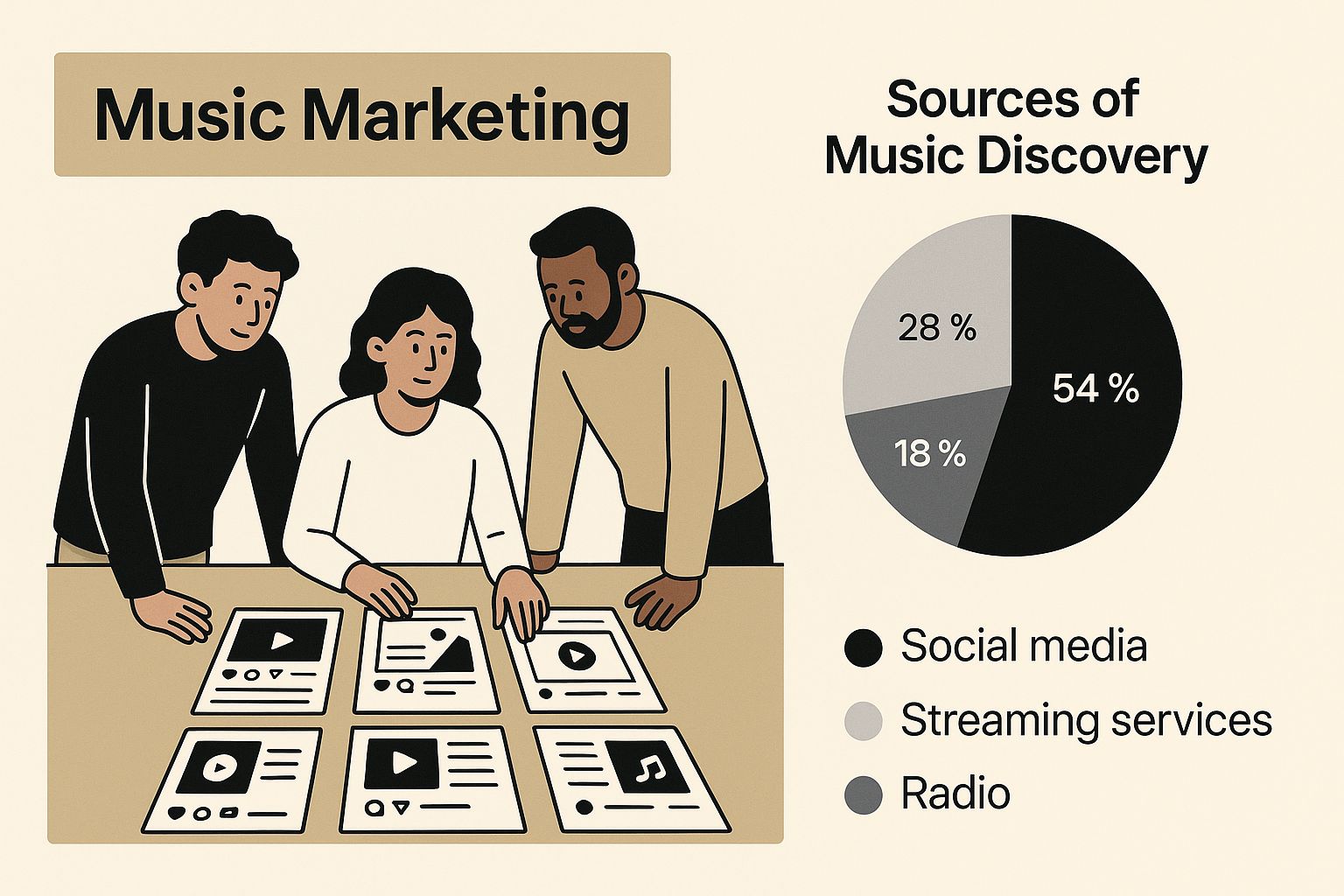
This just goes to show how a solid launch strategy relies on multiple moving parts—from social media to content—all supported by your distribution partner.
Evaluating Features Beyond The Fees
Cost is a huge piece of the puzzle, but the best distributors offer value that goes way beyond a simple price tag. These are the features that can truly move the needle for your release campaign and your career as a whole.
First, check their delivery speed. How quickly can they get your music live on all the platforms? Some can do it in a couple of days, while others might take a few weeks. If your promotion is built around a specific release date, you need a partner who can hit that deadline without fail.
Also, dig into what other artists say about their customer support. Because eventually, something will go wrong. When it does, you want a real human who can help, not a bot sending you links to a FAQ page.
Finally, look at the extra tools they offer. Modern distributors are becoming all-in-one platforms for artists.
Comparing Top Music Distribution Services
To help you weigh your options, we've put together a quick comparison of some popular services. This isn't an exhaustive list, but it highlights the different approaches distributors take, giving you a framework for your own research.
| Distributor | Pricing Model | Key Features | Best For |
|---|---|---|---|
| OohYeah! | Commission-based with artist-friendly splits | Integrated marketing tools, playlist pitching, detailed analytics, royalty splitting | Artists seeking an all-in-one platform to manage and market their music. |
| DistroKid | Annual subscription | Unlimited uploads, 100% royalties, fast delivery, automatic royalty splits | Prolific artists who release music very frequently. |
| TuneCore | Per-release fee or annual plan, plus commission | Comprehensive global distribution network, publishing administration add-on | Artists who want robust publishing support alongside distribution. |
| CD Baby | One-time fee per release | Physical distribution (CD/vinyl), sync licensing, robust metadata tools | Artists who also want to sell physical copies of their music. |
Each service has its strengths. The key is to find the one whose model and toolset align perfectly with your specific goals as an artist.
With streaming now accounting for over 85% of all recorded music revenue, your choice of distributor is more critical than ever. It's not just about getting on Spotify; it's about having the right partner to help you navigate it.
Platforms like OohYeah! are built from the ground up to solve this, combining distribution with a whole suite of tools an independent artist needs. For an even deeper dive, check out our complete guide on how to choose the right music distribution service.
Crafting Your Pre-Release Marketing Strategy
A great release doesn't just happen—it's built. The real work, the kind that separates a track that truly connects from one that just gets lost in the noise, happens weeks and even months before anyone clicks "play." This pre-release window is your time to build a genuine groundswell of excitement and make sure there’s an audience waiting the moment your music drops.
The whole point is to turn your release from a simple upload into a can't-miss event. To pull that off, you need a solid timeline, a smart content plan, and a good grasp of which platforms will get your music in front of the right ears. This is where you start building unstoppable momentum.
Mapping Out Your Release Timeline
Think of your release timeline as the blueprint for your entire campaign. It’s so much more than just circling a date on the calendar; it's about working backward from that date to schedule every single promotional beat. A well-planned timeline means no last-minute scrambling and ensures every announcement you make hits with maximum impact.
For a single, a four-to-six-week timeline is a fantastic sweet spot. It gives you just enough runway to build real anticipation without letting the hype die down before the big day.
Here’s what that might look like in the real world:
- 4 Weeks Out: Time for the big reveal! Announce the release date and share your cover art. This is the official starting gun for your campaign.
- 3 Weeks Out: Launch your pre-save campaign and drop a short, tantalizing audio snippet. Give your fans their first taste of what's coming and get them to commit.
- 2 Weeks Out: Pull back the curtain. This is the perfect time for behind-the-scenes content—maybe some photos from the studio session, a quick video explaining what the song means to you, or even a live Q&A session.
- 1 Week Out: Go all in. Start posting daily reminders, share any cool fan-made content that pops up, and really drive home that sense of an imminent, exciting event.
Don't ever treat your release date as the finish line. It's the peak of a carefully constructed crescendo. Every single post, story, and email you send in the weeks leading up to it is another note building toward that final, powerful chord.
This kind of structured approach creates a narrative around your release, making your audience feel like they're a part of the journey. It’s a foundational piece of releasing music independently with truly professional results.
Using Social Media to Build Hype
In today's music scene, platforms like TikTok and Instagram aren't just places to post updates; they are powerful discovery engines. Every piece of content you create before your release should be designed to feed these engines and get people talking.
The trick is to make content that feels like it belongs on each platform. For TikTok, that means short, punchy videos that use a killer snippet of your song. Could you create a simple challenge? A relatable meme? Or a video that tells a powerful story in less than 15 seconds?
Over on Instagram, you've got a bit more room to play. Keep your audience hooked by mixing up the formats:
- Reels: Perfect for performance clips, slick lyric animations, or teasers that feature your track's audio.
- Stories: Get interactive. Use polls, countdown stickers, and question boxes to chat directly with your fans.
- Feed Posts: This is for your high-quality stuff—professional photos, carousels that detail the song's backstory, and all of your official announcements.
Your mission is simple: stop the scroll. You're fighting for attention, so your content absolutely has to be visually interesting and emotionally resonant. For a much deeper dive into building out your promotional machine, our guide on how to market your music as an independent artist lays out a whole range of strategies.
Getting on Playlists The Right Way
Landing on a major official playlist can be a total game-changer, putting your music in front of tens of thousands of potential new fans overnight. But getting on the radar of curators at places like Spotify and Apple Music isn't about luck; it’s about a professional and timely approach.
Here’s the critical part: you absolutely cannot submit your music for playlisting after it's been released. You have to pitch your track for editorial consideration at least one to two weeks before your release date through their own artist portals.
- Spotify for Artists: This is your direct line. The platform lets you submit one unreleased track at a time straight to Spotify's editorial team.
- Apple Music for Artists: While it's not a direct submission tool like Spotify's, keeping your profile updated and looking sharp is essential for being noticed by their curators.
When you're filling out your pitch on Spotify for Artists, be specific and sell your story. Don't just list a few genres; talk about what makes the song special. What instruments did you use? What's the mood? Who does it sound like? The more context you give an editor, the easier you make it for them to see exactly where your track fits.
Remember, thousands of songs are flooding their inboxes every single day. A thoughtful, well-written pitch that really shines a light on what makes your track unique can be the one thing that helps you cut through all that noise. It's one of the most powerful moves you can make to set your release up for success.
Making a Splash on Release Day (and Keeping the Waves Going)
The big day is finally here. You’ve put in the work, and your track is ready. But hitting "publish" isn't the finish line—it's the starting gun. All that pre-release hustle was about building tension, and now it’s time to unleash it in a way that makes everyone take notice. Release day is all about creating a concentrated blast of activity that tells listeners, and more importantly, the algorithms, that your music has arrived.
That initial push is your first move, but the real game is keeping that track alive and kicking long after its debut. Learning how to release music on your own terms means mastering both the sprint of launch day and the marathon that follows. Let's get into the nitty-gritty of what that actually looks like.
Your Release Day Game Plan
When your track goes live, your one and only goal is to drive as much focused engagement as you possibly can. We're talking streams, saves, shares, and comments—all of it. A sudden flurry of activity signals to platforms like Spotify that people are genuinely interested, which dramatically boosts your chances of landing on crucial algorithmic playlists like Release Radar and Discover Weekly.
You need to have this plan locked and loaded, ready to execute the second your music is out there.
- Update Your Digital Storefront: First things first. Your social media bios, any link-in-bio services you use, and your website all need to point directly to your new release. Make it dead simple for anyone who's even slightly curious to find and play your song.
- Make the Announcement: It’s time to shout it from the rooftops. Post a coordinated announcement across every social channel you're on. Use your best stuff here—that killer video clip, your amazing cover art, or a heartfelt personal message to hook people in.
- Get in the Trenches: This is non-negotiable and, honestly, the most important part. As the shares, comments, and DMs start rolling in, you need to respond to every single one. Thank people by name. This simple act of direct connection is what turns a casual listener into a true fan who feels like they're part of your journey.
Release day isn’t a time to sit back and watch the numbers. It’s an all-hands-on-deck, active day of community building. The way you personally engage with that first wave of listeners sets the whole tone and shows them their support actually matters to you.
How to Keep the Momentum Going
The first week is huge, no doubt. But a truly successful independent release keeps the energy high for weeks, even months. Once that initial buzz starts to fade, your strategy has to pivot from a launch "event" to a sustained campaign. This is where you continue to feed the algorithms and give your audience new reasons to keep listening and sharing.
Your job now is to stop your track from becoming yesterday's news. The best way to do this is by consistently rolling out fresh, related content that keeps the conversation alive.
- Lyric Videos: A slick, well-made lyric video isn't just filler content. It gives fans a new way to connect with your song's message and is prime material for sharing on YouTube.
- Performance Clips: Got an acoustic guitar? Record a stripped-down version. Can you get a live take with your band? Film it. These clips show off your raw talent and give people a different perspective on the music.
- Remixes and Alternate Versions: Teaming up with another producer or artist for a remix is a classic move for a reason. It can expose your music to a completely different circle of fans overnight.
This steady drip of new content keeps your track popping up on people's feeds and continues to pull in new listeners long after the launch-day fireworks have faded.
Using Data to Steer the Ship
After your music has been out for a week or two, you'll start getting a flood of data from tools like Spotify for Artists and Apple Music for Artists. This isn't just for stroking your ego; this is actionable intelligence. It's your roadmap to understanding who is listening and where they're coming from.
Zero in on these key data points:
- Listener Demographics: Where in the world are your fans? What are their age ranges? This is pure gold for targeting future social media ads or even planning a tour down the line.
- Playlist Adds: Pay close attention to which playlists are bringing in the streams, whether they're big editorial ones or smaller ones made by fans. This tells you exactly where your sound is hitting the mark, and you can start reaching out to similar curators.
- Source of Streams: Are people finding you directly from your profile, through playlists, or are they saving your track to their personal library? This shows you how people are interacting with your music.
By checking in on these analytics regularly, you stop guessing and start making informed decisions. See a hotspot of listeners in a city you've never heard of? Maybe run a targeted ad campaign there. Is one user's playlist driving a ton of traffic? Find them and say thanks—you might have just found a superfan who can help you with your next release, too. This data-driven mindset is what turns a one-time release into a long-term plan for growth.
Understanding and Collecting Your Music Royalties
You’ve poured everything into creating your music. It's a massive achievement, but if you want to turn your art into a career, you need to get comfortable with the business side of things. I'm talking about royalties—it might sound complicated, but it's just the system that makes sure you get paid when your music gets played.
Think of it like this: every single time someone streams your song, buys it, or hears it playing in a coffee shop, money is generated. Your job is to make sure you’re set up to collect your share. This doesn't happen automatically; you have to actively register your work with the right groups.
The Two Main Royalty Streams
For an independent artist, your income is going to flow from two different places. Understanding the difference is crucial for making sure you're not leaving any money behind.
Mechanical Royalties: These get paid out whenever your music is reproduced. In today's landscape, that mostly means streams on platforms like Spotify and Apple Music, but it also covers old-school formats like vinyl and CDs. Your distributor usually handles collecting and paying these out to you.
Performance Royalties: This is the money you earn when your song is performed publicly. That includes a surprisingly broad range of uses—radio play, background music in a restaurant or gym, or even when a cover band plays your song live.
To get your hands on performance royalties, you have to join a Performance Rights Organization (PRO). In the U.S., the big ones are ASCAP, BMI, and SESAC. Signing up with one of them is non-negotiable. Without it, you’re essentially letting that money vanish into thin air.
Once you register your songs with your PRO, they become your advocate. They track down where your music is being used and collect the money owed to you. It's the single most important step you can take to get paid for radio plays and other public performances.
The Role of Publishing Administration
As your career grows, your music will hopefully travel far beyond your local scene. A publishing administrator is like a global partner, chasing down royalties in territories your local PRO might not have a strong presence in. They also pitch your music for sync licensing opportunities—getting your tracks placed in films, TV shows, and commercials.
If you're curious about that side of the business, our guide on understanding music licensing can boost your revenue is a great place to start.
This isn’t some small corner of the industry, either. It’s booming. The independent music publishing sector recently hit a global value of €2.57 billion, which is a 5.7% jump from the previous year. In fact, indie publishers are now the biggest single slice of the global music publishing pie.
You can explore more data on the independent publishing market to see just how much growth is happening. Taking control of your royalties isn't just about getting a paycheck; it's about building a real, sustainable business around your music.
Got Questions About Indie Releases? We've Got Answers.
Putting out your first independent release can feel like navigating a maze. It’s totally normal to have a ton of questions. Let’s clear up a few of the most common ones so you can move forward and get your music out there with confidence.
Can I Really Release Music for Free?
Absolutely. Plenty of distributors have free tiers that let you upload your music without paying a dime upfront. The catch? They'll usually take a slice of your royalties.
This model can be a fantastic way to get started, but you need to think long-term. If you plan on releasing a steady stream of music, that commission can add up quickly. It's smart to do the math and compare the potential royalty cut against paying a flat annual fee—what seems cheap now might cost you more down the road.
How Long Until My Music Is Actually Live?
This is a big one, and it varies. A good rule of thumb is to plan for a two to four-week window from submission to go-live.
You have to submit your music well ahead of your release date. This isn't just about giving the distributor time to process everything. That buffer is critical for getting your track into the hands of editorial playlist curators on platforms like Spotify. Rushing this is one of the most common and costly mistakes I see artists make.
Successful independent artists don't just upload their music; they launch it. Treat your release with the same strategic planning as a business launch. That means planning your timeline, understanding the money side of things, and giving your art the professional rollout it truly deserves. This kind of foresight is what turns a passion project into a sustainable career.