How Much Money Do Artists Make? Find Out the Truth
Wonder how much money do artists make? Discover income insights, profession breakdowns, and tips to boost your earnings. Learn more now!

October 15, 2025
Music Marketplace Advisor
Buying & SellingAsking "how much money do artists make?" is a bit like asking how much a business owner makes. There's no single, straightforward answer. The financial reality for a creative professional is a world away from a predictable monthly salary, with incomes spanning from literally zero to millions of dollars. This shatters the old "starving artist" cliché, replacing it with a more modern, entrepreneurial truth.
For most successful artists today, financial stability isn't about landing one big paycheck. It's about skillfully weaving together multiple streams of income.
The Financial Spectrum of a Creative Career
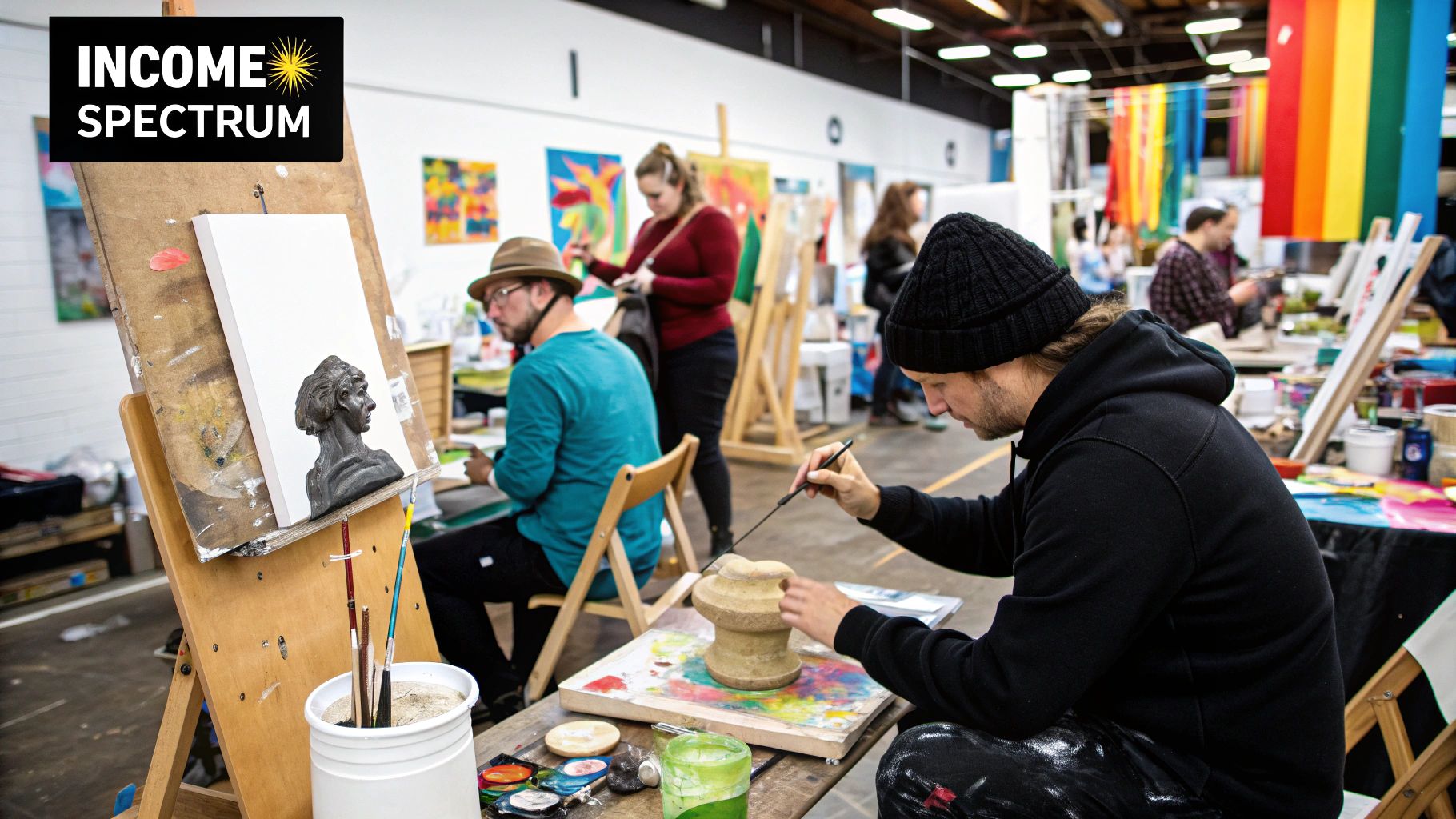
The first thing to understand is that an artist's income rarely resembles a traditional salary. A better way to think about it is to see the modern artist as a small business owner—an entrepreneur. Their earnings aren't drawn from a single source but are patched together from different channels, each with its own rhythm and potential.
The final number is a direct result of their artistic skill, of course, but also their business sense, the current market demand, and how well they've built their personal brand.
The income gap in the art world is massive. Research paints a stark picture of these economic realities, showing that about 85% of artists earn less than $25,000 annually from their creative work alone. Even more sobering, nearly half (45%) report making no money at all from art sales.
At the other end of the spectrum, an exclusive 1% of artists manage to break the $1 million income barrier, placing them in a truly elite tier. If you want to dive deeper into the numbers, this detailed video analysis of the art market is a great resource.
This enormous range means that while some artists are just trying to cover the cost of their paint and canvases, others are commanding premium prices and achieving incredible financial success.
Understanding the Income Tiers
To make sense of this wide financial spectrum, it's helpful to think about artist earnings in a few general tiers. This isn't a set-in-stone career ladder, but it gives you a good sense of the financial journey an artist might take.
To illustrate, here’s a quick breakdown of what these income levels can look like.
Artist Income Tiers At a Glance
| Artist Tier | Annual Art Income Range | Percentage of Artists (Approx.) |
|---|---|---|
| Emerging or Hobbyist | $0 – $5,000 | The vast majority, including the 45% with no sales |
| Mid-Career | $5,000 – $50,000 | A smaller, dedicated group with consistent sales |
| Established Professional | $50,000 – $250,000+ | A minority of full-time, successful artists |
| Top-Tier / "Blue-Chip" | $500,000 – Millions | The top 1%, globally recognized names |
As you can see, the path is steep, with most artists starting at the bottom and a select few reaching the top.
Here’s a closer look at what defines each stage:
- Emerging or Hobbyist Artist: This group is usually just starting out or creating art part-time. Any income from their work is often sporadic and might not even cover their expenses. Most rely on a day job to pay the bills.
- Mid-Career Artist: By this point, an artist has built a reputation and has a more consistent record of sales. They might have representation at a gallery, a steady flow of commissions, and have started to diversify with things like selling prints, teaching workshops, or licensing their work.
- Established Professional Artist: Art has become a full-time, sustainable career. These individuals have a strong brand, a loyal base of collectors, and several robust income streams that provide financial security.
- Top-Tier or Blue-Chip Artist: This is the pinnacle of the art market. These are the household names whose works sell for staggering prices at major auction houses and international galleries.
The journey from an emerging artist to an established professional is about so much more than just honing your craft. It’s fundamentally about building a solid business model around your talent—one that can ride out market trends and create lasting financial stability.
Building Your Primary Income Streams
A financially resilient art career is rarely built on a single pillar. The most successful artists I know think like savvy entrepreneurs, carefully building a portfolio of different revenue streams that all work together. When you ask how much money artists make, the real answer is found by looking beyond one-off sales and exploring this complete ecosystem of income opportunities.
Think of your art as the core asset. From there, you can spin off multiple ways to monetize it. Some of these methods will bring in active income that requires your direct effort, while others can start generating passive revenue over time. This layered approach not only boosts your earning potential but also creates a vital financial buffer against the art market's unpredictable ups and downs.
This diagram breaks down the main categories of income artists can develop, separating active work, passive streams, and grant-based funding.
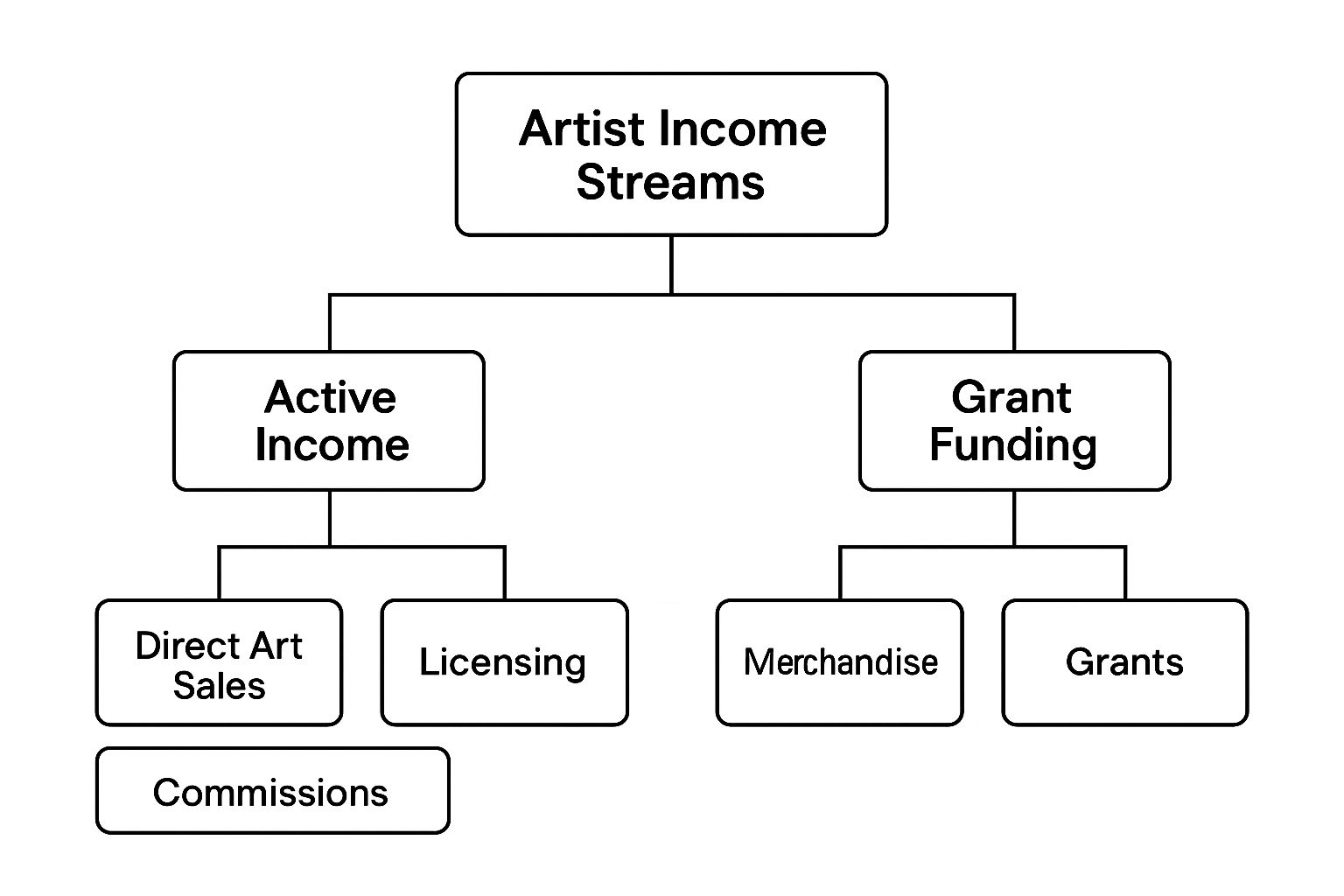
As you can see, a sustainable career often balances direct sales with more scalable options like merchandise and strategic support like grants. Let's dig into what each of these really looks like in practice.
Direct Art Sales: Galleries and Commissions
This is the most traditional path and still the cornerstone of many visual artists' careers: selling original artworks directly to collectors, either on your own or through a gallery.
- Gallery Representation: Getting into a gallery gives your work a stamp of approval and opens doors to an established network of collectors. The trade-off is the commission, which is almost always a 50/50 split. While giving up half the sale price sounds steep, the gallery handles the marketing, logistics, and sales legwork, freeing you up to do what you do best—create.
- Commissions: These are custom pieces you create for a specific client. Commissions are fantastic because they offer guaranteed income before you even start the work, but they demand excellent client communication skills and the ability to merge someone else's vision with your unique style.
Of course, to attract either galleries or commission clients, you need a killer portfolio. It’s worth studying some stellar digital art portfolio examples to get a feel for how to present your work in its best light.
Reproductions and Merchandise
Let's be real: not everyone can drop thousands on an original painting, but many of your fans would still love to own a piece of your art. This is where reproductions and merchandise come in, creating an accessible entry point for your audience and a highly scalable income stream for you.
You create the artwork once, but you can sell it hundreds—or even thousands—of times in different formats. This is how you begin to decouple your time from your income.
Common and effective merchandise options include:
- Fine Art Prints: These are high-quality reproductions of your original work. You can sell them as limited editions to create scarcity and increase their value.
- Posters and Postcards: A much more affordable option that lets a wider audience buy and share your art.
- Apparel and Accessories: Think t-shirts, tote bags, and phone cases. With print-on-demand services, you can offer these without ever having to hold inventory.
- Stationery: Notebooks, calendars, and greeting cards featuring your art are consistently popular items.
Licensing Your Work
Licensing is basically renting your artwork out for a specific commercial use. A company pays you a fee or an ongoing royalty to feature your image on their products or in their advertising. It’s an incredibly powerful way to generate passive income because a single piece of art can earn money for you over and over without any additional creative work on your part.
For instance, a home decor brand might license one of your abstract paintings to use on a line of throw pillows. Or a book publisher might license an illustration for a novel's cover. The possibilities are endless, from textiles and wallpaper to puzzles and tech accessories.
Key Insight: Licensing lets your art reach audiences far beyond the traditional gallery space. Each licensing deal acts like a small, income-generating employee working for you around the clock.
Teaching and Workshops
Don't forget that your skills and knowledge are valuable assets in their own right. Sharing your expertise through teaching can provide a remarkably steady income stream while also building your reputation as an authority in your niche.
Many artists find that teaching is a fulfilling way to supplement sales. You could:
- Lead in-person workshops at a local art center or right from your own studio.
- Create online courses or tutorials that students can access from anywhere in the world.
- Offer one-on-one mentorship or coaching for aspiring artists who need direct guidance.
This revenue channel is often more stable than sales because it's based on your knowledge, not the fluctuating demand for physical art. It’s a strategy used across creative fields; for a different perspective, check out our guide on https://oohyeah.app/posts/how-doindependent-artists-make-money-from-music.
Securing Grants and Residencies
Finally, grants and residencies offer a totally different kind of financial support. They aren't sales—they're opportunities that provide the funding, time, and resources you need to focus on your work without immediate financial pressure.
Grants are cash awards from foundations, governments, or nonprofits to support a specific project or your overall artistic practice. Residencies often provide you with studio space, housing, and a stipend, giving you a dedicated block of time in a new environment to create. These opportunities are competitive, but landing one adds serious prestige and much-needed stability to your career.
How Different Art Professions Compare in Earnings

The term "artist" covers an incredible range of creative careers, and it's a mistake to think they all operate the same way financially. The economic reality for a sculptor selling massive installations is worlds apart from a freelance graphic designer billing hourly for a corporate logo. They're both artists, but their business models couldn't be more different.
To figure out how to build a sustainable career, you have to understand these distinctions. Some fields offer the stability of consistent project work, while others dangle the potential for huge, but unpredictable, paydays. Let's break down the income potential and common business models across a few major art professions.
Visual Artists: Painters and Sculptors
When you picture a "traditional" artist, you're probably thinking of a painter or a sculptor. This path often follows the most classic—and volatile—income model, where earnings are tied directly to selling original, one-of-a-kind artworks. It's a world of high highs and low lows, with massive sales followed by long, dry spells.
An artist’s reputation, gallery representation, and collector network are everything here. An emerging painter might sell their first few pieces for a few hundred dollars, while a mid-career artist could command $5,000 to $20,000 for a single work. At the very top, established "blue-chip" artists see their creations sell for millions.
The real challenge for visual artists is managing cash flow. A single big sale might have to cover your life and studio expenses for six months or more, which requires serious financial discipline and a constant hustle to build your collector base.
Illustrators and Graphic Designers
On the other end of the spectrum, illustrators and graphic designers usually have a much more stable, service-based income. They are commercial artists, creating work for clients in advertising, publishing, tech, and countless other industries. This creates a predictable revenue stream built on retainers, hourly rates, or per-project fees.
A freelance designer's income varies wildly with experience and specialty. Someone just starting out might charge $25-$50 per hour, but a seasoned designer with a killer portfolio can easily bill $100-$300 per hour or more. For those who prefer the stability of a full-time role, the median annual salary for a graphic designer hovers around $58,000.
This career path offers a much clearer road to a steady, middle-class income. You trade the long-shot potential of a massive gallery sale for the comfort of consistent, reliable work.
Musicians and Performing Artists
The music industry is a whole different beast, with a complex mix of royalties, live performance fees, merch sales, and streaming revenue. For decades, touring was the bread and butter for most musicians. While still important, the digital age has completely reshaped how money is made.
Streaming platforms like Spotify are now a major source of income, though not without controversy. The numbers reveal a huge disparity in earnings. Recent data shows that over 103,400 artists earned at least $5,000 from the platform, while about 20,500 artists pulled in $50,000 or more. But the real money is at the top—a tiny group of around 170 artists surpassed $5 million in streaming revenue alone. You can dig into a realistic breakdown of these 2025 streaming numbers to see the full picture.
What this creates is a "superstar" economy. A tiny fraction of musicians captures the vast majority of the earnings, leaving most artists to patch together a living from merchandise, small gigs, and teaching.
Photographers
Photographers also have a wide variety of ways to make a living, and their income models can look completely different from one another depending on their specialty.
- Commercial Photographers: These are often the highest earners, shooting for big brands and ad campaigns. Their day rates can range anywhere from $1,500 to over $10,000.
- Wedding and Portrait Photographers: This is a very popular route for building a sustainable small business. A good wedding photographer can charge several thousand dollars for a single event.
- Photojournalists and Fine Art Photographers: Their income is often more piecemeal, relying on a mix of freelance assignments, selling prints, and licensing images through stock photography sites.
In the end, every artistic path has its own financial blueprint. A graphic designer's success hinges on client management, while a musician’s income is tied to audience growth. Understanding these fundamental differences is the first step toward choosing a path that aligns not just with your creative talent, but with the life you want to build.
The Art Market's Impact on Your Paycheck
Talent gets you in the door, but what really determines your paycheck as an artist is a force much bigger than your studio: the art market. It’s best to think of this market as its own complex ecosystem, one where powerful players—galleries, auction houses, influential collectors, and major art fairs—act as both gatekeepers and tastemakers.
Understanding how they operate is crucial. These institutions don’t just sell art; they actively build an artist's value over time. Landing representation with a reputable gallery, for instance, is about so much more than just a place to hang your work. It's a powerful endorsement, signaling to collectors and critics that you're a serious artist worth investing in.
This kind of validation is a launchpad. It opens doors to prestigious collections, museum shows, and media attention that are incredibly difficult, if not impossible, to get on your own. A top-tier gallery isn’t just selling a painting; they are carefully crafting your career narrative.
How an Artist's Value Is Built
Think of your career in the art market like a company’s stock. As an emerging artist, you're like a penny stock—tons of potential, but highly speculative with no real track record. When a respected gallery "invests" by offering you a show, it’s like a major firm initiating coverage. Suddenly, your stock starts to rise.
From there, success tends to snowball. A sold-out gallery show piques the interest of more established collectors. A museum acquiring one of your pieces sets a new, higher price floor for your entire body of work. And a record-breaking sale at a major auction house like Sotheby's or Christie's can send your "stock price" into the stratosphere overnight.
Each of these milestones adds to your work’s provenance—the documented history of ownership. A strong, clear provenance dramatically boosts the value and desirability of your art, cementing your status and, in turn, your earning potential.
The Top-Heavy Nature of the Market
It's important to be realistic about this ecosystem. The art market is famously top-heavy. A very small percentage of "blue-chip" artists at the peak of their careers command the overwhelming majority of the market's money and attention. This creates a fiercely competitive environment where success hinges on a mix of talent, strategic positioning, and good timing.
The art market operates on a principle of manufactured scarcity and perceived value. An artist's income is a direct reflection of how well their work has been positioned within this system by key market players.
You can see this playing out in the numbers. The global art market recently saw modest growth, reaching an estimated $67.8 billion in total sales. However, this rebound mostly benefited the established, big-name galleries and their top-tier artists. Many smaller galleries and mid-career artists are still feeling the economic squeeze. For a deeper dive, you can explore more about these art market trends and their impact.
Ultimately, this all means that raw talent isn't enough to guarantee a lucrative career. Getting a handle on the mechanics of the art market—knowing who the key players are, how value is constructed, and where the real opportunities are—is just as vital as mastering your craft. It’s the business of art that transforms creative passion into a sustainable, profitable profession.
To help you navigate this, the table below breaks down the key variables that can make or break an artist's financial success.
Key Factors Influencing Artist Earnings
| Factor | Description of Impact | Actionable Tip for Artists |
|---|---|---|
| Gallery Representation | A reputable gallery provides validation, access to collectors, and marketing, significantly increasing an artist's market value. | Research galleries that align with your style. Build a professional portfolio and actively network at art fairs and openings. |
| Provenance | A documented history of ownership, exhibitions, and sales adds immense value and authenticity, making work more desirable to serious collectors. | Keep meticulous records of every piece you create, including sales receipts, exhibition catalogs, and press mentions. |
| Auction Performance | A strong sale at a major auction house can instantly elevate an artist's price point and public profile. | This is typically a later-career stage. Focus first on building a primary market presence through galleries. |
| Critical Acclaim & Press | Positive reviews from respected critics, features in art publications, and museum acquisitions build credibility and demand. | Cultivate relationships with art writers and curators. Develop a compelling artist statement and story behind your work. |
| Collector Demand | The interest of influential, "tastemaker" collectors can create a ripple effect, driving up prices and attracting wider market attention. | Identify the key collectors in your niche. Use gallery events and social media to connect with potential patrons. |
| Art Market Trends | Broader economic conditions and shifting tastes in subject matter or medium can affect which types of art are selling well at any given time. | Stay informed by reading art market reports and industry news, but don't chase trends at the expense of your authentic vision. |
Focusing on these areas won't just improve your art; it will build the foundation for a career with real financial longevity.
Actionable Strategies for Increasing Your Income

Knowing where the money comes from is one thing; actually going out and getting it is another. It's time to move from analysis to action.
To truly build a sustainable career, you need to put on a different hat. You're not just a creator anymore—you're the CEO of your own art business. That shift in mindset is everything. It means getting intentional about how you present, market, and sell your work to the right audience.
Build a Strong Personal Brand
In a world overflowing with art, your work alone often isn't enough to capture attention. Your personal brand is what makes you memorable. It's the story, the values, and the unique perspective that only you can offer.
This is what turns a one-time buyer into a loyal fan—someone who feels a real connection to you and what you create. It’s about clearly defining what makes your art special and then weaving that story into everything you do, from your website to your social media posts.
Want to dig deeper? There are some fantastic resources out there that show you how to build your artistic brand effectively.
Master the Art of Online Sales
Sure, galleries still have their place, but the internet has handed artists the power to sell directly to a global audience. This is your chance to bypass the traditional gatekeepers and, more importantly, keep a much bigger slice of the profit.
Mastering online sales isn't just a nice-to-have skill anymore; it's a core part of a modern artist's toolkit. This starts with creating a professional, easy-to-use online shop and learning the basics of digital marketing to get eyes on your work.
Here are the essential platforms you should be thinking about:
- Your Personal Website: Think of this as your digital flagship store. You control the entire experience, from how your art is displayed to how you interact with customers, all without paying commissions.
- E-commerce Platforms: Sites like Etsy or Saatchi Art are great because they come with a built-in audience of art lovers. They do take a cut, but they can be an excellent launchpad.
- Social Media Marketplaces: Platforms like Instagram and Facebook now have integrated shopping features, making it incredibly simple for your followers to see a piece they love and buy it on the spot.
Key Takeaway: Your online presence is your art gallery that never closes. By investing in a professional website and learning the e-commerce ropes, you build a sales engine that works for you around the clock.
Diversify and Combine Your Revenue Streams
The most financially successful artists I know almost never rely on a single source of income. Diversification is your safety net against the inevitable slow months or shifts in the market.
But the real secret sauce is learning how to make these different income streams work together. You can make a single piece of art work much harder for you by thinking of it as a "parent" asset. From that one creation, you can spin off a whole family of products.
Take one great painting, for instance. It could become:
- The Original Piece: Sold at a premium price to a dedicated collector.
- Limited-Edition Prints: A numbered series of high-quality prints for fans at a more accessible price point.
- Licensed Merchandise: The design could be licensed for phone cases, t-shirts, or notebooks, earning you passive royalties.
- Workshop Content: The techniques you used can become the basis for an online course or a local workshop.
This approach squeezes every drop of earning potential out of your creative work. It’s a powerful strategy that applies across disciplines—musicians can learn a lot from this model, too. For a deeper dive into that world, check out these https://oohyeah.app/posts/tips-for-increasing-music-streams-and-maximize-your-earnings.
Cultivate Strategic Networks
Finally, never underestimate the power of your network. The relationships you build with fellow artists, gallery owners, curators, and collectors can unlock doors you never even knew existed.
This isn't about schmoozing or handing out business cards. It's about building a genuine community. Go to gallery openings, join a local arts group, and be an active, supportive member of online art communities. A recommendation from a respected peer can land you a commission, a spot in a show, or a game-changing collaboration. Every connection is a seed for future growth.
Your Path to a Sustainable Art Career
Let's be honest: figuring out the financial side of being an artist can feel overwhelming. But the old trope of the "starving artist" is exactly that—a tired cliché, not a career sentence. As we've seen, there’s a huge range in what artists actually earn, and a profitable career isn't built on luck. It comes from smart planning, a bit of business savvy, and treating your art like the valuable asset it is.
Success today means thinking bigger than just the next piece you create. It’s about building a brand that tells your story, getting comfortable with selling your work online to connect with buyers everywhere, and not putting all your eggs in one basket. There’s no single magic formula. Instead, financial stability comes from weaving together different income streams—maybe combining original art sales with high-quality prints, licensing a design, or teaching a workshop. This approach creates a financial safety net that can handle the natural ups and downs of the art market.
Embracing the Artist-Entrepreneur
Thinking like an entrepreneur isn't selling out; it's what keeps you in the game. It means understanding what makes your work valuable, whether that's gallery representation or the growing demand from a niche group of collectors. It’s about building genuine relationships, managing your money with intention, and always looking for new ways to get your art in front of people who will connect with it.
The modern artist thrives at the intersection of creativity and commerce. By embracing both roles, you transform your passion from a hobby into a viable, long-term profession with genuine earning potential.
Ultimately, you are in the driver's seat of your financial future. The path won't always be a straight line, but with the right strategies and a clear vision, you can absolutely build a career that is both creatively fulfilling and financially rewarding. The knowledge is out there; it's time to write your own success story.
Common Questions About Making a Living as an Artist
When you're trying to figure out the money side of a creative career, the big-picture advice is great, but it’s the practical, nitty-gritty questions that often keep artists up at night. Let's tackle a few of the most common ones that come up when we talk about what it really takes to earn a living from your art.
How Long Does It Take to Make a Living from Art?
There's no simple answer here, because the timeline is different for everyone. How long it takes to go full-time with your art really depends on your niche, how you market yourself, where you live, and the connections you make along the way. Think of it as a gradual climb, not an overnight success story.
Most artists I know spent years balancing a day job with their studio time. A realistic window to build a strong portfolio, find your first collectors, and get a few different income streams flowing is often 3 to 5 years. For many others, getting to a place where art pays all the bills can easily take a decade or more of focused, consistent work.
The Bottom Line: Building a financially successful art career is a marathon, not a sprint. The key ingredients are patience, persistence, and treating your creative work like a serious business.
Do You Need an Art Degree to Make Money?
An art degree is absolutely not a requirement to make money, but let's be honest—it can help. Going to art school gives you structured training, access to tools and equipment you couldn't afford on your own, and an instant network of professors and peers. These connections can open doors later on. Plus, for certain paths, like teaching at a university or landing major grants, a degree is often a prerequisite.
That said, the art world is full of wildly successful self-taught artists. At the end of the day, what truly matters is the quality and vision behind your work, how you handle yourself professionally, and whether you can get your art in front of the right people. Your portfolio will always speak louder than your diploma.
For some creators, this means rethinking revenue models entirely. We explored a similar dynamic for musicians in our guide on whether artists can make money from streaming services.
What Is the Most Important Factor for Income?
While so many things play a role in an artist's income, if I had to pick just one, it would be market access and visibility.
You could be making the most incredible, museum-worthy art in your studio, but if no one who can actually buy it—collectors, curators, gallery owners, or clients—ever sees it, it’s not going to pay the bills. This is where the business of art becomes non-negotiable. It’s about:
- Building a brand that tells your unique story.
- Getting smart about online marketing and social media.
- Showing up and making connections in the art world.
- Finding the right gallery representation when you're ready.
Your talent is the foundation, but your ability to be seen is what turns that talent into a career. It’s all about building a bridge between what you create and the people who will value and invest in it.
At OohYeah, we're dedicated to building that bridge for musicians. Our platform gives you the tools to sell your music and merchandise directly to your fans, build a loyal community, and take control of your career without the middlemen. Learn how OohYeah can help you grow your income today.