Your Guide to the Harry Fox Agency Mechanical License
Learn how the Harry Fox Agency mechanical license lets you legally release cover songs. This guide explains how to get one, why you need it, and how it works.
January 29, 2026
Music Marketplace Advisor
Buying & SellingIf you've ever wanted to record and sell your own version of a song you love, you've probably heard the term "mechanical license." Think of it as your official, legal green light to do just that, making sure the original songwriter gets paid for their genius before you drop your track.
What Every Artist Needs to Know About Music Licensing

Let's use an analogy. Say you wanted to build an extension onto your house using an architect's original blueprints. You wouldn't just grab the plans and start building, right? You'd need to get the right permits and, of course, pay the architect for using their design.
A mechanical license is the music world’s equivalent of that permit. It grants you permission to use a songwriter's composition—the core melody and lyrics—for your own new recording.
This isn't just a suggestion; it's a legal requirement anytime you plan to distribute your cover song in a format where a copy is created. That includes old-school physical formats like CDs and vinyl records, but it also applies to permanent digital downloads, like the ones you'd sell on a platform like OohYeah. Skipping this step means you're infringing on copyright, which can get your music pulled and land you in serious legal trouble.
Why This Matters for Independent Artists
As an independent artist, getting a handle on this process is a game-changer. It’s about more than just staying out of trouble; it's about operating like a professional. This is where organizations like the Harry Fox Agency (HFA) come in.
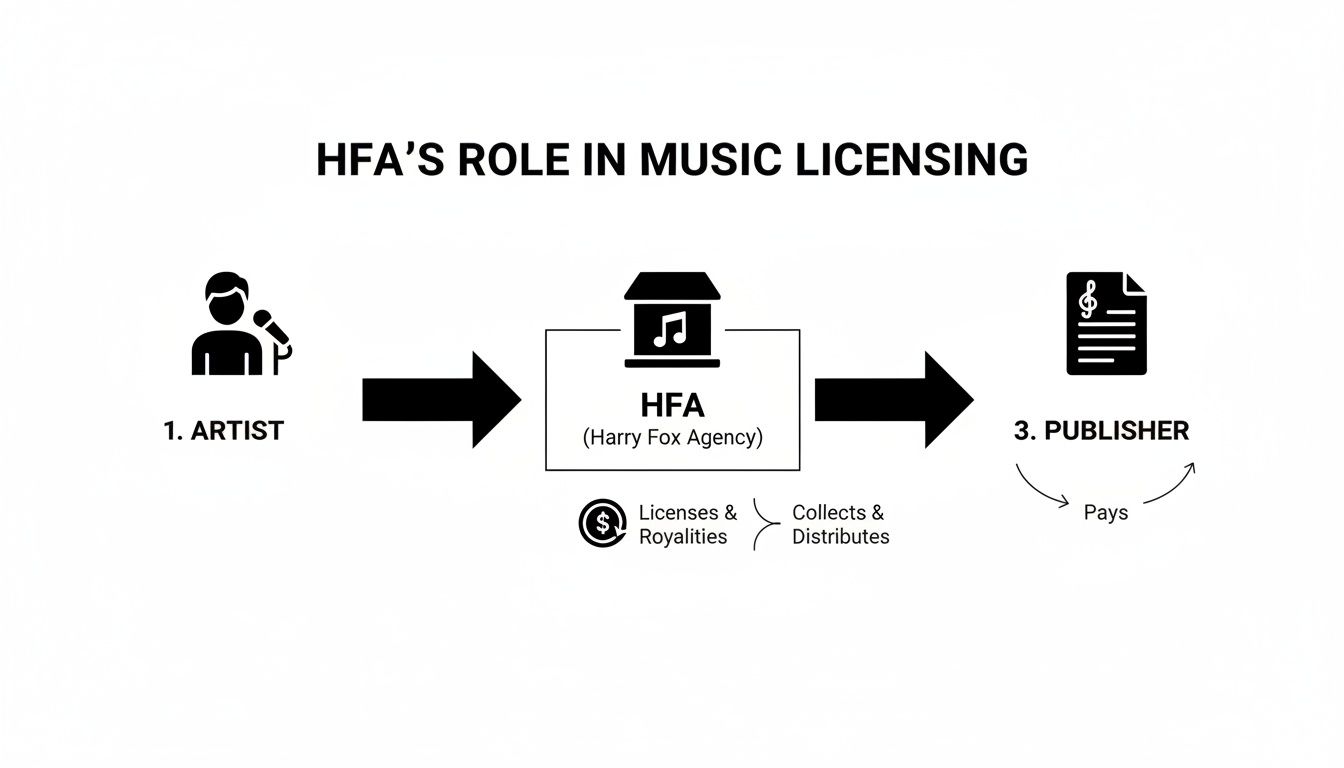
The HFA acts as a crucial middleman, simplifying what would otherwise be a nightmare of tracking down individual publishers and negotiating rights. Instead, they provide a one-stop shop to get the licenses you need quickly and correctly.
This guide is designed to give you a straightforward roadmap. Here's a quick look at what we'll break down:
- What a mechanical license actually is and how it differs from other royalties.
- The specific role HFA plays in the music ecosystem.
- Why you absolutely, positively need a license before you release a cover.
- The biggest benefits for independent artists who are managing their own careers.
By securing a Harry Fox Agency mechanical license, you’re not just following the rules—you’re respecting the craft of songwriting and ensuring that fellow creators get paid for their intellectual property.
For a deeper dive into the wider world of music rights, check out our guide on how understanding music licensing can boost your revenue and open up new income streams you might not have considered.
Understanding the Mechanical License for Cover Songs
Before we get into the nitty-gritty of the Harry Fox Agency mechanical license, let's first get a solid handle on what a mechanical license actually is. Imagine it like this: you want to publish your own version of a famous chef's signature recipe. You can use their ingredient list and instructions to cook the dish your way, but you owe them a small fee for using their brilliant creation. That's the core idea.
In music, a mechanical license is your legal green light to record and sell a song that somebody else wrote. It gives you permission to create your own unique performance of an existing composition—the melody and lyrics—and then share that recording with the world.
It's just as important to understand what a mechanical license doesn't let you do. It absolutely does not give you the right to use the original sound recording—the actual track you hear on the radio by the original artist. That means no sampling, no remixing, and no using even a tiny snippet of their recording without getting a completely separate (and often much harder to obtain) license from the record label that owns it.
When You Absolutely Need a Mechanical License
So, when does this all matter to you as an independent artist? You must secure a mechanical license if you plan on releasing your cover song in any format where a "copy" of the song is made. This applies to both the old-school physical formats and permanent digital ones.
Here are the most common situations where a mechanical license is non-negotiable:
- Physical Copies: If you're pressing your cover onto CDs, vinyl records, or even cassette tapes to sell at shows or online.
- Digital Downloads: When you sell your track on platforms where fans can download and own the file, like on OohYeah or iTunes.
- Ringtones: If you create and sell a ringtone from your cover performance.
A mechanical license is really all about making sure the original songwriter gets paid for every copy of their work you distribute. It’s the system that ensures creators are compensated when their music is reproduced.
Mechanical vs. Performance Royalties: What's the Difference?
The music industry has a few different kinds of royalties, and it's easy to get them mixed up. But the distinction between mechanical and performance royalties is crucial.
A mechanical royalty is paid to the songwriter every time a copy of their song is made—think back to our examples of CDs and downloads.
A performance royalty, on the other hand, is generated whenever a song is performed publicly. This could be a spin on the radio, a stream on Spotify, or even background music in a coffee shop. These royalties are handled by Performance Rights Organizations (PROs) you've probably heard of, like ASCAP and BMI.
The Harry Fox Agency deals strictly with mechanical rights, not performance rights. For an indie artist, that means you'll work with HFA (or a similar service) to clear the rights for your cover song downloads, but you'll rely on PROs to collect royalties from streams and public plays. Budgeting for this is a key step, and you can learn more about the costs of covering a song in our dedicated guide.
The Harry Fox Agency's Role in Music
Imagine trying to release a cover song without a central hub for music rights. You'd be on a wild goose chase, trying to find the specific publisher who owns the original song, then negotiating terms, and finally figuring out how to pay them. It would be a nightmare.
That's where the Harry Fox Agency (HFA) comes in. Think of them as the music industry's most trusted matchmaker. For decades, they’ve been the bridge connecting artists who want to record a cover with the publishers who own the rights to that composition.
HFA takes that convoluted, messy process and makes it simple. Their main job is to issue the Harry Fox Agency mechanical license you need to legally release your cover. They collect the royalty payments from you and then make sure that money gets into the hands of the right publishers and songwriters. This system opens up the world of music copyright to everyone, whether you're a major label or an independent artist on OohYeah getting ready to release your first track.
A Long History of Licensing
The agency isn't some new tech startup; it's been a cornerstone of the music industry for nearly a century. The National Music Publishers' Association founded the Harry Fox Agency way back in 1927. This was a direct response to the chaos that followed the 1909 Copyright Act, which introduced compulsory licensing and created a sudden, massive need for a standardized way to handle mechanical royalties.
HFA quickly became the industry standard. Today, it represents over 48,000 music publishers and issues more licenses for physical and digital sales in the U.S. than anyone else. You can get a sense of their deep industry roots on their official site.
That massive catalog and deep-seated trust are what make HFA so vital. It provides a clear, legal path for you to honor the original creators while sharing your own unique take on their work with the world.
HFA essentially takes the legal guesswork out of the equation for creators. When you pay for your license through them, you can trust that the royalties are calculated correctly and will actually reach the people who wrote the song you love.
At the end of the day, HFA is a crucial piece of infrastructure in the music business. They handle all the complicated financial and legal details behind the scenes so you can focus on what you do best: making music. Without this service, legally releasing cover songs would be a far more painful, if not impossible, task for most independent artists.
How to Get a License Through HFA Songfile
For many independent artists, the world of music rights feels like a maze. But when it comes to licensing a cover song, the Harry Fox Agency has created a surprisingly simple path forward with its Songfile service.
Think of Songfile as your go-to online tool for securing mechanical licenses for smaller projects. It’s built specifically for creators who need to clear rights for physical releases like CDs and vinyl, or for permanent digital downloads—the kind you might sell on a platform like OohYeah. It cuts out the complicated back-and-forth negotiations and gives you a direct, legal way to license your cover.
Step 1: Search the Songfile Database
First things first, you need to make sure HFA actually handles the song you want to cover. Head over to the Songfile platform and use their public search tool. You can look for the song by its title, the songwriter's name, or the original artist.
A word of advice: be specific. So many songs have similar titles, and it’s easy to pick the wrong one. Double-check that you’ve found the exact composition and songwriter before moving on.
If your song pops up in the search, you’re in luck! You can start the licensing process right then and there.
Step 2: Calculate and Pay the Royalties
Once you've confirmed the song, Songfile walks you through figuring out the royalty payment. This isn't some arbitrary number—it's calculated using the statutory mechanical royalty rate, which is set by the U.S. Copyright Royalty Board.
All you have to do is enter the number of copies you plan to make. For example, if you’re pressing 500 CDs or anticipating 500 digital downloads, you just plug in that number. The system instantly calculates what you owe. HFA also tacks on a small processing fee for each license. You can pay for everything with a credit card, making it a quick and straightforward transaction.
Step 3: Complete the Application and Get Your License
The final piece of the puzzle is filling out a simple online application. You'll need to provide a few key details about your project:
- Your Information: Your name and contact details.
- Release Information: The title of your single or album and its release date.
- Recording Artist: Your name or your band's name.
- Configuration: Specify whether it's a digital download, CD, vinyl, or another format.
After you submit the form and your payment, HFA gets to work. Once everything is approved, they'll email you a license ID number. This is your official proof that you've legally secured the rights to release your cover song. Be sure to save this number—it’s the documentation you’ll need to prove you’re good to go.
If you’re planning on releasing a cover, our full guide on how to get a mechanical license to cover a song dives even deeper into the process.
HFA vs. Other Music Licensing Organizations
The Harry Fox Agency mechanical license is a powerhouse tool, but it's only one piece of a much larger music rights puzzle. Getting a handle on the whole picture is the key to making sure you’re always legally covered and, just as importantly, collecting every cent you've earned. HFA has you covered for physical copies and digital downloads, but what about everything else?
Sometimes, you have to go straight to the source. If a song you're dying to cover isn't in HFA's massive catalog, your next step is to track down the music publisher and negotiate a license directly. It's definitely more hands-on, but it's a necessary skill for any serious artist.
The MLC: Your Go-To for Streaming Royalties
Another major player you absolutely need to know is The Mechanical Licensing Collective (The MLC). Created by the Music Modernization Act, The MLC handles a very specific, yet enormous, slice of the industry: mechanical royalties from interactive streaming services in the United States.
Think about it this way: when someone streams your cover song on Spotify or Apple Music, those platforms pay a blanket license fee to The MLC. The MLC then takes on the complex job of matching that money to the right publishers and songwriters. This is a totally separate system from the license you’d get from HFA to sell a download on OohYeah.
Key Takeaway: HFA is for tangible products and permanent downloads. The MLC is for U.S.-based interactive streams. Knowing the difference is non-negotiable for managing your music rights properly.
PROs: Cashing In on Public Performances
Finally, let's talk about Performance Rights Organizations (PROs) like ASCAP and BMI. These groups operate in a completely different lane. They collect public performance royalties, which have nothing to do with mechanicals.
A performance royalty is generated anytime a song is played in public. This includes a huge range of uses:
- Radio broadcasts (terrestrial and satellite)
- Plays in TV shows, commercials, or movies
- Live performances at a concert venue
- Background music in a coffee shop, bar, or retail store
PROs collect licensing fees from all these businesses and then pay those royalties out to songwriters and publishers. It's an income stream that's entirely separate from what HFA or The MLC handle. As an artist releasing music, you need to be affiliated with a PRO to collect these earnings.
Music Licensing Organizations Compared
Sorting out who does what can feel overwhelming at first. To simplify things, this table breaks down the roles of the key players in the U.S. music industry.
| Organization | Primary Function | When an Artist Needs Them |
|---|---|---|
| Harry Fox Agency (HFA) | Issues mechanical licenses for physical products (CDs, vinyl) and permanent digital downloads. | When releasing a cover song for sale as a download or on a physical format. |
| The MLC | Collects and distributes mechanical royalties from U.S. interactive streaming services. | To ensure publishers are paid when your cover is streamed on platforms like Spotify. |
| PROs (ASCAP, BMI) | Collect and distribute public performance royalties from radio, TV, live venues, and businesses. | To get paid when your original songs or covers are performed publicly. |
Understanding these distinctions ensures you're not just legally compliant but also strategically positioned to capture all the revenue your music generates. Each organization plays a vital, distinct role in your career.
Common Licensing Mistakes and How to Avoid Them
Diving into music licensing can feel a bit like walking through a minefield, but knowing where the traps are can save you from serious legal and financial trouble down the road. Getting the right Harry Fox Agency mechanical license is a great first step, but you have to know how to use it.
One of the biggest mistakes artists make is assuming a song is in the public domain just because it's old. Copyright law is notoriously tricky and terms can last for decades. A song written in the 1940s could very well still be protected. Don't guess—always do your homework and verify a song's status before you hit record.
Another common pitfall is lowballing your distribution numbers. It might be tempting to get a license for 500 downloads when you're aiming for 1,000, but that's a direct path to copyright infringement. If your track takes off and you sell more copies than you licensed, you have to go back and get a new license to cover the difference. Be honest and realistic from the start.
Licensing the Wrong Rights
This is where the details really matter. A mechanical license is very specific, and misunderstanding its scope can lead to some expensive problems. Let’s break down two of the most common errors.
Licensing the Wrong Version: Did you know that many famous songs have multiple arrangements or slightly different published versions? You have to be absolutely sure you’re licensing the exact composition you intend to cover. The best way to do this is to double-check the songwriter credits in the HFA Songfile database to make sure everything matches up.
Confusing the Song with the Recording: This is the big one. Your mechanical license gives you the right to create and distribute your own performance of a song—the underlying melody and lyrics. It gives you zero rights to the original artist's sound recording. If you use even a tiny sample from the original track, you'll need a completely separate (and often very costly) master use license directly from the record label.
Cautionary Tale: Picture this: an indie artist gets a mechanical license to cover a classic soul track. Super excited, they lift the iconic drum break from the original recording to use in their version. Soon after, the label that owns the master recording finds out and slaps them with a takedown notice, forcing them to pull the song and potentially face a lawsuit.
At the end of the day, being diligent is your best protection. Scrutinize every detail, understand exactly what your license covers (and what it doesn't), and always, always get your permissions sorted out before you release your music.
Got Questions? Let's Talk Mechanical Licenses
When you're dealing with something as specific as a Harry Fox Agency mechanical license, it's natural to have a few questions pop up. Let's clear up some of the most common points of confusion for independent artists so you can move forward with total confidence.
So, what if you're just giving your cover away for free? Do you still need a license? Almost always, yes. Under U.S. Copyright Law, the original songwriter has the exclusive right to decide who gets to reproduce their work, period.
Even if you’re not charging a dime, every promotional download is still considered a "copy." You're required to pay the statutory royalty rate for each one. Think of it this way: you're compensating the creator every time a new version of their song enters the world, no matter the price tag.
What Happens If I Just… Don't Get a License?
It's tempting to skip the paperwork, I get it. But releasing a cover song without permission is copyright infringement, and the fallout can be pretty damaging. For starters, the publisher can send a takedown notice to platforms like OohYeah, and poof—your music is gone.
Worse, they can take legal action. That could mean suing you for any money you made from the song. They might even go after statutory damages, which can climb into the thousands of dollars for a single infringement. Getting that license isn't just about being professional; it's a non-negotiable step to protect your career.
A mechanical license is more than just a piece of paper. It’s your proof that you respect the craft, and it shows you're a responsible member of the music community who believes in making sure songwriters get paid for their art.
Do HFA Licenses Cover Spotify and Apple Music?
This is a big one, so listen up. A license you get from HFA's Songfile does not cover interactive streaming on services like Spotify or Apple Music. Your HFA license is strictly for physical products (like CDs and vinyl) and permanent digital downloads.
In the U.S., mechanical royalties from streaming are a whole different ballgame. They're handled by a blanket licensing system run by The Mechanical Licensing Collective (The MLC). The streaming platforms pay The MLC, and The MLC then pays the publishers and songwriters. It's a separate system entirely.
Ready to sell your next cover song legally and keep more of your earnings? With OohYeah, you can distribute your licensed tracks directly to your fans commission-free. Take control of your music career today!