Top Free Music Distribution Services to Launch Your Music
Explore the best free music distribution services to get your songs on Spotify and Apple Music. Choose the right platform and distribute easily today!
August 20, 2025
Music Marketplace Advisor
Buying & SellingSo, you’ve poured your heart and soul into a track, and now you want the world to hear it. This is where free music distribution services come in. Think of them as the digital equivalent of a record label's logistics team, but without the hefty price tag. They're the ones who get your music from your hard drive onto the virtual shelves of massive platforms like Spotify and Apple Music.
This access is a game-changer for independent artists. It breaks down the old barriers to entry, letting you reach a global audience without needing a big budget. But let's be clear: "free" doesn't mean "no strings attached." It’s crucial to peek behind the curtain and understand how these companies actually make their money before you jump in.
How Free Music Distribution Actually Works
At its heart, a free music distribution service is your personal pipeline to the world’s biggest digital music stores. You’ve done the hard part—creating the art. Their job is to handle the complex, technical process of delivering that art correctly to hundreds of platforms, each with its own unique requirements.
Instead of hitting you with an invoice before you've even earned a penny, these services have built their businesses around different financial structures. It's a smart move that has opened up the industry, giving countless artists a shot at finding their audience on a global scale.
The Business Models Behind "Free"
To pick the right partner, you need to know how they keep the lights on. These distributors aren't non-profits; they're businesses. The "free" part is their way of getting you in the door, and it's usually balanced by one of a few common business models.
- Revenue Sharing: This is the big one. The distributor won’t charge you to upload your music. Instead, they’ll take a small slice of the royalties you earn every time someone streams or downloads your song.
- Freemium Tiers: Here, you get the basics for free, but the really powerful tools are locked behind a paywall. You can get your music out there, but you might have to upgrade for things like faster release times, detailed listener analytics, or priority customer support.
- Promotional Trials: Some services will let you release a song or two for free as a trial. The hope is that you'll like the experience and sign up for a paid plan to release more music in the future.
By 2025, the revenue-sharing model has become the standard. Most free music distribution services now take a cut of around 10-15% from your streaming royalties. It’s a volume game for them—they profit when lots of artists succeed, even just a little. For a deeper dive into how these models stack up, this complete guide to no-cost services is an excellent resource.
To make sense of these options, let's break them down into a simple table.
Core Models of Free Music Distribution at a Glance
| Model Type | How It Works | Best For Artists Who... |
|---|---|---|
| Revenue Sharing | No upfront fees, but the distributor takes a percentage (e.g., 10-15%) of your future earnings. | Are just starting out, have a limited budget, and are okay with sharing a small piece of the pie in exchange for access. |
| Freemium | Basic distribution is free, but premium features like faster releases or analytics require a paid subscription. | Want to test the waters with a distributor before committing, or who only need the most basic services. |
| Add-On Services | The core distribution is free, but the company makes money by upselling optional services (e.g., marketing, playlist pitching). | Are looking for more than just distribution and want an all-in-one platform for other artist services. |
Ultimately, understanding these models helps you see the complete picture. The distributor gets a sustainable business, and you get your music in front of millions of potential fans without paying out of pocket.
The crucial takeaway is that "free" rarely means a complete absence of cost. The cost is simply shifted from an upfront fee to a different part of the value chain, such as a portion of your future earnings or limited access to premium tools. This trade-off is the central dynamic you'll navigate when choosing a distributor.
Why Digital Distribution Is a Must-Have for Any Serious Artist
Not too long ago, the only path to getting your music heard was a record deal. That world is long gone. But today, just tossing your tracks onto SoundCloud or Bandcamp isn't enough either. Think of it like setting up a merch table in an empty alley—only people who already know you're there will ever stop by.
To build a real career in music, you have to meet listeners where they are. Digital distribution is the essential bridge that connects your home studio to a global audience. It’s the engine that gets your music onto the massive platforms everyone uses, like Spotify, Apple Music, and Amazon Music, putting you in front of millions of potential new fans.
Get Your Music in Front of a Global Audience
Without a distribution partner, your music is practically invisible to the overwhelming majority of people who stream music daily. These services are the gatekeepers, ensuring your audio files, metadata, and artwork all meet the strict technical standards of each platform. They handle the messy backend logistics so you can stay focused on the creative work.
The sheer scale of the streaming universe is hard to wrap your head around. By 2025, music streaming is projected to make up 84% of all revenue in the global music industry. With worldwide streaming revenue already at $17.5 billion and roughly 120,000 new tracks hitting these platforms every single day, you simply have to be in the game.
Think of a digital distributor as your passport to the professional music world. It validates your work and makes it accessible to a massive, worldwide audience actively looking for their next favorite artist.
Making the Leap from Hobby to Career
Using a distributor—even free music distribution services—sends a clear signal: you're serious about your music. It's the move that takes you from a hobbyist posting tracks for friends to an artist building a real presence in the industry. This single step unlocks the door to potential playlist features, proper royalty collection, and a verifiable track record of releases.
Of course, getting your music on the platforms is just the first part of the equation. It's a critical component of a successful release, but it works best when paired with a solid promotional strategy. You can dive into some of the best strategies for independent music distribution to make sure your music doesn't just arrive, but actually makes an impact.
Navigating the Hidden Costs of "Free" Services
The word "free" is music to an independent artist's ears, especially when every dollar counts. And while free music distribution services have certainly leveled the playing field, it’s smart to remember the old saying: there’s no such thing as a free lunch.
Often, "free" just means you're paying with something other than cash upfront. It's less of a giveaway and more of a trade. Understanding that trade is key—it’s not about avoiding free services, but about walking in with your eyes open so you don't get hit with surprises later.
Unpacking the Royalty Commission
The most common catch is the royalty commission. A distributor won't charge you to upload your song, but they’ll take a slice of every dollar you earn from streams and sales. This cut usually lands somewhere between 10% and 20%.
That might not sound like much when you're just starting out. But what happens if your song blows up? Suddenly, that small percentage turns into a significant chunk of your earnings—money that could have funded your next project. This is the basic deal: you get distribution with no upfront cost, and they get a piece of your future success.
The Fine Print on Features and Support
Beyond the commission, the real limitations of a free plan often show up right when you need a feature most. Things that are standard on paid plans suddenly become expensive add-ons or are just completely off-limits.
- YouTube Content ID: This is a big one. It's how you get paid when other people use your music in their videos. Many free distributors will charge you extra for it or, worse, take a much higher commission—sometimes as much as 40%—on just those specific earnings.
- Customer Support: Got a problem with a release? On a free plan, you’re often stuck with slow email responses or a chatbot that can't help. Paid users get to talk to actual people who can solve problems quickly.
- Release Speed: Timing is everything. If you're trying to sync your release with a PR push, a free service’s slow processing time (sometimes up to four weeks) can throw a wrench in your plans. Paid tiers usually get your music live in a matter of days.
The real trap with many "free" models is the à la carte pricing. You start with a free service, but then you end up paying for every little thing you actually need—takedown requests, adding new stores, you name it. It adds up fast.
Long-Term Commitment and Exit Fees
What if you want to switch distributors? This is where some of the nastiest hidden fees can bite you. Some companies will actually charge you a fee just to take your own music down. Others might hit you with a "legacy" fee to keep your old releases on Spotify and Apple Music after you've stopped working with them.
If you don't pay up, they could pull your entire catalog, wiping out all the stream counts and playlist placements you worked so hard to get. Reading the terms of service isn't just a suggestion; it's absolutely essential.
To see how a more transparent model works, it's worth checking out plans that lay everything out clearly from the start. For example, you can learn more by reviewing OohYeah’s straightforward artist pricing plans to see what a no-surprises approach looks like.
Choosing the Right Distribution Partner for Your Goals
Picking a distributor isn't really about finding the "cheapest" or "free-est" option. It's about finding a genuine partner for your music career. Making the right choice can seriously boost your growth, but the wrong one can throw up frustrating roadblocks at every turn. You have to look past the price tag and dig into what a service actually offers and whether it lines up with your specific goals as an artist.
Let your goals be your guide. Are you gunning for that viral TikTok moment? If so, you'll need a distributor that offers lightning-fast release speeds and tight social media integrations. On the other hand, if you're a touring artist, you'll want detailed sales analytics to pinpoint which cities have your most passionate fans. The perfect service for one artist could be a total mismatch for another.
Creating Your Distributor Checklist
To make a smart decision, you need a clear way to compare your options. Don't get sidetracked by flashy marketing—focus on the nuts and bolts that will affect your career day in and day out. A systematic approach is the only way to find a partner that truly supports your vision.
So, what should be on that checklist? Start with the big stuff: no hidden fees, crystal-clear royalty percentages, and a massive global reach. You'll want a partner that can get your music onto 200+ streaming services and digital stores worldwide. Other deal-breakers include how fast they deliver your music, who really owns your rights, and whether you get access to useful extras like analytics or publishing admin.
Understanding the Fine Print
This is where you have to pay close attention. One of the most critical details to confirm is who owns your master recordings. The answer should always be you. A good distributor is your logistical partner, not your boss. If their terms and conditions are fuzzy on this point, that's a massive red flag.
You must retain 100% ownership of your masters. Period. This gives you the freedom to move your catalog to another distributor later, license your tracks for a movie, and control your own artistic legacy without asking for permission.
Choosing a distributor isn’t just a logistical step; it’s one of the most important business decisions you’ll make as an independent artist. The right partner provides the tools and transparency needed to build a sustainable career on your own terms.
A great partner also empowers you with data and control. Look for a clean, easy-to-use analytics dashboard that gives you information you can actually act on. How many streams did you get in Brazil versus Germany? Which playlists are sending you the most listeners? This data is pure gold for planning tours, shaping marketing campaigns, and truly getting to know your audience. For a more detailed guide, check out our article on how to choose the right music distribution service.
Feature Comparison Across Distributor Tiers
Often, the "free" services come with trade-offs. While they're a great starting point, upgrading to a paid plan can unlock features that are essential for serious career growth. Here’s a look at what you can typically expect.
| Feature | Typical Free Tier | Typical Paid Tier | Why It Matters |
|---|---|---|---|
| Royalty Split | 80-90% to artist | 100% to artist | More money in your pocket, especially as your streams grow. |
| Release Speed | Standard (e.g., 2-4 weeks) | Expedited (e.g., a few days) | Allows you to release music quickly to capitalize on trends or tour announcements. |
| Advanced Analytics | Basic stream counts | Detailed listener demographics, playlist data, geo-stats | Gives you the data needed to make informed marketing and touring decisions. |
| Customer Support | Email/Ticket-based, slower response | Priority support, dedicated reps | When something goes wrong, you need fast, reliable help. |
| Customization | Limited release dates, no custom label names | Full control over release dates, label info, ISRCs | Professionalizes your releases and gives you strategic control over your schedule. |
| YouTube Content ID | Often an add-on or not available | Included as a standard feature | Helps you monetize your music whenever it's used in other people's YouTube videos. |
Deciding whether to pay for distribution really comes down to where you are in your career. If you're just starting out and testing the waters, a free tier is a fantastic, no-risk way to get your music out there. But once you start gaining traction and want to operate like a business, the tools and higher payout from a paid tier often become a necessary investment in your future.
Your Step-by-Step Guide to Releasing Music
Getting your finished track out into the world can feel like a huge undertaking, but it’s really just a series of manageable steps. When you use free music distribution services, you’re basically following a clear workflow that takes the guesswork out of the process. I like to think of it like preparing a package for international shipping—you just need the right contents, the correct labeling, and a courier you can trust.
First thing's first: get your assets in order. This means having your final, mastered audio file ready to go, usually as a high-quality WAV file. You'll also need your cover artwork, and this is one area where you can't cut corners. Every platform has its own specs, but the universal standard is a perfect square, high-resolution image (aim for 3000x3000 pixels) in RGB color format. Nail these details from the start, and you'll avoid the headache of having your release rejected or delayed.
Preparing Your Release Information
Once your files are prepped, it's time to gather all the essential metadata. This is the "passport" for your song—it’s all the crucial information that stores like Spotify and Apple Music use to identify, categorize, and ultimately pay you for your music.
The process is pretty straightforward and breaks down into a few key stages.
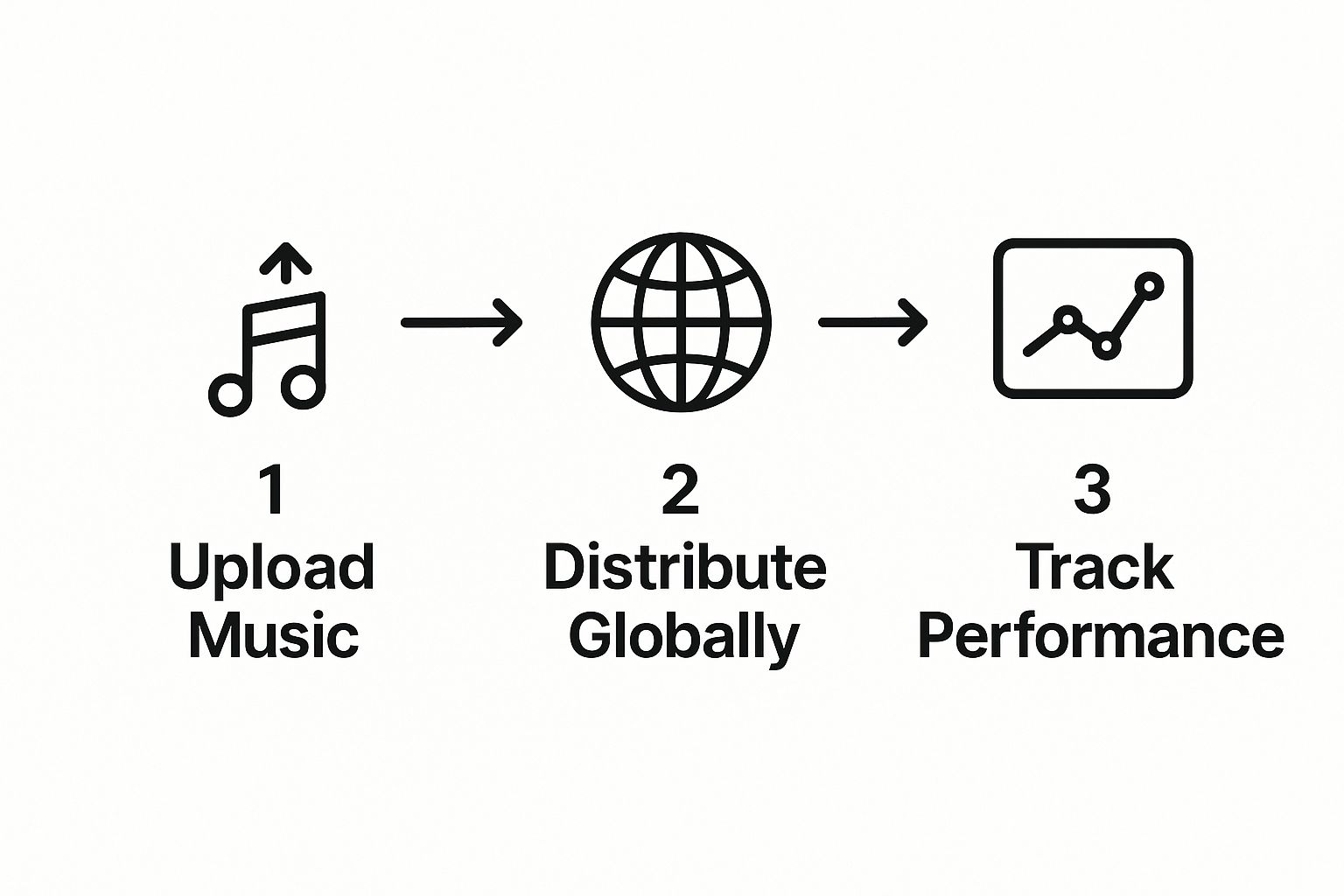
This visual really simplifies the journey: you upload your music, the distributor sends it out to the stores, and then you get to track how it’s all performing.
Finalizing and Submitting Your Music
After you've created an account with your chosen distributor, you'll start the upload process. This is where you’ll provide your audio file, artwork, and all that metadata you prepared earlier. From there, you get to choose which digital stores you want to send your music to and—this part is important—set your official release date.
Pro Tip: Always, and I mean always, submit your music at least four weeks before you want it to go live. This window is absolutely critical if you want a shot at getting considered for major editorial playlists, which can give your track a massive initial boost.
Once you hit "submit," your role shifts from creator to promoter. Getting your music on the platforms is only half the battle. Now, you need to drive people to it. Learning how to increase your social media engagement is non-negotiable for turning casual listeners into a real fanbase and making sure your music finds its audience. A great release is always a combination of seamless distribution and smart, strategic marketing.
How OohYeah Empowers Independent Artists
https://www.youtube.com/embed/4ajmfzj9G1g
After wading through the murky waters of commissions, hidden fees, and frustrating feature limitations, one thing becomes clear: most free music distribution services demand a compromise. The industry standard seems to be a choice between two bad options—either "free" means giving up a chunk of your future success, or it means paying out of pocket for every essential tool.
This is the exact problem OohYeah was created to fix.
We think it’s time to rewrite that deal. OohYeah isn't just a pipeline to get your music onto streaming platforms; we're a strategic partner invested in your long-term growth. Our entire model is built on transparency and a simple, powerful promise: what you earn is yours.
Keep 100 Percent of Your Royalties
The single biggest difference you'll find with OohYeah is our approach to your money. While other services quietly skim a 10-20% commission off your royalties, our plans let you keep 100% of what you earn from the stores. This isn't just a marketing line—it's the foundation of our entire philosophy.
Think about it like this. A typical free service is like a consignment shop that takes a big cut of every sale you make. OohYeah is your own storefront where every dollar from every sale goes directly into your pocket. That financial freedom is everything, allowing you to pour your earnings right back into your career, whether that’s funding the next EP, a new marketing push, or hitting the road for a tour.
OohYeah was founded on the idea that artists shouldn't have to sacrifice their earnings for access. Our model eliminates the conflict of interest inherent in commission-based distribution, ensuring our success is tied directly to providing you with the best tools, not taking a piece of your art.
A Partnership Built for Growth
Getting your music into stores is just the first step. To build a real career, you need powerful tools, and OohYeah provides them without the nickel-and-diming you'll find elsewhere. We just don't believe in locking away the features you need most behind expensive paywalls.
Our platform is a complete ecosystem designed to support every angle of your music business:
- Dedicated Artist Support: Got a question about a release? You won’t be talking to a chatbot or digging through a generic FAQ page. Our team is here to give you real support and help you solve problems quickly.
- Comprehensive Analytics: We give you clear, actionable data that actually helps you understand who's listening. You can track your audience demographics, pinpoint which playlists are driving the most streams, and identify your biggest fans around the world.
- Integrated Monetization Tools: OohYeah is more than a distributor. You can sell merch, create fan subscriptions, and manage every release from a single dashboard, opening up multiple streams of revenue without juggling a half-dozen different services.
By combining top-tier distribution with a genuine commitment to empowering artists, OohYeah goes far beyond the limits of standard free music distribution services. We give you the infrastructure and support you need to not just release music, but to build a lasting, profitable career entirely on your own terms.
Got Questions? We’ve Got Answers.
Stepping into the world of music distribution can feel like learning a new language. It's completely normal to have questions. Let's break down some of the most common things artists ask when they're getting started.
What if I Choose a Distributor and Then Want to Switch?
You absolutely can. It happens all the time. Switching just means you'll ask your current distributor to take down your music, and then you'll re-upload everything with your new partner.
The key is to make it a seamless transition so you don't lose your stream counts or playlist spots. To do this, you must reuse the original ISRC and UPC codes for every single song and album. This whole process can take a few weeks, so it's smart to plan ahead to minimize any time your music is offline.
What Exactly Are ISRC and UPC Codes? Do I Really Need Them?
Yes, you 100% need them. Think of them as the official digital fingerprints for your music. They are non-negotiable for any release.
Here’s the simple breakdown:
- An ISRC (International Standard Recording Code) is a unique identifier for a specific recording of a song. It’s like a serial number for a single track.
- A UPC (Universal Product Code) is the barcode for the entire product—your full album, EP, or single.
The good news? You don’t have to go out and buy these. Any reputable free music distribution service will generate them for you for free as part of the upload process.
Switching distributors is totally doable, but reusing your original ISRC codes is the most critical step. If you don't, your stream counts reset to zero. It's like starting over.
Will a Free Distributor Promote My Music for Me?
Generally, no. A distributor's main job is logistics—they're the digital trucking company that gets your music from your hard drive to Spotify, Apple Music, and everywhere else. They handle the complex delivery process, not the marketing.
While some of the pricier distributors might offer promotional packages as an add-on, free services are built to focus on one thing: distribution. The marketing is still your responsibility. That means building your audience on social media, pitching your tracks to blogs and playlisters, and running your own campaigns. A good distributor will give you tools like pre-save links to help you out, but you're in the driver's seat.
Ready to get your music out there without giving up your control or your cash? OohYeah gives you the tools and support to build a real career. Get started and keep 100% of your royalties.