
Fishman Pro EQ Platinum: A Complete Musician's Guide
Master your acoustic tone with our guide to the Fishman Pro EQ Platinum. Explore specs, setup tips for stage and studio, and sound shaping for any instrument.
May 19, 2026
Music Marketplace Advisor
Buying & SellingYou know the feeling. Your instrument sounds rich in your hands, then you plug into a venue PA and suddenly the body disappears, the pickup quack jumps out, or the room starts feeding back before you've even settled into the first tune. That problem gets worse when you're not playing standard acoustic guitar. Violin, upright bass, and ukulele often get treated like afterthoughts in live rigs, even though they need more careful shaping, not less.
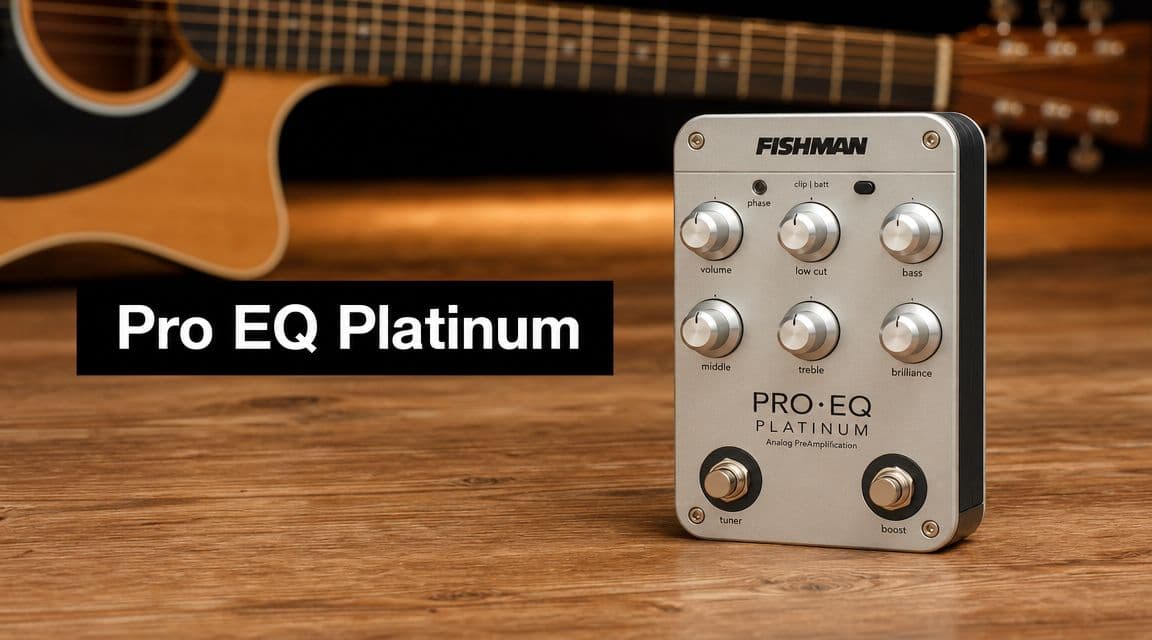
That's where the fishman pro eq platinum earns its keep. It isn't just a DI with a few tone knobs. It was introduced on November 14, 2014 with a listed price of $384.54, and Fishman positioned it as a complete redesign built around all-analog, discrete high-headroom Class-A circuitry for any acoustic instrument, as noted in Premier Guitar's launch coverage. That matters because it tells you what this unit was made to do from day one. It was built as a premium, all-in-one front end for working players.
For performers, the appeal is simple. You get one box that can sit between your instrument and the rest of the rig, give you control before the signal hits a stage amp or front of house, and solve several real problems at once. Weak pickup signal. Harsh upper mids. Low-end bloom. Stage feedback. Level jumps between instruments.
Non-guitar players especially benefit from that kind of control. A fiddle pickup can be strident in one room and dull in another. Upright bass can go from warm to unusable the moment a wedge points the wrong way. Ukulele can vanish in a busy mix unless you shape it with intention. A pedal like this gives you a fighting chance before the sound engineer reaches for broad EQ moves that may not suit your instrument.
Your Acoustic Tone Deserves the Spotlight
A lot of acoustic players buy pickups for convenience, then spend years wondering why the amplified sound never feels like the instrument they know. The issue usually isn't the instrument. It's the translation. Piezo systems, contact pickups, and onboard preamps often need help before they hit a mixer.
The fishman pro eq platinum sits in that exact gap. It was designed as a serious stage and studio tool rather than a basic utility pedal. That's why it developed a reputation as a workhorse among players who need reliable control over their own signal.
Where live acoustic tone usually falls apart
The most common failures are predictable:
- Pickup harshness that exaggerates attack and strips away woodiness
- Low-end buildup that sounds fine alone but turns muddy through a PA
- Feedback hotspots that show up at specific notes or body resonances
- Inconsistent level when switching between instruments in the same set
Those problems don't care whether you're playing a steel-string, a violin, or an upright. They show up whenever the source is resonant and the stage is loud enough.
Practical rule: If your acoustic sound changes drastically from room to room, you don't have a playing problem. You have a signal-control problem.
That's why so many experienced players stop relying on venue EQ alone. Front of house can help, but the best results usually come when you hand the engineer a signal that's already stable, musical, and resistant to feedback.
Why this pedal still matters
The Platinum Pro EQ entered the market in the mid-2010s as a premium all-in-one unit, not a budget add-on. That original positioning still tells you a lot about who it's for. It's aimed at players who want one road-ready device handling preamp, DI, EQ, tuner, boost, and dynamics control without building a larger acoustic board.
For mixed-instrument gigs, that matters more than the brand story. You don't want to carry one box for bass, another for fiddle, and a third for ukulele if one pedal can cover the practical jobs well.
What keeps this unit relevant is that it addresses the part of live sound many acoustic players neglect. Not the instrument itself. The handoff between instrument and system.
What Is the Fishman Pro EQ Platinum
Think of the Platinum Pro EQ as a small channel strip for your pedalboard. It takes the place of several separate tools and puts them under your foot and fingertips. That's the cleanest way to understand it.

If you've only seen it described as an acoustic guitar pedal, that undersells it. In practice, it works more like the control center for any pickup-equipped acoustic instrument.
The five jobs it handles
Here's the practical breakdown:
Preamp
Your pickup signal often needs proper gain staging before it reaches a console or interface. A dedicated preamp helps the instrument feel more alive and less flat.DI box
This is what lets you send a balanced signal to a mixer or PA without depending on a separate direct box at the venue.EQ section
This is the part that lets you shape the sound for the room, the instrument, and the pickup. That's where much of the pedal's value lives.Compressor
Acoustic instruments can jump in level fast, especially with aggressive bowing, thumb-driven uke playing, or percussive bass articulation. Compression can smooth that out when used sparingly.Tuner and feedback control
The built-in tuner is convenient on stage, but the feedback tools are what save gigs.
Why combining those functions matters
Separate boxes can do each of these jobs. The trade-off is complexity. More cables, more power needs, more failure points, and more decisions in the middle of a soundcheck that's already running late.
With the fishman pro eq platinum, the logic is simpler. Plug in, gain it properly, shape the tone, send a consistent output to the PA, and keep a few emergency tools ready when the room fights back.
A good acoustic preamp doesn't just make the instrument louder. It makes the signal more manageable.
That distinction matters most for non-guitar players. Violin and upright bass often need quick corrective moves based on stage conditions. Ukulele needs help finding a place in the mix without sounding brittle. A pedal that centralizes those moves makes live work easier.
The right mental model
Don't think of this as a magic tone box. Think of it as a problem-solving front end.
If your instrument already sounds perfect through every house system, you might not need much from it. But if you play varied rooms, inconsistent backline, or multiple acoustic instruments in one set, this kind of pedal gives you control where it counts most, before the signal leaves your hands.
Detailed Features and Controls Explained
The control layout makes more sense once you stop thinking in terms of features and start thinking in terms of stage problems. Every knob or switch exists because acoustic players deal with recurring issues under pressure.

According to Peghead Nation's overview of the Fishman Platinum Pro EQ, the pedal uses a 17-volt, discrete Class-A analog preamp, includes a 5-band EQ with sweepable mids, offers a 12 dB boost, provides a balanced XLR DI output with pre/post-EQ switching, and fits all of that into a 6.2" x 5.6" x 2.2" chassis (158 mm x 143 mm x 54 mm).
The EQ section
The EQ is the heart of the unit. A 5-band EQ with sweepable mids gives you more control than the usual simple bass and treble arrangement found on many acoustic pedals.
Why the sweepable mids matter:
- For violin you can search for the nasal or sharp zone and reduce it without killing air.
- For upright bass you can target the muddy area that blooms through wedges.
- For ukulele you can add focus so the instrument speaks in a band mix instead of sounding toy-like or papery.
The biggest mistake players make is overusing the extreme bands. Most acoustic cleanup happens in the mids, not in huge bass or treble swings.
Notch filter and phase switch
These are your feedback survival tools. They don't work the same way, and that's worth understanding.
The phase invert is often the first thing to try when the room starts giving you low-end rumble or body resonance. It's quick, harmless, and sometimes fixes the problem immediately.
The notch filter is more surgical. Use it when a specific frequency keeps taking off. That's common with upright bass and violin, where one resonant area can dominate the whole instrument through stage monitors.
Hit phase first when the low end feels unstable. Reach for the notch when one note or narrow band keeps jumping out.
Compressor, boost, and tuner
The built-in compressor is useful, but acoustic compression is easy to overdo. Too much and your instrument stops breathing. On fiddle, that can flatten bow articulation. On upright, it can reduce natural dynamic bloom. On ukulele, it can make transients clicky and small.
The 12 dB boost is best treated as a controlled level jump for solos or a feature cue, not as a permanent loudness fix. If the base tone isn't balanced, boost only amplifies the problem.
The tuner earns its place because it reduces pedalboard clutter and keeps your workflow fast on stage.
DI output and physical layout
The balanced XLR out is one of the reasons this pedal integrates cleanly into professional rigs. The pre/post-EQ switch matters because it lets you decide whether front of house gets your shaped sound or a cleaner feed. Some engineers prefer a neutral signal. Some appreciate receiving the tone you've already dialed in.
The size also matters in practice. It's compact enough to live on a small acoustic board, but large enough that the controls don't feel cramped during a rushed setup.
Integrating Into Your Live and Studio Rigs
The best acoustic preamp in the world won't help if it's patched badly. The Platinum Pro EQ works best when you decide in advance what role it's playing. Front-end tone shaper, DI hub, stage monitor feed, or recording preamp.

Live setup that stays simple
For most gigs, the cleanest signal path is:
- Instrument into the Platinum Pro EQ
- XLR out to front of house
- 1/4" out to your stage amp or personal monitor if needed
That split is practical. You send the PA a stable balanced signal and still keep local control of what you hear on stage.
A few live-use habits make a big difference:
Use the ground lift when hum appears
Don't assume the venue power is clean. If you hear a ground-related buzz, try the lift before chasing EQ ghosts.Choose pre or post EQ on purpose
Post-EQ makes sense if your pedal tone is part of your sound. Pre-EQ can make sense when the engineer wants more freedom out front.Set the low cut carefully
If you're still learning mastering audio with HPF, it's worth reviewing how a high-pass filter changes perceived clarity without gutting the instrument.
Studio use that doesn't fight the mix
In the studio, the Platinum Pro EQ can work as a direct front end before your interface. That's useful when the raw pickup or transducer output feels too stiff going straight into a generic input.
A simple chain looks like this:
| Use case | Signal path | Best reason to use it |
|---|---|---|
| Direct acoustic tracking | Instrument > Platinum Pro EQ > Interface | Better control before conversion |
| Hybrid session | Instrument > Platinum Pro EQ > amp and DI split | Capture both focused DI and room flavor |
| Overdub work | Instrument > Platinum Pro EQ > DAW | Fast recall and low setup friction |
If you're budgeting your recording workflow, the broader economics of production are covered in this piece on what it really costs to professionally record a song in 2024.
This demo gives a useful visual sense of how players deploy the pedal in real setups.
The smartest way to use an acoustic preamp live is to solve your problems before they reach front of house.
That doesn't mean overprocessing. It means handing the engineer a signal that already behaves.
Sound Shaping for Guitar Bass and Beyond
Most discussion of the fishman pro eq platinum stops at acoustic guitar. That misses one of its best strengths. It was designed as a universal preamp with a guitar/bass EQ mode and tuner modes for guitar, bass, ukulele, and violin, which is one reason it adapts well to non-guitar instruments, as described in Guitar Center's Fishman Platinum Pro EQ listing.

The key is to treat any settings as starting points, not recipes carved in stone. Different pickups, strings, bows, and stage volumes change everything.
Violin and fiddle
Piezo-equipped violin often has two issues at once. A hard upper-mid edge and an unpleasant scratch on aggressive bow attacks. The fix usually isn't more treble reduction. It's finding the ugly midrange area and trimming it precisely.
A practical starting approach:
- Use the mid sweep to locate the most nasal frequency area, then pull it back modestly.
- Keep the bass restrained so the instrument stays agile and doesn't cloud the mix.
- Add only a touch of compression if long sustained lines need more level consistency.
- Reach for the notch filter if a specific resonant note starts to bloom through wedges.
What doesn't work is scooping everything until the violin sounds polite but distant. That often removes the very frequencies that help it project.
Upright bass and acoustic bass
The guitar/bass mode proves especially useful. Upright bass often needs firmness, not just warmth. Too much low end in the pedal can make the player feel good on stage while the house mix turns soft and indistinct.
A better starting point is:
- Use bass mode and keep the deep lows under control.
- Search the low-mid area for the muddy push that makes notes blur together.
- Use the phase switch early if the stage starts exciting body resonance.
- Apply compression sparingly so pizzicato notes feel even without choking the natural envelope.
On upright, clarity usually comes from removing bloom, not from adding more bottom.
A lot of bass players also benefit from setting the pedal for the room first, then adjusting right-hand attack before making another EQ move.
Ukulele and small-body acoustic instruments
Ukulele can be deceptive. In the room, it sounds lively and complete. Through a pickup, it can come across as thin, chirpy, or overly clicky.
A workable strategy:
- Add a bit of body with careful low or low-mid support.
- Trim any boxy center that makes strummed chords feel congested.
- Leave enough top-end detail for definition, but don't chase brightness.
- Use light compression if you move between fingerstyle and strong strumming.
The target sound isn't “big guitar.” It's a believable amplified ukulele with enough mass to survive a mix.
For artists thinking about how production choices change listener response, this article on whether quality production affects music success is worth reading alongside your live-tone decisions.
Acoustic guitar still benefits
Even if your main focus is non-guitar work, standard steel-string acoustic still responds well to the same disciplined approach. Cut the problem area first. Add sweetness second. Don't build a live tone in solo mode that collapses when the band enters.
That mindset transfers across instruments better than any fixed knob position ever will.
Is the Platinum Pro EQ Right for You
Not every acoustic player needs a feature-dense preamp. Some do. The fastest way to decide is to look at the kind of work you do.
Players who get the most from it
A musician playing multiple instruments is the obvious fit. If you switch between fiddle, ukulele, acoustic bass, and guitar, one pedal that handles DI duties, tuning, shaping, and feedback control makes more sense than assembling separate pieces.
The gigging singer-songwriter also benefits if venue quality varies a lot. When you can't count on the room, carrying your own signal control reduces surprises.
The studio-minded performer gets value from having a dedicated acoustic front end that can make direct tracks easier to manage before they ever hit the DAW.
Players who might not need it
If you already run through a high-end acoustic amp or a channel strip that gives you all the control you need, the Platinum Pro EQ may duplicate functions you already own.
If your setup is extremely minimal and you only play occasional quiet sets through a reliable house DI, it may be more pedal than you need.
Real trade-offs
The strength of this unit is consolidation. The trade-off is that an all-in-one box won't always give you the deepest possible control in every category compared with a larger custom rig.
It also sits in the same general conversation as other premium acoustic preamps such as the LR Baggs Venue DI. The deciding factor usually isn't brand loyalty. It's whether you want this combination of EQ control, instrument flexibility, and integrated utility in one footprint.
If your gigs involve changing rooms, sensitive pickups, and more than one acoustic voice, it's a strong yes. If your rig is already stable and specialized, maybe not.
Fishman Pro EQ Platinum FAQ
Can it handle more than acoustic guitar?
Yes. This is one of the better reasons to buy it. The unit was built as a universal acoustic preamp, and in practice it makes the most sense for players who move across instrument types or need one reliable control point for varied pickup systems.
When should I use guitar mode versus bass mode?
Use the mode that matches the instrument's role in the mix, not just its name. Acoustic bass and upright usually benefit from bass mode because the EQ behavior suits lower-range sources better. Some baritone or unusually full-bodied instruments may also respond better there. The answer is your ears, not the label.
Should front of house get my EQ or a clean signal?
That depends on trust and consistency. If your pedal settings are part of your signature tone and you know they translate well, sending post-EQ often makes sense. If you're in a tightly managed production or working with an engineer who wants full control, pre-EQ may be the safer choice.
Is the compressor something I should leave on all the time?
Usually, no. Acoustic compression works best when it's subtle and task-specific. Use it to smooth uneven bowing, tame hard strums, or make fingerstyle passages sit more evenly. If you hear the instrument losing breath or transient detail, back it down.
For product help, setup clarification, or platform-related guidance, OohYeah keeps a useful support center for artists and users.
If you're shaping your tone with the same care you bring to writing, tracking, and performing, OohYeah is worth a look. It gives artists a music-first place to share work, connect with listeners, and build direct revenue without adding another layer between the music and the audience.