Music Event Promotion Timeline: A Practical Playbook
Build a music event promotion timeline that actually sells tickets. Step-by-step playbook for pre-launch, on-sale, week-of, day-of, and post-event tasks.

September 17, 2026
Music Marketplace Advisor
Buying & SellingMost event organizers say the bulk of ticket sales arrives in the final two weeks, with 43% identifying that closing window as the period when most sales happen, according to Event Crowd's summary of Eventbrite data. That doesn't mean you can wait until the final fortnight. It means a strong music event promotion timeline has two speeds: a long period for building attention, followed by a short, disciplined conversion sprint.
For indie and mid-size shows, the practical question isn't how early to post the announcement. It's whether your campaign has enough runway to make the event familiar, whether your ticketing path is ready when interest appears, and whether you've given the quiet middle a clear job. A timeline that handles those three conditions will outperform a louder campaign that relies on one announcement and a last-minute panic.
Why Music Event Timelines Follow a Two-Speed Pattern
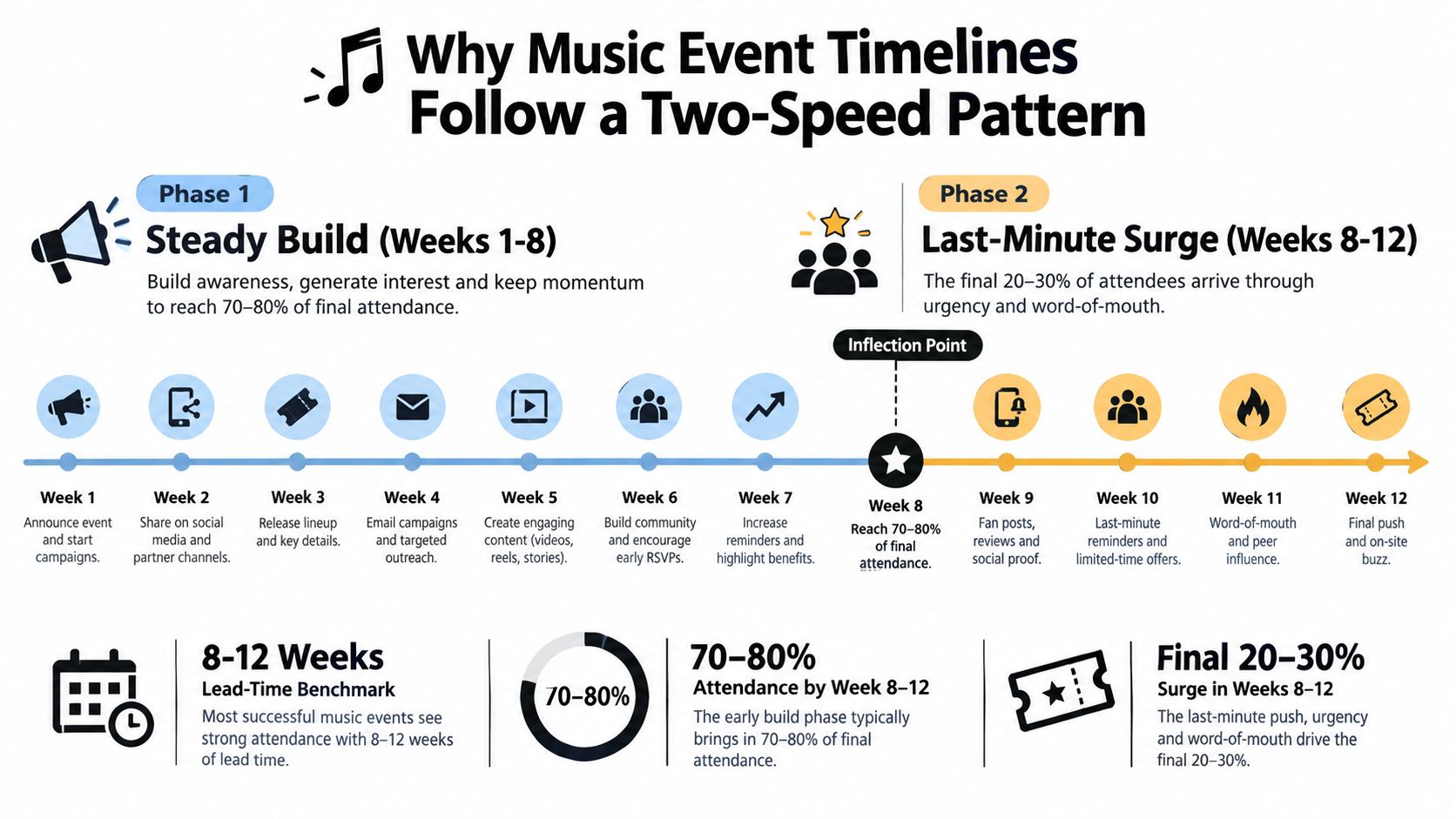
A mid-sized event commonly uses an 8 to 12-week selling window, while larger conferences and festivals often need 4 to 6 months or more. Tickera's ticket-sale timing guidance places many events within the shorter range and points to a longer runway for large gatherings. The useful lesson for music promoters is not the calendar length alone. It is the shift from gradual awareness to concentrated buying activity.
Music campaigns need time to make the artist, venue, date, and ticket feel familiar. Fans check their schedules, compare the show with other plans, and decide whether the night deserves their money. That decision usually develops slowly, then accelerates as the event approaches and postponement becomes less useful than buying.
Give each phase a different job
Phase one is the steady build. Announce the date, publish the ticket link, introduce the lineup, and give the artist, venue, openers, partners, and local tastemakers reasons to repeat the message. Rehearsal clips, venue footage, playlist placements, radio outreach, and artist posts should answer one practical question: why attend this show instead of leaving the date open?
The pace depends on existing fan attention. An artist with an active local audience may need less time to create recognition. A newer act, unfamiliar lineup, or unusual venue needs more repeated exposure before asking for a purchase.
Phase two is the conversion sprint. Retarget ticket-page visitors, email interested fans who have not bought, explain what remains available, and make the approaching date visible across every active channel. The required runway changes with the event format, ticketing complexity, and level of audience commitment. A club show and a large gathering should not share the same campaign calendar because both sell admission.
The quiet middle needs an owner. The announcement creates awareness, while the final countdown supplies urgency. Between those points, schedule messages that add a reason to attend, answer a hesitation, or return the ticket link to someone already showing interest. If nothing changes during this period, early attention fades before the sprint begins.
Keep a working calendar and channel plan beside your broader music promotion resources. The operating rule is simple: build slowly, then convert decisively.
Pre-Launch Foundations Before Promotion Starts
Your highest-intent traffic is wasted if the ticket page is broken, the date changes, or the artist asset still says “details coming soon.” Before anything goes public, make the show commercially and operationally real.
Lock the show before announcing it
Confirm the date, venue hold, door time, artist routing, lineup, capacity, and settlement assumptions. A promoter can fix a weak caption later. Fixing a venue problem after the announcement damages trust and forces every partner to update their posts.
Set ticket tiers and decide what each tier means. If there's an early-access or early-bird offer, define its closing condition before the campaign starts. Establish your capacity target and break-even number as internal controls, not public promises. You need to know when the event is safe, when paid acquisition is justified, and when the team needs a rescue plan.
Wire the measurement and buying path
Build the landing page around one action, buy a ticket. Test the mobile layout, ticketing embed, payment flow, confirmation email, and refund or transfer information. Add UTM-tagged links for the artist, venue, each opener, radio partners, record stores, and paid campaigns.
Install the relevant Meta and Google pixels on the ticket page, configure conversion events in GA4, and keep a simple attribution sheet. It doesn't need to be elaborate. Record the source, link, date, ticket type, and sales movement so you can distinguish a partner that sells from one that only generates likes.
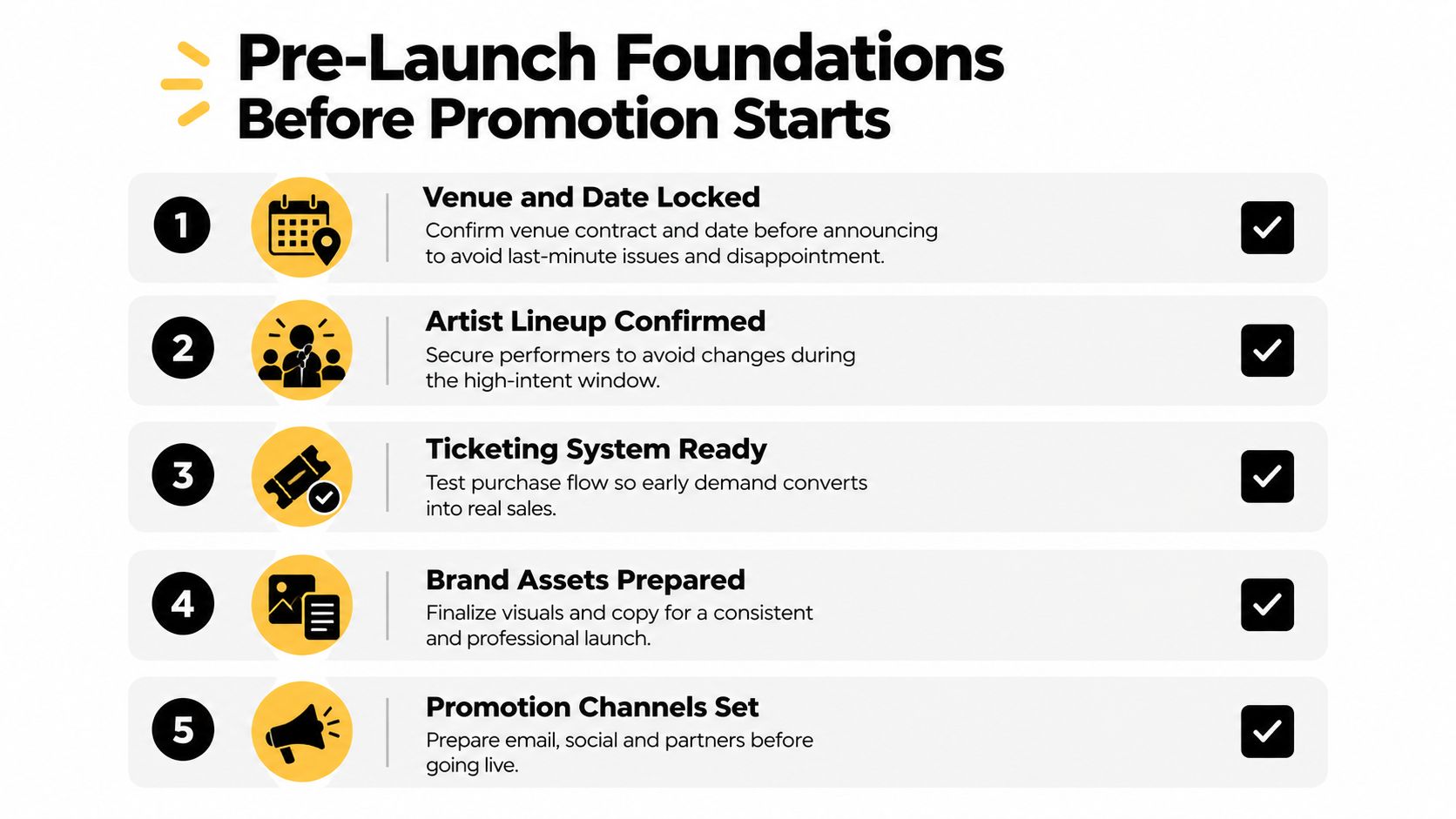
Use a short pre-launch checklist:
- Venue and date: Confirm the contract, hold, access times, and public details.
- Artist lineup: Secure every performer and asset needed for the announcement.
- Ticketing system: Complete test purchases on mobile and desktop.
- Brand assets: Prepare the artist image, venue image, date lockup, copy, and vertical formats.
- Promotion channels: Prepare email, social, partner, SMS, and paid-media access before launch.
Collect early-access contacts from the artist, venue, openers, and promoter. Decide who announces first, when the public ticket link appears, and how the pre-sale code reaches the warmest audience. If you need help comparing creative and workflow options, use a practical guide to find the right promo tool, but don't let tool selection delay a working launch.
This walkthrough can also complement structured learning in the OohYeah Academy courses. The principle is firm: promotion should begin only after the conversion path works.
On-Sale and the Build Phase That Converts
The first 72 hours after tickets go on sale are your signal window. Send the full warm-list email, coordinate the artist's main social post, activate retargeting, and ask every partner to publish with a unique trackable link. You're not trying to create the entire campaign in that window. You're testing whether the offer, creative, audience, and checkout experience are aligned.
The middle needs a weekly rhythm. Give each piece of content one job. A lineup reveal should create a new reason to attend. A rehearsal clip should make the night feel tangible. A venue walkthrough should remove uncertainty. A buyer or attendee testimonial should provide social proof. If one post tries to do all four, it usually says none of them clearly.
Use milestones that can be verified. An early-bird deadline, a sold-out ticket tier, a section filling, or a venue upgrade gives people a reason to act without resorting to vague “hurry” language. Partners should receive finished assets, suggested copy, the event link, and a deadline. Make sharing easy for a local radio station, record store, sponsor, or aligned brand.
| Weeks Out | Target % Sold | Primary Content | Key Tactic |
|---|---|---|---|
| 12 to 10 | 20% | Announcement and artist assets | Warm-list email, coordinated artist post, early-access window |
| 9 to 7 | 40% | Lineup, venue, and rehearsal content | Partner shares with unique links, retargeting audiences |
| 6 to 4 | 60% | Social proof and show details | Ticket-holder segmentation, non-opener follow-up, offer deadline |
| 3 to 2 | 75% | Set expectations and remaining inventory | Paid conversion creative, partner reminder, capacity messaging |
| 1 | 100% focus | Final countdown and logistics | Daily reminders, direct outreach, last-ticket communication |
The percentages in this table are working targets, not industry facts. Adjust them to your capacity, price, audience warmth, and prior sales history. A weekly review should answer three questions: which channel sold tickets, which message moved hesitation, and what objection keeps appearing in replies?
For scheduling short-form updates, a resource on Threads timing strategies can help organize posting windows. The tool matters less than consistency. A campaign stalls when the team confuses “we announced it” with “we kept giving people reasons to buy.”
The Final-Week Urgency Playbook
The closing stretch changes the buyer's question from “Should I go?” to “Can I still get in?” Demand often arrives late. One industry summary reports that 43% of organizers say most ticket sales happen in the final two weeks, while Everlage's timeline guidance says 49% of webinar registrations happen in the final seven days. Webinar behavior cannot forecast a concert directly, but both observations support the same operating decision: plan a concentrated conversion sprint instead of leaving the final week to autopilot.
Use the seven days to assign each message a job:
| Day | Channel Focus | Expected % of Remaining Sales | Urgency Trigger |
|---|---|---|---|
| Monday | Email and artist channels | 10% | Lineup reminder or opener reveal |
| Tuesday | Short-form social | 10% | Countdown plus rehearsal footage |
| Wednesday | Venue and partner channels | 15% | Partner drop and local relevance |
| Thursday | Email retargeting | 15% | Ticket-tier or access change |
| Friday | Paid and organic social | 20% | Verified capacity or section update |
| Saturday | Direct messages and community outreach | 15% | Warm-contact reminder |
| Sunday | Email, SMS, and final broadcast | 15% | Final 48-hour message |
These figures are a planning model, not a verified benchmark. Apply them to the remaining opportunity in your own forecast, then revise the plan as actual sales arrive. If Monday's reminder produces little movement, do not repeat it unchanged on Tuesday. Shift the message, audience, or channel.
Generic scarcity loses force when buyers have seen it for weeks. Use facts people can check: the remaining ticket tier, a sold-out section, the actual seating or standing arrangement, or the time a price changes. Never invent a count. If inventory is not verified, use a truthful qualitative message such as limited availability.
When sales lag, diagnose before discounting. Check whether the offer is clear, the audience understands who is playing, and the purchase path works on mobile. A surprise guest, useful add-on, new opener, or short flash offer can give warm prospects a fresh reason to act. Keep the intervention deliberate and limited, so buyers do not learn to wait for cheaper tickets.
Practical rule: In the final week, every message should contain one verified fact, one clear reason to attend, and one direct ticket action.
Day-Of Execution and On-Site Promotion
Day-of promotion isn't a substitute for an empty funnel. It protects the people who already bought, catches fence-sitters who need a final nudge, and creates the visual material that will sell the next show.
Start in the morning by confirming door times, set times, access instructions, and any venue changes with staff. Send a concise email and SMS reminder with the doors time, venue address, ticket location, and the most useful arrival information. Post an Instagram Story showing the venue exterior, a setup detail, or a soundcheck tease. If weather or transit conditions change, publish practical guidance quickly.
Protect the attendee experience
In the afternoon, test ticket scanning and reconcile the will-call list. Brief ushers on capacity, queues, accessibility, re-entry, and the answer to common questions. Assign one person to content. Without a named owner, the team usually captures random stage footage and misses the crowd reactions, opener energy, and arrival atmosphere that make future promotion credible.
During the evening, post set-time graphics, run a preshow playlist through venue social channels, and capture vertical clips for TikTok and Reels. Film the opener as well as the headline act. The opener gives you a second story and helps the next announcement reach an audience that may not yet know the promoter.
A short late-arrival post can convert a final fence-sitter, but don't frame it as a desperate ticket push. “The show is happening, doors are open, and this is what the room looks like” gives undecided people a reason to move while keeping the event's energy intact.
The best day-of checklist is short:
- Confirm logistics: Doors, set times, access, weather, and transport information.
- Verify entry: Scanners, will-call, guest list, and capacity briefing.
- Capture proof: Crowd, opener, headline, venue, and audience reactions.
- Publish selectively: Useful reminders first, atmosphere second, hard selling last.
Post-Event Tasks That Feed the Next Show
The next event promotion timeline starts while the last room is still fresh in people's minds. Post-event work isn't administrative cleanup. It's where you preserve permission, collect evidence, and turn one night into an audience asset.
Within the first 24 hours, reconcile ticket buyers, email respondents, attendees, and no-shows. Respect consent and platform rules, then segment the audience by attendance and relevant purchase behavior. Send a thank-you that feels specific to the night, followed by a pre-save link, next-show waitlist, or artist update that gives the relationship a next step.
Use the first two days for visible proof
Publish a strong photo or short video recap while the show is still recognizable in the audience's feeds. Tag the venue, artists, openers, photographers, partners, and sponsors so they have a reason to share it. Ask the headline artist to post a direct thank-you reel. A recap shouldn't be a random folder dump. Choose moments that communicate atmosphere, crowd density, performance quality, and the identity of the room.
Within the first week, compare channel performance with the original forecast. Look at ticket velocity from the artist, venue, partners, email, organic social, and paid media. Record which partner link sold, which email moved non-buyers, which creative earned useful traffic, and where checkout friction appeared.
A good post-event report tells you what to repeat before it tells you what to celebrate.
Keep the debrief practical. Save winning copy, high-performing assets, partner contact details, audience segments, and unresolved objections in one place. The next date should inherit this information, not restart from a blank document. For operational answers on audience communication and platform use, the OohYeah help center guides can sit alongside your own show report.
Choosing the Right Runway for Your Event Type
A longer campaign does not automatically produce more tickets. A small show with a warm, reachable fan base can disappear into the feed if you announce it too early and repeat the same message without adding information. A first-time artist with little local recognition faces the opposite problem. That campaign needs time to introduce the artist, establish trust, and give unfamiliar listeners a reason to attend.
The right schedule depends on audience warmth and event complexity. POSH's event-marketing guidance distinguishes between warm repeat audiences, which may support a compressed campaign, and larger festivals, which need a longer build. Use those ranges as planning inputs, not fixed rules. The practical model is two-speed: create awareness over a measured runway, then concentrate attention during the conversion sprint. Manage the quiet middle with new proof, useful updates, or a deliberate pause.
Match the runway to the risk
A first-time local artist needs local discovery, venue credibility, community partners, and consistent content. The awareness phase has to do more work because the audience is learning both the artist and the event. Direct local partnerships and targeted discovery usually beat broad reach that produces little recognition. The conversion sprint should then focus on clear reasons to buy, access information, and direct outreach.
An established touring act at a small venue can move faster when the artist owns an active fan list and the date fits the tour route. Prioritize artist channels, email, SMS, and retargeting. The main risk is saturation. Several similar messages sent to the same fans can make the event feel routine, especially during a quiet middle with no new announcement or proof.
Festivals and multi-stage events need more runway because buyers evaluate a larger promise. Lineup releases, travel planning, sponsors, ticket tiers, and schedule information each need room to develop. A reunion or one-off special may have built-in demand, but the team still needs time to coordinate the announcement, pricing, press, and reliable audience access.
| Event Type | Total Runway | Awareness Phase | Conversion Sprint | Primary Spend Channel |
|---|---|---|---|---|
| First-time local artist | 8 to 12 weeks | Local discovery and credibility | Final countdown and direct outreach | Local partners and targeted social |
| Established act, small venue | 4 to 8 weeks | Routing and fan reactivation | Retargeting, email, and SMS | Artist-owned channels |
| Festival or multi-stage event | 12 to 20+ weeks | Lineup, travel, partners, and trust | Tier deadlines and final inventory | Partnerships and paid discovery |
| Reunion or one-off special | 6 to 12 weeks | Announcement and proof of uniqueness | Scarcity and access clarity | Artist, venue, and press channels |
Compare venue capacity with reachable fan base before setting the schedule. Count the people you can realistically reach through owned lists, active artist channels, venue contacts, and reliable partners. If that reachable audience is large relative to the room, compress awareness and put more effort into conversion. If the room is large relative to reachable attention, allow more time for recognition and reach.
A warm list does not guarantee sales. Check that it is active, permission-based, geographically relevant, and connected to the artist or event. MPG's conference lead-time guidance supports the broader planning point: paid attendance requires more preparation than simple awareness.
The common failures are easy to recognize. Start too early without a content plan, and the show fades into the feed. Start too late for a touring act, and the highest-intent period gets consumed by asset fixes, tracking problems, and checkout repairs. Set the runway using audience warmth, event complexity, capacity risk, and the number of decisions a buyer must make. Then give the quiet middle a job, whether that means releasing proof, answering objections, or holding attention until the conversion sprint begins.
OohYeah gives artists and promoters a music-focused place to support direct fan engagement, distribute work, and organize promotional activity around upcoming shows. Use OohYeah to keep the audience relationship connected to the wider event promotion timeline, then carry the campaign's lessons into the next room.