Best Platforms for Selling Digital Products: Top Marketplaces and Selfhosted
Discover the best platforms for selling digital products with a quick comparison of marketplaces, direct-to-fan, and self-hosted options.

February 3, 2026
Music Marketplace Advisor
Buying & SellingDeciding where to sell your digital products really comes down to what you're trying to achieve. If your main goal is getting in front of as many new people as possible, a massive marketplace like Beatport can be a great launchpad. But if you're more focused on building your own brand, controlling the experience, and keeping more of your hard-earned cash, then a direct-to-fan platform like OohYeah or a self-hosted store on Shopify is the way to go. It’s all about balancing discovery, audience ownership, and how much of the revenue you get to pocket.
How to Choose the Best Platform for Your Digital Products

Let's get one thing straight: there's no single "best" platform. The real task is finding the right tool for your specific job as a creator. The biggest choice you’ll make is whether to tap into a platform’s existing audience or to build a direct line to your own. This isn't a small decision—it affects everything from your profit margins to the long-term health of your career.
To get this right, you need to weigh your options against a consistent set of criteria. That's exactly what we'll do throughout this guide, breaking down each platform type based on what truly matters to creators like you.
Key Decision-Making Factors
Before you even start looking at specific names, think about where you stand on these core factors. Getting clear on your priorities here will make the final decision much easier.
- Revenue Splits and Fees: After all the platform commissions and payment processing fees, how much of each sale actually lands in your bank account?
- Audience Ownership and Data: Do you get your customers' email addresses and contact info? Or does the platform gatekeep that valuable data?
- Marketing Control and Discovery: Is the platform bringing you new fans, or are you on the hook for driving 100% of the traffic and sales yourself?
- Brand Customization: Can you make your store look and feel like your brand, or are you stuck with a generic, cookie-cutter template?
Thinking through this framework helps you see the trade-offs clearly. For example, a big marketplace might give you instant visibility, but it almost always comes at the cost of smaller profit margins and zero access to your own fan data. It's a critical trade-off, much like the one artists face when choosing between different services to get their music on Spotify. You can read more about that specific challenge here: https://oohyeah.app/posts/how-to-choose-the-right-music-distribution-service.
The most valuable asset you'll ever have as a creator is a direct connection with your audience. Any platform that helps you build and nurture that relationship isn't just a sales tool—it's the foundation for a sustainable career.
Understanding the Core Platform Models
We're going to break down four main types of platforms, each with its own set of pros and cons. If you're looking for a wider overview of what’s out there, especially for educational content, checking out the 8 best online course platforms can provide some useful context.
| Platform Model | Primary Benefit | Ideal For Creators Who... |
|---|---|---|
| Marketplaces | Built-in Audience & Discovery | Want to reach new customers fast and don't mind a higher commission to do it. |
| Direct-to-Fan | Audience Ownership & High Margins | Prioritize building direct fan relationships and maximizing every single sale. |
| Self-Hosted Stores | Complete Customization & Control | Need total control over their brand and have the time to manage their own tech and marketing. |
| Subscription Services | Recurring & Predictable Revenue | Have a loyal community ready to pay a monthly fee for exclusive content and access. |
Getting a handle on these different approaches is the first real step toward creating a sales strategy that actually supports your goals.
Understanding the Four Core Platform Models
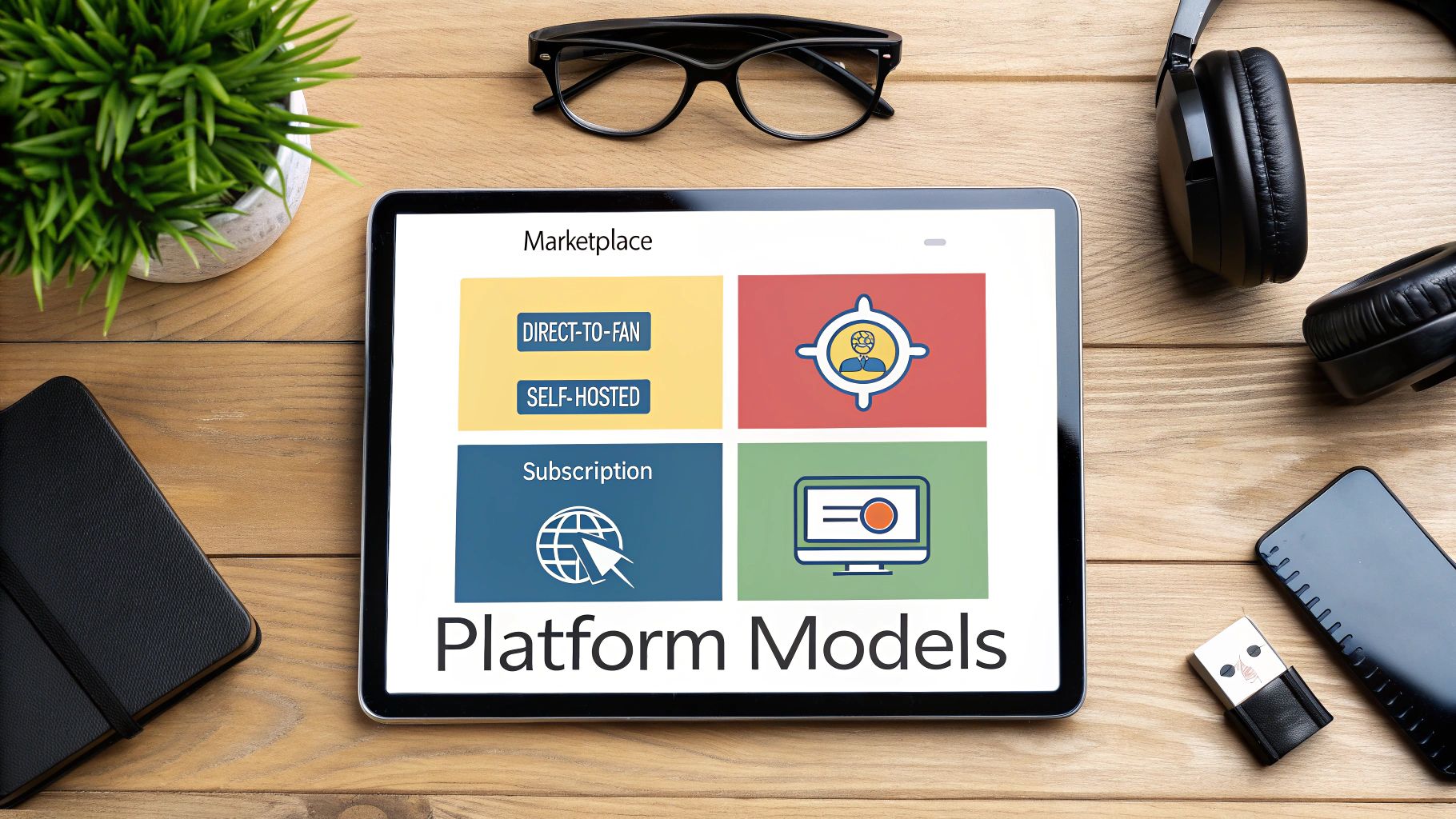
Before you can pick the best platform for selling your music or digital products, you have to realize they aren't all built the same way. Each one operates on a different philosophy, forcing you to make a choice between things like audience reach, creative control, and how much of the revenue you actually keep. Getting this first step right is crucial.
Nearly every platform out there fits into one of four main models. Each is designed for a different kind of creator with a unique set of goals, whether it’s finding a brand-new audience or nurturing a dedicated community. Let's break down what makes each one tick.
Marketplaces Built for Discovery
Think of marketplaces like Beatport, Bandcamp, or even Etsy for digital art as giant online shopping malls. Their biggest selling point is simple: they already have a massive, built-in audience of people actively looking for what you’re selling. If you're just starting out, this can be an incredible way to get your first sales.
But that convenience has its trade-offs. Marketplaces are notorious for taking a significant cut through commissions or fees, which can seriously eat into your profits. More importantly, they own the customer relationship. You rarely get direct access to your buyers' data, which makes building a real, lasting connection with your audience nearly impossible.
Direct-to-Fan Platforms for Control
This is where direct-to-fan (D2F) platforms like OohYeah come in. They are designed to put you, the creator, firmly in the driver’s seat. You get total control over your storefront, your pricing, and—most importantly—your audience data. Every sale gives you a direct line to the person who supported you.
This model is all about empowering artists and maximizing how much money lands in your pocket. Yes, you're more responsible for driving traffic to your store, but the payoff is huge: a loyal fanbase you can connect with directly, long after the transaction is over. It’s perfect for creators who see their audience as a community, not just a list of sales.
Owning the relationship with your fans is the ultimate currency. A direct-to-fan model turns every sale into an opportunity to build a connection that outlasts any single platform or trend.
Self-Hosted Stores for Total Customization
For creators who want absolute control over every single pixel of their brand, a self-hosted e-commerce store is the way to go. Using a platform like Shopify or a WooCommerce plugin for WordPress, you build your digital shop from scratch. This gives you unmatched freedom in design, features, and integrations.
Of course, this path demands the most technical know-how and marketing muscle. You are responsible for absolutely everything—from site security and maintenance to payment gateways and driving all your own traffic. It’s a powerful choice for established artists, brands, or labels that have the team and resources to manage a fully independent online presence.
Subscription Models for Recurring Revenue
Finally, subscription platforms like Patreon completely change the game by shifting the focus from one-off sales to predictable, recurring income. This model is all about community and exclusivity. Fans pay a monthly fee to get special access to content, behind-the-scenes looks, or a closer connection with you.
This approach works wonders for creators who already have a dedicated following willing to support them on an ongoing basis. It’s a huge shift in the digital music market, which is projected to hit USD 56.22 billion by 2031. With streaming's massive 83.30% revenue share often paying fractions of a penny, recurring revenue offers a much-needed sense of stability. You can dive deeper into the data on the digital music market to see how these trends are shaping careers.
Comparing Platform Features That Matter Most
Picking the right platform is about more than just a features checklist. To really know what's best, you have to dig into how each model handles the nuts and bolts of your business—from how you get paid to how you actually connect with the people who support you. The differences might seem subtle at first, but trust me, they have a massive impact on your growth and your bottom line.
Let's break down the most critical criteria for any creator selling digital products. We'll compare the four main models—Marketplaces, Direct-to-Fan, Self-Hosted, and Subscription services—and look at them through the lens of what it takes to build a lasting career.
Revenue and Payouts
Let's start with the most important question: how much money do you actually get to keep? The answer varies wildly across platforms, often buried in a combination of platform fees, transaction costs, and payout schedules. Getting this right is the first step toward making a smart financial decision for your business.
Marketplaces, for instance, are known for taking a hefty revenue share. It’s not uncommon to see cuts as high as 30-50%. The trade-off, of course, is access to their massive, built-in audience, which can offer exposure you might not get on your own.
Direct-to-Fan platforms are built on a completely different philosophy. Their main goal is to put as much money as possible back in your pocket. You might pay a flat monthly fee, but the commission on your sales is usually 0%. This means that outside of standard payment processing fees (typically around 2.9% + 30¢), you keep just about everything you make.
Self-hosted stores give you a similar advantage, but the responsibility for integrating and managing your own payment gateways falls on you, adding a technical hurdle. Meanwhile, subscription models like Patreon also take a percentage, usually somewhere between 5% and 12%, depending on the features you need.
"Your revenue model dictates your business strategy. A platform that takes a high commission forces you to focus on volume, while a commission-free model allows you to prioritize value and direct fan relationships."
Content Control and Delivery
How your digital products are delivered and kept secure is another crucial piece of the puzzle. A producer selling high-resolution sample packs has entirely different needs than a musician offering exclusive streams to their top fans.
Marketplaces and direct-to-fan platforms typically handle all the technical heavy lifting for you. They provide secure file hosting, automated download link delivery, and often, built-in streaming players. This convenience is a huge plus, letting you focus on creating instead of worrying about server space or bandwidth limits.
With a self-hosted store, however, you’re in the driver's seat. This is both a blessing and a curse. You can set up custom solutions for file delivery, including complex licensing or DRM (Digital Rights Management), but you’re also on the hook for the cost and upkeep of that infrastructure. If your server crashes, so does your customers' access to their purchases.
Subscription platforms are designed from the ground up to handle gated content. They are masters at delivering exclusive posts, videos, and audio streams to paying members while keeping everything locked away from the public. Their entire system is built to manage access based on membership tiers.
Audience Data and Engagement
Owning your audience data is, without a doubt, the most valuable long-term asset you can build. It’s the difference between simply selling a product and actually building a business.
This is where you'll find the most dramatic difference between the platform models.
- Marketplaces: You almost never get customer email addresses or contact information. Platforms like Beatport own the relationship, and you are essentially renting access to their audience. This makes it nearly impossible to build your own email list or let your past buyers know about your next release.
- Direct-to-Fan Platforms: Here, the opposite is true. Platforms like OohYeah are founded on the principle of audience ownership. With every single sale, you get direct access to your customer's data, empowering you to build real, lasting relationships through email marketing and direct communication.
- Self-Hosted Stores: You own it all. Every bit of customer data flows directly into your systems, like Shopify, giving you total control for analytics and marketing campaigns.
- Subscription Models: These platforms typically give you the contact info for your patrons, since direct communication is key to keeping your community engaged and reducing churn.
Understanding these differences is critical. You can learn more about what to look for by reading our guide on selecting a platform that offers commission-free sales.
Discovery and Marketing
Finally, you have to consider how each platform helps you find new fans—or if it helps at all. Some platforms are powerful discovery engines, while others are simply toolkits that require you to bring your own audience to the party.
Marketplaces are the undisputed champions when it comes to built-in discovery. Their algorithms, curated collections, and high-traffic homepages are all designed to put new products in front of buyers who are ready to spend. This is their core value proposition.
On the other hand, Direct-to-Fan and Self-Hosted platforms offer very little, if any, built-in discovery. They give you the tools to build a beautiful storefront, but it’s almost entirely up to you to drive traffic to it through social media, SEO, paid ads, and your email list.
Subscription platforms fall somewhere in the middle. While you still need to promote your page, platforms like Patreon have some internal discovery features and a brand that people already know and trust, which can help nudge visitors toward becoming paying members.
The global music landscape really puts these dynamics into perspective. While major streaming services act like marketplaces, the real power is shifting. Globally, paid streaming now accounts for 57.1% of music industry revenue, completely dwarfing digital downloads, which have fallen to just 3%. This trend is a clear signal that creators need to adapt, moving toward subscription and direct-fan models to build a sustainable income. You can dive deeper into these numbers in the latest industry report on music streaming market share.
Platform Model Feature Comparison for Musicians
To make things even clearer, let's put these models side-by-side. This table breaks down how each platform type stacks up against the key features we've discussed, helping you see at a glance which one aligns best with your goals.
| Feature | Marketplaces (e.g., Beatport) | Direct-to-Fan (e.g., OohYeah) | Self-Hosted (e.g., Shopify) | Subscription (e.g., Patreon) |
|---|---|---|---|---|
| Revenue Share | High (30-50% commission) | 0% commission (flat fee model) | 0% platform commission | Low (5-12% commission) |
| Audience Ownership | No access to fan data | Full ownership of fan data | Full ownership of all data | Full access to patron data |
| Discovery | High (built-in audience) | Low (bring your own audience) | Low (bring your own audience) | Medium (some internal discovery) |
| Technical Control | Low (platform-managed) | Medium (customizable storefront) | High (full control over everything) | Low (template-based pages) |
| Setup & Maintenance | Very easy (just upload) | Easy (guided setup) | Complex (requires technical skill) | Easy (guided setup) |
| Best For | Reaching a new, large audience | Maximizing profit and fan relationships | Full brand control and custom needs | Building a recurring revenue community |
Ultimately, there's no single "best" platform—only the one that's best for you. Use this comparison to weigh the trade-offs. Are you willing to give up a larger revenue share for easy discovery, or is owning your fan relationships the most important thing? Your answer will point you in the right direction.
Matching the Right Platform to Your Career Stage
It's one thing to compare platforms in a vacuum, but the real test is figuring out which one actually makes sense for your career, right now. There’s no single "best" platform for selling digital products—it's a strategic choice that needs to line up perfectly with where you are on your journey and how big your audience is. What works wonders for a producer with a massive following could be a total misstep for an artist just starting to build their name.
To nail this, you have to be honest with yourself about your current situation. Are you all about raw discovery, just trying to get your sound in front of as many new ears as possible? Or is your main goal to strengthen the bond with your existing fans and make the most out of every single supporter? Each of those goals points you in a very different direction.
This decision tree can help clear things up, guiding you based on what you value most: maximizing your reach, taking full control, or setting yourself up for serious growth.
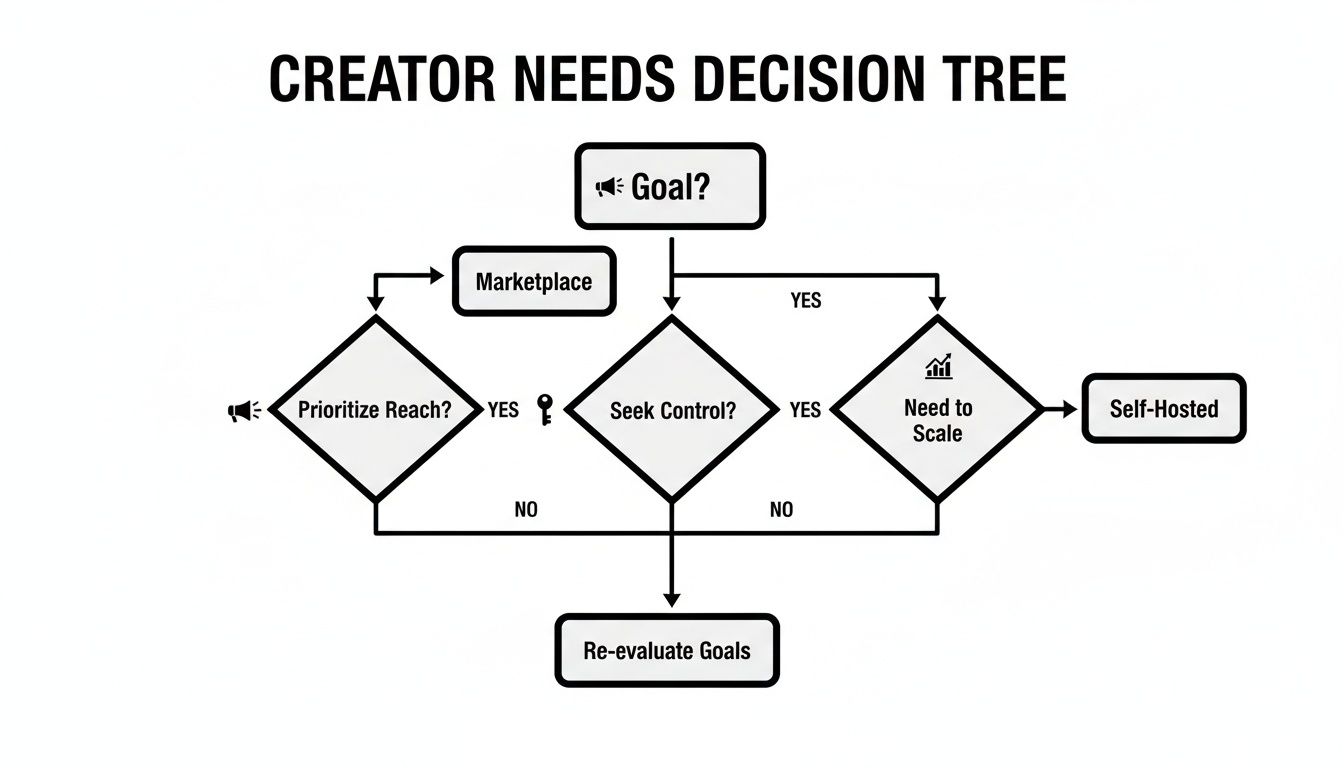
As you can see, your core objective directly maps to a specific type of platform. Following this logic helps you avoid that frustrating mismatch between your strategy and the tools you're using to execute it.
For the Emerging Independent Artist
If you're just starting out, you're playing a two-part game: building a loyal fanbase while trying to make your first real income from your music. The big, shiny marketplaces can seem tempting, but honestly, your best bet is often a direct-to-fan platform. It hits that sweet spot between being easy to use and giving you the control you need to grow.
This approach lets you own your audience data—easily the most valuable asset you can build early on. Every time someone buys a track or a t-shirt, you get their email. That means you can let them know about your next single, a new music video, or a last-minute gig. It’s a direct line of communication that marketplaces simply can’t and won't give you.
For a new artist, every single fan interaction is gold. A direct-to-fan platform turns each sale into a potential long-term relationship, building a foundation for a sustainable career instead of just a one-off transaction.
For the Established Music Producer
Let's say you're an established producer selling sample packs, beat leases, or project files. Your world looks a little different. Your customers are often more niche, even professional, and they expect robust file delivery and crystal-clear licensing terms. Discovery is still nice, but your top priority is a platform that can reliably handle complex digital products and secure transactions.
This is where a direct-to-fan platform with beefed-up e-commerce features or even a self-hosted store really comes into its own. These options give you:
- Flexible Product Types: You can effortlessly sell different file formats (WAV, MP3, project files) and bundle them up however you like.
- Licensing Control: Attaching specific license agreements—like non-exclusive or exclusive rights—to your beats is crucial, and these platforms make it straightforward.
- High-Profit Margins: Let’s be real, when you’re selling higher-priced products, giving away a 30-50% cut to a marketplace is a massive hit to your bottom line.
Your brand and professional network are already doing the heavy lifting of driving traffic. The smart move is to use a platform that lets you keep more of the revenue from the audience you built.
For the Independent Label
Running an indie label is a whole other level of complexity. You're managing releases, merch, and marketing for multiple artists. The name of the game is scalability, centralized management, and analytics that actually tell you something useful. You need a system that can handle a diverse catalog while giving you a clear view of what’s selling, where, and for which artist.
An all-in-one ecosystem or a powerful self-hosted solution is almost always the right call here. A platform that merges a storefront, fan engagement tools, and analytics into one dashboard simplifies the monumental task of juggling several artist careers at once. You can set up separate artist pages under a single label account, track sales for every release, and run campaigns from a central hub.
This kind of integrated approach saves an incredible amount of admin time and creates a cohesive brand experience for fans, no matter which artist on your roster they’re checking out. It ensures that as your label grows, your backend operations can keep up without turning into a chaotic mess of different tools. Your focus stays on the music, not on wrestling with software.
When Does an All-in-One Ecosystem Make Sense?
We've walked through the different ways to sell your music online. Marketplaces get you in front of new ears, direct-to-fan platforms give you control, and subscription services create steady income. But what if you’re tired of juggling three different services to get the job done? That's precisely when a unified, all-in-one ecosystem becomes a game-changer.
An integrated platform isn't just about convenience. It pulls the best features from each model into a single, cohesive home for your music business. For creators who are weary of multiple logins, scattered analytics, and a disjointed brand experience, this approach finally simplifies things. It handles the business side so you can get back to the music.
The Power of a Unified Platform
Imagine your digital store, streaming player, fan club, and direct messaging all living under one roof. When every tool works together, you unlock deeper insights into your audience and build much stronger relationships. It’s about creating a seamless world for both you and your fans.
This unified model directly addresses the biggest weaknesses of other platforms. You get the audience ownership of a direct-to-fan store, the recurring revenue of a subscription service, and the discovery potential of a community marketplace—all without the high commission fees that eat into your earnings.
An all-in-one ecosystem stops you from being just another vendor on someone else’s platform. It gives you a digital headquarters to run your entire music business on your own terms.
This is especially valuable for musicians who wear a lot of hats. Maybe you sell beats, offer mixing services, run a fan club, and sell merch. A unified system lets you manage every one of those income streams from a single dashboard, giving you a clear, holistic view of your career’s financial health.
Key Features of a Music-First Ecosystem
A true music-first ecosystem is more than just a bundle of tools; it’s a thoughtfully integrated environment designed to help musicians thrive. The entire point is to give you a complete toolkit that supports every stage of your career, from creation and monetization to genuine fan engagement.
Think about how these features connect and build on each other:
- Commission-Free Marketplace: Sell your music, merch, and digital files directly to fans and keep 100% of the revenue. This is a foundational principle. It ensures your hard work actually translates into income, unlike traditional marketplaces that can take a huge bite out of your sales.
- Built-in Subscription Tools: Launch your own fan club with different membership tiers, offering exclusive content, early access, and direct interaction. This builds a predictable, recurring revenue stream, which is a massive win for financial stability. To learn more, check out our guide on how to use Patreon and subscription models to build a loyal community.
- Direct Fan Messaging: Go beyond one-way social media posts. An integrated system lets you send direct messages, voice notes, and private updates to your followers. This fosters a real connection that can turn casual listeners into lifelong supporters.
- Robust, Consolidated Analytics: Instead of trying to piece together data from three different services, you get a single, clear picture of your audience. See who’s buying, who’s streaming, and who’s subscribing, all in one place. That means smarter marketing decisions and a much deeper understanding of what your fans actually want.
Who Benefits Most from an Ecosystem?
While any creator can appreciate a more streamlined workflow, this model is a real powerhouse for artists and labels focused on sustainable, long-term growth. It's built for the creator who gets that their audience is their most valuable asset and wants to build a direct, multifaceted relationship with them.
This solution is a perfect fit if you are:
- An Independent Artist: You need powerful tools without the complexity or high costs. An ecosystem gives you everything to manage your sales, community, and marketing from one spot.
- A Producer or DJ: You can sell sample packs, DJ mixes, and exclusive tracks while also offering mentorship or feedback through a subscription tier.
- An Independent Label: Manage multiple artists under one roof, with consolidated analytics and a unified brand presence for all your releases and merchandise.
In the end, choosing an all-in-one ecosystem is a strategic move to invest in your own brand and community. It provides one of the best platforms for selling digital products by combining total financial control with powerful fan engagement tools—the perfect foundation for a lasting career.
Frequently Asked Questions
Choosing where to sell your digital products goes way beyond a simple feature list. It's about your long-term vision, how you want to connect with your audience, and where you should invest your time and energy, especially when you're just starting out. Let's tackle some of the most common questions that pop up.
Getting these fundamentals right will give you a much clearer path toward building a creative business that lasts.
Should I Sell My Digital Products on Multiple Platforms?
It’s easy to think that listing your products everywhere will get you the most eyes, but that strategy usually comes with some serious hidden costs. Sure, selling on a big marketplace and your own direct-to-fan store at the same time might get you a few more initial sales. But you’re also splitting your audience and doubling (or tripling) your admin work.
A multi-platform approach means you’re juggling different storefronts, trying to make sense of analytics from all over the place, and handling customer support through separate systems. That’s a fast track to burnout, and it pulls you away from what you should be doing: creating. The discovery boost from a marketplace is tempting, but it often comes at the expense of building a loyal, centralized audience that’s truly yours.
Spreading yourself too thin is a classic mistake. You’re almost always better off picking one primary platform that aligns with your goals and funneling all your energy into driving traffic there.
Focusing on an exclusive, direct-to-fan platform means you can build one real home for your brand. Every piece of marketing points to a single destination, which strengthens your identity and makes it so much easier to build a genuine relationship with every person who supports you.
How Important Is Owning My Fan Data?
Honestly? It's not just important—it's everything. Owning your fan data is probably the single most critical asset you have for building a sustainable career. When a marketplace or social media platform makes a sale for you, they might give you a cut of the money, but they keep the most valuable part: the customer’s information. You get the cash from that one transaction, but they own the relationship.
Think about what that means. You can't email that person about your next release. You can't invite them to an exclusive online event. You can't even figure out who your most dedicated supporters are. You're basically renting an audience, and if that platform's algorithm changes or it falls out of fashion, your connection to those people vanishes.
When you have direct access to your fan data—names, emails, purchase history—your entire business changes.
- Direct Marketing: You can build an email list and talk to your audience whenever you want, without having to pay a platform to reach them.
- Deeper Insights: Your own data shows you exactly who’s buying what. That lets you make more of what your fans actually want.
- Career Sustainability: An audience you own is an asset you can take with you anywhere. It gives you the freedom to evolve and adapt, no matter what happens to any single platform.
What Is the Best Platform for Someone Just Starting Out?
If you're just getting started, you need a platform that’s easy to get going on but won't hold you back later. Marketplaces look simple at first, but they can teach you bad habits by making you dependent on their traffic instead of teaching you how to build your own audience. The best starting point is a platform that gives you both simplicity and control.
A direct-to-fan platform with a straightforward setup process is usually the perfect fit. These tools take care of the technical headaches—like secure file delivery and payment processing—but you get full ownership of your brand and fan data from day one. It’s an approach that gets you into the habit of building your own community right away.
Look for a platform that lets you start small, maybe with just a single track or a sample pack, but has the features you'll need as you grow. Down the road, you'll want to add subscriptions, sell more complex product bundles, and dig into your sales data. Starting on a platform that can scale with you means you won't have to deal with a painful migration later on. It sets you up for the long haul, right from the beginning.
Ready to take full control of your music business? Join OohYeah and start selling your digital products commission-free while building a direct connection with your fans. Sign up for free today!