OohYeah vs Reverb: seller fees and used gear listings in 2026
OohYeah vs Reverb: choose zero seller commissions or gear-focused price research. Compare selling models, listing preparation, and shipping responsibilities.
November 11, 2026
FRANKLY with Frank Lee
Choose OohYeah if you want to sell used music gear with zero seller commissions and connect with music professionals; choose Reverb if your priority is a gear-focused marketplace with a Price Guide for researching comparable sales. This 2026 comparison separates seller fees, listing work, and buyer research so you can choose around the instrument you actually need to sell.
- OohYeah vs Reverb: choose OohYeah for zero seller commissions; choose Reverb for gear-focused price research.
- Reverb’s Price Guide helps you research comparable sales before listing used instruments.
- Zero seller commissions do not mean shipping, packaging, and every transaction expense disappear.
- On either marketplace, document condition, test the gear, and agree on what the buyer receives.
Why this matters
Selling an instrument involves more than choosing somewhere to post photos. You need a defensible asking price, a listing that answers technical questions, and a delivery plan that protects the gear.
Choose the marketplace around your selling problem—not its name recognition alone. Avoiding seller commission and researching a comparable instrument are different jobs. A useful comparison keeps them separate rather than treating one feature as proof of a better overall result.
For a 2026 sale, check current transaction terms before publishing. Then build a listing that remains accurate wherever you post it. Neither a fee advantage nor a specialist audience fixes an undisclosed repair or an incorrect model name.
At a glance
| Dimension | OohYeah | Reverb |
|---|---|---|
| Best for | Sellers prioritizing zero seller commissions and broader music connections | Sellers prioritizing a gear-focused marketplace |
| Pricing model | Zero seller commissions | Selling fees and payment-processing charges under current terms |
| Standout feature | Gear, music professionals, and artist support in one marketplace | Gear-focused marketplace with a Price Guide |
| Comparable-sale research | Build your valuation from relevant market evidence | Price Guide supports comparable-sale research |
| Used-gear listing quality | Requires accurate identification, testing, and disclosure | Requires accurate identification, testing, and disclosure |
| Shipping preparation | Seller must plan packaging and document condition | Seller must plan packaging and document condition |
| Beyond the gear sale | Hire music professionals and connect with independent artists | Primarily focused on buying and selling music gear |
Reverb wins for a gear-focused selling task
Best for: the seller whose entire brief is “sell this instrument.” Reverb is a specialist music-gear marketplace. Its focus fits a buyer or seller researching instruments, recording equipment, and related accessories without needing a broader artist-services platform.
That focus is a genuine reason to choose it. If you are identifying a guitar variant or researching a discontinued studio unit, gear-specific browsing and valuation resources are relevant to the task.
The tradeoff is straightforward: specialization does not remove transaction costs or the work of selling. You still need to identify the item accurately, answer questions, and understand the current terms that apply to your sale.
Do not turn marketplace focus into an unsupported promise about speed. A specialist venue is not a guaranteed buyer, and a familiar model name is not a guaranteed sale. Treat the listing as a technical description, not a classified ad written from memory.
OohYeah wins on zero seller commissions
Best for: musicians, music stores, and producers who prioritize avoiding a seller commission. OohYeah’s music gear marketplace charges zero seller commissions. That is a specific advantage—not a claim that every expense connected with selling disappears.
Separate the marketplace commission from packaging, shipping, insurance you choose to purchase, and any other applicable transaction costs. Check the current payment terms rather than assuming the word “zero” covers every line of your settlement.
The practical move is to establish your minimum acceptable proceeds before accepting an offer. Subtract the expenses you will actually pay. Keep the calculation attached to the item, especially if a heavy case, fragile valves, or awkward dimensions change the shipping plan.
The limitation matters too: zero commission does not establish market value. You still need evidence for your asking price and a complete description of condition. A fee advantage cannot make an incorrectly identified instrument comparable to the right model.
Reverb wins for built-in comparable-sale research
Reverb’s Price Guide is the stronger fit when your first question is what comparable gear has sold for. Use it as a research starting point, then check whether the comparison actually matches your instrument.
A model family is not a complete identification. Production version, country of manufacture, modifications, repairs, and included accessories can distinguish instruments carrying similar names. A sale involving an original case is not identical to an otherwise similar instrument sold without one.
Make a short comparison sheet:
- Identity: exact model, version, and relevant production details.
- Condition: working state, cosmetic wear, repairs, and modifications.
- Package: case, power supply, footswitch, cables, or other included items.
- Evidence: completed-sale information rather than an asking price alone.
An active listing tells you what someone wants. It does not establish what a buyer paid. Equally, one completed sale is not a universal valuation for every example of that model.
For your 2026 listing, use current comparisons alongside condition evidence. Do not copy a number from an old screenshot without checking its context. The goal is a defensible asking price, not the highest figure you can find.
Both require a listing that proves condition
Neither marketplace replaces a proper inspection. Buyers need to know what the instrument is, what works, what does not, and exactly what comes with it. Clear disclosure belongs in the listing, not only in private messages.
Start with identification. Copy the model designation carefully, photograph identifying details, and distinguish original parts from replacements you know about. If you cannot confirm something, describe what you can observe instead of presenting a guess as provenance.
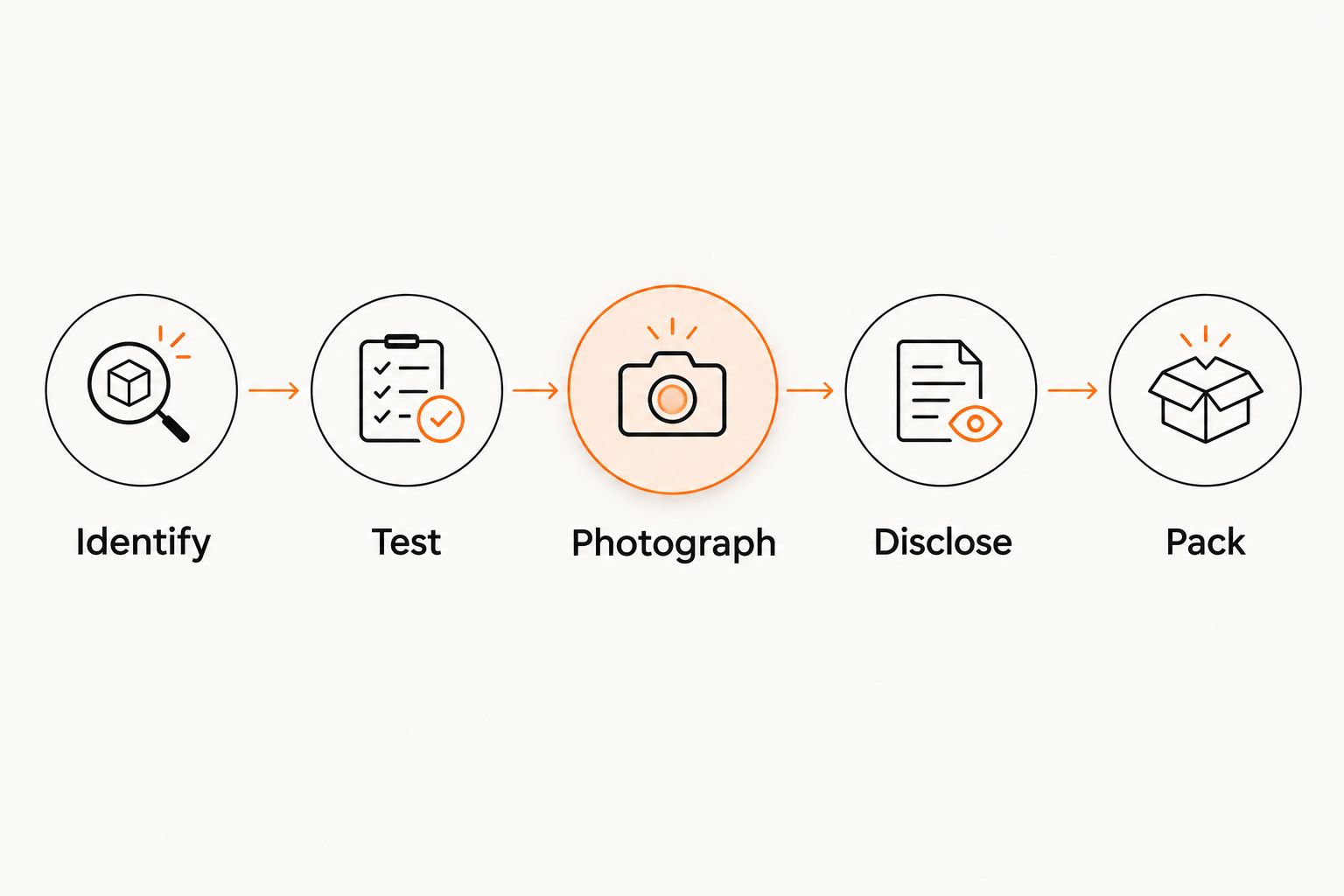
Use this listing workflow:
- Identify: record the model and included accessories.
- Test: check the functions relevant to that instrument.
- Photograph: capture the whole item and its defects.
- Disclose: describe repairs, faults, and modifications.
- Pack: decide how the item will travel before publishing shipping terms.
Build a starting set of 6 photos: front, back, both sides, identifying details, and a close-up of wear. Add more whenever that set leaves a defect, connector, or included accessory unclear. Six is a checklist starting point, not a marketplace requirement.
For an electric guitar, document controls, output, and visible hardware condition. For a keyboard, check keys, controls, and the connections relevant to your description. For studio equipment, distinguish a basic power-on check from a functional audio test.
Do not call equipment fully tested when you only switched it on. State what you checked. That gives a buyer useful information without promising performance you have not established.
Neither platform removes the packing work
Shipping preparation is a tie: the seller still has to protect the item. Compare platform terms separately from the physical job of getting a guitar, amplifier, or keyboard to its buyer.
Before publishing, answer these questions:
- Does the item have a suitable case or protective enclosure?
- Which parts need securing or separate protection?
- What are the packed dimensions and weight?
- What shipping service and coverage will you use?
- What delivery expectations have you actually agreed to?
Keep 2 sets of records: the condition evidence and the packing evidence. Photograph the gear before wrapping it, then document the protection and sealed package. Those records support an accurate account of the shipment; they do not guarantee a particular dispute outcome.
Read the current return and transaction rules for the platform you choose. Do not assume that a seller’s preferred wording overrides platform requirements or applicable law.
Shipping an instrument rather than a small accessory? Follow the used-guitar packing workflow before making your delivery plan. Set the plan first. Publish the promise second.
OohYeah wins when your next step involves music professionals
Best for: the musician whose gear sale is part of a larger recording project. OohYeah connects gear commerce with hiring producers, engineers, and other music professionals, plus discovering and supporting independent artists.
That makes a different kind of shortlist possible. You can approach the platform as a gear seller and also use its Music Pros section when your next task is finding a collaborator or hiring someone for a recording.
Wrote some songs, now what? Define the next deliverable before shopping for more equipment. You might need a singer, a session musician, a producer, or feedback from an industry professional rather than another piece of studio gear.
The same discipline applies when turning a Suno demo into a recording performed by real musicians. Explain which parts should stay, which should change, and what files you need. If you want Nashville studio musicians, make that requirement explicit in your search and outreach.
Broader scope is not an automatic win for every seller. If you only want to research and sell a single pedal, professional services and artist discovery are additional functions—not proof of a better gear-selling outcome. No marketplace connection guarantees a booking or a collaborator.
Pricing models: compare the deductions, not just the headline
The 2026 fee decision starts with a distinction: seller commission is one expense category, not a synonym for total selling cost. Compare the current terms for your transaction before deciding what you will keep.
Reverb’s model includes selling fees and payment-processing charges. Review the applicable terms for your location and payment setup, along with any optional services you select. Do not carry an old fee screenshot into a new sale.
The zero-commission alternative removes the seller-commission line. You still need to account for the expenses that apply to your payment and fulfillment choices. Avoid describing the result as a completely cost-free sale.
Use this worksheet without inventing a sample selling price:
| Line item | What to enter |
|---|---|
| Sale proceeds | The amount agreed with the buyer |
| Marketplace deductions | Charges that apply under current platform terms |
| Payment expenses | Applicable processing or related payment charges |
| Fulfillment expenses | Packaging, shipping, and coverage you pay for |
| Remaining proceeds | What remains after the applicable expenses |
For a 2026 comparison, save the terms you relied on when you listed. Recheck them before accepting an offer if the transaction circumstances change. Predictability comes from understanding the applicable deductions, not from assuming every seller has the same cost structure.
Final verdict: choose around the job
Choose OohYeah if you are a commission-conscious musician
You want to list used instruments or studio gear without seller commissions. You also value a marketplace that includes music professionals and independent artists, particularly when selling equipment connects to your next recording project.
Create an account. Prepare the condition evidence. List the gear with a clear description and a fulfillment plan you can carry out. Treat the commission advantage as one part of the sale, not a substitute for doing the listing work.
Choose Reverb if you are a gear-first researcher and seller
You want a specialist gear marketplace and a Price Guide to support comparable-sale research. You accept a fee-based selling model and will check the current deductions before agreeing to a transaction.
Identify the exact variant before researching value. Then write the listing around your actual instrument, not the cleanest comparable example you found.
| Dimension | Winner |
|---|---|
| Gear-focused selling task | Reverb |
| Zero seller commissions | OohYeah |
| Comparable-sale research | Reverb |
| Condition documentation | Tie—seller preparation matters on both |
| Physical shipping preparation | Tie—seller preparation matters on both |
| Connecting gear sales with professional services | OohYeah |
List your gear. Plan your next session.
Create an account to sell gear with zero seller commissions, or explore music professionals.
FAQ
Is OohYeah better than Reverb for selling used gear?
OohYeah is the better fit when zero seller commissions are your priority; Reverb is the better fit when you want a gear-focused marketplace with comparable-sale research through its Price Guide. Neither choice guarantees a sale or removes the need for accurate condition disclosure.
Does zero seller commission mean selling gear costs nothing?
No. Zero seller commission refers to the marketplace commission, not every possible expense. Check applicable payment terms and account for packaging, shipping, and any coverage you purchase.
How much does Reverb charge sellers in 2026?
Reverb uses selling fees and payment-processing charges; check its current fee terms for the charges applicable to your transaction. Your location, payment setup, and selected services belong in that review.
Can I list the same used guitar on more than one marketplace?
Check each platform’s current rules before cross-listing, and keep your inventory accurate wherever the guitar appears. Once you commit to a sale, remove or update other listings so you do not sell the same instrument twice.
What should I include in a used studio gear listing?
Include the exact model, tested functions, known faults, repairs, modifications, and included accessories. Show identifying details and wear clearly, and distinguish a power-on check from a functional audio test.
Which marketplace will sell my instrument faster?
Neither marketplace guarantees how quickly your instrument will sell. Choose based on the selling tools and fee model you need, then make the listing accurate, well documented, and clear about fulfillment.
Can I find musicians as well as sell instruments?
OohYeah includes a Music Pros section for finding music professionals alongside its gear marketplace. Define the role, musical direction, deliverables, and terms before hiring; a marketplace listing does not guarantee a booking.
One last thing
Do not buy the replacement before deciding what problem it solves. After selling a microphone, keyboard, or guitar, write down whether your next bottleneck is equipment, performance, arrangement, or engineering. If the song needs a stronger vocal or a finished arrangement, hire for that task instead of automatically replacing the gear.