OohYeah vs Fiverr: comparing mastering services in 2026
OohYeah vs Fiverr mastering: choose a music network or packaged freelance services. Compare engineer fit, project scope, revisions, and delivery needs.
November 10, 2026
FRANKLY with Frank Lee
Choose OohYeah if you want mastering within a music-focused network that also connects you with producers and other collaborators; choose Fiverr if you want to compare packaged freelance services for an already-defined job. This 2026 comparison separates marketplace fit from the engineer’s actual sound—because those are different decisions.
- OohYeah vs Fiverr mastering comes down to a music-focused network versus a broader freelance marketplace.
- Choose OohYeah for music collaboration beyond mastering; choose Fiverr for comparing clearly scoped freelance packages.
- Neither marketplace name proves mastering quality. Judge the engineer’s relevant work and written deliverables.
- Finish the mix, confirm revisions, and agree on file formats before booking mastering services.
Why this matters
Mastering is the final audio preparation stage, not a replacement for recording or mixing. A mastering engineer evaluates the finished mix, makes tonal and dynamic adjustments, and prepares agreed delivery files. An uneven vocal balance or a missing guitar part usually needs attention earlier.
OohYeah is the better music marketplace fit for artists who want mastering alongside a wider collaboration network. Its Music Pros section fits a workflow that can also involve producers, engineers, singers, and session musicians. Start with OohYeah when you need that broader musical context, rather than treating every production problem as a mastering problem.
For a 2026 release, decide what you need before comparing providers. A finished single with an approved mix calls for a different brief than a songwriter’s demo that still needs performances and production.
At a glance
| Dimension | OohYeah | Fiverr |
|---|---|---|
| Best for | Artists building a wider music collaboration network | Buyers comparing freelancers across different service categories |
| Standout feature | Music professionals, gear commerce, and artist support in one marketplace | A broad freelance catalog extending beyond music |
| Service format | Start with the music professional and establish the project scope | Compare gig packages and request a custom offer when needed |
| Mastering quality | Evaluate the individual engineer’s relevant work | Evaluate the individual engineer’s relevant work |
| Pricing model | Confirm the professional’s service scope and current terms | Compare package inclusions or a custom offer’s terms |
| Seller focus | Music-centered positioning and zero seller commissions | A general freelance setting for offering defined services |
The table compares buying contexts, not audio results. Neither a specialized marketplace nor a neatly described package proves that a particular engineer understands your record.
OohYeah wins for a music-first collaboration brief
Best for: songwriters and independent artists whose next step extends beyond mastering.
“Wrote some songs, now what?” is the right question when your recording is not finished. You might need a singer to interpret the melody, a producer to shape the arrangement, or an engineer to mix the performances before anyone masters the result.
A music-focused marketplace fits that search. You can approach the project as a chain of musical decisions instead of assuming the final processing stage will solve everything.
That matters when turning a Suno demo into a recording performed by real musicians. Use the demo to explain the arrangement and feel, clarify your rights to the material, and define what the musicians will record. Hire Nashville studio musicians when that specific experience fits your project—not because a location guarantees a sound.
The limitation is straightforward: music focus is not proof of mastering expertise. Ask the professional for relevant examples and a clear description of the work. A producer’s excellent arrangements do not automatically establish experience delivering finished masters.
Fiverr wins when you need services beyond music
Best for: self-managing artists who want a general freelance marketplace for separate release tasks.
Fiverr covers more than audio. That makes it a better fit when your shopping list also includes services such as graphic design, video editing, or copywriting, and you prefer to search within a broad freelance environment.
The advantage is category breadth, not a guaranteed coordinated release team. Treat mastering, artwork, and promotional assets as separate assignments unless the providers explicitly agree otherwise.
The tradeoff is that a wide catalog does not organize your music project for you. You still need to know which specialist you are hiring and where that specialist’s responsibility ends.
For example, an artwork designer does not decide your master’s file requirements. A mastering engineer does not automatically handle distribution. Put those responsibilities in the brief instead of assuming that buying related services creates a managed release.
Fiverr wins for package-first comparison
Best for: buyers with an approved mix and a precise delivery checklist.
Fiverr’s gig format gives you a package-first way to compare services. Read the scope, examine what each package includes, and ask for a custom offer when your project falls outside those boundaries.
That approach suits a buyer who can already describe the assignment: the number of tracks, intended release formats, required alternate versions, and revision expectations. A written package makes comparison easier only when the underlying jobs match.
Do not compare one offer covering basic stereo mastering with another covering extra versions and additional revision work as if they were identical. Package names are not technical specifications.
The limitation is scope mismatch. A tidy package can still be the wrong purchase if your mix needs repair or your album needs sequencing decisions that were never discussed.
For either marketplace, ask the engineer to confirm:
- Source files: a finished stereo mix or separately grouped stems.
- Deliverables: the exact master files and alternate versions.
- Revisions: what changes are included and what counts as new work.
- Timing: when the first delivery and subsequent revisions are due.
- Approval: how you confirm the final version.
Neither marketplace wins on mastering quality alone
Best for: every artist comparing actual engineers rather than platform reputations.
The platform helps you find a provider. The provider makes the audio decisions.
Listen to work that resembles your record in the ways that matter: arrangement density, low-end weight, vocal presentation, and dynamics. An impressive acoustic master does not answer every question about how an engineer handles a dense electronic mix.
Ask whether an example reflects mastering alone or also includes production and mixing. Otherwise, you risk crediting the mastering stage for decisions made earlier.
When comparing a mix with a master, match playback loudness as closely as practical. Louder playback can influence preference; the useful question is whether the master improves balance, clarity, translation, and control without damaging the performance.
In 2026, a release-ready file is still about more than loudness. Listen for distorted transients, harsh vocals, unstable bass, and a chorus that loses impact after heavy processing.
A strong engineer explains the choices in terms of your song. Equipment lists and technical vocabulary are secondary to relevant work and clear communication.
Pricing models: compare scope before the total
Neither platform wins on value until the offers cover the same job. Compare current terms directly and keep your brief identical across providers.
On Fiverr, examine the package or custom offer. Check whether the quoted scope includes all tracks, requested alternate versions, revisions, and the delivery schedule you need.
For a Music Pros inquiry, establish those same items with the professional. Do not assume a universal mastering package or a platform-wide delivery policy.
A fixed scope offers predictability when your mix is approved and your requirements are settled. A custom scope gives you room to describe album sequencing, unusual deliverables, or an incomplete production—but those details need agreement before work starts.
Ask what happens if you replace the mix after mastering begins. Changing a vocal level in the source mix is different from requesting a tonal adjustment to the supplied master.
For your 2026 budget, compare the complete assignment rather than the smallest advertised service. A narrower offer is not better value if it leaves out files you need.
OohYeah wins on explicitly music-centered seller positioning
Best for: musicians and engineers who want to present their work within a music-focused marketplace.
The brand explicitly emphasizes zero seller commissions and serving musicians, gear sellers, producers, engineers, and artists. That is a clear music-community position, rather than a general freelance identity.
Keep the distinction between seller positioning and a mastering agreement. Confirm the terms that apply to your particular service; zero seller commissions does not define the engineer’s deliverables, revision policy, or payment schedule.
For engineers offering services, write a listing around the work you actually perform. State whether you provide stereo mastering, stem mastering, mix feedback, or another defined service. Include relevant examples without claiming credits you cannot substantiate.
Fiverr remains a genuine alternative for a provider who wants to present a tightly packaged service in a general freelance catalog. Neither marketplace guarantees inquiries or bookings.
The practical move is the same: explain the result, define the boundaries, and tell the buyer what to send. Clear service descriptions help both sides avoid an assignment neither intended.
Get your song ready before you book
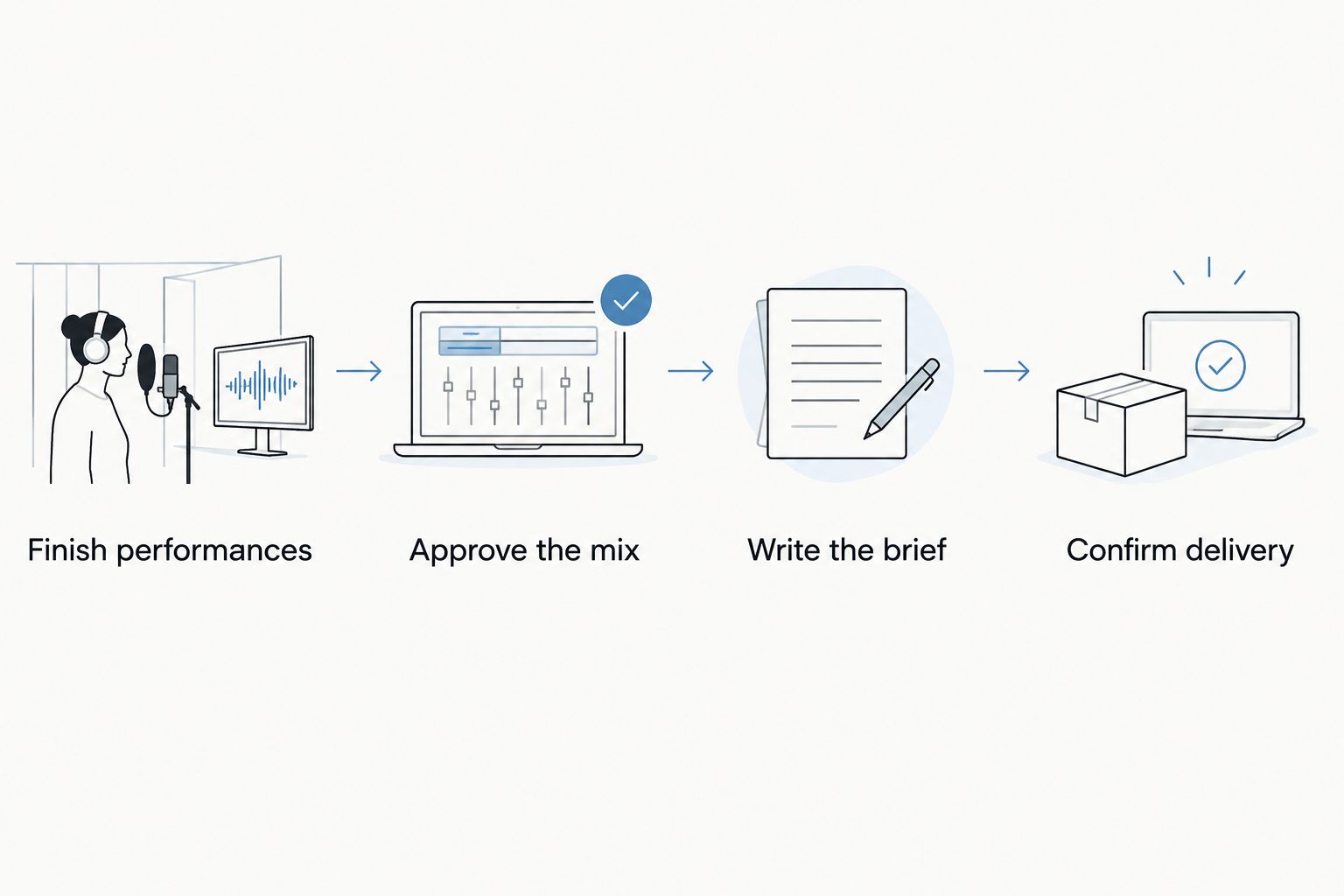
A useful mastering brief follows a simple sequence. Complete the musical decisions first; then agree on the final technical delivery.
- Finish performances. Record the vocals and instruments the released version needs.
- Approve the mix. Resolve balance, editing, noise, and arrangement problems.
- Write the brief. Describe the intended sound, reference tracks, formats, and deadline.
- Confirm delivery. Agree on files, revisions, and approval before work starts.
Ask the engineer what source format they want. A 24-bit WAV is a common working format; 44.1 kHz and 48 kHz are standard sample rates. Keep the project’s native sample rate unless the engineer requests conversion, and do not assume that converting a lower-resolution file restores lost detail.
Do not remove intentional mix-bus processing blindly. Explain what is part of the sound and ask whether the engineer wants an additional version without final loudness processing.
For a songwriter who still needs outside ears, request song feedback from an industry professional before paying for the finishing stage. An arrangement note is much easier to act on before the final mix is approved.
Find your next music collaborator
Explore Music Pros for production, engineering, and the performances your song needs.
Final verdict: choose the workflow your record needs
Choose OohYeah if you are building the recording team
Named profile: the songwriter moving from demo to finished record. You want a music-focused setting for finding producers, engineers, singers, and session musicians, with mastering as one step in that process.
Use the Music Pros section to explore collaborators. Confirm each person’s role and relevant work; do not assume every professional supplies every stage.
Choose Fiverr if you are buying a defined freelance assignment
Named profile: the self-managing artist with an approved mix. You know the deliverables, want to compare packaged services, and value access to freelance categories beyond music.
Choose an engineer whose examples fit your record. Then make the written offer match your actual release requirements.
| Dimension | Winner |
|---|---|
| Music-first collaboration brief | OohYeah |
| Non-music freelance categories | Fiverr |
| Package-first service comparison | Fiverr |
| Mastering quality | Tie: judge the individual engineer |
| Pricing model and value | Tie: compare equivalent scopes |
| Explicit music-centered seller positioning | OohYeah |
FAQ
Is OohYeah or Fiverr better for mastering in 2026?
OohYeah fits artists seeking a music-focused collaboration network; Fiverr fits buyers comparing packaged freelance services. Neither platform establishes an individual engineer’s sound or suitability, so review relevant work and confirm the assignment.
Can mastering fix a bad mix?
Mastering is not a substitute for fixing the mix. Problems such as an overly loud vocal or an unbalanced instrument usually need changes in the mix, where those elements remain separately adjustable.
How do I compare mastering offers?
Compare offers against the same written brief. Match the track count, source files, deliverables, revision scope, and schedule before evaluating the complete terms.
Do I need stereo mastering or stem mastering?
Stereo mastering works from a finished mix, while stem mastering uses separately grouped elements such as vocals, drums, and instruments. Ask the engineer which approach addresses your specific problem; supplying stems changes the assignment.
Can I send a Suno demo straight to a mastering engineer?
Mastering can process the supplied audio, but it does not turn a Suno demo into a recording performed by real musicians. If real performances are your goal, arrange recording, production, and mixing before mastering.
What files should I send for mastering?
Send the format your chosen engineer requests, normally a suitable uncompressed source rather than a lossy listening copy. Confirm the sample rate, bit depth, and treatment of mix-bus processing before exporting.
Can engineers find guaranteed mastering work on either marketplace?
Neither marketplace guarantees mastering work or bookings. Engineers should describe their services accurately, provide relevant examples, and define what buyers receive.
One last thing
Before approving your 2026 master, listen across a transition—not just to the loudest chorus. Check the entrance from the verse, the weight of the first kick, and the space around the vocal. Approve the musical result, not just the louder file.