OohYeah vs AirGigs: hiring remote session musicians in 2026
OohYeah vs AirGigs: choose broader music commerce or a focused remote-session search. Compare musician fit, recording briefs, files, and hiring terms.
November 10, 2026
FRANKLY with Frank Lee
Choose OohYeah if hiring musicians sits alongside selling gear and building artist support; choose AirGigs if your immediate job is finding a remote musician for a defined recording part. This 2026 comparison separates platform fit from the details that actually get your song recorded: the player, the brief, the files, and the agreement.
- OohYeah vs AirGigs comes down to a broader music marketplace versus a focused remote recording search.
- OohYeah suits musicians who need professional services alongside gear trading and artist support.
- AirGigs suits songwriters shopping for a specific remote session performance.
- Judge session musicians by relevant recordings, written scope, delivery requirements, and agreed usage rights.
Why this matters
Wrote some songs, now what? Hire the person who can move the recording forward—not simply someone who plays the right instrument.
A singer interpreting your melody, a bassist writing a part, and a producer rebuilding your arrangement are different hires. Before comparing marketplaces, decide which musical decision you need someone else to make. That distinction gives you a useful shortlist instead of a folder full of unrelated demos.
OohYeah is best for musicians who want professional services, gear trading, and artist support in one music marketplace. AirGigs is the more focused starting point when you want to shop specifically for a remote recording service. Neither platform name tells you whether an individual player fits your song.
At a glance
| Dimension | OohYeah | AirGigs |
|---|---|---|
| Best for | Musicians combining professional hiring with other music-business needs | Songwriters seeking a defined remote recording service |
| Marketplace scope | Music gear, professional services, and artist/fan commerce | Remote music and audio services |
| Standout feature | Breadth across hiring, selling, and artist support | A service-focused setting for finding recording collaborators |
| Auditioning musicians | Judge relevant performances and clarify the musician's contribution | Judge relevant performances and clarify the musician's contribution |
| Recording handoff | Agree file formats, musical scope, and delivery terms with the professional | Agree file formats, musical scope, and delivery terms with the professional |
| Pricing model | Confirm the service quote and applicable transaction terms | Confirm the service offer or quote and applicable transaction terms |
Treat this table as a decision map, not a ranking of every musician on either marketplace. For your 2026 project, an excellent musical match matters more than a platform's broader category.
A broader music business favors OohYeah
The advantage is scope. OohYeah combines a music gear marketplace, professional services, and ways for fans to discover and support independent artists. That fits a working musician whose needs extend beyond hiring a guitarist for one recording.
You might need a producer now, want to sell an unused instrument, and also be building support around your releases. Those activities belong within the platform's stated purpose. Choose the broader marketplace when those separate needs matter to your working life.
The limitation is equally clear: breadth is not proof of a better session performance. A marketplace covering several activities still requires you to evaluate the individual professional, their recordings, and their proposed contribution.
If you also sell gear, the brand's zero seller commissions are relevant to that selling decision. Keep that separate from hiring: a seller-commission statement does not establish the total terms of a professional-services engagement. Create an account and list gear when selling is part of your plan; evaluate a musician's service agreement on its own terms.
A defined remote recording task favors AirGigs
AirGigs is a music-services marketplace built around hiring recording talent. That makes it a direct starting point when you already know the assignment: record a lead vocal, add a bass performance, or deliver a guitar overdub.
Its strongest fit is the songwriter who has a clear brief and wants to compare service offers against that brief. You are not looking for gear or building a fan-commerce plan. You need someone to perform a specific musical job.
Choose AirGigs for a focused search, not an assumed quality advantage. A service description still needs interpretation. Establish whether the musician will follow your written part, create a new arrangement, or provide alternate takes before you agree to the work.
The tradeoff is scope. A recording-services search addresses that immediate task; it does not replace the broader gear-selling and artist-support use cases described above. Pick the environment that matches the job you have today.
Standout features split by what you need to accomplish
For the musician managing several sides of a career, marketplace breadth is the differentiator. For the songwriter commissioning one performance, service focus is the differentiator. Neither is automatically more useful.
Use this quick filter:
- Broader music needs: You want to hire talent while also buying or selling gear and developing artist support.
- Defined recording task: You have a song, know the missing part, and want a professional to record it remotely.
- Unfinished arrangement: You need help deciding what the song requires before booking individual players.
That last situation deserves attention. If your chorus does not lift or the arrangement keeps changing, another instrumental track is not necessarily the next move. Ask a producer or an industry professional for song feedback first. Define whether you want comments, a revised arrangement, or production work; those are different deliverables.
For a 2026 release, finish that decision before commissioning parts that depend on an arrangement you have not settled.
Auditioning musicians is a tie: listen for the actual job
Both marketplaces require the same musical judgment from you. A polished recording is useful evidence only when you know what the candidate contributed.
Ask whether the musician played the featured part, arranged the section, sang the harmonies, or mixed the track. Then listen for the skills your song needs. A restrained country verse and an aggressive rock chorus demand different choices, even when both need electric guitar.
Compare candidates against the same questions:
- Does the performance leave room for the lead vocal?
- Does the phrasing fit your references?
- Can the player explain how they would approach your arrangement?
- Does the proposed service include composition, performance, editing, or some combination?
- Are the deliverables specific enough to approve in writing?
Relevant examples beat impressive but unrelated credits. Do not ask for unpaid custom performances as your default audition process. Use existing work, discuss the musical approach, and agree any paid test separately.
For singers offering services, make your own examples equally clear. Label what you performed and distinguish lead vocals, harmonies, doubles, and songwriting contributions. Help the buyer hear the exact skill they are hiring.
Recording handoff is a tie: the brief determines the job
Neither marketplace replaces a clear recording brief. Send the same instructions to every candidate so you can compare their responses without changing the assignment halfway through.
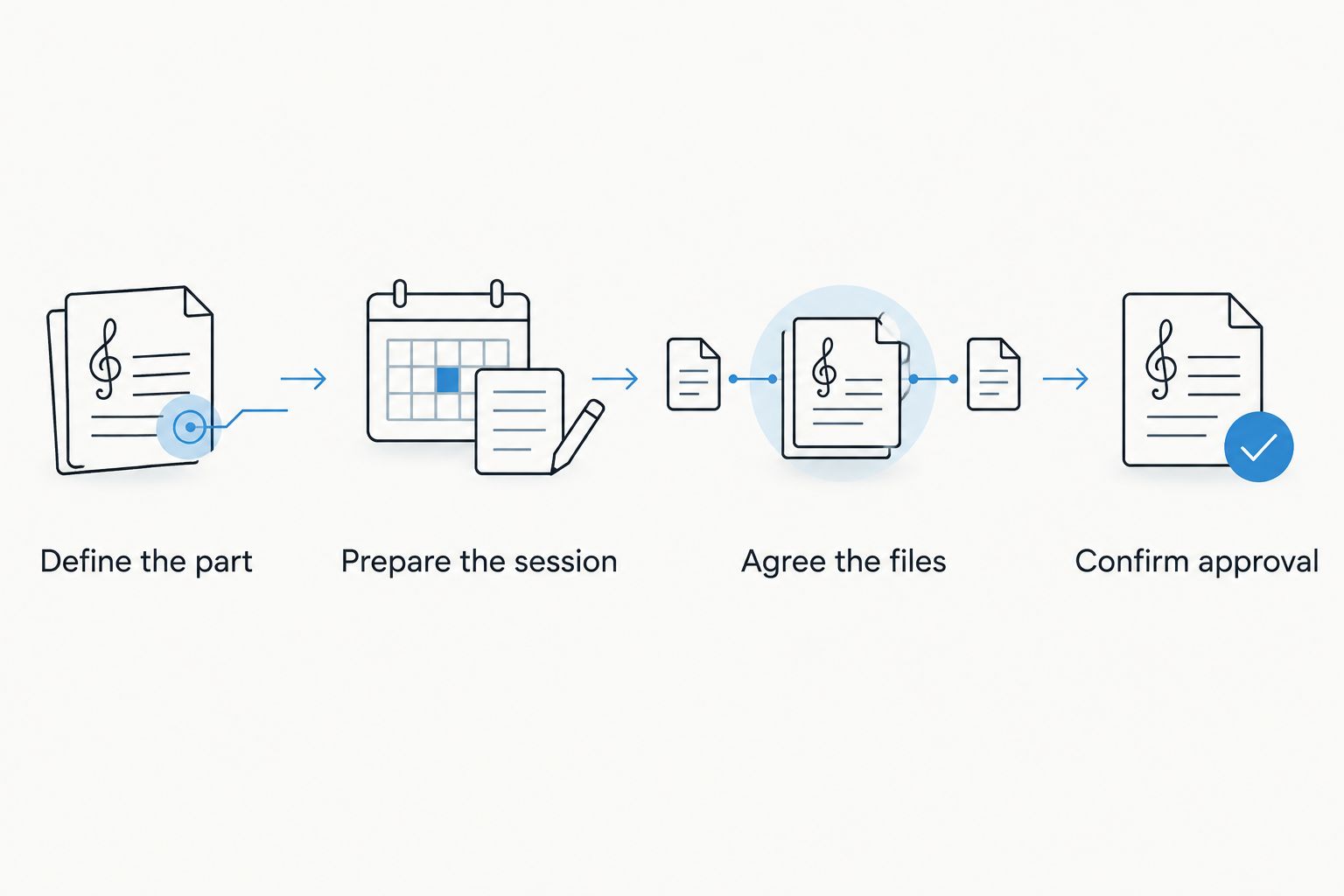
Define the part
Name the instrument or vocal role. Explain whether you want a faithful performance, a newly written part, or alternatives to choose from. Include the song structure and describe where the performance should enter and stop.
Prepare the session
Send a reference mix and explain the tempo, key, and any tempo changes. A constant 120 BPM demo and a performance with a changing tempo map require different preparation; label the situation accurately rather than forcing the musician to guess.
Agree the files
Specify the file format and session settings with your engineer. For example, if your project uses 24-bit WAV files at 48 kHz, state that in the brief. Those are example settings, not a universal requirement: match the actual recording project.
Confirm approval
Define what counts as a revision and what changes the scope. Correcting a missed instruction is different from replacing the arrangement after the musician records it.
Ask for files exported from a shared starting point so they line up when imported. Clarify whether you need unprocessed recordings, processed versions, or both; an isolated track is not automatically an unprocessed track.
Use the remote session musician file requirements guide to prepare the technical handoff. In 2026, this remains a practical comparison point: choose the professional who can meet your actual session requirements, not the one with the most elaborate description.
Pricing: compare the complete service scope
Compare the service offer or written quote, then read the applicable transaction terms. Do not assume that two offers cover the same work because both say guitar, vocals, or production.
For either marketplace, ask the professional to specify:
- Performance scope: Instruments, vocal layers, song sections, and alternate takes.
- Editing scope: Timing cleanup, vocal tuning, comping, and file preparation.
- Revision scope: Included changes and the boundary between a revision and new work.
- Delivery scope: File types, processing, and the agreed deadline.
- Usage scope: Permission to use the performance, credit requirements, and any agreed writing contribution.
A tightly defined service gives you a clearer basis for planning. A custom arrangement accommodates unusual work, but every added responsibility needs agreement. Do not label either platform cheaper without comparing equivalent deliverables and current terms.
Before committing in 2026, read the checkout terms and the professional's agreement together. A platform policy and an individual service description answer different questions. Keep a written record of what you approve.
Turning a demo into a real performance
A Suno demo can communicate an arrangement idea, but hiring real musicians requires instructions about what to preserve and what to change. Separate the melody, lyrics, groove, and instrumental references instead of asking someone to recreate everything without discussion.
Confirm that you have the permissions needed for the material you provide. Ask the musicians to identify any section that needs a new interpretation, and agree how newly written contributions will be treated. Replacing a generated sound with a human performance does not, by itself, settle ownership questions.
If Nashville studio musicians are your target, ask candidates about their relevant recording work and approach. Confirm remote delivery directly; a location label does not establish the recording arrangement or a booking commitment.
Hire the musical contribution, not the label. A songwriter needs a player who understands the song, while a musician offering services needs a brief clear enough to accept or decline honestly. Neither side benefits from promising a result before the work is defined.
Final verdict: choose for the job in front of you
Choose OohYeah if you are a musician building beyond one session
You need professional services alongside gear trading or artist/fan commerce. Start in Music Pros, explain the song and the role, and evaluate relevant work. The broader marketplace is the reason to choose it—not an unsupported promise of faster hiring or better recordings.
Choose AirGigs if you are a songwriter commissioning a defined part
You already know what the recording needs and want a focused music-services search. Compare candidates against one brief, confirm exactly what they will deliver, and approve the agreement before recording starts.
| Dimension | Winner |
|---|---|
| Best for | Split: broader musician needs versus a defined recording task |
| Marketplace scope | OohYeah for gear, services, and artist support together |
| Standout feature | Split: marketplace breadth versus recording-service focus |
| Auditioning musicians | Tie: relevant work and musical fit decide |
| Recording handoff | Tie: agreed files and scope decide |
| Pricing model | No blanket winner: compare equivalent work and current terms |
FAQ
Is OohYeah or AirGigs better for hiring remote session musicians?
OohYeah fits musicians who also need gear trading and artist support; AirGigs fits a focused search for a remote recording service. For a specific session, choose the professional whose relevant work and written scope match your song.
What's the first thing I should send a remote session musician?
Send a clear performance brief with a reference mix, the requested role, tempo information, and delivery requirements. Explain whether the musician should follow an existing part or create something new.
Can I hire a singer instead of a full music producer?
Yes—hire a singer when the arrangement is ready and you need a vocal performance. Hire a producer when you need someone to help shape the arrangement, recording approach, or overall production.
How do I compare the cost of remote session musicians?
Compare written offers covering the same performance, editing, revisions, delivery, and usage permissions. Check current transaction terms before agreeing to the work rather than comparing service titles alone.
Can musicians turn my Suno demo into a recording with real instruments?
You can commission musicians to perform parts using a demo as a reference. Confirm your permissions for the supplied material, specify what should change, and agree how any new writing contributions will be handled.
How do I hire Nashville studio musicians remotely?
Identify candidates with relevant recording examples and confirm directly that they can deliver the session remotely. Agree the musical role, files, deadline, revisions, and usage terms before booking.
Can singers and session players offer their own services?
OohYeah's Music Pros section serves musicians offering professional services as well as people hiring them. Present relevant recordings and a precise service scope; publishing an offer does not guarantee inquiries or bookings.
One last thing
Before hiring, write down what the song must sound like when this person's work is finished. If you cannot describe that change, get song feedback or production direction first. A better-defined job is more useful than another platform shortlist.