How to Sell Stems and Sample Packs Independently in 2026
Learn how to sell stems and sample packs independently. Keep 100% of your revenue, license sounds, and build a profitable direct-to-creator audio storefront.
September 23, 2026
FRANKLY with Frank Lee
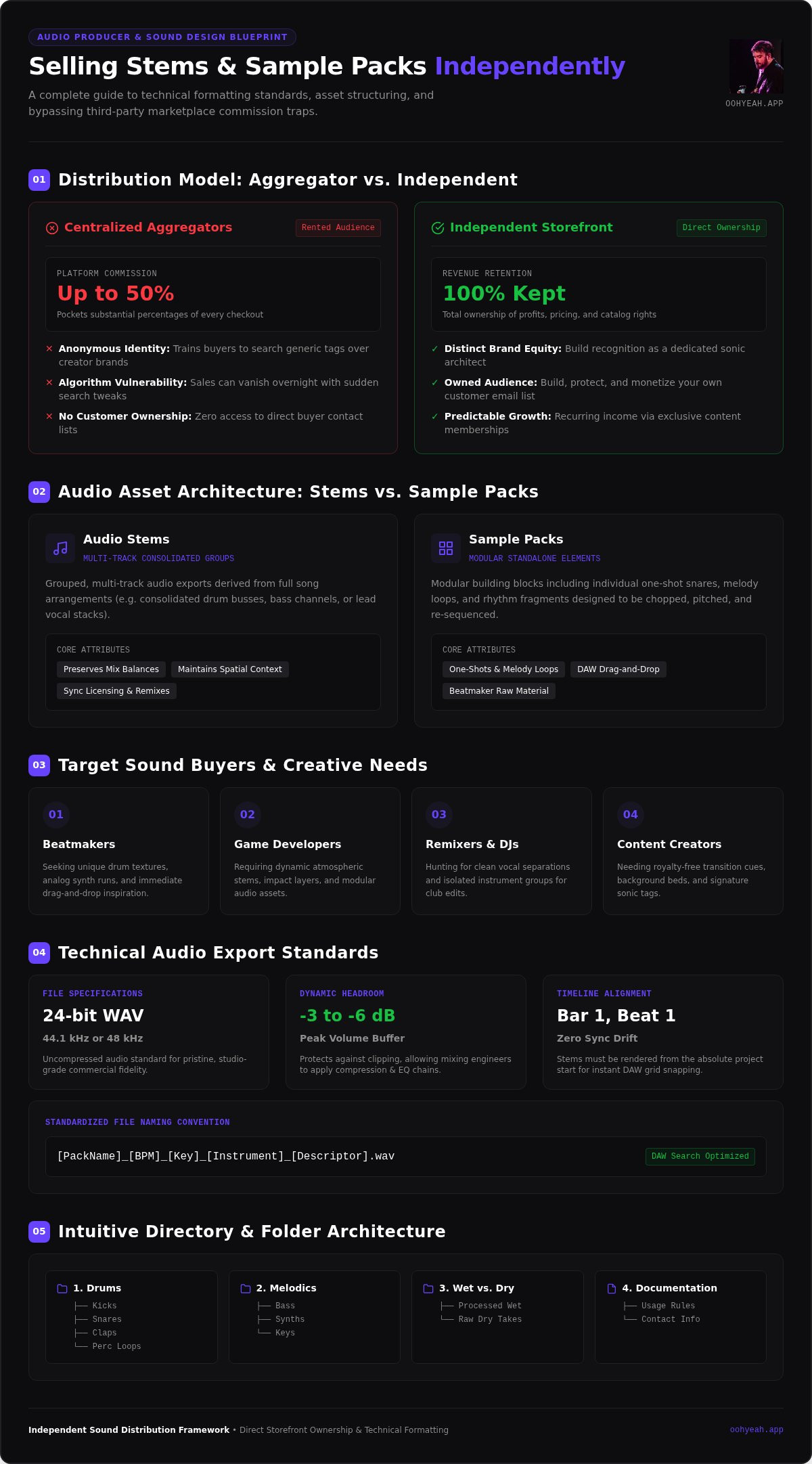
Aggregator marketplaces don't build your sound design business; they rent you an audience while pocketing up to half your revenue. Mastering how to sell stems and sample packs independently is the definitive antidote to distributor commissions, giving you full command over your pricing, catalog rights, and buyer relationships from day one.
You spend dozens of studio hours crafting pristine loops, textured percussion, and multi-track stems. You shouldn't have to surrender your hard-earned customer contacts or settle for murky licensing terms just to get your sounds into production tracks. In this guide, you will learn the complete step-by-step framework to package, license, and sell audio stems and sample packs directly to creators while keeping total ownership of your revenue. Ahead, we walk through how to format professional sound assets, draft transparent commercial clearances, and launch an independent storefront that turns one-off downloads into predictable, recurring creator income.
Key Takeaways
- Discover how to sell stems and sample packs independently to escape platform cuts and retain 100 percent of your revenue.
- Establish rigid audio export standards and clean folder hierarchies so purchasing producers can drop your sounds directly into active sessions.
- Ditch marketplace rent extraction in favor of owned storefronts that let you build, protect, and monetize your customer email list.
- Build compelling audio demonstration tracks and clear commercial terms that turn curious browsers into confident, paying buyers.
- Leverage dedicated creator profile hosting and exclusive content memberships to transform sporadic sound drops into predictable recurring income.
What Does It Mean to Sell Stems and Sample Packs Independently?
Selling independently means cutting out corporate distribution gates entirely. You host your own catalog, set your own prices, and deliver audio directly to the creators who need it. Instead of acting as an anonymous supplier filling out a monolithic sound warehouse, you build distinct brand equity as a sonic architect. Producers learn your signature processing, recognize your aesthetic, and return directly to your ecosystem for new releases.
Understanding how to sell stems and sample packs independently transforms sound design from a passive micro-hustle into a high-margin business. Direct distribution shields your profit margins from unpredictable royalty cuts and sudden platform fee hikes. It also lets you cater directly to diverse buyer profiles:
- Beatmakers: Seeking unique drum textures, analog synth runs, and immediate drag-and-drop inspiration.
- Game Developers: Requiring dynamic atmospheric stems, impact layers, and modular audio assets.
- Remixers and DJs: Hunting for clean vocal separations and isolated instrument groups for club edits.
- Content Creators: Needing royalty-free transition cues, background beds, and signature sonic tags.
The Functional Difference Between Stems and Sample Packs
Precision matters when you package production assets. Stems represent grouped, multi-track audio exports derived from full song arrangements, such as consolidated drum busses, bass channels, or lead vocal stacks. They preserve spatial context and mixing balances, making them prime territory for remixers and sync licensing partners. In contrast, sample packs feature modular, individual building blocks: one-shot snares, melody loops, and rhythm fragments. Grounded in the deep history and technique of audio sampling, these standalone elements give beatmakers raw material to chop, pitch, and re-sequence inside their digital audio workstations.
The Strategic Traps of Centralized Sound Marketplaces
Third-party sample hubs sell discovery, but they extract a massive toll. They train buyers to search for generic genre tags rather than individual creator profiles, effectively erasing your artistic identity. If an aggregator tweaks its search algorithm, your monthly sales can vanish overnight without explanation.
Worse, platform commission structures quietly eat away at your operational margins. When middlemen pocket substantial percentages of every checkout, producing extensive sound libraries becomes economically unsustainable. Learning how to sell stems and sample packs independently breaks this cycle, letting you keep every dollar while establishing lasting, direct relationships with working artists.
How to Prepare, Structure, and Format Your Audio Assets
Professional sound design requires surgical technical standards. If a producer downloads your sound pack and encounters clipped peaks or mismatched tempos, they won't return. Succeeding at how to sell stems and sample packs independently hinges on delivering pristine, production-ready audio that drops seamlessly into any modern DAW session without manual cleanup.
Leave at least -3 to -6 dB of volume headroom across all raw assets. Dynamic headroom allows mixing engineers to apply their own compression and equalization chains without digital distortion. Clean sound files protect your reputation and instantly position your catalog alongside top industry offerings.
Exporting Standards for Commercial Sample Packs and Stems
Render every loop and one-shot as uncompressed, 24-bit WAV files at 44.1kHz or 48kHz. When rendering song stems, always print the audio files from bar one, beat one. This guarantees identical timeline alignment, allowing the buyer to drag twenty tracks into their software with zero sync drift. Follow a uniform naming convention: [PackName]_[BPM]_[Key]_[Instrument]_[Descriptor].wav. Clear naming lets producers spot the right sound in seconds.
Structuring an Intuitive Folder Hierarchy for Buyers
Keep your folder architecture clean and shallow. Producers work fast and resent digging through deeply nested folders. Divide your content logically:
- Drums: Segment into subfolders for Kicks, Snares, Claps, and Percussion Loops.
- Melodics: Group by instrument type, such as Bass, Synths, and Keys.
- Wet vs. Dry: Offer both processed layers and completely dry takes so users retain full mixing control.
- Documentation: Include a simple text file detailing usage rules and your contact info.
Selecting the Right Licensing Framework for Your Sounds
Clarity eliminates legal friction. State clearly that your packs are non-exclusive and 100 percent royalty-free for derivative musical compositions. This permits the buyer to monetize commercial beats, sync placements, or game scores containing your sounds without paying future backend splits. The legal guidelines governing royalty-free distribution require explicit protection for the source sound designer. Your agreement must strictly ban re-distributing, repackaging, or reselling your raw samples as part of a competing sample collection.
When you take full control of your asset delivery and packaging through dedicated digital music download hosting, you set professional expectations that justify premium pricing.
Choosing Your Sales Channel: Closed Marketplaces vs. Direct Storefronts
Where you host your catalog determines whether you run a genuine enterprise or simply feed another company's revenue machine. Figuring out how to sell stems and sample packs independently means making a fundamental choice between aggregator hubs and dedicated creator storefronts. Marketplaces promise instant discovery, but they extract steep fees and hide your buyers behind digital walls. Direct storefronts flip this dynamic, letting you capture full commercial value while building lasting audience equity.
Custom websites once required tedious coding and constant maintenance. Today, modern artist profile hosting platforms give sound designers turn-key commerce solutions. You get instantaneous file delivery, custom branding, and zero backend headaches.
The True Financial Cost of Platform Commission Cuts
Aggregator hubs frequently take between 10 and 50 percent of every sale. When your monthly volume accelerates, that percentage cut compounds into thousands of dollars pulled directly out of your pocket. Direct sales models remove that toll entirely. Retaining 100 percent of your digital download revenue shifts your studio balance sheet instantly. You stop subsidizing an aggregator's infrastructure and start funding your own creative growth, hardware acquisitions, and sonic research.
The Power of First-Party Customer Relationships
Centralized marketplaces deliberately shield buyer identities. They hide customer email addresses to keep creators dependent on paid internal promotions and arbitrary search algorithms. Direct distribution hands you complete ownership of your buyer list:
- Targeted Announcements: Email past customers the exact moment you drop a new stem kit or modular synth pack.
- Organic Feedback: Poll actual purchasers to discover which instrument stems or dynamic tempos they need next.
- Direct Loyalty: Cultivate fans who invest in your specific production techniques rather than browsing random catalog tags.
Moving beyond one-off transactional sales transforms your studio income. When you master how to sell stems and sample packs independently, you can introduce exclusive content access and recurring supporter tiers. Monthly memberships smooth out the erratic revenue spikes of traditional product drops, replacing seasonal dry spells with consistent, predictable cash flow.
Step-by-Step Blueprint to Launching Your Independent Sound Store
Launching a storefront requires more than uploading audio files to a server. You need a streamlined, visually compelling destination that highlights your production identity and removes checkout friction. Executing an effective plan for how to sell stems and sample packs independently means pairing sonic excellence with deliberate conversion mechanics.
Your storefront should reflect the quality of your audio. Clean layouts, clear asset descriptions, and lightning-fast checkout flows turn casual listeners into paying supporters.
Building Audio Demos That Convert Browsers into Buyers
Audio demos are your primary sales pitch because working producers won't buy blind. Build a dynamic 60-to-90-second audio montage that showcases your standout melodies, chord progressions, and rhythm loops in a finished, competitive track mix. Follow that context track with isolated audition snippets of raw, unmixed one-shots. Ensure your audio player supports responsive waveform scrubbing so buyers can test loops instantly without page reloads.
Packaging Strategic Bundles and Tiered Offerings
Tiered pricing structures maximize your average checkout value. Rather than listing every asset at a single price, give creators options based on their project needs:
- Entry-Level Packs: Sell standalone drum kits or melodic loop sets at accessible rates to attract new buyers.
- Production Suites: Bundle multi-track stems, MIDI files, and one-shots into comprehensive toolkits commanding higher price points.
- Limited Drops: Issue exclusive sample runs available for a short window to generate genuine urgency around fresh sound drops.
Direct Marketing Tactics to Reach Music Makers
Social media feeds crave authentic proof of craft. Record short video clips breaking down the synth patches, field recordings, or analog saturation chains you used to engineer specific sounds. Seeing your workflow builds authority and proves the bespoke quality of your library.
Offer a free five-sound teaser pack to capture buyer email addresses directly. Once creators test your audio quality in their own arrangements, invite them to join beat challenges using your sounds. Community participation turns curious producers into loyal brand advocates.
When you want to capture full commercial value from your catalog, mastering how to sell stems and sample packs independently starts with the right platform. Launch your commission-free storefront on OohYeah! and keep every dollar you earn.
Scaling Your Sound Business with OohYeah!
Establishing your own distribution hub shouldn't require stitching together disconnected plugins, complex hosting setups, and steep merchant aggregators. Taking command of how to sell stems and sample packs independently works best when your entire commercial ecosystem lives under one roof. OohYeah! eliminates the traditional barriers between sound designers and creators, providing the dedicated infrastructure you need to package, monetize, and scale your brand on your own terms.
Unifying your creative output strengthens your enterprise. When fellow producers discover your signature sound, they shouldn't encounter friction, distributor ads, or third-party detours.
Commission-Free Digital Music and Sample Distribution
Middlemen shouldn't tax your creativity. Through robust artist profile hosting, you can upload high-fidelity digital music downloads, multi-track audio stems, and standalone sample libraries directly to your audience. Unlike legacy distribution platforms that extract cuts from every checkout, you retain 100 percent of your sales revenue. Zero commission deductions mean every dollar from your sound packs stays in your business, giving you the capital to invest in premium analog gear, acoustic treatment, and professional monitoring.
You can also feature physical goods through an integrated merchandise marketplace right alongside your digital audio catalog. Selling limited-run apparel, branded slipmats, or studio accessories within the same ecosystem expands your earning potential without forcing fans across separate checkout screens.
Unlocking Predictable Recurring Revenue with Fan Memberships
Relying exclusively on single-pack drop dates leads to feast-or-famine income cycles. Introducing exclusive content access changes the math entirely. By structuring monthly creator tiers, you give your most dedicated peers continuous access to fresh stems, unreleased loop kits, and private production resources.
Memberships transform sporadic buyers into a dependable creative community. Instead of fighting unpredictable social algorithms for every single transaction, you build predictable cash flow directly from collaborating producers who value your vision.
True creator equity starts with complete operational freedom. Take total control of your audio business and launch your direct artist storefront on OohYeah! to see how an equitable platform can elevate your craft.
Build Your Independent Sound Design Future
Renting an audience on centralized marketplaces is a relic of the past. When you master how to sell stems and sample packs independently, you turn your audio craft into a sustainable, equity-rich business. Pristine technical exports, organized folder hierarchies, and transparent licensing establish immediate trust with working producers. More importantly, direct distribution keeps your customer email lists, catalog rights, and hard-earned profits firmly in your hands.
You don't have to surrender substantial revenue cuts to middlemen or endure unpredictable drop cycles. Unifying direct digital downloads with exclusive membership tiers and physical merchandise creates lasting financial stability on your own terms. Your studio output deserves an equitable foundation that rewards your talent directly.
Start keeping 100% of your sound pack and stem sales with OohYeah! and claim the creative independence you've earned.
Frequently Asked Questions
Can I legally sell stems containing samples from other artists?
No, you cannot legally sell stems or packs containing uncleared samples from other artists. You must own 100 percent of the underlying sound recordings and compositions, or hold an explicit commercial clearance agreement. Distributing unauthorized copyright material exposes you to infringement claims and store takedowns. Always design your stems and samples from scratch using original synthesizer patches, live instruments, or field recordings to ensure your catalog remains fully defensible.
How much should I charge for an independent sample pack?
Price your sample packs based on catalog depth, production utility, and target creator workflow rather than arbitrary guesses. Standalone mini packs or single-instrument kits sit at accessible entry tiers to attract new producers. Full production suites packed with stems, MIDI, and one-shots command premium valuation. Experiment with bundle pricing to increase average order volume. When learning how to sell stems and sample packs independently, direct storefront control lets you adjust prices instantly without marketplace restrictions.
What audio format is best for selling stems and sample packs?
Deliver your stems and sample packs as uncompressed, 24-bit WAV files at 44.1kHz or 48kHz. WAV remains the universal industry standard across every major digital audio workstation. It preserves dynamic headroom, transient impact, and harmonic clarity without lossy compression artifacts. Avoid delivering lossy formats like MP3 for raw assets. Package your final folders as clean, standardized ZIP archives so buyers can download, unpack, and import the sounds into their project sessions immediately.
Do I need a business license to sell audio samples online?
In most jurisdictions, you can begin selling as a sole proprietor, but establishing a formal business structure offers greater liability protection. Setting up a dedicated business entity separates your personal assets from your commercial sound design operations. You should check your local regional regulations regarding digital sales tax, commerce registration, and business banking requirements. Operating under a registered commercial entity also builds credibility when negotiating direct custom sound design contracts or commercial sync licensing agreements with larger production studios.
How do royalty-free licenses protect both seller and buyer?
Royalty-free agreements grant buyers legal permission to use your sounds in commercial music without paying ongoing backend royalties. For the buyer, this license eliminates clearance risks when pitching finished beats to labels or streaming platforms. For you as the seller, the agreement retains your underlying copyright and explicitly prohibits customers from repackaging your raw audio files into competing sample libraries. Clear legal language ensures mutual trust, establishing a secure environment for independent sound commerce.
What is the most effective way to protect stems from unauthorized sharing?
The most effective defense against unauthorized sharing is building an authentic brand and serving paying buyers with high utility. Technical copy protection often frustrates legitimate customers while doing little to stop dedicated piracy. Instead, deliver unique value through direct updates, uncompressed stems, and community access. Purchasing producers value official commercial licenses that protect their master recordings in commercial releases. Focus on direct relationships and transparent delivery rather than heavy-handed digital rights management schemes.
How does selling on OohYeah! compare to traditional sound marketplaces?
Traditional sound marketplaces take substantial commission cuts and hide buyer contact details, while OohYeah! operates on a commission-free model. Discovering how to sell stems and sample packs independently through OohYeah! lets you retain 100 percent of your digital download and merchandise revenue. Instead of competing inside a crowded directory where platform algorithms dictate your visibility, you get dedicated artist profile hosting, direct fan relationships, and exclusive content access tools to build predictable, recurring studio income.