
Highest Paying Music Streaming for Artists in 2026: What the Numbers Really Mean
Discover the highest paying music streaming for artists in 2026. Learn what per-stream rates really mean and how to maximize your overall music revenue today.

October 7, 2026
FRANKLY with Frank Lee
What if the platform with the highest per-stream estimate isn’t the one that gives you the best chance to earn? The highest paying music streaming for artists is a harder question than a leaderboard suggests. Published estimates can conflict, and a rate per stream doesn’t show what will reach your account.
It makes sense to look beyond stream counts. Services generally pay rights holders, not artists directly, and your share depends on factors such as listener location, account type, and your agreements with labels, distributors, or publishers. A headline rate is an estimate, not a guaranteed take-home amount.
This guide explains how to assess payout estimates, compare platforms using consistent criteria, and understand how royalty models shape artist income. It also covers direct-to-fan sales as a complementary route. On OohYeah!, artists retain 100% of music and merchandise sales revenue while paying a recurring subscription for platform access and sales tools. OohYeah! isn’t a per-stream royalty service. The goal is to help you see what streaming can offer, what its numbers leave out, and how to build income while strengthening your connection with fans.
Key Takeaways
- The highest paying music streaming for artists depends on more than a headline rate. Audience reach, listening patterns, and royalty terms all affect potential earnings.
- Treat per-stream figures as estimates, not guaranteed payments. Compare them only when their sources, dates, territories, and methods are clear.
- Follow the royalty path from listener activity through rights holders to artist reporting to understand why stream totals may not match your take-home income.
- Choose platforms around your goals, weighing discovery and reach alongside direct sales and recurring fan support.
- OohYeah! complements streaming with artist profiles, downloads, merchandise, and exclusive content. Artists retain 100% of music and merchandise sales revenue and pay a recurring subscription for platform access.
Highest Paying Music Streaming for Artists: Why One Rate Cannot Tell the Whole Story
No published rate guarantees the highest earnings for every artist. A per-stream figure is an estimate or average, not a fixed payment promised for each play. The highest paying music streaming for artists depends on what the estimate measures and how an artist’s listeners, rights, and agreements affect the money that reaches them.
Streaming royalties and direct fan sales are different income streams: streaming royalties come from platform use of music rights, while direct fan sales come from supporters buying music, merchandise, or access from an artist. Keep that distinction in mind when comparing streaming platforms with artist-owned sales options.
What does “highest paying” mean for an independent artist?
“Highest paying” can mean a higher estimated amount per stream or more total income across an artist’s catalog. Those aren’t the same. A platform with a higher estimated rate may produce less overall income if an artist has few listeners there. A lower-rate platform may generate more total royalties if more of that artist’s audience listens on it.
A platform-wide calculation also isn’t necessarily the artist’s take-home share. Platforms generally account to rights holders, such as labels, distributors, publishers, or collection societies. The artist’s reporting and final income depend on which rights they control and the terms of their agreements. Recordings and compositions can follow separate royalty paths, so one track may generate different payments for the recording owner and the songwriter or publisher.
Why per-stream payout claims vary
Rates can shift with listener territory, subscription type, the rights included in a calculation, and the reporting period. A premium subscription stream and an ad-supported stream may contribute different amounts to royalty pools. A figure based on one market or month may not represent an artist whose listeners are spread across countries or whose catalog has different listening patterns.
Check what kind of evidence a rate claim uses. A platform-wide estimate summarizes assumptions across a service. An artist statement or distributor report reflects specific usage and accounting, though it may cover only certain rights or a defined period. These figures answer different questions, so don’t treat them as interchangeable.
Before relying on a rate table, look for its source, publication date, territory, methodology, rights assumptions, and reporting window. If those details are missing, the number can’t support a reliable current comparison. Treat it as an unverified claim, not a promise of what your next stream will earn. This helps you compare payout evidence fairly without confusing an estimated rate with actual income.
How Music Streaming Royalties Reach Artists
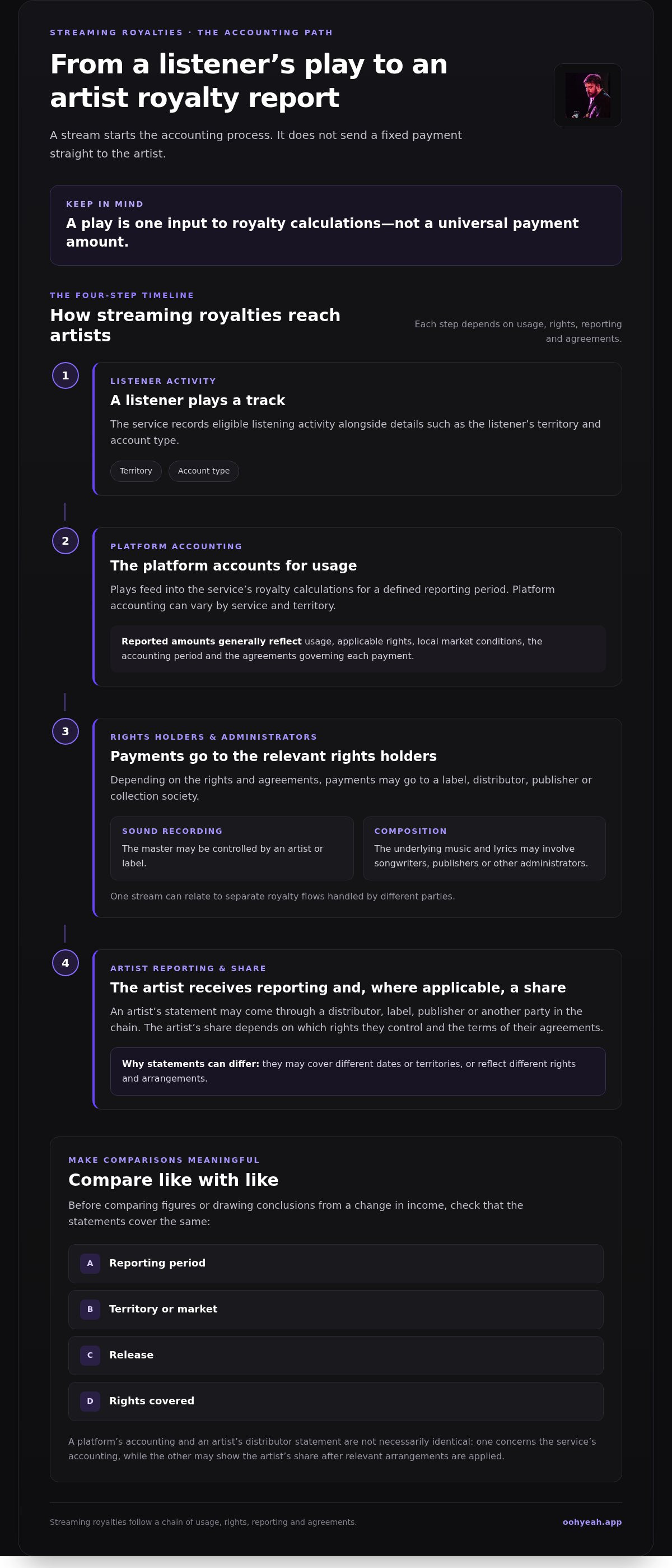
A listener’s play starts the accounting process, but it doesn’t send a fixed payment straight to the artist. Streaming services account for usage and revenue, then pay the relevant rights holders under their agreements. The artist’s share depends on who controls each right and how payments are reported through the artist’s arrangements.
From a listener’s play to a royalty report
Think of the flow in four steps:
- 1. A listener plays a track. The service records eligible listening activity, alongside information such as territory and account type.
- 2. The platform accounts for usage. Plays feed into the service’s royalty calculations for a defined reporting period. A play is one input, not a universal payment amount.
- 3. Payments go to rights holders or administrators. Depending on the rights and agreements, these may include a label, distributor, publisher, or collection society.
- 4. The artist receives reporting and, where applicable, a share. The artist’s statement may come through a distributor, label, publisher, or another party in the chain.
Platform accounting can vary by service and territory, but the reported amount generally reflects usage, applicable rights, local market conditions, the accounting period, and the agreements governing each payment. Two statements can cover different dates or territories and still be accurate. Check the reporting window and market before comparing figures or drawing conclusions from a change in income.
Who may receive or administer streaming royalties?
A recording and the composition embodied in it involve distinct rights. The sound recording, often called the master, may be controlled by an artist or label. The composition, meaning the underlying music and lyrics, may involve songwriters, publishers, or other administrators. A single stream can therefore relate to separate royalty flows handled by different parties.
Contracts shape what reaches the artist. A label agreement, distribution deal, publishing arrangement, or songwriter split may determine who collects revenue and how it is divided. Platform reporting and an artist’s distributor statement aren’t necessarily identical: the first concerns the service’s accounting, while the second may show the artist’s share after relevant arrangements are applied.
To understand your own figures, compare the same reporting period, territory, release, and rights category. Then review the statement from the party that reports your artist share. If you’re also building income through direct downloads, merchandise, or exclusive content, OohYeah!’s artist profiles and direct-to-fan tools can sit alongside streaming, without turning those sales into per-stream royalties.
Which Music Streaming Platforms Pay Artists Most? Compare the Evidence
There’s no defensible universal winner in this comparison. The 2026 estimates below offer a rough reference point, but they aren’t based on a shared methodology. Treat the figures as directional, not as a like-for-like ranking or a promise of what you’ll earn.
| Platform | Reported figure | Source and date | Territory and method | Evidence type |
|---|---|---|---|---|
| Spotify | $0.003-$0.005 per stream | 2026 research brief, October 2026 | Territory and calculation method aren’t specified | Estimate, not artist-reported |
| Apple Music | $0.007-$0.01 per stream; Apple has stated an average of $0.01 | 2026 research brief, October 2026; Apple’s statement is described in the brief | Territory and calculation method for the range aren’t specified | Estimate; includes a platform-stated average, not an individual artist report |
| Amazon Music | $0.004-$0.006 per stream | 2026 research brief, October 2026 | Territory and calculation method aren’t specified | Estimate, not artist-reported |
| YouTube Music | $0.001-$0.002 per stream | 2026 research brief, October 2026 | Territory and calculation method aren’t specified | Estimate, not artist-reported |
A platform ranking is not an earnings forecast. It can’t predict your income without comparable territory, period, rights, and calculation details, as well as your audience and agreement terms.
How to read platform payout comparisons
The table shows the limits of the available evidence. The estimates are dated, but most don’t identify a territory or explain how the figure was calculated. Apple’s stated average offers context, but it still isn’t a report of what a particular artist received. Don’t mistake a published estimate for confirmed artist-specific revenue. Rate tables without a clear source, date, and method are weaker evidence and shouldn’t anchor a current comparison.
Beyond per-stream rates: reach, tools, and audience fit
A platform’s audience access and artist tools matter, but they aren’t payout rates. Spotify for Artists, for example, offers tools to understand and grow an audience; those features don’t prove that Spotify pays more per stream. Consider where your listeners already engage, whether they return, and how each service supports discovery. Repeat listening can help build reach, while direct sales and fan support give dedicated listeners another way to back your work. Compare the whole strategy, not just the headline number.
How Artists Can Choose a Streaming Strategy That Fits Their Audience
Choose your platform mix around the outcome you want, not a payout headline. Are you building discovery, seeking steadier income, protecting ownership, or deepening fan relationships? Your priority can change as your career grows. Streaming royalties and direct-to-fan sales serve different purposes, so don’t compare them as if they were interchangeable rates. Assess how each route supports your audience and your wider income plan.
Match the platform mix to your career stage
If discovery is your priority, focus on where listeners can find your music and which artist-facing tools help you understand audience activity. If you already have an engaged community, consider whether supporters would value downloads, merchandise, or exclusive content. For mixed goals, use streaming to reach listeners and direct channels to offer fans another way to support you. These routes can complement each other.
Direct sales aren’t a substitute calculation for streaming royalties. A stream creates royalty income under a platform’s and rights holders’ accounting arrangements. A download or merchandise purchase is a direct transaction with a fan. OohYeah! lets artists offer music downloads, merchandise, and exclusive content. Artists retain 100% of music and merchandise sales revenue while paying a recurring subscription for platform access and sales tools. That model differs from a per-stream payout.
Questions to ask before acting on payout claims
Before changing your strategy based on an estimate, check whether it accounts for the rights you own, any distributor or label deductions, listener territories, and the reporting period. Compare those assumptions with your own audience. A rate based on a different market or listening mix may not reflect your results. Treat projections as planning scenarios, not guarantees of future income.
- Discovery: Where can new listeners encounter your music, and what tools help you understand their response?
- Income mix: Could downloads, merchandise, or exclusive content complement streaming for your existing fans?
- Control: Who holds or administers the relevant rights, and what agreements shape your share?
- Evidence: Does the estimate state its source, territory, timeframe, and calculation method?
Want to build a direct-to-fan channel alongside your streaming presence? Create an artist profile on OohYeah! to offer downloads, merchandise, and exclusive content while keeping streaming discovery and direct support distinct in your income plan.
Add Direct Fan Revenue Alongside Streaming with OohYeah!
Streaming can help listeners discover your music, while direct support works differently. Your income plan doesn’t have to depend on per-stream estimates or finding the single “highest paying music streaming for artists” platform. OohYeah! complements streaming with artist profiles and direct-to-fan options. It isn’t a conventional service that pays artists per stream.
Through an artist profile, you can offer digital music downloads, merchandise, and exclusive content. These give listeners who want to support you a direct way to buy or access what you share. Fans may also choose optional recurring subscriptions for ongoing support. Each option creates a different kind of connection, but none guarantees a purchase or subscription.
How commission-free artist sales differ from streaming royalties
A stream contributes to platform royalty accounting. Its estimated value can vary with factors such as territory, account type, rights, and agreements. A direct purchase is different: a fan buys music or merchandise from your artist offering rather than generating an estimated per-stream royalty.
On OohYeah!, artists retain 100% of music and merchandise sales revenue. The platform doesn’t take a commission on those sales, but artists pay a recurring subscription to access hosting and sales tools. That subscription is a platform fee, not a deduction from an individual stream or a guarantee of sales. Keep both parts in view when weighing this model against streaming income.
Turn supportive listeners into a closer fan community
Support can go beyond a one-time purchase. Optional fan subscriptions give artists a recurring direct-support route, while exclusive content gives supporters something additional to engage with. Merchandise and downloads offer other ways for fans to participate. These choices can complement streaming discovery, especially when listeners want to deepen their connection with your work.
Use streaming to help people find and hear your music. Then give interested fans clear ways to support you directly, without assuming every listener will convert. OohYeah! brings artist profiles, music downloads, merchandise, exclusive content, and optional fan subscriptions together in a direct-to-fan model.
Explore OohYeah! and see how direct fan support can sit alongside your streaming strategy.
Build an Income Strategy Around Your Fans
The highest paying music streaming for artists isn’t a guaranteed winner for every career. Per-stream estimates depend on their assumptions, while your actual royalties are shaped by listeners, rights, and agreements. Compare platforms carefully, then choose a mix that supports discovery and your goals for connecting with fans.
Direct-to-fan income adds another path. On OohYeah!, artists can offer downloads, merchandise, exclusive content, and optional fan subscriptions. Artists retain 100% of music and merchandise sales revenue, with a recurring subscription fee for platform access. Fans can access music, downloads, and merchandise without sales commissions. This model complements streaming; it doesn’t replace per-stream royalties.
Explore OohYeah! and connect with your fans directly. Give your supporters more ways to take part, and keep building an income strategy on your own terms.
Frequently Asked Questions
Which music streaming platform pays artists the most per stream?
Qobuz has the highest estimate in the 2026 figures provided, at approximately $0.015 to $0.019 per stream, based on the company’s audited figures. Tidal is estimated at roughly $0.013 to $0.015. These numbers don’t establish a universal winner: territory, rights, reporting periods, and calculation methods can differ. The highest paying music streaming for artists in a rate table may not generate the most total income for a particular artist.
How much do artists make per stream in 2026?
There’s no single 2026 rate for every artist or stream. Estimates in the article range from about $0.001 to $0.002 for YouTube Music, $0.003 to $0.005 for Spotify, $0.007 to $0.01 for Apple Music, $0.013 to $0.015 for Tidal, and $0.015 to $0.019 for Qobuz. Treat these as estimates, not guaranteed artist earnings. Actual income depends on rights, listener markets, account types, and artist agreements.
Do artists get paid every time someone streams a song?
Not as a fixed payment sent directly to the artist for each play. A stream is recorded as part of platform accounting, and eligible usage contributes to royalty calculations for a reporting period. The platform typically pays rights holders or administrators, such as labels, distributors, publishers, or collection societies. An artist’s eventual share depends on the rights they control and their agreements. Check artist or distributor statements for reported income and the period they cover.
Why do music streaming payout rates differ between platforms?
Platforms use different business models and royalty accounting arrangements. Estimates can also reflect different listener countries, subscription or ad-supported accounts, rights included, and reporting periods. Label, distributor, publisher, or other agreements may then affect what an artist receives. Compare figures only when their source, date, territory, method, and rights assumptions are clear. A platform-wide estimate and an artist’s own royalty statement measure different things, so they shouldn’t be treated as equivalent evidence.
Can independent artists earn more from direct fan sales than streaming?
They can, but the outcome depends on their audience and sales. A fan purchase is a direct transaction, while streaming royalties come from platform accounting and rights arrangements. Artists using OohYeah! retain 100% of music and merchandise sales revenue, with a recurring subscription fee for platform access and sales tools. Direct sales and optional fan subscriptions can complement streaming, but listeners won’t automatically become buyers or subscribers.
Does OohYeah! pay artists per stream?
No. OohYeah! is a music streaming and marketplace platform, but it isn’t a conventional per-stream royalty service. Artists can host a profile and offer downloads, merchandise, exclusive content, and optional fan subscriptions for direct support. OohYeah! doesn’t take commissions on music and merchandise sales, and artists retain 100% of that sales revenue. Artists pay a recurring subscription to access hosting and sales tools, so that fee remains part of the income calculation.
What should artists check before trusting a streaming payout calculator?
Check the calculator’s source, publication date, territory, reporting period, and method. Look for whether it accounts for subscription type, the rights being measured, and potential label or distributor deductions. Compare its assumptions with your listeners’ locations and listening patterns. Treat the result as a planning scenario, not a promise. A calculator’s platform-wide estimate can’t replace your artist or distributor statements, which show reported revenue under your own arrangements.