Music Merch Store Guide: Models, Pricing, and Promotion
Learn how a music merch store works, compare print-on-demand, inventory, and dropship fulfillment, and plan pricing, design, and promotion for fans.
October 24, 2026
Music Marketplace Advisor
Buying & SellingA fan stops at your merch table after the show, picks up a shirt, and asks whether you sell it online. You've got artwork ready and people asking, but you're less sure about ordering sizes, pricing international shipping, or finding somewhere to put unsold boxes.
Opening a music merch store means making those decisions before fans start buying. The useful starting point isn't a huge catalog. It's a product your audience wants, a fulfillment arrangement you can manage, and a price that leaves enough room to handle problems fairly.
What a Music Merch Store Is and Why Fans Buy
That fan holding your shirt isn't necessarily looking for more clothing. They may want something that reminds them of the show, signals their connection to your music, or lets them support your next release.
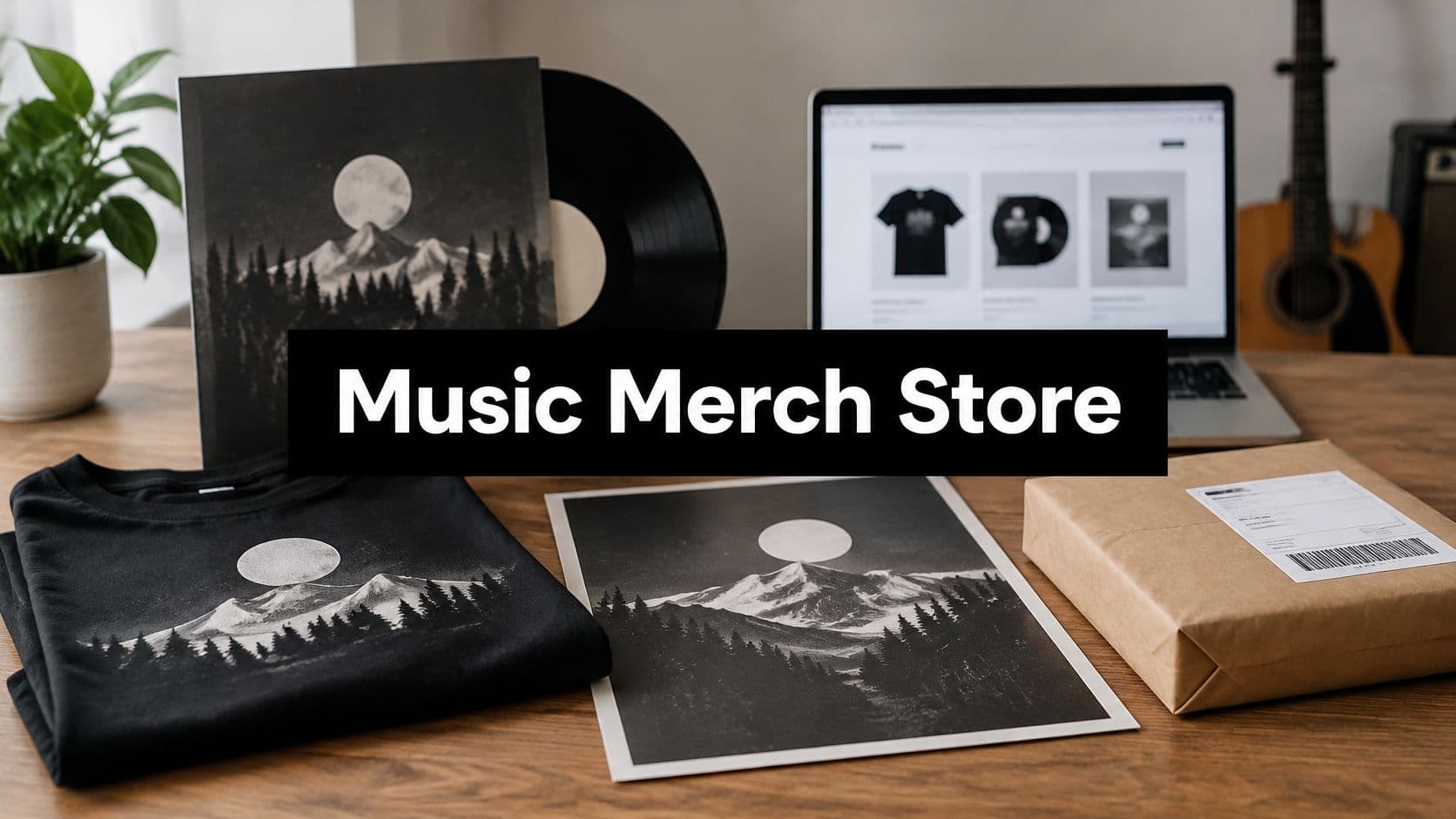
A music merch store is an artist-controlled storefront for products connected to your music and community. It can sell apparel, posters, physical music editions, collectibles, and branded goods tied to a release, tour, or shared moment.
What Belongs in the Store
Think of the store as an extension of your artist identity, not a shelf that needs filling. A product belongs there when you can explain its connection to your work and why a fan might want to own it.
- Wearable identity: Shirts, hoodies, and other apparel let fans carry a visual connection to your music.
- Physical ownership: Vinyl, CDs, and special editions give listeners something tangible to collect.
- Shared memories: Posters and tour-related pieces can commemorate a particular performance or release.
- Community objects: Collectibles and accessories can reference artwork, lyrics, or symbols your audience recognizes.
Not every buyer wants the same thing. Someone discovering your music may prefer an accessible accessory, while a committed collector may care more about an unusual physical edition.
Why Merch Deserves Business Attention
Merchandise has commercial history well beyond today's online storefronts. Elvis Presley merchandise reportedly generated $22 million, New Kids on the Block merchandising was estimated at roughly $400 million during 1989–1990, and Kanye West claimed $1 million from a three-day New York pop-up, according to Highsnobiety's history of music merchandise.
Those examples aren't sales forecasts for an independent artist. They illustrate how artists have turned recognition, loyalty, and cultural connection into purchases beyond recordings and tickets.
A useful merch product gives a fan something they want to keep, not merely another way to send you money.
For your own store, start by naming the reason behind the purchase. Is the shirt attractive without an explanation? Does the poster preserve a meaningful occasion? Does the physical release offer something a listener values?
You don't need celebrity-scale demand to ask those questions seriously. You need a clear relationship between the product, its buyer, and the experience you're promising.
Comparing Print-on-Demand, Inventory, and Dropshipping
Fulfillment is the work between receiving an order and getting the correct product to the fan. The model you choose determines who buys stock, who packs parcels, and how much responsibility you delegate.
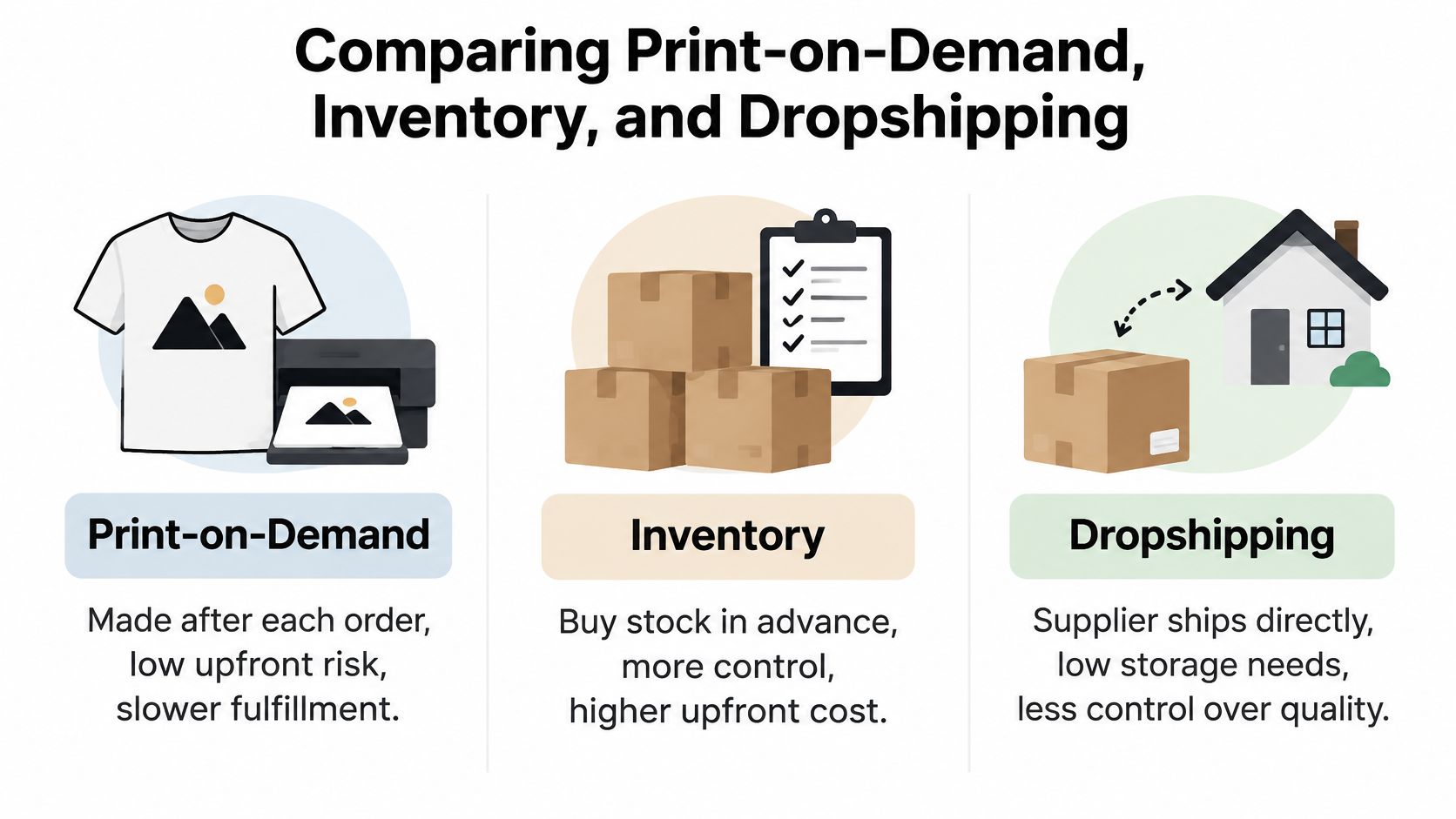
Think of the alternatives like feeding people on tour. Print-on-demand resembles cooking after someone orders, inventory resembles preparing meals in advance, and dropshipping resembles asking another kitchen to deliver directly.
This comparison shows where the main responsibilities sit.
Fulfillment Models at a Glance
| Model | Upfront Stock Cost | Artist Control | Best Fit |
|---|---|---|---|
| Print-on-demand | No bulk stock purchase, though samples and setup can cost money | Control over artwork and product selection, less over production and dispatch | Testing uncertain demand without holding merchandise |
| Inventory | Stock purchased before customer orders | More control over inspection, packing, and available quantities | Proven products and artists able to manage fulfillment |
| Dropshipping | Usually no artist-held stock | Supplier-dependent quality, packaging, and delivery | Supplier-made products where outsourced dispatch is acceptable |
With print-on-demand, production starts after a purchase. That avoids guessing how much finished stock to buy, but manufacturing becomes part of the delivery timeline. Compare the complete supplier quote, not just the advertised garment price.
With inventory, you or a fulfillment partner holds finished products. You can inspect stock and prepare consistent packaging before launch. The trade-off is cash committed to merchandise that might not sell, including unpopular size variants.
With dropshipping, a supplier ships directly to the customer. It describes the delivery arrangement, not necessarily how the item is manufactured. Print-on-demand can therefore also use dropshipping, while other dropshipped products already exist in the supplier's warehouse.
Separate the Storefront From the Shipping Operation
A storefront isn't automatically a printer, warehouse, or carrier. OohYeah is an artist-controlled marketplace option where creators can upload merchandise, set prices, and sell without intermediary fees; its seller guide is the place to review the selling workflow.
You still need to establish who fulfills each product. Don't assume a marketplace will manufacture or dispatch merchandise unless that service is explicitly offered.
Before choosing a partner, request a sample and ask about stock availability, production delays, tracking, damaged orders, and exchanges. Treat delivery speed as a supplier-specific promise, not a guaranteed feature of any model.
A mixed arrangement can be sensible. You might hold a proven item for shows while keeping an experimental design made to order, provided fans can understand any separate deliveries.
Designing Merch That Fans Will Actually Buy
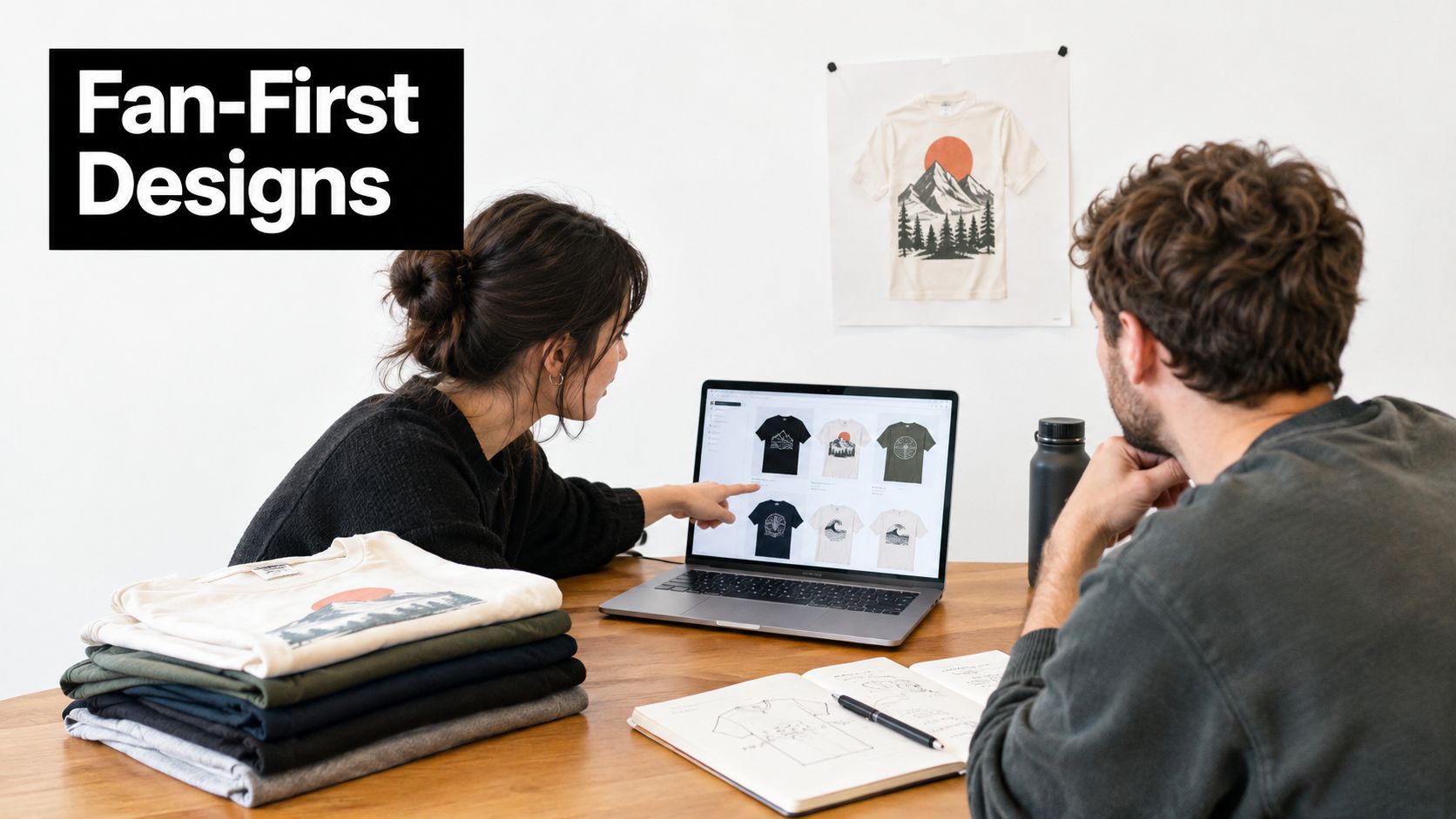
A design can earn enthusiastic comments without earning purchases. For a small audience, the important question is whether fans want the actual product at its actual price, with shipping included in their decision.
Review the garment, artwork, and buying experience together rather than approving an image in isolation.
An industry dataset put concertgoer merchandise purchasing at about 21% in both 2024 and 2025, while items per transaction increased from 1.7 to 2.1, as reported in Mordor Intelligence's live-music market coverage. That's a reason to consider committed buyers carefully, not assume everyone attending a show will purchase.
Choose Products Around Evidence
Ask fans to respond to a concrete offer: the design, product, fit, likely price, and destination options. For help turning an artistic idea into a product proposal, consult Sprello's guide to product concept design.
Then match the commitment you request to the risk you're considering:
- Preorders: Set a production threshold using your supplier's requirements and cost calculations. Explain what happens if the threshold isn't reached.
- Limited drops: Limit quantities when you have a genuine production or inventory constraint, not an invented scarcity message.
- Accessories: Consider items without apparel sizing when your audience is dispersed or fit demand is unclear.
- Bundles: Combine related products only when the combination makes sense to the fan.
- Deposits: Publish the balance, timing, and cancellation terms before accepting money.
If you can't justify buying stock from those signals, keep the offer made to order or postpone production. Choosing not to manufacture is a legitimate business decision.
Use the video below as a discussion prompt while reviewing your product direction.
Distinguish Show Excitement From Lasting Demand
An immediate purchase after a performance and an online order days later happen under different conditions. Record where orders originate and which designs people return to after the event.
Paid orders and clearly documented commitments should carry more weight in your production decision than likes. Also track requested sizes and destinations, since total interest alone won't tell you which variants to make.
Pricing Merch for Healthy Margins
Your selling price needs to cover the order you hope to receive and the problems you may have to resolve. A shirt isn't profitable just because its retail price exceeds the printer's invoice.
Start with a cost sheet for each product. Keep quoted costs separate from estimates so you can see what still needs checking before launch.
Build the Price From the Order Up
Include the blank or finished product, decoration, inbound freight where relevant, packaging, packing labor, payment processing, and any platform charges. Add the shipping cost you absorb rather than charge separately.
Then allow for replacements, exchanges, and unsold inventory. These aren't guaranteed expenses on every sale, but excluding them entirely gives you an incomplete picture.
- Production cost: Check whether the quote includes printing, labels, setup, and other finishing.
- Fulfillment cost: Account for storage, picking, packing materials, and the person preparing parcels.
- Transaction cost: Confirm payment charges and the marketplace's actual fee terms.
- Risk allowance: Use your own order history when available, then revise estimates as you learn.
Contribution per order is what remains after the costs directly associated with that order. It isn't the same as final business profit, because artwork, samples, photography, and other shared expenses still need funding.
If your expected margin looks healthy but little cash remains, review the cost categories that may be missing. Quikly's resource can help you understand what's shrinking your ecommerce margins.
Compare the Tee With the Whole Basket
Consider a hypothetical shirt and poster bundle. The bundle brings in more revenue than the shirt alone, but the poster may require different packaging or a separate shipment.
Calculate the combined order before offering a discount. Higher order value isn't automatically higher contribution, especially if the extra item changes handling or delivery costs.
Pricing checkpoint: A discount is affordable only after you've accounted for the work and materials needed to fulfill the discounted order.
Retaining control over your prices lets you choose where to position a product. A marketplace without intermediary fees removes that particular charge, but it doesn't remove manufacturing, payment, shipping, or support costs.
To test alternative prices, use clearly explained offers across comparable limited releases or product versions. Avoid charging fans different amounts for the same offer, and honor every price already paid.
Record purchases, cancellations, buyer questions, and contribution alongside the price. With a small audience, treat the result as directional evidence rather than proof that you've found a universally correct price.
Handling Sizing, Packaging, and Returns
A fan can love your artwork and still receive a shirt they can't wear. For limited merchandise, that creates a practical problem: the replacement size may already be gone.
Treat fit information as part of inventory management. It helps fans choose from the stock you have rather than discovering a mismatch after delivery.
Make Fit Information Product-Specific
An ACM-published study found that fit-oriented prediction could materially reduce size-related returns through large-scale testing, as described in the SizeFlags research. A small artist store doesn't need to copy its technical system to adopt the underlying discipline of collecting useful fit information.
Publish measurements for the actual garment, not a generic chart copied across unrelated products.
- Garment measurements: Provide chest, length, and sleeve measurements, with instructions showing how you measured.
- Fit expectations: Explain whether the cut is relaxed, oversized, fitted, or another clearly described shape.
- Worn examples: Include the wearer's measurements and garment size where possible.
- Care guidance: Pass on verified supplier instructions and any known shrinkage guidance.
Ask fans to compare those measurements with something they already own. Regional size conversions can help orient them, but shouldn't replace the garment's dimensions.
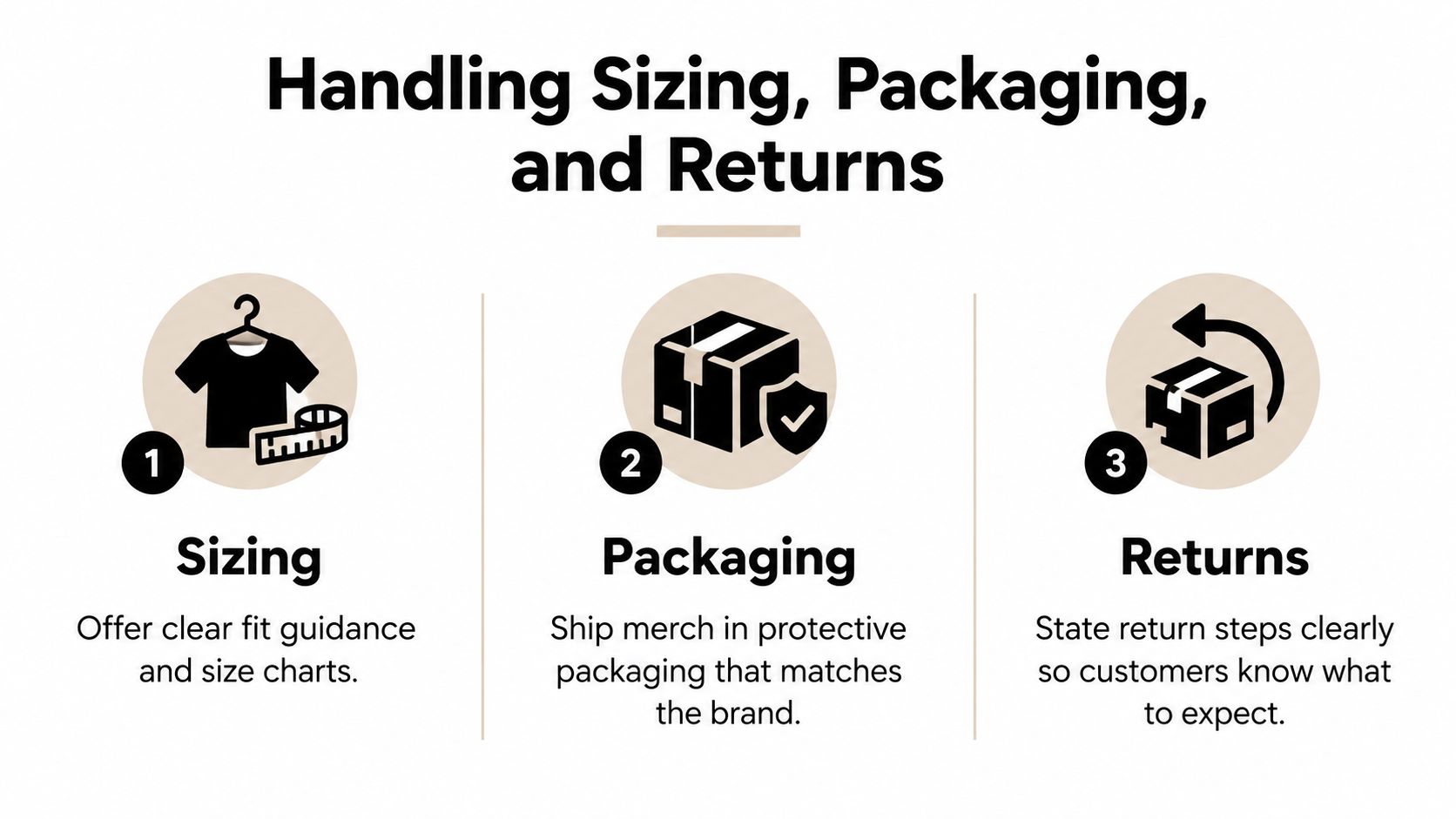
Use this checklist when reviewing the physical order experience.
Match Packaging and Policies to the Journey
Don't assume reusable packaging is automatically the lower-impact choice. An apparel e-commerce life-cycle study found a returnable mailer had greater environmental impact in 9 of 10 assessed categories, even with 40 reuses within the same city, with transport distance and reuse central to the comparison, according to the packaging life-cycle assessment.
For folded apparel, evaluate the smallest protective mailer that suits the shipment. Record parcel weight and dimensions, and compare alternatives for the actual destination rather than choosing by appearance.
Before launch, document who pays for an exchange, how fans request one, and what happens when a replacement is unavailable. Check applicable consumer requirements, and use the platform's shipping information alongside your carrier and supplier terms.
Finally, record return reasons by product and size. That gives you something specific to investigate, such as a misleading fit description or a garment that differs from its published measurements.
Promoting Your Music Merch Store Around Releases
Give fans a reason to visit now, rather than repeatedly announcing that a store exists. My recommendation is to build promotion around releases, performances, and meaningful milestones, when you have a clear story to tell.
A merch launch can extend that story. Artwork details, a lyric reference, or a design worn at a show gives you something more useful to discuss than a checkout link alone.
Treat Digital Commerce as a Direct Relationship
A 2025 estimate valued the artist-merchandising sector at $6.6 billion, with online channels representing 40.0% of sales, according to DataIntelo's artist-merchandising market report. That estimate includes artist webstores, marketplaces, and social commerce, rather than a single type of online shop.
For an independent artist, the practical aim is to make discovery, buying, and follow-up feel connected. A fan shouldn't have to search through unrelated posts to find the product you've just announced.
Start with people who have chosen to hear from you. Direct messages, community posts, and voice notes can carry a personal explanation of the design, provided you respect consent and avoid repetitive unsolicited messages.
A Promotion Calendar With a Purpose
| Moment | What to Share | What the Fan Needs to Know |
|---|---|---|
| Before the drop | Artwork detail, sample footage, or the product's story | What's coming and when ordering opens |
| Launch window | Finished product, fit demonstration, and store destination | Price, availability, and delivery expectations |
| Next show | The item worn or displayed in a performance context | Whether it's available online, at the venue, or both |
| Closing message | A truthful ordering deadline or stock update | What happens next and whether a restock is planned |
Create each message around a different question. A teaser explains the connection to the music; a launch post explains the offer; a reminder can answer a sizing or delivery concern.
For visual planning, Image Studio's discussion of how cinematic content drives social engagement offers a resource to consider. Keep your own execution practical: show fabric movement, print placement, and the garment on a person, not just a digital mockup.
Let the campaign tell a story, but let the product page answer the purchasing questions.
Don't invent urgency when the item will remain available. A genuine preorder closing date is useful information; an endlessly renewed deadline can undermine the trust you're trying to build.
After dispatch, shift from selling to communication. Share production updates where relevant, explain delays plainly, and invite feedback from buyers who've received their orders.
Launching Your Store on OohYeah and Taking the First Step
Before publishing, rehearse an order from the fan's side. Open the listing on a phone, choose a size, check the delivery information, and read the exchange terms without relying on anything you know privately.
Anything essential that only exists in your head needs to move onto the product page or into a clear support process. That includes who handles a damaged parcel and how a buyer contacts you.
Turn the Decisions Into a Launch Plan
Use the artist registration page when you're ready to set up your selling presence. The platform supports merchandise alongside music and subscriptions, with artist control over pricing and distribution; fans can join for free.
Prepare the launch in a sequence that prevents expensive assumptions:
- Confirm fulfillment: Name the person or supplier responsible for production, dispatch, tracking, and exceptions.
- Approve the catalog: Choose the products supported by the demand signals you've collected.
- Check the economics: Finalize your cost sheet and the amount available for operational problems.
- Complete the listing: Add actual product photographs, garment measurements, care information, and exchange terms.
- Schedule the announcement: Connect the launch to a real release or performance and prepare the messages in advance.
Don't interpret a completed storefront as a completed operation. Keep supplier contacts, product details, and customer-service responsibilities somewhere you and any bandmates can access.
Decide What Would Make You Change Course
Write down your decision rules before orders arrive. You might postpone production if preorder demand doesn't meet the supplier's requirements, pause a variant after repeated fit complaints, or stop offering a destination you can't serve reliably.
Those aren't signs that the store has failed. They're boundaries that help you avoid spending more cash or making promises you can't keep.
Your first launch should also produce usable information. Keep notes on what fans asked, which variants sold, and where fulfillment required manual intervention.
This week, prepare a single limited-run product for an upcoming show or release. Approve its sample, write its measurement guide, and schedule its announcement only after you can explain exactly how the order will reach the fan.
OohYeah lets artists bring merchandise, music, and subscriptions together while retaining control over pricing and distribution. Visit OohYeah to prepare your first merch listing, then pair it with a clear size guide, confirmed fulfillment plan, and launch tied to your next release.