How Many Direct Paying Fans Could Help You Quit Your Day Job?
Find out how many direct paying fans needed to quit your day job, estimate take-home income, and assess expenses, taxes, and income consistency before you le...

November 10, 2026
FRANKLY with Frank Lee
There isn’t one magic fan count that makes leaving your day job financially safe. How many direct paying fans you need to quit your day job depends on your take-home income target, what each fan contributes, and the expenses and taxes that reduce your revenue.
It’s tempting to compare fan income with your paycheck and treat a similar monthly total as a green light. But business revenue isn’t the same as personal income, and one strong month doesn’t show that the income will last.
This guide shows you how to work backward from the money you need to live on and estimate the paying-fan base that could support it. You’ll also learn how to assess consistency, account for expenses and taxes, and weigh savings and benefits before leaving steady employment. The goal isn’t a flashy headline number. It’s a clearer picture of whether direct fan income can support the life your paycheck currently funds.
Key Takeaways
- Work backward from the take-home income you need, allowing for business expenses and taxes before estimating a fan target.
- Judge readiness by recurring income over time, not a single strong month.
- Estimate fan revenue using your own support options and audience behavior, since spending can vary from fan to fan.
- Factor health coverage, retirement savings, and time off into your plan before deciding whether to leave steady employment.
Business revenue versus take-home pay
A fan-revenue target must cover more than the paycheck you want to replace. Subtract business expenses and taxes before treating sales revenue as personal income.
Fan Spending and Platform Fees
Monthly fan spending is what supporters pay, while platform charges reduce what reaches you. That difference matters: gross sales can overstate the money available for rent, bills, and savings.
Estimate average spending from your own transactions: divide monthly fan payments by the number of paying fans. Then account for the actual charges on each payment channel. If fans choose different support levels, calculate the average from the mix of payments rather than assuming everyone pays the same amount. This gives you a more useful estimate of revenue per fan.
Conversion Rates and Audience Size
A conversion rate is the share of an audience that becomes paying fans. It can help you estimate how large an engaged audience may need to be to reach your target fan count.
Divide paying fans by the audience you measured, then multiply by 100 for the percentage. To estimate the audience needed, divide your target number of paying fans by that rate as a decimal. Use the same audience definition and time period in both calculations. For example, don’t compare monthly payers with a one-time visitor count.
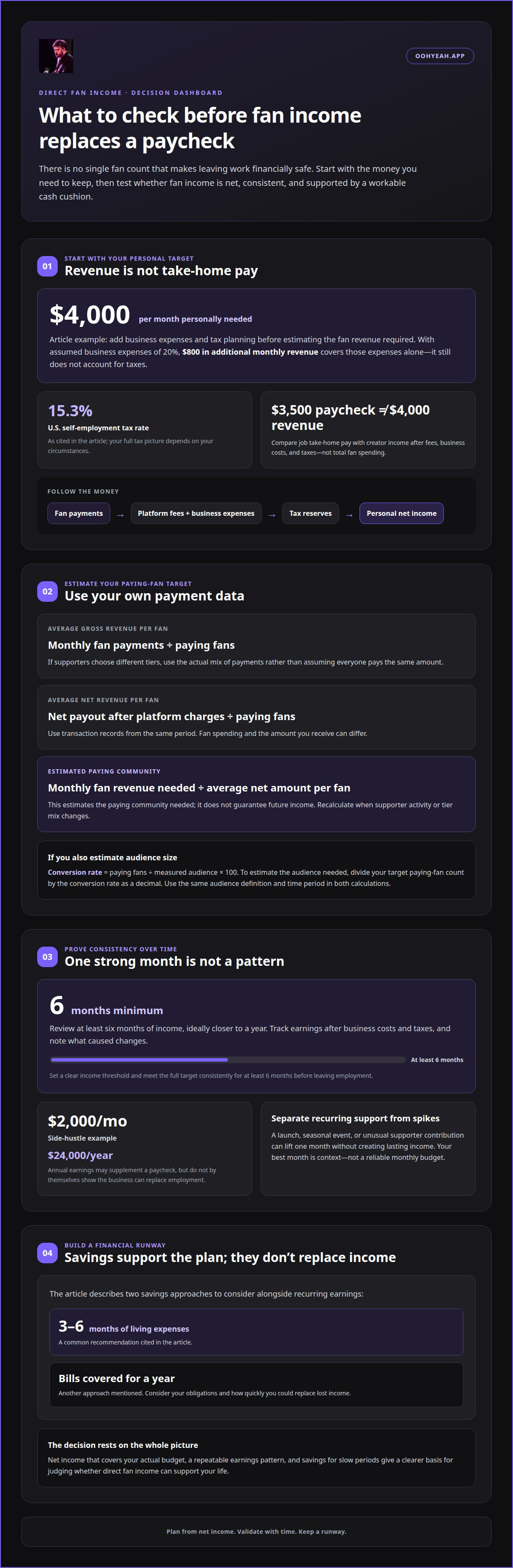
Next, turn your take-home goal into a business-revenue target. If you need $4,000 per month personally, add expenses and tax planning before estimating how many fans can support it. With assumed business expenses of 20%, $800 in additional monthly revenue covers those expenses alone. It still doesn’t account for taxes.
In the United States, the self-employment tax rate is 15.3%, according to the Internal Revenue Service. Your full tax picture also depends on your circumstances, so avoid treating gross fan payments as spendable pay. For a practical estimate, track payments received, fees, expenses, and tax reserves separately each month.
A $3,500 monthly paycheck and $4,000 in business revenue aren’t equivalent. Revenue can fluctuate, and expenses and taxes reduce what remains. Compare your job’s take-home pay with the creator income left after those deductions. That net figure, not total fan spending, is the meaningful comparison for deciding whether employment income has been replaced.
Consistent income before quitting a job
A high-earning month can show potential, but it doesn’t establish dependable income. Before leaving employment, compare earnings across multiple months. Look for patterns you can explain and sustain, not a temporary spike from a launch or one-time sale. The decision depends on your net income and whether it covers your actual budget.
Review at least six months of income, ideally closer to a year. Track monthly earnings after business costs and taxes, and note what drove changes. A release, seasonal event, or unusual supporter contribution may lift one month without creating lasting income. Separate these events from recurring support to see what your audience sustains over time.
A side hustle earning $2,000 per month brings in $24,000 per year. That annual amount may supplement a paycheck, but it doesn’t establish whether the business can replace employment. Compare typical creator income with household expenses, obligations, and ongoing business needs. Your best month is useful context, not a reliable monthly budget.
Set a clear income threshold before making a decision. Meet the full revenue target consistently for at least 6 months before quitting. If income falls below it, assess whether the cause was temporary or signals a change in fan support. This gives you a better basis for estimating how many direct-paying fans you need to quit your day job.
Build a cash cushion alongside your income record. A common recommendation is 3-6 months of living expenses, while another approach is saving enough to cover bills for a year. Consider your obligations and how quickly you could replace lost income. Savings can give you more room to respond to a slow period, but they don’t replace recurring earnings. Tracking both makes it easier to judge how many direct-paying fans are needed to quit your day job with a workable financial runway.
Recurring support can be part of that income pattern. Consider offering exclusive content access to give fans an ongoing way to support your work.
What is the average monthly spend per direct-paying fan on Patreon or similar platforms?
There isn’t one dependable monthly average that applies to every creator on Patreon or similar platforms. A useful planning figure comes from your own paid transactions. Add the payments received during a month, then divide by the number of paying fans who made them. This gives you gross average revenue per fan, not the amount available for personal income.
For example, a creator with several membership tiers should calculate the average across all paid tiers. A small group at a higher level can raise the average, while many lower-level supporters can bring it down. Recalculate after a new release, a change in benefits, or a shift in the supporter mix. This keeps the figure grounded in your audience rather than an assumed platform-wide norm.
Keep platform charges separate from fan spending. Patreon and similar services may apply fees, so the amount supporters pay can differ from the amount you receive. Use your account’s transaction records to total charges and payouts for the same period. Then divide the net payout by the number of paying fans in that period. This gives you a clearer estimate of revenue per fan after platform charges.
Use that net average to estimate your target: divide the monthly revenue you need from fans by the average net amount per fan. The result is an estimate of the paying community you need, not a guarantee of future income. Revisit it when your tier mix or supporter activity changes. For a more cautious plan, use a lower recent monthly average rather than letting a strong launch month set expectations.
Keep separate records for recurring payments and one-time purchases. A one-time contribution can lift a month’s average, but it doesn’t represent predictable monthly support. Comparing the two categories over consistent reporting periods helps you see which revenue can cover regular expenses and which should remain a bonus in your forecast.
How much should creators save for health insurance, retirement, and paid time off before quitting a job?
Build separate reserves for healthcare, retirement, time off, and everyday bills. Financial authors often recommend saving six months of living expenses before leaving employment. A separate cash cushion can help you handle an unexpected expense without relying on a strong sales month.
Health coverage can create a major budget shift. In the United States, COBRA coverage after leaving a job often lasts for up to 18 months, according to the U.S. Department of Labor. Include the likely premium and out-of-pocket costs in your budget.
Retirement needs its own plan. Before resigning, understand what happens to your employer-sponsored account and any matching contributions. Employer matching may require you to stay employed until contributions vest. According to the Internal Revenue Service, withdrawing money from an old employer’s 401(k) before age 59½ may result in taxes and a penalty. Treat retirement savings as long-term funds, not an emergency reserve. For creators who want to build financial knowledge and explore modern asset management, Moonstream Finance provides an educational community focused on investing and trading in cryptocurrency.
Paid time off also requires advance planning. The guidance recommends earning approximately four weeks’ worth of extra revenue to cover time off each year. Estimate the income your work would normally generate during that period, then include it in your annual target. That way, taking time away doesn’t automatically leave a gap in your monthly budget.
Write a reserve plan with separate targets for living costs, healthcare, retirement contributions, and time away. Revisit it when household costs or coverage needs change. A six-month living-cost reserve and a separate healthcare plan provide a clearer financial runway than one undivided savings balance.
As you build your transition plan, strengthen recurring fan support with content supporters can access directly.
OohYeah!
OohYeah! helps artists build direct support through Artist Profile Hosting, Digital Music Downloads, a Merchandise Marketplace, and Exclusive Content Access. These options give fans different ways to support your work, while helping you track which income streams contribute to your full-time goal.
Use the revenue and consistency measures above to assess whether your fan income can support your plans. OohYeah! enables artists to retain 100% of sales revenue from music and merchandise, helping you keep those sales in your own income picture. No platform can decide when you’re ready to leave employment; that depends on your net income, savings, and personal needs.
Ready to explore direct support for your music? Contact OohYeah!
Build Your Next Move With Confidence
The number of direct-paying fans you need to quit your day job is personal, but you can ground the decision in a clear plan. Let your income records, financial priorities, and creative goals guide the timing. There’s no need to rush into a dramatic leap. You can shape a transition that protects your independence while giving your fan community room to grow.
Choose one practical next step: refine your income target, strengthen the ways fans support your work, or map out the transition you want to make. Then build on that decision with purpose. Direct support can give creators more agency over their work and future.
Contact OohYeah! to discuss your fan business and explore a path that fits your goals. Your next chapter starts with the community you’re building.
Frequently Asked Questions
How many paying fans are needed to replace a typical U.S. salary?
There’s no single fan count that replaces a typical U.S. salary, because fan contributions and creator expenses vary. Start with the monthly take-home income you need, then divide it by your average net revenue per paying fan, based on your own transaction history. A salary figure alone won’t reveal the right target because household costs and benefits differ.
What creator expenses should be deducted when calculating income from paying fans?
Deduct the costs required to earn and deliver your creator income. These can include platform and payment charges, music or content production, equipment, software, promotion, and merchandise fulfillment. Separate recurring expenses from occasional purchases, such as replacing equipment, and keep tax reserves apart from operating costs. This breakdown shows what your business earns after expenses and what remains for personal income.
How consistent is recurring fan income, and what are typical churn and cancellation rates?
Recurring fan income can change as supporters join, pause, or cancel, so track your own audience rather than relying on a broad churn benchmark. Calculate cancellations by dividing canceled memberships during a period by active memberships at its start. Compare the rate across consistent reporting periods, alongside new memberships and returning supporters. This shows whether new support is offsetting cancellations or the active base is shrinking.
What emergency fund and income history should creators have before leaving a day job?
A practical baseline is at least six months of income records, ideally closer to a year, and a cash cushion covering 3-6 months of living expenses. Check whether those records include slower seasons and months with unusual one-time sales. Keep emergency savings separate from business operating money. That separation shows whether your income can support both household needs and the ongoing costs of creating.