How Independent Artists Actually Make Money in 2026
Learn how independent artists actually make money today. Ditch low-paying streams for high-margin sales, merch, and superfan strategies to build a real career.
August 12, 2026

Music Business Insider
Music BusinessChasing millions of streams is the fastest way to stay broke in the modern music industry. You already know the math doesn't add up when platforms like Spotify pay as little as $0.003 per play. If you want to understand how independent artists actually make money today, you have to stop thinking like a playlist addition and start acting like a business owner. The old gatekeepers and their 30% commission fees are finally becoming relics of a broken, restrictive past. You feel the weight of high marketplace fees and the frustration of not even knowing who your top supporters are.
You deserve to keep every cent you earn instead of handing it over to platforms that hide your own fan data from you. This article reveals the high-margin revenue strategies that allow creators to build sustainable careers without relying on record labels or low-payout streaming models. We will break down how to build a diversified income stream through digital downloads, exclusive content, and merchandise while maintaining absolute ownership of your fan relationships. It's time to reclaim your independence and build a career that actually pays the bills.
Key Takeaways
- Stop chasing fractions of a penny and learn why volume-based streaming is a financial trap for modern creators.
- Discover how independent artists actually make money today by pivoting from a stream-first to a sales-first release strategy.
- Unlock the "superfan" strategy to generate 50% of your income from just 5% of your most dedicated audience.
- Maximize your profit margins by utilizing commission-free marketplaces for digital downloads and physical merchandise.
- Take full ownership of your fan relationships and data to build a sustainable, label-free career that lasts.
The 2026 Reality: Why Volume-Based Streaming Is a Financial Trap
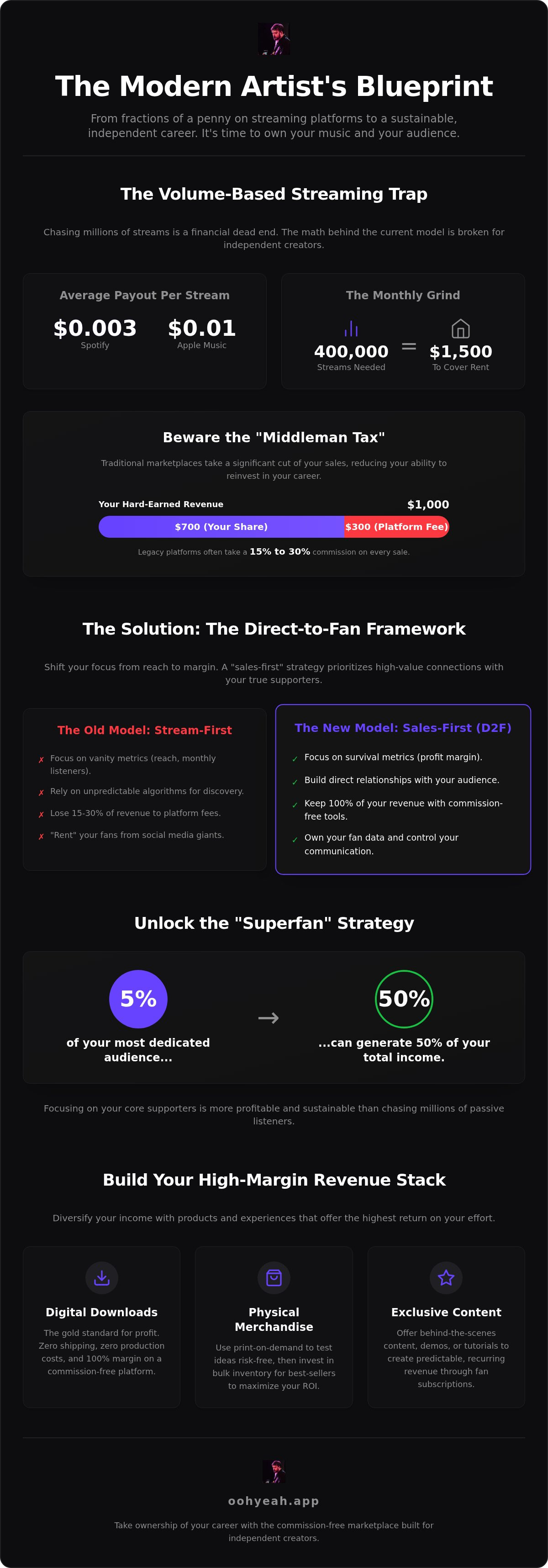
The dream of "going viral" on streaming platforms has become a financial nightmare for most. In 2026, the pittance-per-stream model is officially broken. Spotify currently pays between $0.003 and $0.005 per stream, while Apple Music sits between $0.007 and $0.01. These fractions of a penny simply don't add up for the average creator. If your rent is $1,500, you need roughly 400,000 streams every single month just to cover your housing. This volume-based trap is the primary reason why people are asking how independent artists actually make money today without burning out or holding down three side jobs.
Algorithms are designed to keep users on the platform; they aren't designed to put money in your pocket. They prioritize "passive discovery," which often means your music becomes background noise for a listener who might never even see your name. When you finally do make a sale on traditional marketplaces, you hit the "Middleman Tax." Most legacy platforms take a 15% to 30% cut of every digital sale and merch order. You lose a massive chunk of your hard-earned revenue before it ever touches your bank account, making it nearly impossible to scale your business.
The Math of Modern Music Consumption
Effective payout is the net profit you actually keep after distribution fees and platform commissions are stripped away. Consider the massive effort required to gain 100,000 streams. That mountain of work might net you a measly $400. In contrast, selling just 100 digital albums at $10 each brings in $1,000. Relying on passive discovery is a gamble; selling directly is a strategy. High-volume streaming rarely leads to long-term financial stability because you don't control the flow of traffic or the payout terms.
The Rise of the Ownership Economy
Your most valuable asset isn't your monthly listener count. It's your fan data. Owning your audience's email addresses and purchase histories allows you to bypass the algorithm entirely. You stop "renting" your fans from social media giants and start "owning" the relationship on your own terms. Independent artists and labels now account for approximately half of all royalties on major platforms. This shift proves that the "middle class" of the music industry is growing. You can command a sustainable career by focusing on the 40% of the market that values direct connection over corporate curation.
The Direct-to-Fan (D2F) Framework: Maximizing Margin Over Reach
Reach is a vanity metric. Margin is a survival metric. If you want to know How Independent Artists Actually Make Money Today, you must abandon the "stream-first" mindset. The old model focuses on getting as many ears as possible for the lowest possible price. The D2F framework flips this. You prioritize a "sales-first" release strategy that targets your most dedicated supporters. By retaining 100% of your revenue, you generate the capital needed to fund professional mixing, mastering, and high-end visual content without begging for a label advance.
This approach creates an "Efficiency Gap" that works in your favor. When you aren't losing a massive percentage to gatekeepers, your break-even point for everything from studio time to indie tours drops significantly. You don't need to sell out a stadium to be profitable. You just need to build a "Value Ladder." This ladder starts with free streaming to attract new listeners, then leads them toward digital downloads, limited-run merchandise, and eventually premium exclusives. Every step up the ladder increases your profit per fan.
Commission vs. Commission-Free: The Financial Impact
The math is undeniable. Imagine you sell $1,000 worth of digital albums and t-shirts. On a traditional platform with a 30% commission, you walk away with $700. On a commission-free subscription platform, you keep the full $1,000. That $300 difference represents your next music video or a week of targeted social media ads. Using a commission-free music marketplace allows you to offer fairer prices to your fans while still making more money than you would on a high-fee site. Fans love knowing their money supports your art directly instead of padding a corporate balance sheet.
Identifying Your High-Margin Revenue Streams
Not all income is created equal. To build a sustainable career, you need to focus on products with the highest return on investment. Digital downloads are the gold standard for digital margins because they require zero shipping or physical production costs. For physical goods, many artists now balance print-on-demand services for low-risk testing with bulk inventory for their best-selling items to maximize ROI. Finally, fan subscriptions provide the predictable recurring revenue that streaming simply cannot offer. By turning sporadic buyers into monthly members, you create a financial foundation that allows you to focus on the music instead of the hustle.
Beyond the MP3: Monetizing Exclusive Content and Experiences
The standard audio file is a gateway, not the destination. If you want to master How Independent Artists Actually Make Money Today, you must look past the play button. Successful creators in 2026 rely on the "Superfan" strategy. Research indicates that just 5% of your audience can provide up to 50% of your total income if you offer the right value. These aren't casual listeners; they are patrons who crave a deeper connection to your creative process. You can transform a simple release into a "Digital Deluxe" by bundling exclusive stems, high-resolution artwork, or commentary tracks that provide a glimpse into your world.
Thinking like a digital-first creator means looking at how other successful industries engage their fans; for example, the way So Yummy utilizes creative video hacks and lifestyle content provides a great blueprint for musicians looking to build a dedicated following through visual storytelling.
Recurring fan memberships are the engine of a sustainable career. They turn the unpredictable nature of the music industry into a predictable monthly salary. By offering exclusive content access, you give your supporters a reason to invest in your long-term growth. Behind-the-scenes footage, unreleased demos, and early access to ticket sales are high-value digital products that cost you nothing to replicate but mean everything to a dedicated fan. This represents the ultimate liberation from the volume-based trap mentioned earlier. You stop chasing millions of strangers and start serving your most loyal community—which can even include offering ultra-exclusive rewards like a luxury retreat in the Greek islands with YAL’OOU Exclusive Yachting & More.
How to Build an Exclusive Content Tier
Creating a premium experience doesn't have to be complicated. Follow these steps to start scaling your income:
- Step 1: Identify content that's too raw for a polished streaming profile but perfect for superfans. Think voice memos, alternate takes, or studio vlogs.
- Step 2: Set up a dedicated artist profile hosting exclusive audio and video. This centralizes your value and makes it easy for fans to subscribe in one place.
- Step 3: Use limited-time "drops" to create urgency. Scarcity drives action and rewards those who support you early.
The Psychology of Fan Support
Fans don't just pay for files; they pay for the feeling of being part of your journey. This is the "Supportive Patron" model. People often buy music they could easily stream for free because they believe in your mission. When you communicate your career goals clearly, your audience feels like equal participants in your success. Transparency is key to this relationship. A commission-free experience builds massive trust. When fans know that 100% of their contribution goes toward your next record, they're far more likely to open their wallets. You aren't just selling a song; you're inviting them to fund a movement.
Physical Goods: Strategic Merchandising Without the Fees
Physical merchandise is your most powerful real-world billboard. In 2026, a fan wearing your shirt in public does more for your brand than a thousand passive streams. But the logistics have changed. Fans now demand sustainable materials and participate in a "drop" culture that values scarcity over mass production. Managing this doesn't require a warehouse or a third-party distributor. You can control a global storefront directly from your artist dashboard, keeping your brand consistent and your margins high.
One of the biggest hurdles in How Independent Artists Actually Make Money Today is the "merch cut." When you sell at a venue, they often take 20% or more of your gross sales just for the privilege of using a table. Traditional marketplaces take their own 15% to 30% cut on top of that. Selling through your own commission-free marketplace eliminates these unnecessary losses. You keep the profit that would otherwise go to a middleman, allowing you to reinvest in your next tour or studio session.
What Merch Actually Sells for Indie Artists?
Fan preferences have shifted back toward tactile experiences. While apparel remains a staple, collectibles and physical media are seeing a massive resurgence. In the first half of 2026, CD sales grew by 16% as fans looked for affordable ways to own a piece of the music. Vinyl remains a premium "souvenir" that commands high prices. You can boost your average order value by bundling these physical items with digital downloads. A fan buying a vinyl record should instantly receive the high-quality digital files, giving them immediate gratification while they wait for shipping.
Optimizing Your Store for Conversion
Your merch store shouldn't be a separate destination. It must be integrated into your music profile so fans can shop while they listen. Reducing friction is the key to conversion. A seamless, mobile-first checkout process ensures that a fan doesn't abandon their cart because of a clunky interface. Use your artist analytics to see which designs are getting the most clicks. If a specific graphic is resonating, you can launch a limited-run "drop" to capitalize on that interest. You can launch your commission-free merch store today and start keeping 100% of your physical sales revenue.
Building Your Revenue Stack: The OohYeah! Advantage
The "Commission Tax" is a silent killer for your creative business. When legacy platforms take 15% to 30% of your revenue, they aren't just taking money; they're taking your ability to grow. OohYeah! changes this by replacing percentage-based fees with a simple, flat monthly subscription. This shift is the definitive answer to How Independent Artists Actually Make Money Today. You shouldn't be penalized for your success. As your sales grow, your costs remain predictable. This allows you to scale your career without losing a larger slice of the pie to a corporate middleman.
Efficiency comes from consolidation. Managing separate accounts for streaming, digital sales, and merchandise is a logistical headache that drains your creative energy. OohYeah! provides a unified marketplace that houses your music, merch, and fan community in one ecosystem. Your artist dashboard provides real-time data on sales and engagement. This puts you back in the driver's seat. You own the fan relationship, you own the data, and you own the profit. This platform isn't just a tool; it's the blueprint for How Independent Artists Actually Make Money Today without compromise.
Once you’ve secured your primary income streams, the next step in acting like a business owner is learning how to grow that capital. Just as professional investors rely on Wavetraders to identify market trends and protect their wealth, independent creators can use their increased margins to build a more robust financial future.
In addition to smart investing, long-term sustainability for any business owner involves reducing fixed overhead like energy; many forward-thinking professionals visit Sonalis to plan efficient solar and storage systems for their homes and studios.
Setting Up for Success on OohYeah!
Building your revenue stack starts with a centralized hub. Your professional artist profile functions as the heart of your business. It's where fans come to support you directly. You can move from setup to sales in minutes by following these steps:
- Create a profile that reflects your brand and hosts your entire creative output.
- Upload your catalog for commission-free digital downloads to maximize your profit per release.
- Integrate your merch marketplace to capture 100% of physical sales without venue or aggregator cuts.
The Future of Independent Music Business
The "liberated artist" model is no longer a dream; it's the only sustainable path in 2026. By joining a community of creators who prioritize fairness and financial health, you're helping dismantle a broken system. You don't need a label to reach your audience or a marketplace that treats your income as its own. You just need the right tools and the courage to own your worth. Start your commission-free journey on OohYeah! today and take back control of your music career.
Take Control of Your Creative Future
The era of settling for fractions of a penny is over. You've seen the data; streaming alone cannot sustain a professional career in 2026. True financial liberation comes from shifting your focus toward high-margin revenue and direct fan relationships. By prioritizing digital downloads and exclusive content, you build a business that scales on your terms rather than an algorithm's whim. This is How Independent Artists Actually Make Money Today; they stop asking for permission and start owning their own ecosystem. You have the talent and the audience. Now, you just need a platform that respects your bottom line.
It's time to reclaim your independence and build a career that lasts. Stop paying commissions and start earning more on OohYeah! You'll keep 100% of your sales revenue from both music and merch while hosting a professional artist profile that serves as your central business hub. Your fans are ready to support you. Give them the direct connection they crave and build the sustainable, profitable career you deserve.
Frequently Asked Questions
Is it possible for an independent artist to make a living without a record label?
Yes, it's entirely possible and increasingly common. You no longer need a label to reach a global audience or manage your business operations. Direct-to-fan platforms allow you to act as your own CEO. By owning your master recordings and publishing rights, you control your financial destiny. Independence is the new industry standard for creators who value equity and long-term career health.
How much does the average independent artist make per stream in 2026?
Payouts remain extremely low across all major platforms. Spotify currently pays between $0.003 and $0.005 per stream, which forces creators to find other paths. This reality is the driving force behind How Independent Artists Actually Make Money Today. You simply cannot survive on streaming alone. You must diversify your income through direct sales and exclusive fan experiences to build a real living.
What are the best platforms for selling music directly to fans?
You should prioritize marketplaces that offer a unified, professional experience. The best platforms host your artist profile, digital downloads, and merchandise in one central location. This centralization makes it easy for fans to support you without jumping between different websites. Look for options that replace high commission fees with a flat, predictable subscription model to ensure your financial health remains a priority.
Why is commission-free music distribution better than percentage-based models?
It's a matter of simple math and fairness. Percentage-based models take more of your money as you become more successful. This acts as a "success tax" on your hard work. Commission-free models keep your overhead low and predictable regardless of your sales volume. You keep every cent of your sales revenue, which provides the capital needed to fund high-quality music videos and professional studio time.
How many fans do I need to earn a full-time income from music?
You don't need a massive viral hit to earn a full-time income. The "1,000 True Fans" theory is more relevant than ever in the modern economy. If 1,000 dedicated supporters spend $100 annually on your art, you've built a six-figure business. High-margin products like digital deluxes and limited-run merch make this goal much easier to reach than chasing millions of passive streams.
Can I sell merch and digital music in the same place?
Consolidating your storefront is a smart business move that reduces friction for your audience. When you sell merch and digital music in the same place, you create a seamless shopping experience. Fans can buy a vinyl record and a digital album in a single transaction. This integration boosts your average order value and provides you with a clearer picture of your audience's buying habits.
What is the 'Middleman Tax' in the music industry?
The "Middleman Tax" is the 15% to 30% revenue share claimed by traditional platforms and venues. It's a legacy system that drains independent budgets and stalls growth. Avoiding this tax is a core strategy for How Independent Artists Actually Make Money Today. By using direct-to-fan infrastructure, you cut out the unnecessary gatekeepers and keep your hard-earned revenue for yourself.
Do fans actually still buy digital downloads?
Digital downloads are making a strong comeback as a "patronage" product. While streaming is for convenience, downloads are for ownership and direct support. Fans want to know their money goes directly to the creator rather than a corporation. High-resolution audio files and exclusive digital booklets provide value that streaming services can't match, making downloads a high-margin staple for indie artists.