Understanding Music Royalties: A Clear Guide for Artists
Stop losing money on your music. Our guide to Understanding Music Royalties Without the Confusion shows you how to collect every penny you've earned.

August 16, 2026

Music Business Insider
Music BusinessWhy did the global music industry generate $31.7 billion in 2025 while most independent creators are still struggling to pay their bills? It feels like the system is rigged. You see millions of streams turn into pocket change. The alphabet soup of PROs, the MLC, and SoundExchange only adds to the frustration. You know you're being underpaid, but finding the missing money feels impossible when the rules keep changing.
We believe you deserve every penny your music generates. This guide is your roadmap to Understanding Music Royalties Without the Confusion. We are stripping away the gatekeeper jargon to give you total clarity on your earnings. You'll learn exactly how to set up your collection system and why the 2026 statutory mechanical rate of 13.1 cents per download matters to your bottom line. We will demystify the complex world of backend payments and show you how to find financial independence by connecting directly with your fans. It is time to stop settling for fractions of a cent and start claiming your worth.
Key Takeaways
- Identify the legal difference between your song compositions and sound recordings to protect your ownership rights.
- Master the four major royalty streams to ensure you collect every cent from radio play, live venues, and digital streams.
- Follow a practical checklist for Understanding Music Royalties Without the Confusion by joining essential organizations like PROs and SoundExchange.
- Recognize the limits of streaming payouts and why direct-to-fan sales are the fastest path to a sustainable income.
- Learn how to bypass industry gatekeepers by selling digital downloads and merchandise directly to your supporters.
Mastering the Basics: The Two Sides of Every Song
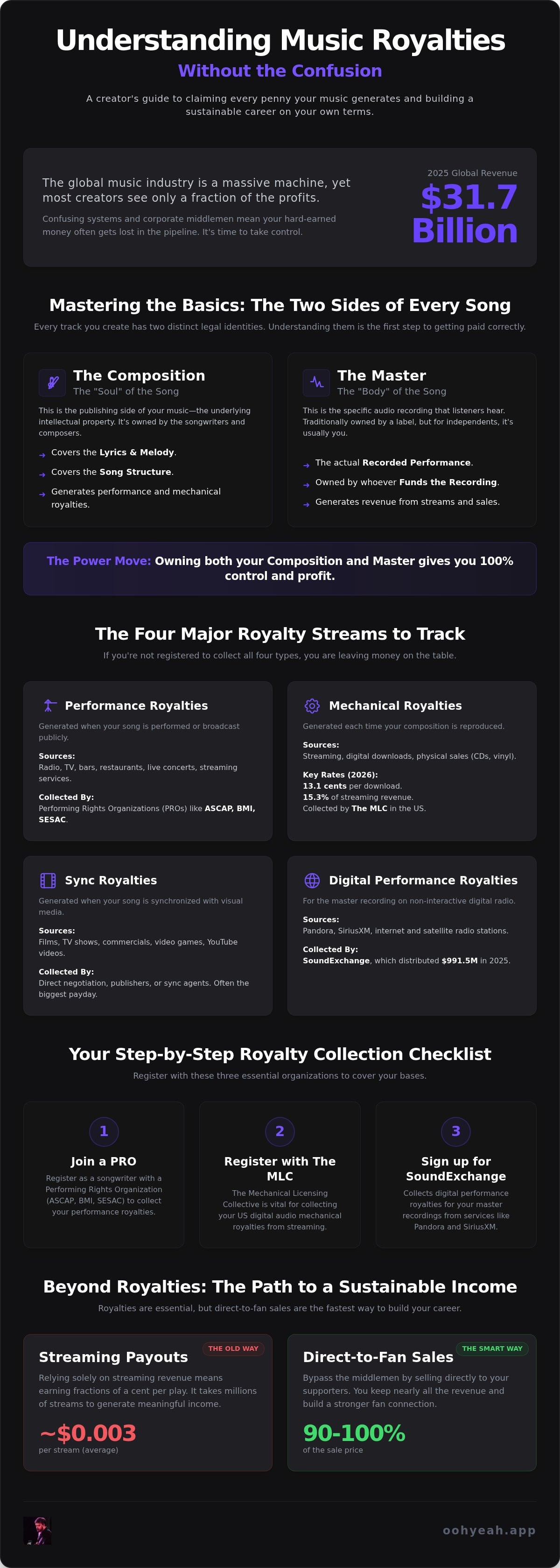
You just finished your latest track. You exported the file and you're ready to share it with the world. In your mind, you have created one piece of art. Legally, you have actually created two separate assets. Every song has a split personality. One side is the "soul" of the music, and the other is the "body" that carries it. If you want to get paid fairly, you have to treat these as two distinct businesses. Understanding Music Royalties Without the Confusion begins with separating these two identities once and for all.
Think of it like a book. There is the story itself, and then there is the physical copy printed on paper. One cannot exist without the other, but they are governed by different rules. Gaining a foundational grasp of Music royalties helps you see why these silos exist and how they affect your bank account. As an independent artist, your greatest advantage is often owning both sides of this equation.
The Composition Right (Songwriting)
This is the "publishing" side of the track. It covers the lyrics, the melody, and the underlying structure of the song. Songwriters and composers own this right the moment the idea is fixed in a tangible format. You don't even need a professional recording to own the composition. You must register this work even if you only have a rough demo. It ensures that if another artist covers your song or a filmmaker uses the melody, you receive your share of the songwriting revenue.
The Master Right (Recording)
The master is the specific audio file people hear. It is the actual performance captured on "tape" or in your digital workstation. Traditionally, whoever pays for the recording session owns the master. In the old industry model, that was almost always a record label. For most modern independent creators, you are the one funding the project, which means you are the rightful owner. This right generates revenue every time a fan hits the "play" button on a streaming service or purchases your digital music downloads.
Owning both the composition and the master is the ultimate power move. It gives you 100% control over how your music is used and who gets a cut. You aren't just the performer; you are the publisher and the label. This independence means you don't have to ask permission to license your work or split your earnings with corporate middlemen who didn't help you create the art. You keep the control. You keep the profit. You build a sustainable career on your own terms.
The Four Major Royalty Streams You Need to Track
Tracking your income shouldn't feel like a full-time accounting job. To succeed as an independent creator, you must master the four primary avenues where your music generates cash. Understanding Music Royalties Without the Confusion means knowing exactly which organization collects which check and why. If you aren't registered for all four, you're essentially donating your hard-earned money back to the industry.
- Performance Royalties: These land in your pocket when your song is played in public. This includes traditional radio, bars, restaurants, festivals, and even your own live sets.
- Mechanical Royalties: These are paid for the "reproduction" of your work. In 2026, the statutory rate for physical copies and digital music downloads is 13.1 cents per track. For streaming, the headline rate is 15.3% of the service's revenue.
- Sync (Synchronization) Royalties: This is a fee paid when your music is "synced" with visual media. Think film, television, video games, and advertisements.
- Digital Performance Royalties: This is the "hidden" stream. It covers non-interactive digital broadcasts like SiriusXM or Pandora. SoundExchange is the powerhouse here, having distributed $991.5 million to artists in 2025 alone.
Performance vs. Mechanical: The Great Divide
Performance royalties are handled by Performing Rights Organizations (PROs) like ASCAP, BMI, or SESAC. Mechanical royalties for US streaming are now centralized through the Mechanical Licensing Collective (MLC). You must register with both a PRO and the MLC because they collect for entirely different legal rights; missing one means leaving half your revenue on the table.
Sync Licensing: The Big Payday
Sync is where the life-changing money lives. A single placement in a commercial or a hit series can earn you more than a million streams ever will. You can hire a sync agent to pitch your music or take the DIY route by contacting music supervisors directly. The secret to winning here is your metadata. If your files aren't tagged with your contact info, mood, and BPM, supervisors will skip your track for one that is easier to clear. While you wait for that big Hollywood placement, you can host an artist profile to start building a direct revenue stream from your most loyal fans today.
In 2026, SoundExchange rates for commercial webcasters are set at $0.0028 for non-subscription plays and $0.0032 for subscription plays. These fractions add up quickly if your music gains traction on digital radio. Claiming these requires an active SoundExchange account. Don't let these "hidden" streams go unclaimed simply because the paperwork felt too daunting.
The Streaming Reality Check: Why Math Isn't on Your Side
Streaming is a volume game where the house usually wins. While the global recorded music industry generated $31.7 billion in 2025, the average independent creator is still fighting for scraps. Understanding Music Royalties Without the Confusion requires a cold look at the numbers. The money is there; it is just rarely making it into your bank account. The system is designed to reward the top 1% of artists while leaving everyone else to survive on fractions of a cent.
The Math of $0.003
Most major platforms pay out between $0.003 and $0.005 per stream. This sounds small because it is. To pay a modest $1,800 rent bill in 2026, you would need to generate 600,000 streams every single month. That is not just a high bar; it is an impossible hurdle for most emerging artists. Even when you hit those numbers, the 15.3% mechanical "all-in" rate is often chipped away by deductions for performance royalties. Exposure does not pay the bills, and "plays" are not a currency you can spend at the grocery store.
The "Black Box" problem makes this math even worse. Every year, hundreds of millions in royalties go unclaimed because of poor metadata or missing registrations. This money sits in a digital purgatory for a set period. If it remains unclaimed, it is eventually distributed to the biggest labels and artists based on their market share. You are essentially subsidizing the superstars with your own lost revenue.
The Middleman Tax
Even if your music is registered perfectly, a army of middlemen stands between you and your paycheck. Traditional distributors often take a 10% to 30% cut of your earnings. If you are signed to a label, they might take 50% to 80% of what remains. By the time the money reaches you, the gross revenue has been decimated by fees, commissions, and "administrative costs."
The commission trap is the systemic drain where platforms and distributors take a percentage of every sale, ensuring you never truly own your financial future. This is why many artists are moving away from passive royalty collection as their only income. They are reclaiming their power by selling digital music downloads and merchandise directly to their fans. When you cut out the middleman, you stop being a line item in someone else's budget and start being the owner of your own business. You can keep 100% of your sales revenue by using a platform designed for the creator, not the corporate board.
Your Step-by-Step Royalty Collection Checklist
Don't let your hard work sit in a "Black Box" account waiting for a corporate giant to claim it. Collecting what you're owed requires a proactive strategy. You must register your work across multiple platforms to ensure every stream and broadcast translates into cash. Understanding Music Royalties Without the Confusion means following a clear, repeatable process for every track you release. This checklist is your blueprint for financial sovereignty.
- Step 1: Register your copyrights. File your work with the U.S. Copyright Office to establish legal ownership of both the composition and the master recording.
- Step 2: Join a Performing Rights Organization (PRO). Sign up with ASCAP or BMI to capture performance royalties from radio, live venues, and streaming.
- Step 3: Register with the Mechanical Licensing Collective (MLC). This is mandatory for collecting the 15.3% streaming mechanical royalty rate set for 2026.
- Step 4: Sign up for SoundExchange. They distributed $991.5 million in digital performance royalties in 2025. This covers non-interactive digital radio plays.
- Step 5: Select a fair distributor. Use a partner that delivers your music to stores without eating your future earnings through hidden commissions.
Choosing the Right PRO
ASCAP and BMI are the industry leaders, but they operate differently. ASCAP is owned and run by its members; it requires an annual fee. BMI is free for songwriters to join but has different contract terms. Whichever you choose, you must register every single "work" before it goes live. Don't forget to submit your live performance setlists. Both organizations have programs that pay you for performing your own songs at licensed venues, turning a local gig into an extra royalty check.
Global Collection and IPI Numbers
Your IPI (Interested Party Information) number is your musical social security number. It is a unique nine-digit code that identifies you as a rightsholder worldwide. Without it, your money gets lost when your music travels abroad. Reciprocal agreements between international organizations rely on this number to route payments back to your home PRO. If you want to maximize these global earnings, consider a publishing administrator who can track down micro-royalties in foreign territories that DIY artists often miss.
Building a sustainable career requires more than just collecting backend checks. While you wait for royalty distributions, you can take immediate control of your cash flow. Create an artist profile today to sell digital downloads and merchandise directly to your fans while keeping 100% of your revenue. This direct-to-fan approach ensures you aren't just surviving on fractions of a cent while the industry giants process your paperwork.
Beyond Royalties: Taking Control with Direct-to-Fan Sales
Waiting for a royalty check is a passive strategy that rarely pays the bills on its own. While Understanding Music Royalties Without the Confusion is essential for your legal foundation, it is not the fastest way to achieve financial freedom. The traditional system forces you to wait months for payments that often amount to pocket change. Direct-to-Fan (D2F) sales flip the script. They give you immediate cash flow and total control over your business. You stop being a line item in a corporate ledger and start being the CEO of your own brand.
Selling Digital Downloads and Merch
Fans still want to own music in a streaming world. They want to feel a connection to the artist that a generic playlist cannot provide. Consider the math. If you sell one digital album for $10, you earn more than you would from roughly 3,000 streams on a major platform. It is much easier to find one dedicated supporter than to hunt for thousands of casual listeners. You can maximize this by bundling your digital music downloads with exclusive physical merchandise. This creates a high-value package that fans are proud to purchase, providing you with the capital needed to fund your next project.
OohYeah!: The Commission-Free Revolution
OohYeah! is built to dismantle the traditional middleman model. Most marketplaces take a 10% to 30% cut of every sale you make. We believe that money belongs to you. We offer a commission-free marketplace where you keep 100% of your sales revenue for a flat subscription fee. This approach eliminates the commission trap that keeps independent artists struggling. Your artist profile serves as your central business hub, allowing you to host music, sell merch, and offer exclusive content access to your most loyal supporters.
Building a recurring income stream is the ultimate goal. By offering fan subscriptions, you create a predictable monthly check that doesn't depend on the whims of an algorithm. You can provide your audience with behind-the-scenes footage, early song drafts, or limited-edition merchandise. This direct connection fosters a community that is invested in your long-term success. It is time to stop settling for fractions of a cent and start building a sustainable career on your own terms. Start building your commission-free future on OohYeah! today.
Claim Your Financial Independence
You now have the definitive blueprint for Understanding Music Royalties Without the Confusion. You understand that owning both your compositions and master recordings is the only way to maintain total control. By registering with PROs, the MLC, and SoundExchange, you ensure that no stream or broadcast goes unpaid. These are the foundational steps every serious creator must take to protect their art and secure their legacy.
Sustainable success requires more than just collecting checks from the past. It demands a forward-thinking strategy that places you at the center of your own economy. Don't let middlemen take a percentage of your growth. Our commission-free marketplace and direct-to-fan sales tools are built to keep your money where it belongs. Join OohYeah! and keep 100% of your music sales revenue. You can sell digital downloads and merchandise while building a recurring income through fan subscriptions. The era of the exploited artist is over. The power is finally in your hands; start building your independent future today.
Frequently Asked Questions
What is the difference between songwriting and master royalties?
Songwriting royalties belong to the creators of the lyrics and melody. Master royalties belong to whoever owns the actual audio recording file. If you are an independent creator who writes and records your own music, you likely own both. This distinction is vital for Understanding Music Royalties Without the Confusion. You must register these assets separately to ensure you are paid for every legal right you own.
How much does an artist actually make per stream in 2026?
Most major streaming platforms pay between $0.003 and $0.005 per play in 2026. The headline mechanical rate for streaming is currently 15.3% of the service's revenue. These fractions add up slowly for most independent artists. To earn a living wage from these rates alone, you would need millions of monthly plays. This is why many creators are shifting toward direct-to-fan models to supplement their income.
Do I need a publisher to collect my music royalties?
You do not strictly need a traditional publishing company to collect your money. Independent artists can act as their own publishers by registering with organizations like ASCAP or BMI as both the writer and the publisher. This allows you to keep 100% of the publishing share. While a publishing administrator can help track down global micro-royalties, you can manage the core collection process yourself by staying organized.
What is the MLC and why should independent artists care?
The Mechanical Licensing Collective (MLC) is a nonprofit organization that administers blanket mechanical licenses to streaming services in the United States. They ensure songwriters and publishers receive their mechanical royalties from digital plays. Independent artists should care because the MLC holds millions in unclaimed money. If you don't register your works with them, you are essentially leaving your mechanical streaming income in a digital vault you cannot reach.
How often are music royalties paid out to artists?
Payout schedules vary depending on the organization collecting your money. PROs like BMI and ASCAP typically distribute performance royalties every quarter. Streaming services and digital distributors often provide monthly reports and payments, though they may require a minimum balance before you can withdraw. SoundExchange also operates on a monthly or quarterly cycle. Always check the specific distribution calendar for each organization to manage your business cash flow with precision.
Can I collect royalties for my music played on YouTube?
You can collect multiple types of royalties from YouTube. Content ID captures revenue when your music is used in any video on the platform. Additionally, you earn performance royalties when your music is streamed on YouTube Music or through official videos. Achieving Understanding Music Royalties Without the Confusion means knowing that a distributor usually handles your Content ID, while your PRO collects the performance share from public broadcasts.
Is it better to sell music directly to fans than to rely on streaming?
Selling music directly to fans is significantly more profitable than relying solely on streaming. One digital album sale for $10 generates the same revenue as roughly 3,000 streams. Direct sales provide immediate cash flow and allow you to keep a much higher percentage of your earnings. While streaming is great for discovery, direct-to-fan platforms empower you to build a sustainable business by cutting out middlemen and their commissions.
What happens to my royalties if I don't register with a PRO?
If you fail to register with a PRO like ASCAP or BMI, your performance royalties will go uncollected. These organizations cannot pay you for radio play, live performances, or background music in public spaces if they don't know you exist. After a certain period, this unclaimed money is often distributed to the top-earning artists in the industry based on market share. You are effectively giving your revenue to the stars.