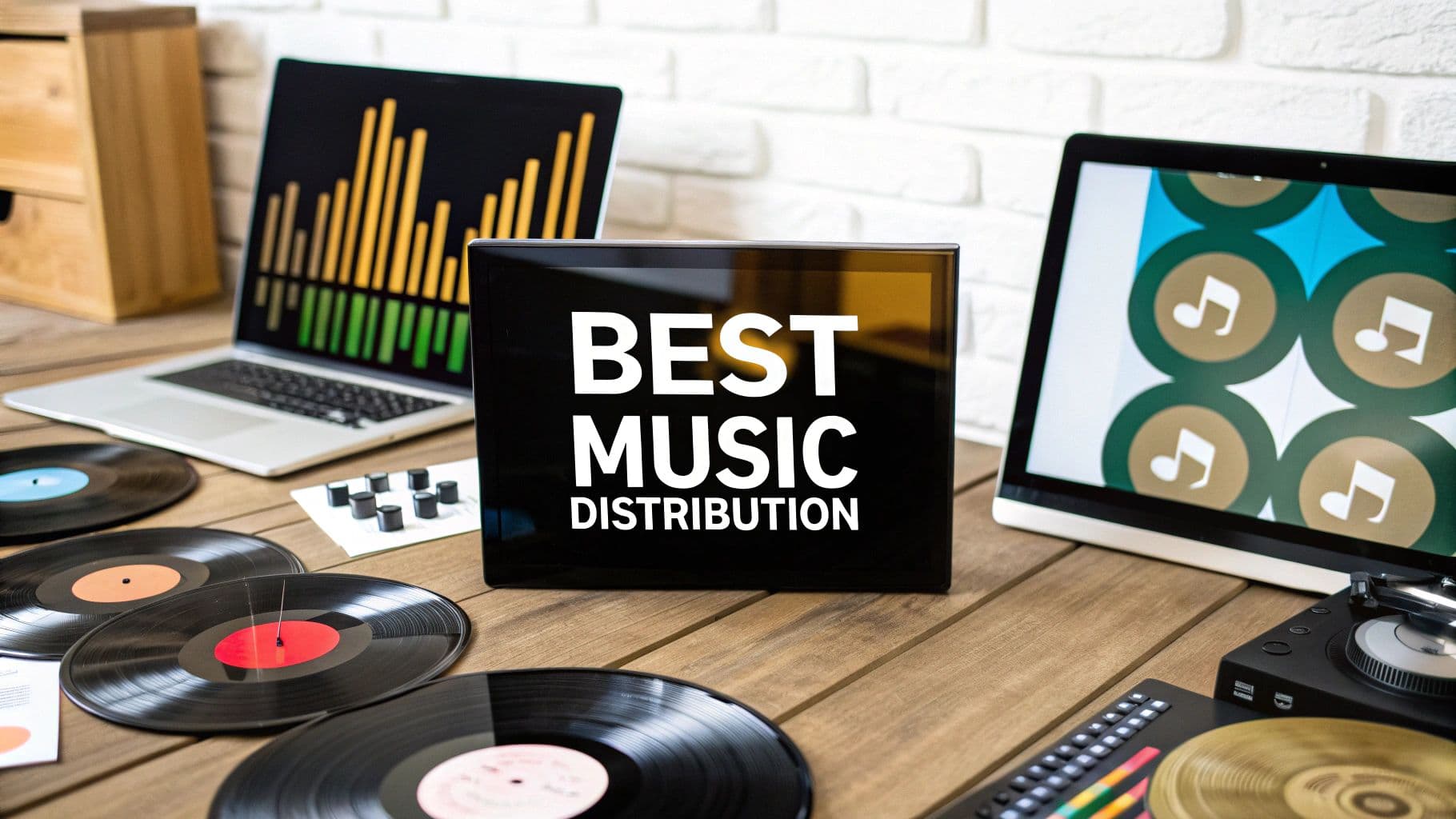
Finding the Best Music Distribution Platforms
Discover the best music distribution platforms for independent artists. We compare DistroKid, TuneCore, and CD Baby on pricing, features, and royalties.
August 21, 2025
Music Marketplace Advisor
Buying & SellingPicking the best music distribution platforms really comes down to what you’re trying to achieve in your music career. If you're constantly in the studio pumping out new tracks, something like DistroKid is a no-brainer with its unlimited uploads. On the other hand, if you’re more focused on crafting milestone albums, CD Baby's one-time fee for a lifetime of distribution might make more sense. And for the artists who live and breathe data, TuneCore's analytics and publishing admin tools are tough to beat.
Choosing Your Bridge to a Global Audience
For any artist today, your choice of a music distributor is one of the most important decisions you'll make. This isn't just a technical step to get your song online; it's about building a reliable bridge from your creative space to listeners all over the world. The platform you choose will directly affect your income, your reach, and how much control you have over your work in a world dominated by streaming.
This guide isn't just another feature list. We’re going to dig into a strategic comparison of the major players. The goal is to give you the insight to pick a partner that actually fits your release strategy, whether you're dropping singles every month or pouring your soul into a full-length album. And once you've picked your distributor, it's just as crucial to increase your overall online presence to make sure people actually hear your music.
Understanding the Modern Music Landscape
The digital music scene is exploding. By 2025, music streaming now makes up roughly 84% of all revenue in the industry, which shows you just how central it is to an artist's career. With around 120,000 new songs hitting streaming platforms every single day, just having a great track isn't enough. You need a distribution partner who can help you cut through the noise. You can dive deeper into these trends with this detailed report.
Think of your distributor as your digital logistics team. They handle the nitty-gritty of getting your music properly formatted, delivered, and set up for monetization across hundreds of stores and services worldwide.
The right distributor doesn’t just get your music on Spotify. They provide the tools, data, and support you need to turn your art into a real, sustainable career. It's less of a service and more of a foundational partnership.
Key Factors in Your Decision
Before we get into a head-to-head comparison, let's establish what you should be looking for. The best platforms strike a balance between powerful features, reliable support, and a fair price tag. Here’s a quick rundown of what to keep in mind when looking at DistroKid, TuneCore, and CD Baby.
| Feature | DistroKid | TuneCore | CD Baby |
|---|---|---|---|
| Pricing Model | Annual Subscription | Annual Subscription | One-Time Per Release |
| Artist Royalties | 100% | 100% | 91% (9% commission) |
| Key Advantage | Unlimited uploads | Advanced analytics | Lifetime distribution |
| Best For | Prolific artists | Data-driven artists | Album-focused artists |
Each of these models is built for a different kind of artist. An annual subscription is perfect if you’re releasing music all the time. But if your release schedule is slower and you want your music up forever without paying every year, a one-time fee is far more cost-effective.
The Core Criteria for Evaluating Distribution Platforms

When you're trying to pick from the best music distribution platforms, it's easy to get lost in the slick marketing and bold promises. But to make a decision that will actually serve your career, you need to look past the surface and evaluate each service with a clear set of criteria.
Think of this as your framework for cutting through the noise. Before we jump into specific platform comparisons, let's nail down the non-negotiables—the fundamental things every musician should be looking for in a distribution partner. Getting these right will directly impact your music's reach, your revenue, and your growth as an artist.
Distribution Reach and Store Network
The first, most basic question is: where will my music actually go? A distributor's primary function is to get your tracks onto all the digital stores and streaming platforms. While pretty much every service covers the big guys like Spotify, Apple Music, and Amazon Music, the real difference lies in the depth of their network.
Here’s what you should be looking for when you dig into a platform’s reach:
- Global Territories: Does the service have a strong presence in booming markets across Asia, Latin America, and Africa? Getting your music onto platforms like Tencent Music in China or Boomplay in Africa could connect you with millions of new listeners.
- Niche Platforms: If you make electronic music, you need to be on Beatport. Same goes for other genre-specific stores. Make sure the distributor caters to your specific sound.
- Social Media Integration: This is a big one. Your distributor must deliver your music to Instagram, TikTok, and YouTube’s Content ID system. Monetizing your sound on social media isn't just a bonus anymore; for many artists, it's a core part of their income.
A truly global network means your music shows up wherever your fans are, not just where it's most convenient to send it.
Royalty Collection and Payment Systems
Getting paid for your streams is the whole point, right? But it's rarely as simple as a direct deposit for every play. How a distributor handles your money can have a huge impact on your cash flow and how much you ultimately get to keep. You have to read the fine print.
Pay close attention to the payment structure. Some services have high payment thresholds, meaning you can't cash out until you’ve hit a certain balance, sometimes $50 or more. For an artist just starting out, hitting that number could take months. Also, check out their withdrawal methods and whether they charge fees for the transaction.
A distributor that offers flexible, low-threshold payment options and transparent reporting is a true partner. Your ability to access your earnings quickly and without hefty fees is a critical component of building a sustainable music career.
Understanding these financial nuances is a huge piece of the puzzle. If you want to dive deeper, our guide on how to choose the right music distribution service breaks down exactly what to look for so your expectations match reality.
Release Speed and Customer Support
When you're ready to drop a new track, timing is everything. The speed at which a distributor gets your release from your dashboard to being live on Spotify is a critical detail. Some platforms can turn it around in 2-3 business days, while others can take a week or more. That difference can make or break a well-planned marketing campaign.
Just as important is what happens when things go wrong. Because eventually, they will. Whether it’s a simple metadata mistake or a confusing payment report, you need to know you can reach a real person who can help. A service that hides behind a chatbot or takes days to respond to an email can bring your entire operation to a grinding halt.
Analytics and Performance Data
Finally, the best platforms do more than just ship your music out. They give you the data you need to understand how it's performing. Simple stream counts don't cut it anymore. What you need are actionable insights that can actually shape your marketing and career strategy.
Look for a distributor that provides a detailed analytics dashboard with:
- Demographic Data: Who is listening? You need to know their age, gender, and location.
- Playlist Placements: Real-time tracking for when your songs get added to playlists, big or small.
- Streaming Source Information: Are people finding you through algorithmic discovery, their own playlists, or by searching your name?
This is the kind of data that turns you from an artist into an entrepreneur. It empowers you to make smarter decisions about where to tour, how to target your ads, and what your audience truly wants to hear next.
Comparing The Top Music Distribution Services
Choosing the right distribution partner is one of the most critical decisions you'll make in your music career. It's not just about getting your tracks onto Spotify; it’s about finding a service that aligns with your release strategy, budget, and long-term goals. Let's break down the real-world differences between four of the biggest names in the game: DistroKid, TuneCore, CD Baby, and Amuse.
We're going to move past the marketing hype and look at what truly matters: how they charge, how you get paid, and the extra tools they offer that can actually help you grow.
To get a quick overview, here’s a high-level look at how these platforms stack up against each other.
Music Distribution Platform Feature and Pricing Comparison
This table offers a side-by-side comparison of the top music distribution platforms, focusing on the pricing models, royalty splits, and essential features that matter most to independent artists.
| Platform | Primary Pricing Model | Royalty Split (Artist's Share) | YouTube Content ID | Publishing Administration | Best For |
|---|---|---|---|---|---|
| DistroKid | Annual Subscription | 100% | Add-on (20% commission) | No | Prolific artists releasing music frequently. |
| TuneCore | Annual Subscription | 100% | Included in paid plans | Add-on | Career artists needing deep analytics and publishing. |
| CD Baby | One-Time Fee (Per Release) | 91% | Add-on (30% commission) | Add-on | Artists releasing albums infrequently; "set it and forget it." |
| Amuse | Freemium/Subscription | 85% (Free) or 100% (Paid) | Included in paid plans | No | New artists starting with zero budget. |
This comparison highlights the fundamental trade-offs you'll face. Now, let's dig into the details of what these differences mean for you.
Pricing Models: The Annual Subscription vs. The One-Time Fee
The first and biggest fork in the road is how you pay. This choice alone can define your distribution costs over the life of your career, and it all comes down to how often you plan to release music.
DistroKid is the poster child for the annual subscription. You pay one flat fee per year and can upload as much music as you want. If you're a producer dropping a new beat every week or an artist committed to a single-a-month strategy, this model is a no-brainer. It makes distribution a predictable, fixed cost and is almost always cheaper if you release more than two or three times a year.
On the other side, you have CD Baby, which sticks to a classic one-time fee model. You pay once for a single or an album, and it stays up forever—no recurring bills. This is perfect for the band that spends two years crafting an album and wants to know it will remain online permanently without having to think about another subscription payment.
A one-time fee offers peace of mind and long-term stability, making it a great fit for artists with infrequent but significant releases. In contrast, an annual subscription provides unparalleled value for high-volume creators, turning distribution into a predictable, fixed operational cost.
TuneCore and Amuse have landed somewhere in the middle. TuneCore switched to an annual plan, directly competing with DistroKid but at different price points with more features. Amuse famously offers a free plan to get you in the door (taking a commission), but also has paid tiers that unlock faster releases and more professional tools.
This image really drives home the financial reality of these different models.
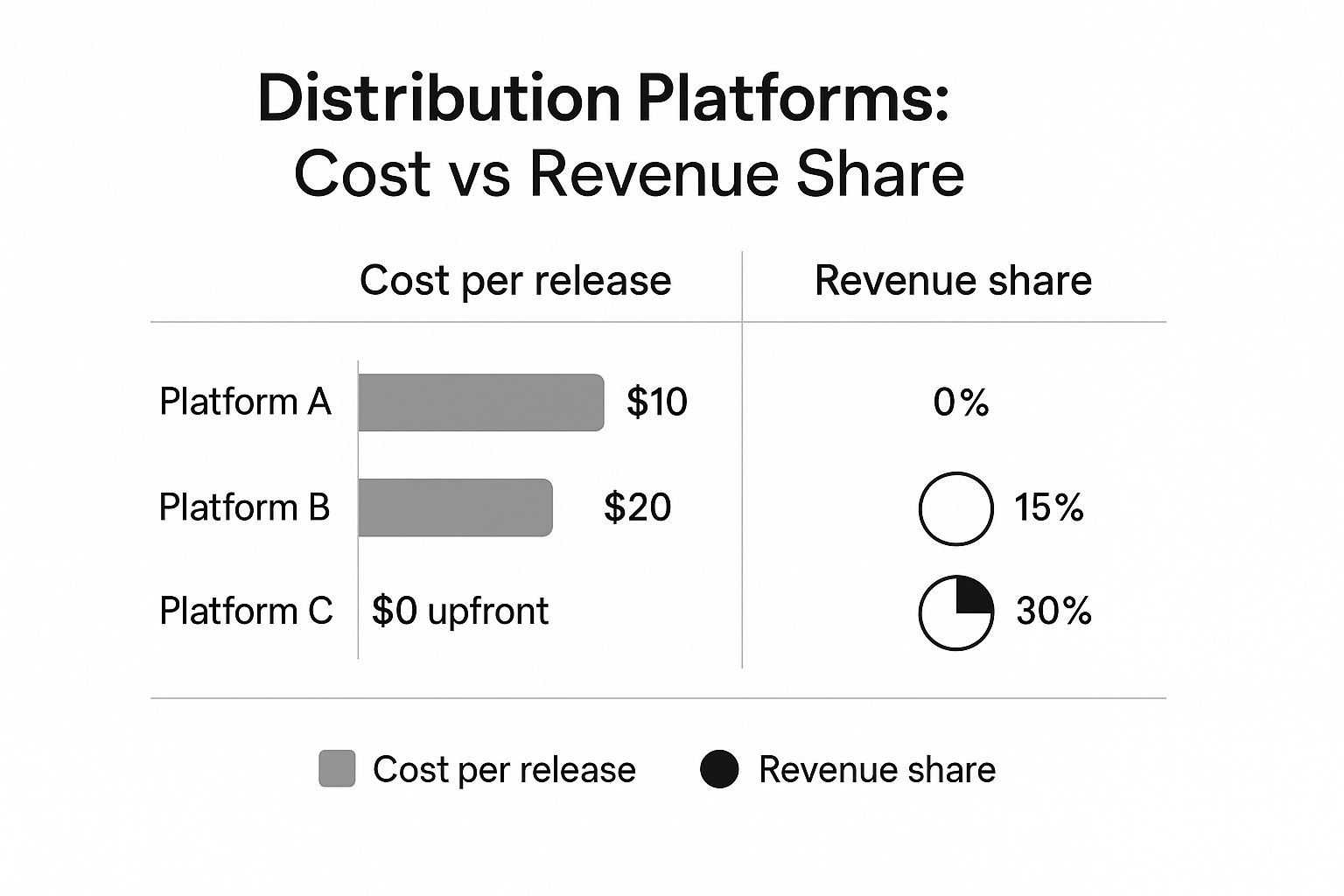
As you can see, what starts as "free" can end up costing you more in the long run through a slice of your revenue, while paying upfront lets you keep everything you earn.
DistroKid: A Deep Dive
DistroKid built its brand on three things: speed, simplicity, and unlimited uploads. It has become the go-to for artists who just want to get their music out into the world fast and without a lot of fuss. Their user interface is famously minimal, cutting out nearly all the friction between finishing a song and seeing it on Spotify.
The basic "Musician" plan kicks off at $22.99 per year, which covers one artist for unlimited uploads. But be warned: many of the features a serious artist needs are either part of more expensive plans or sold as à la carte add-ons.
Here’s what you need to know:
- Release Speed: They are consistently one of the fastest distributors out there. It’s not uncommon for releases to go live on stores within a couple of days.
- Royalty Splits: The free "Splits" feature is a genuine game-changer. You can automatically send a percentage of your earnings to collaborators, producers, or anyone else on a track without any hassle.
- Hidden Costs: This is the big one. If you stop paying your annual fee, DistroKid will take down your music unless you've paid for the "Leave a Legacy" add-on. That's a one-time fee of $29 per single or $49 per album. YouTube Content ID is also an extra charge and comes with a 20% commission on any ad revenue it generates.
TuneCore: The Professional's Choice
TuneCore has positioned itself as a more robust, professional-grade service for artists who are thinking seriously about the business side of their careers. After sticking with a per-release model for years, they've shifted to an unlimited plan that makes them a direct DistroKid competitor, but with a clear emphasis on data and comprehensive royalty collection.
Their free plan lets you get your music onto social platforms like TikTok and Instagram, but their paid tiers are where the real power lies. TuneCore's major strengths are its detailed analytics and its integrated publishing administration service—a tool designed to collect songwriting royalties that basic distribution completely ignores.
This is a bigger deal than most artists realize. The global music streaming market hit $53.7 billion in 2024, a 12.5% jump from the year before. And with subscriptions accounting for 51.2% of that revenue, leaving any royalty stream uncollected is just leaving money on the table. You can explore the full report on these industry trends to see just how high the stakes are.
What makes TuneCore stand out?
- Advanced Analytics: They offer deep-dive daily trend reports and sales data, giving you far more insight than many of their rivals.
- Publishing Administration: For a one-time $75 setup fee, TuneCore Publishing will register your songs globally to collect songwriter royalties. This is an essential income stream for anyone writing their own music.
- Support: Their customer support is generally considered more thorough and responsive compared to the more automated systems of some competitors.
CD Baby: The Legacy Builder
As one of the original independent distributors, CD Baby has earned a reputation for being reliable and trustworthy. Their entire model is built differently: you pay once, and your music is distributed forever. It’s a true "set it and forget it" service that appeals to artists who want their work to have a permanent home online.
While the upfront cost of $9.99 for a single or $29.99 for an album may seem steep compared to a subscription, it frees you from any ongoing financial commitment. The critical trade-off, however, is that CD Baby takes a 9% commission on your digital revenue. This is a major departure from the 100% artist share you get with most subscription services.
CD Baby really shines in a few key areas that others have abandoned:
- Physical Distribution: They are one of the last major players offering physical CD and vinyl distribution, connecting you with a network of over 15,000 record stores.
- Sync Licensing: Sync placement is included in their standard and pro packages, meaning their team will actively pitch your music for use in films, TV shows, games, and ads.
- Comprehensive Royalties: Their "CD Baby Pro" offering bundles distribution with publishing administration, creating a simple, all-in-one solution for collecting both your master and composition royalties.
Amuse: The Modern Upstart
Amuse shook up the industry by launching with a completely free distribution model, making it an instant magnet for new artists with no budget. Their free "Start" plan gets your music onto all the major stores, but it comes with two big caveats: they take a 15% commission on your royalties, and your release can take up to four weeks to go live.
The platform was built from the ground up to be mobile-first, and you can genuinely upload and manage everything straight from your phone. Amuse also operates as a data-driven record label, using its own analytics to find promising artists on its platform and offer them label deals with a 50/50 profit split.
For artists who are ready to invest, the paid "Boost" and "Pro" tiers eliminate the commission, drastically shorten release times, and add crucial features like YouTube Content ID and support for multiple artist profiles. Amuse is a fantastic launchpad for someone just starting out, but more established musicians will likely need the faster turnaround and advanced tools offered by other services.
Which Distributor Aligns With Your Artist Profile?

Trying to find the single "best" music distributor is a trap. The truth is, the right choice is completely personal. A service that’s a game-changer for a prolific producer could be a terrible financial move for a band that only drops an album every few years. The key is to match a platform's business model to your own goals, release schedule, and budget.
This section gets past the generic feature lists and offers clear recommendations based on common artist scenarios. By figuring out which platform is actually built for someone like you, you can make a choice that genuinely supports your career.
For The Prolific Producer or Frequent Releaser
Are you constantly in the studio, churning out new tracks? Maybe you're a hip-hop producer dropping beats every week or a pop artist committed to a new single each month. If that's you, your biggest enemy is the per-release fee. You need a model that rewards your high output instead of penalizing it.
This is where annual subscription plans with unlimited uploads really shine. You pay one flat fee for the year and can release as much music as you can create without watching the costs pile up.
Top Recommendation: DistroKid. This platform was practically built for volume and speed. Its no-frills interface and quick turnaround times are all about getting your music live with minimal hassle. The fixed annual cost means your expenses don't change whether you release one song or a hundred.
Alternative: TuneCore. While TuneCore also has an unlimited plan, it brings a more robust set of tools to the table, particularly with its analytics. It’s a great fit if you release often but also want to dive deep into your listener data to figure out what's working.
For The Album-Focused Band or Occasional Artist
If you work on a much longer cycle, maybe spending a year or more crafting the perfect album, a recurring subscription fee can feel like a waste of money. It just doesn't make sense to pay every year for a service you only use once in a while. You need a solution that’s built for the long haul, without the ongoing financial pressure.
The pay-per-release model is the obvious winner here. You pay once to get your music up, and it stays there—no more bills, no more worries.
The one-time fee model offers true "set it and forget it" peace of mind. For artists who view their releases as permanent fixtures in their catalog, this approach ensures their work remains accessible to fans forever, independent of any future subscription payments.
- Top Recommendation: CD Baby. As one of the original players in this space, CD Baby is the classic choice for artists who just want to pay once and be done. They do take a 9% commission on earnings, but with no annual fees, it's incredibly cost-effective for those big, milestone releases like a new EP or album.
For The Emerging Artist on a Tight Budget
When you're just starting out, every penny counts. Committing to an annual subscription before you've even made your first dollar from streams can feel like a huge risk. The most important thing for new artists is just to get your music out there and start finding listeners without an upfront financial burden.
This is where a freemium model is perfect. You get your music distributed for free, and the platform takes a cut of your royalties in return. It’s a zero-risk way to get your tracks onto Spotify, Apple Music, and other major stores.
- Top Recommendation: Amuse or RouteNote. Both Amuse and RouteNote offer free distribution tiers where they take a 15% commission on your earnings. This lets you get your foot in the door, learn the ropes, and build an audience. Once you start earning consistently, you can always move to a paid plan or a different distributor. To see how these models affect your take-home pay, it's helpful to explore different artist pricing and revenue splits.
For The Data-Driven Musician and Entrepreneur
For some artists, distribution isn't just about uploading music; it's about building a business. If you live and breathe analytics, track your growth meticulously, and want to capture every last penny you've earned, you need a platform with serious backend tools.
Your ideal distributor goes way beyond simple stream counts. You're looking for detailed listener data, playlist tracking, and access to services like publishing administration to collect royalties that most artists miss.
- Top Recommendation: TuneCore. They've really established themselves as the go-to for professional-grade analytics. Their dashboard provides deep insights into listener demographics, playlist placements, and daily trends. More importantly, their integrated Publishing Administration service is a must-have for serious songwriters, ensuring you collect the mechanical and performance royalties that are separate from standard distribution earnings.
Looking Beyond Simple Distribution
Picking the right music distribution platform isn't just about finding a way to get your tracks onto Spotify. The real game-changer often lies in the extra services that can genuinely push your career forward. These tools are what separate a simple upload service from a true career partner, offering you ways to make more money and build real momentum.
Think about it this way: basic distribution gets your music into the store. But these value-added services are like having a marketing and accounting team making sure people actually find it and you get paid for it. For a lot of artists, this is the difference between a release that just sits there and one that actually takes off.
Publishing Administration: Stop Leaving Money on the Table
One of the most important—and often overlooked—services is publishing administration. When your song gets played, it actually creates two kinds of royalties: one for the master recording (what your distributor collects) and another for the composition itself (your lyrics and melody).
If you don't have a publishing administrator, you're literally missing out on half your potential income. Services like TuneCore and CD Baby offer publishing add-ons that handle this for you. They register your songs globally and collect mechanical and performance royalties from sources like radio, TV, live shows, and international streams. This is money you simply wouldn't see otherwise.
Publishing administration isn't some luxury add-on; it's a core part of your business as a professional artist. Skipping it is like playing a sold-out show and then telling the venue to keep the money you earned for writing the songs.
These tools make sure you’re paid for your work as a songwriter, not just as a performer. Tapping into this revenue is a critical step for anyone serious about building a sustainable career. For a closer look at maximizing what you earn, check out these strategies for independent music distribution.
Built-in Promotional Tools for a Stronger Launch
Getting your music onto streaming platforms is just step one. The real work begins with building hype, and modern distributors get that. Many now offer integrated promotional tools designed to help you nail your release day and get people listening from the jump.
Some of the most effective features you'll find are:
- Pre-Save Links: These are huge. They let fans on platforms like Spotify add your upcoming release to their library before it's even out. A surge of pre-saves signals to the platform's algorithms that your track is something to watch, which can help you land on editorial playlists.
- Playlist Submission Portals: Distributors like TuneCore have their own curated playlists and give you a direct way to submit your tracks for a shot at being featured. It’s another great avenue for discovery.
- Social Media Generators: These tools are perfect for creating quick, professional-looking video clips and artwork formatted for Instagram, TikTok, and other platforms, making it much easier to promote your music visually.
Using these tools effectively is all about building a solid release plan. For example, Spotify, which first launched way back in 2008, is still the giant in the room, with over 626 million active users worldwide as of 2024. The platform commands roughly 31.7% of the global streaming market, so using features like pre-saves is essential for getting any kind of traction there. You can dig into more of this data with insights on music streaming data at Business of Apps.
Of course, your distributor's tools are just one part of the puzzle. Many artists also need to expand their reach through public relations. While your distributor helps with digital promotion, it’s worth learning some strategies for getting on PR lists and boosting your brand opportunities. By pairing smart promotional tactics with a solid publishing administration setup, you turn your distributor from a simple delivery service into a powerful partner in your career.
Answering Your Music Distribution Questions
Stepping into the world of music distribution opens up a lot of questions. It’s easy to get bogged down in the technical details when all you want to do is get your music out there. But getting these early decisions right is crucial for building a sustainable career without major headaches down the road.
Let's cut through the noise. Here are some straightforward answers to the big questions that come up time and time again when artists are picking the best music distribution platforms. We’ll cover everything from switching services to understanding your revenue streams.
Can I Switch Distributors for a Song That Is Already Released?
Yes, you absolutely can, but you have to do it the right way to avoid losing your stream counts and precious playlist spots. This isn't something you want to mess up.
The whole process hinges on keeping your track’s original identifiers. You'll need the ISRC code (for the specific track) and the UPC code (for the single or album) from your first distributor. When you re-upload the track to your new service, you must use the exact same audio file, metadata, and, most importantly, those original codes.
Timing is everything here. Don't ask your old distributor to take the release down until after it's officially live on the new platform. This simple step ensures there’s zero downtime and a seamless switch for your fans.
What Is the Difference Between a Distributor and a Publisher?
This is a common point of confusion, but the distinction is vital for understanding your money. A distributor and a publisher manage two entirely separate types of royalties your music generates.
Think of it this way: your distributor handles the master recording. They’re the ones who get your song onto Spotify and Apple Music, and they collect the royalties earned from streams and sales of that recording.
A publisher, however, manages the underlying composition—the melody and lyrics you wrote. They collect performance royalties (from radio play or live shows) and mechanical royalties (when someone else covers your song). Many of the best distributors now offer publishing administration services, which is a great way to consolidate both income streams under one roof.
How Important Is YouTube Content ID for an Artist?
For any artist releasing music today, YouTube Content ID isn't just a nice-to-have; it's a must. This system is your digital detective, constantly scanning YouTube for any video that uses your music.
When it finds a match in user-generated content—whether it’s a fan’s travel vlog, a dance tutorial, or a gaming stream—it gives you the power to monetize that video by placing ads on it. You then get a cut of the revenue. Without Content ID, you're essentially letting countless people use your work for free and leaving a serious amount of money on the table.
Ready to take full control of your music, merchandise, and fan relationships? OohYeah provides a commission-free ecosystem where you keep what you earn and connect directly with your audience. Start building a sustainable career on your own terms by visiting the OohYeah website.