Sell Merch Directly to Fans: 2026 Guide to 100% Revenue
Learn how to sell merch directly to fans and keep 100% of your revenue. Our 2026 guide helps you bypass middlemen, own your data, and build a real business.

August 14, 2026

Music Business Insider
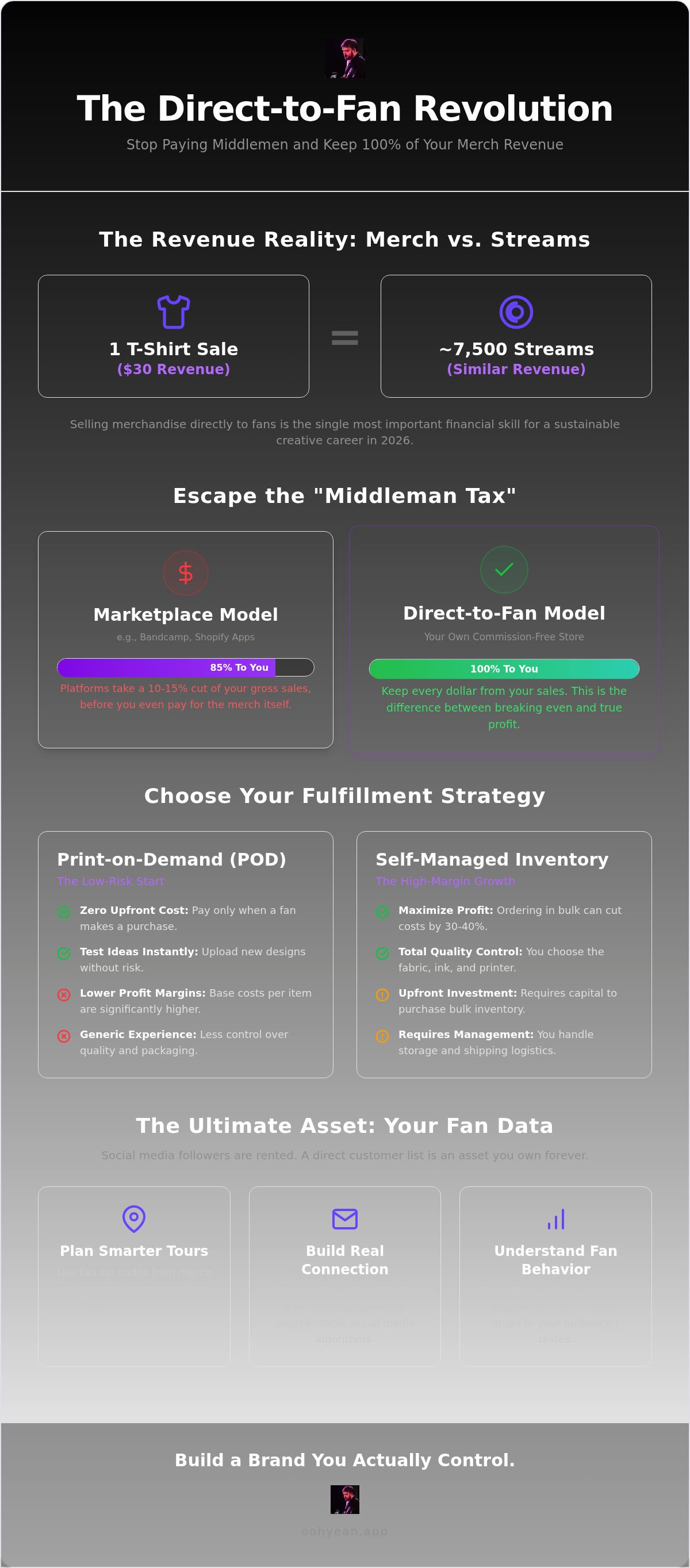
Music BusinessDid you know that selling just one $30 t-shirt earns you the same revenue as roughly 7,500 music streams? It's a staggering reality that highlights why learning how to sell merch directly to fans is the most important financial skill for your career. Yet, most platforms still act like gatekeepers, taking massive cuts of your hard-earned sales. You're likely tired of seeing Bandcamp take 15% or watching Shopify apps eat into your margins before you even ship a package. We believe you deserve better.
This guide reveals how to bypass middleman commissions and keep 100% of your revenue. You'll learn how to automate your fulfillment, strengthen your connection with supporters, and finally own the fan data that drives your growth. We are breaking down the 2026 landscape to help you move from commission-based traps to total financial independence. From choosing the right tools to mastering limited edition drops, this is your roadmap to a sustainable, creator-first business. It's time to stop settling for a fraction of your worth and start building a brand you actually control.
Key Takeaways
- Stop paying the "middleman tax" and discover how to sell merch directly to fans while keeping 100% of your sales revenue.
- Decide between the low-risk entry of Print-on-Demand and the high-margin potential of self-managed inventory based on your specific growth goals.
- Use the direct-to-fan model to own your audience data and build a stronger, more profitable connection with your community.
- Transform sporadic sales into predictable income by bundling merchandise perks into a monthly fan membership.
- Master a streamlined five-step process to launch a professional shop that prioritizes your brand identity over marketplace algorithms.
Why Selling Directly to Fans is the Future of Music
The music industry has reached a tipping point. In 2026, the power belongs to the creator. Fans no longer want to support a faceless corporate marketplace; they want to support you. Understanding how to sell merch directly to fans isn't just a side hustle. It's the core of your career. This direct-to-fan business model creates a commission-free relationship where every dollar spent on a hoodie or vinyl goes exactly where it belongs: into your pocket.
Traditional platforms often lure you in with "free" setups, but they charge a heavy price later. This "Middleman Tax" can reach 15% or even 30% of your gross sales. For an independent artist, that's the difference between breaking even and actually making a profit. Keeping 100% of your revenue is the only way to fund your next tour or studio session without taking on debt. This isn't just a retail choice. It's a liberation strategy that ensures your business remains sustainable.
The Death of the Traditional Retail Model
Physical record stores are now secondary to your own digital storefront. While browsing bins is a nostalgic hobby, your fans live online. The problem is that many "free" platforms take a massive cut of your hard-earned money. If a site takes $15 out of every $100 you earn, they're a partner you didn't ask for. The direct-to-fan economy acts as the primary engine for independent artist survival by ensuring financial equity in a crowded market. Fans in 2026 are more conscious than ever. They prefer artist-owned platforms because they want their money to fuel your art, not a tech giant's stock price.
Owning Your Data: The Real Value of Direct Sales
Direct sales offer something social media never will: ownership. A million followers on a social app can disappear with one algorithm change. An email list of buyers is a goldmine. When you learn how to sell merch directly to fans, you gain access to their zip codes and buying habits. You can see exactly where your supporters live. Instead of guessing where to book your next show, you can use your merch data to plan a tour route that guarantees a packed house. Direct connection is the ultimate leverage for any artist looking to scale their business without permission from gatekeepers.
Choosing Your Fulfillment Model: POD vs. Self-Managed
Deciding how to fulfill orders is the most critical logistical choice you'll make. Most platforms push Print-on-Demand (POD) because it's easy for them, but it isn't always best for you. Mastering how to sell merch directly to fans requires looking past the convenience of automated apps and focusing on your bottom line. POD offers a low-risk entry since you don't pay for inventory until a fan buys it. However, the research shows that base costs for a standard t-shirt often range from $9 to $15. When you add shipping costs of $4 to $7, your profit margin shrinks fast.
Self-managed inventory is the bold alternative for creators ready to scale. By ordering in bulk, you slash the cost per unit and keep more money from every sale. This requires an upfront investment, but it gives you total control over the quality. You pick the fabric, the ink, and the packaging. Many successful artists now use a hybrid approach. They use POD for basic, "evergreen" designs and self-fulfill limited edition vinyl or high-end streetwear. This strategy keeps your shop active without draining your bank account on unsold stock.
The Pros and Cons of Print-on-Demand
POD is perfect for testing new ideas. You can upload a design today and see if fans like it by tomorrow. There is no risk of ending up with boxes of unsold shirts in your garage. The downside is the generic experience. You often can't add a handwritten note or a custom sticker to the package. If your brand relies on a premium "unboxing" feel, POD might hold you back. It's a great starting line, but it's rarely the finish line for a professional business.
When to Switch to Bulk Manufacturing
The switch to bulk manufacturing usually happens when you reach a predictable "break-even" point. For a 50-unit shirt run, your cost per item might drop by 30% or 40% compared to POD prices. This is where your profit truly scales. Quality control also becomes your superpower. You can vet local printers to ensure the ink doesn't fade after two washes. Finding a reliable local partner often beats overseas manufacturing because you save on international shipping and can verify the working conditions yourself.
Calculating your true profit is simple: Sale Price minus the sum of production, shipping, and platform commissions. While other sites take a 15% cut, keeping 100% of your revenue ensures your hard work actually pays off. Don't let hidden fees dictate your business model.
The Hidden Cost of Commissions: Marketplace vs. Direct
Marketplace fees are the silent killer of independent music careers. Many platforms lure you in with a "free" setup, but they charge a heavy price once you actually start moving product. Let's look at the math. If you generate $1,000 in sales on a platform taking a 15% commission, you've already lost $150 before shipping or production costs. When you learn how to sell merch directly to fans on a commission-free platform, that money stays in your tour fund. This is the difference between surviving and thriving in a digital economy.
This "Commission Trap" creates a psychological barrier to growth. It's hard to get excited about a big merch drop when you know a massive chunk of the reward disappears instantly. This often leads artists to promote their shop less, which hurts their brand in the long run. Transitioning your fans from a giant marketplace to your own direct store is a move toward professional maturity. You're telling your supporters that their money goes straight to the source, which is exactly what modern fans want to hear.
Comparing the Big Players: Bandcamp, Shopify, and OohYeah!
Bandcamp remains a staple for discovery, but their 10% physical merchandise fee is a significant drain on high-volume sellers. While they waive fees on specific Fridays, your business shouldn't depend on a calendar event. Shopify offers powerful tools, but the "app bloat" is real. You start with a monthly fee and quickly find yourself paying for extra plugins just to manage basic tasks. OohYeah! disrupts this cycle entirely. It's a commission-free marketplace designed for 100% revenue retention. You get the professional tools you need without the percentage-based penalties that punish your success.
Calculating Your Annual Savings
A flat subscription fee always outperforms percentage cuts as your sales volume increases. Even when you factor in standard payment processing fees from Stripe or PayPal, the savings are undeniable. Saving just $500 a year in commissions is the financial equivalent of selling 25 extra shirts without any additional production work. These small wins accumulate over a career. By choosing a direct model, you aren't just saving money; you're building a fortress around your income. This financial independence allows you to take bigger creative risks and invest in higher-quality products for your community.
5 Steps to Launching Your Direct-to-Fan Merch Shop
Launching your store is about momentum. You don't need fifty different items to succeed. You need the right ones. Focus on the core products that drive 80% of independent revenue: t-shirts, hoodies, hats, and tote bags. This lean approach reduces your risk while maximizing your impact. Once you have your products, your next goal is to present them with authority. This is the foundation of how to sell merch directly to fans effectively.
Step three is the most important for your wallet. Set up your commission-free storefront on OohYeah! to ensure you keep every cent you earn. Unlike platforms that penalize your growth with percentage cuts, this model treats you like a business owner. After your shop is live, establish clear shipping and return policies. Transparency builds trust and prevents headaches later. Finally, move away from the "always open" mindset and embrace the "Drop" strategy to create immediate excitement.
Product Photography That Sells
Visuals are your silent salespeople. Lifestyle photos, which show you or your friends wearing the gear in a real-world setting, always beat generic flat mockups. They help fans visualize themselves owning the product. You don't need a professional studio to get this right. Use natural light near a large window to avoid harsh shadows. It's free and often looks better than cheap artificial lights. Boost your credibility by reposting photos of fans wearing your gear. This social proof creates a community feel that encourages others to buy.
The "Merch Drop" Strategy
The "Drop" model is a powerful tool for driving immediate sales. Instead of keeping every item in stock indefinitely, release items in limited quantities for a short time. This creates a sense of urgency that forces fans to act now rather than later. You can also use pre-orders to fund your manufacturing costs. This ensures you never spend money on inventory that doesn't sell. For your most loyal supporters, create exclusive items only available through your fan membership. This rewards your "Superfans" and provides a steady, recurring revenue stream that supports your creative work.
Scaling Your Business with Fan Subscriptions
One-off sales provide a great boost for any new shop. But relying solely on them creates a cycle of feast or famine. To build a truly sustainable career, you must turn your customers into community members. Scaling your business means moving from "one-off sales" to "recurring revenue." Mastering how to sell merch directly to fans through a subscription model creates a predictable income stream that supports your art every single month.
A unified platform is the ultimate artist tool. Instead of sending fans to three different websites for music, shirts, and memberships, you keep everything in one place. This simplicity isn't just for you; it's for your supporters. Bundling merch discounts into a monthly fan membership is a proven way to increase loyalty. When a fan knows they get a discount on every new drop because they're a subscriber, they're much more likely to buy. Exclusive merch access becomes the ultimate perk for your top-tier supporters, making them feel like true partners in your journey.
Building Your Inner Circle
Defining the value of a fan subscription on OohYeah! is about more than just money. It's about access. You can pair exclusive digital content, like unreleased demos or behind-the-scenes videos, with your physical merchandise. This creates a multi-dimensional experience that a standard retail store can't match. Recurring revenue provides a vital financial safety net that keeps your business running smoothly during the quiet months between tours. It allows you to invest in better production and bigger ideas without the stress of starting from zero every month.
Integrating Music and Merch Sales
Your merch shouldn't exist in a silo. Every physical purchase is an opportunity to share your music. Offering a free digital download with every t-shirt or hoodie purchase adds immediate value to the sale. It bridges the gap between the physical and digital worlds. Use your OohYeah! profile as a centralized "Link in Bio" hub. This centralized hub is the most efficient way to manage how to sell merch directly to fans while growing your music catalog simultaneously. Stop sending your audience to platforms that profit from your hard work.
Start your commission-free journey on OohYeah! today and take control of your creative future.
Claim Your Creative Independence
The status quo is broken; you don't have to be a part of it anymore. You've seen the math and the strategies. By bypassing the "middleman tax" and choosing a fulfillment model that fits your specific goals, you're building a financial foundation that lasts. Learning how to sell merch directly to fans is the single most important move you can make for your career health in 2026. It's time to stop renting your audience from platforms that take a cut of your hard work and start owning your future.
You now have the roadmap to turn one-off sales into a lifelong community. Whether you start with the low risk of print-on-demand or jump straight into high-margin bulk orders, the goal remains the same: 100% revenue retention. OohYeah! empowers you with commission-free sales, integrated fan subscriptions, and a dedicated direct-to-fan marketplace. Don't wait for a permission slip from the old industry gatekeepers. Join OohYeah! and keep 100% of your merch revenue today. Your fans are ready to support the real you. Let's build something that belongs entirely to you.
Frequently Asked Questions
Is it better to use print-on-demand or hold my own inventory?
Use print-on-demand if you are starting out or testing new designs without upfront costs. Switch to holding your own inventory once you have predictable sales volume. This move increases your profit margins because bulk ordering reduces the cost per unit. It also gives you total control over the unboxing experience, which builds a much stronger brand connection with your community.
How much commission does OohYeah! take on merch sales?
OohYeah! takes zero commission on your merchandise sales. We operate on a subscription model instead of taking a percentage of every shirt or vinyl you sell. This means you keep 100% of your revenue, allowing you to reinvest in your music and tours. It's a fair, transparent alternative to platforms that penalize your growth by taking a 10% to 15% cut.
What are the best-selling merch items for independent artists in 2026?
T-shirts, hoodies, hats, and tote bags remain the core drivers, accounting for roughly 80% of independent artist merch revenue. In 2026, fans also value high-quality vinyl and exclusive limited-edition drops. Focusing on these essentials ensures you aren't wasting resources on niche items that don't move. High-quality basics with strong branding are the most reliable way to learn how to sell merch directly to fans.
Do I need a business license to sell merch directly to fans?
Requirements for a business license vary by your specific location and sales volume. While many artists start as sole proprietors, getting a license can help you manage sales tax and access wholesale pricing from manufacturers. You should check your local state regulations regarding economic nexus laws. These laws might require you to collect sales tax if you reach certain transaction thresholds in specific states.
How can I promote my merch without sounding too salesy?
Focus on storytelling and lifestyle content rather than constant pitches. Wear your gear in your music videos and social posts naturally. Share the meaning behind a design or the process of creating it. When fans feel an emotional connection to the art, the purchase feels like a way to support a creator they love rather than a cold transaction. Authenticity is your best marketing tool.
Can I sell digital downloads alongside my physical merchandise?
You can and should sell digital music downloads alongside your physical merchandise. Bundling a digital album with a t-shirt or vinyl adds immediate value and encourages fans to buy from your store rather than just streaming. OohYeah! provides an integrated marketplace where you can host both digital and physical products in one place. This streamlined approach makes it easier for fans to support your entire creative output.
What is the best way to handle international shipping for band merch?
Using print-on-demand for international orders is often the most efficient way to handle global shipping without high costs. If you fulfill orders yourself, set clear flat-rate shipping zones to avoid surprises at checkout. Be transparent about potential customs duties or taxes that international fans might need to pay upon delivery. Clear communication prevents frustrated supporters and helps you maintain a professional reputation across the globe.
How do I move my store from Bandcamp to OohYeah!?
Moving your store is a straightforward process that starts with setting up your artist profile on OohYeah!. You can export your fan email lists from your previous platform to ensure you don't lose contact with your supporters. Once your new commission-free shop is live, announce the move to your fans. Explain that buying from the new store helps you keep 100% of the revenue while you learn how to sell merch directly to fans.