Finding the Best Music Distribution Platforms
Discover the best music distribution platforms for independent artists. We compare DistroKid, TuneCore, and CD Baby on pricing, features, and royalties.
August 21, 2025
FRANKLY with Frank Lee
Choosing the best music distribution platform comes down to what you're trying to accomplish with your music career. If you're constantly recording and releasing new songs, a service like DistroKid might make sense with its unlimited uploads. If you're more focused on releasing an album every year or two, CD Baby's one-time payment model could be a better fit.
For artists who want detailed analytics and publishing administration, TuneCore offers tools worth considering. Meanwhile, Amuse provides subscription-based distribution with artists retaining 100% of their streaming royalties on paid plans.
But distribution isn't just about getting your music onto Spotify or Apple Music. It's about choosing a company that fits your budget, protects your interests, and gives you the tools to build a sustainable music career.
Let's compare the major players and look at what independent musicians should consider before signing up.

Choosing Your Bridge to a Global Audience
For independent artists, choosing a music distributor is one of the most important business decisions they'll make.
Your distributor is responsible for delivering your recordings to streaming platforms and digital stores, collecting recording royalties, and providing the reporting tools you need to track your earnings.
Some distributors focus on simplicity and affordability. Others provide additional services such as publishing administration, promotional tools, royalty splitting, and artist development opportunities.
The right choice depends on several factors: how frequently you release music, how much you're willing to spend, what services you need, and how much control you want over your catalog.
Whether you're releasing your first single or managing an extensive catalog, understanding these differences can save you money and prevent problems later.
Understanding the Modern Music Landscape
Streaming has fundamentally changed how musicians release and monetize recordings.
Independent artists no longer need a traditional record label to distribute music worldwide. With a distributor, they can make their recordings available on Spotify, Apple Music, Amazon Music, YouTube Music, and numerous other services.
But accessibility has also created competition.
Thousands of new recordings are uploaded to streaming services every day, making it increasingly difficult for independent musicians to attract attention.
Distribution gets your music into the marketplace. It doesn't guarantee anyone will listen.
That's why choosing a distributor should involve more than comparing subscription prices. Artists should also consider the available marketing tools, royalty reporting, customer support, and opportunities for long-term growth.
Key Factors When Choosing a Music Distributor
Before comparing individual companies, it's important to understand what makes a good distribution service.
Distribution Reach and Store Network
The first question is straightforward: where will your music be available?
Most major distributors deliver recordings to popular platforms such as Spotify, Apple Music, Amazon Music, and YouTube Music.
However, distribution networks can differ in several important areas.
- International distribution: Does the company distribute to services popular in Asia, Latin America, Africa, and other growing music markets?
- Genre-specific platforms: If you're releasing electronic music, for example, does the distributor support Beatport?
- Social media platforms: Can your music be delivered to TikTok, Instagram, Facebook, and other platforms where listeners discover music?
- YouTube monetization: Does the distributor offer YouTube Content ID, and are there additional fees or revenue-sharing arrangements?
A broad distribution network can help independent artists reach listeners beyond the major streaming platforms.
Royalty Collection and Payment Systems
Getting paid is one of the most important aspects of music distribution.
Most distributors collect royalties generated by the use of your sound recordings on streaming services and digital stores.
However, their payment structures vary.
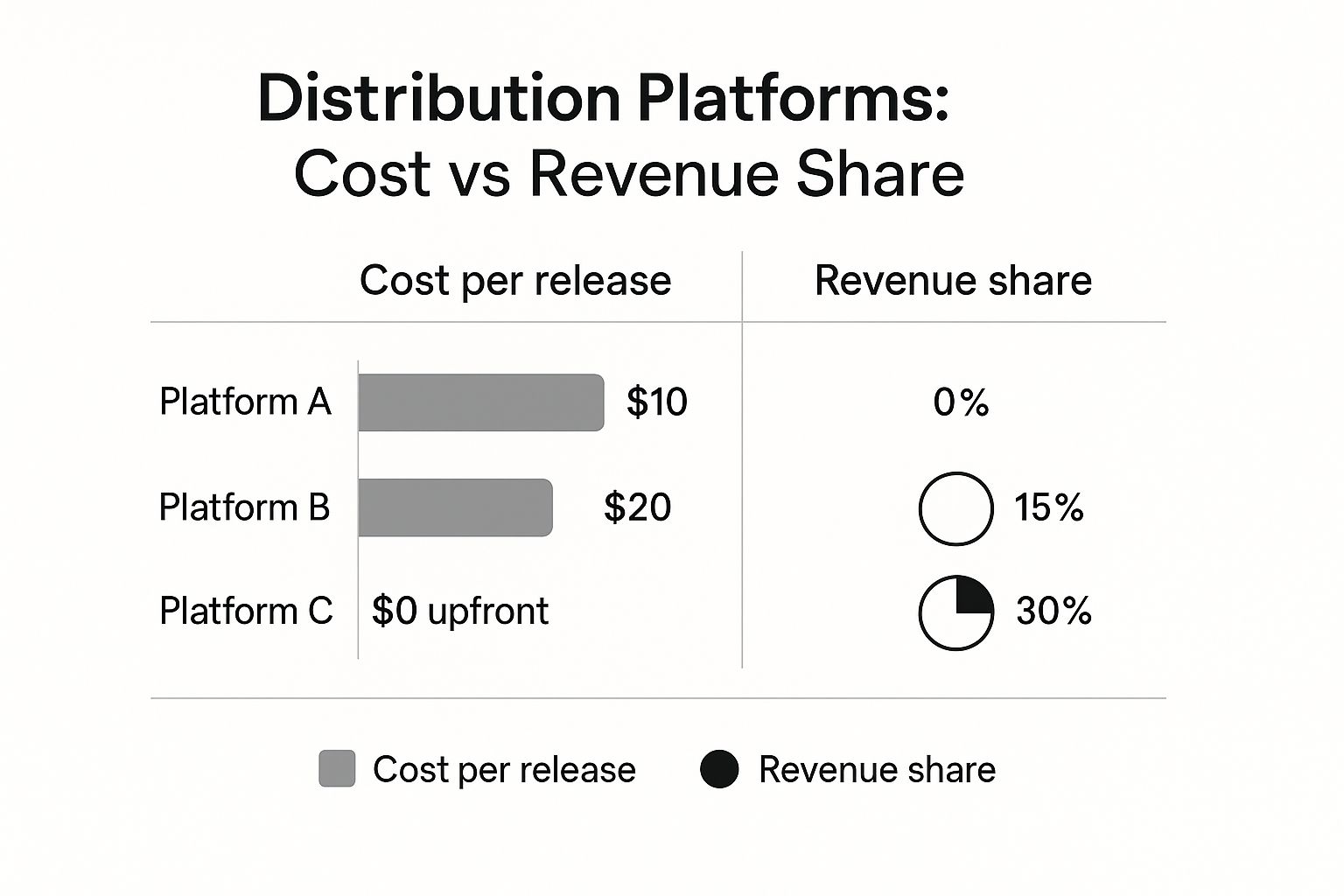
Some distributors charge annual subscription fees while allowing artists to retain 100% of the streaming royalties received by the distributor. Others charge per release or retain a percentage of revenue.
Artists should also examine payment thresholds, withdrawal fees, supported payment methods, and how frequently royalties are reported.
And remember, keeping 100% of your streaming royalties doesn't mean receiving every dollar a listener spends on streaming. Streaming platforms calculate and pay royalties according to their own agreements and accounting systems.
Your distributor's percentage generally refers to the amount it receives and passes along to you.

Release Speed and Customer Support
Release timing matters, particularly when you're coordinating publicity, advertising, music videos, or live performances.
Some distributors process recordings quickly, while others require additional review time.
Even after a distributor delivers a recording, the streaming platform may need time to process and publish it.
For that reason, artists should schedule releases well in advance whenever possible.
Customer support is equally important.
If a recording is delivered with incorrect metadata, an artist profile gets mixed up with someone else's, or a royalty payment appears inaccurate, you need a reliable way to resolve the issue.
Before choosing a distributor, investigate its support options and policies for correcting problems.
Analytics and Performance Data
Music distribution services increasingly provide analytics that help artists understand how their recordings are performing.
Useful information may include:
- Streaming activity: How many streams are your recordings generating, and on which platforms?
- Geographic data: Where are your listeners located?
- Playlist performance: Which playlists are generating activity?
- Revenue reporting: Which recordings and platforms are producing income?
- Audience trends: Are your releases gaining momentum over time?
The availability and detail of these reports vary by distributor and subscription plan.
For independent artists who manage their own marketing, this information can help determine where to advertise, which songs to promote, and which markets deserve additional attention.
Comparing the Top Music Distribution Services
Four of the most recognizable independent music distribution companies are DistroKid, TuneCore, CD Baby, and Amuse.
Although they perform similar basic functions, their pricing structures and additional services differ.
Music Distribution Platform Feature and Pricing Comparison
Platform
Pricing Model
Artist Streaming Royalty Share
Primary Advantage
Annual subscription
100%
Unlimited music uploads
Annual subscription
100% on qualifying plans
Analytics and publishing services
One-time fee per release
91%
No recurring distribution subscription
Annual subscription
100% on paid plans
Accessible distribution and artist services opportunities
Pricing, features, and royalty arrangements can change. Review each company's current terms before subscribing.
Annual Subscriptions vs. One-Time Distribution Fees
One of the biggest differences between distributors is how they charge artists.
Subscription-based services generally require an annual payment. Depending on the plan, artists may be able to release unlimited music without paying separately for each recording.
This can be economical for musicians who release frequently.
A per-release service, on the other hand, charges when an artist distributes a single, EP, or album.
For musicians who release music infrequently, paying once rather than maintaining an annual subscription may be attractive.
However, subscription prices aren't the only consideration.
Artists should also examine what happens to their recordings if they cancel, whether additional services cost extra, and whether the distributor retains a percentage of royalties.
DistroKid: Built for Frequent Releases
DistroKid has become popular among independent musicians because of its straightforward approach to music distribution.
Its subscription model allows artists to upload music without paying a separate distribution fee for every release, subject to the limits of their plan.
For musicians who regularly release singles, remixes, collaborations, or full albums, that convenience can be valuable.
DistroKid also offers tools for managing royalties and distributing earnings among collaborators.
What Makes DistroKid Attractive?
Unlimited uploads: Eligible subscriptions allow musicians to release music throughout the year without paying individually for each track.
Royalty splitting: Artists can assign percentages of earnings to collaborators, producers, and other participants.
Simple workflow: DistroKid focuses on making the upload and distribution process relatively straightforward.
Additional services: Optional features can include YouTube monetization, release customization, and other promotional or catalog-management tools.
What Should Artists Watch For?
Not every feature is included in the base subscription.
Some services require additional payments, and artists should review the company's current policies regarding canceled subscriptions and continued availability of recordings.
DistroKid offers a Leave a Legacy option for eligible releases, but its terms and pricing should be reviewed before purchasing.
Best for: Independent musicians who release frequently and want a relatively simple distribution workflow.
TuneCore: Distribution With Professional Tools
TuneCore is another established distributor serving independent musicians.
The company offers subscription-based distribution along with additional services that can appeal to artists who take a more business-oriented approach to their careers.
TuneCore's strengths include royalty reporting, analytics, and access to publishing administration services.
What Makes TuneCore Different?
Music distribution: TuneCore provides distribution to major streaming platforms and digital stores.
Analytics: Artists can review reporting information to better understand how their recordings are performing.
Publishing administration: TuneCore offers services designed to help eligible songwriters collect publishing royalties beyond those generated by the sound recording itself.
Artist services: Depending on the plan and eligibility, musicians may have access to additional promotional and career-development tools.
Why Publishing Administration Matters
When a recording is streamed, different rights can generate different types of royalties.
The owner of the sound recording may receive master recording royalties, while the songwriter and publisher may be entitled to royalties associated with the underlying composition.
A music distributor generally focuses on the recording side.
Publishing administration addresses certain royalties associated with the songwriting itself.
These are separate income streams, and artists who write their own material should understand how each is collected.
Best for: Independent artists and songwriters who want distribution alongside additional business and publishing tools.
CD Baby: A One-Time Payment Approach
CD Baby has been involved in independent music distribution for decades.
Unlike distributors that primarily use annual subscription models, CD Baby offers a per-release payment structure.
Artists pay to distribute a recording rather than maintaining an annual distribution subscription.
For musicians who release music occasionally, this can be appealing.
What Makes CD Baby Different?
One-time distribution fees: Artists pay for each release rather than maintaining a recurring subscription for basic distribution.
Royalty structure: CD Baby traditionally retains a 9% commission on digital distribution revenue, leaving artists with 91%.
Established distribution network: The company distributes recordings to major streaming platforms and digital stores.
Additional royalty services: CD Baby offers services related to royalty collection and monetization, with availability and fees depending on the service.
The Trade-Off
The advantage of CD Baby's model is that artists don't need to pay an annual distribution subscription to maintain their catalog under the standard arrangement.
The trade-off is the company's commission on digital distribution revenue.
For an artist generating substantial streaming income, that percentage may eventually exceed the cost of an annual subscription elsewhere.
For an artist releasing an occasional album, the one-time payment model may be more convenient.
Best for: Musicians who release infrequently and prefer a per-release payment structure.
Amuse: Modern Distribution for Independent Artists
Amuse entered the music distribution market with a model that attracted considerable attention: free music distribution.
For independent musicians who wanted to release recordings without paying upfront, the service offered an accessible alternative to traditional distribution arrangements.
However, Amuse discontinued its free distribution tier in March 2024.
The company now offers paid annual subscriptions, with artists retaining 100% of their streaming royalties under those plans.
Amuse Pricing and Subscription Plans
According to information provided directly to OohYeah Magazine by Amuse, its subscription options include:
Amuse Plan
Annual Price
Artist
$23.99
Artist Plus
$39.99
Artist Pro
Starting at $59.99, with three tiers
The plans are intended to accommodate different artist needs, with features and services varying by subscription level.
Artists should compare the available options and review the current terms before choosing a plan.
What Makes Amuse Different?
Amuse has emphasized accessibility and a mobile-friendly approach to music distribution.
Its platform allows independent artists to manage releases and access distribution services without requiring a traditional record label relationship.
The company also offers services beyond standard music distribution.
Amuse Artist & Label Services
An important distinction is that Amuse is not a record label, according to the company.
In addition to its subscription-based distribution business, Amuse offers tailored Artist & Label Services partnerships.
These arrangements can provide additional support and opportunities for participating artists while allowing them to retain ownership of their music.
The services and commercial terms associated with these partnerships are separate from standard distribution subscriptions and should be evaluated individually.
For independent musicians, this distinction matters.
Signing up for a distribution subscription does not automatically mean entering a record deal or transferring ownership of your recordings.
Likewise, eligibility for additional artist services should not be assumed simply because an artist subscribes to a particular plan.
Is Amuse Right for You?
Amuse may appeal to independent artists who want predictable annual distribution costs and the ability to retain their streaming royalties.
Its Artist subscription provides an entry point for musicians willing to pay an annual fee, while higher-priced plans offer additional options.
Artists should still compare features, support, renewal terms, and available services against competing distributors.
Best for: Independent artists seeking subscription-based distribution with potential access to additional artist services.
Which Music Distributor Is Best for Your Career?
There's no single distribution platform that's right for every musician.
The best choice depends on your release schedule, budget, and long-term plans.
For the Prolific Producer or Frequent Releaser
If you're releasing new music every month, paying separately for each release can become expensive.
Subscription services offering unlimited uploads are often attractive in this situation.
Top recommendation: DistroKid
DistroKid's subscription model and straightforward workflow make it worth considering for artists with frequent release schedules.
Alternative: TuneCore
TuneCore may appeal to musicians who want additional analytics and publishing-related services.
For the Album-Focused Band or Occasional Artist
Some artists release only one album every few years.
For these musicians, maintaining an annual subscription may be less appealing than paying a distribution fee when the album is released.
Top recommendation: CD Baby
CD Baby's per-release model allows artists to distribute music without maintaining an annual distribution subscription.
However, artists should consider the ongoing royalty commission when comparing long-term costs.
For the Emerging Artist on a Tight Budget
When you're releasing your first recordings, keeping expenses under control is important.
Some distributors offer free distribution in exchange for a percentage of royalties. Others charge an annual subscription while allowing artists to retain their streaming royalties.
Both models have advantages.
Top recommendations: RouteNote or Amuse
RouteNote offers a free distribution option with a revenue-sharing arrangement, making it worth considering for musicians who want to avoid upfront distribution costs.
Amuse no longer offers free distribution, but its Artist plan starts at $23.99 annually, according to information supplied by the company.
For artists who can budget for an annual subscription, retaining 100% of their streaming royalties may be attractive.
The right choice depends on how frequently you release music, how much revenue you expect to generate, and which additional features you need.
For the Data-Driven Musician and Entrepreneur
Some musicians approach their careers like businesses.
They track streaming performance, evaluate marketing campaigns, and look for ways to collect every royalty they're entitled to.
These artists may benefit from distribution platforms that offer detailed reporting and additional rights-management services.
Top recommendation: TuneCore
TuneCore's analytics and publishing administration offerings make it worth evaluating for musicians who want more than basic distribution.
However, artists should compare the specific features available under each subscription and verify which services require additional fees.
Looking Beyond Simple Music Distribution
Getting your recordings onto streaming platforms is only one part of building a music career.
Once your music is available, you still need listeners, promotional opportunities, and reliable ways to generate revenue.
Several additional services can help independent artists manage these responsibilities.
Publishing Administration: Understanding Your Songwriting Royalties
One of the most commonly misunderstood areas of the music business is the difference between recording royalties and publishing royalties.
A sound recording and the underlying musical composition are separate copyrighted works.
The sound recording generally involves the recorded performance, while the composition covers the underlying music and lyrics.
When recordings are streamed, both categories of rights can generate royalties.
A distributor typically collects royalties associated with the sound recording.
Songwriting royalties may be collected through performing rights organizations, mechanical rights organizations, publishers, or publishing administrators, depending on the royalty type and territory.
A publishing administrator can help songwriters register compositions and collect certain royalties that basic music distribution does not cover.
However, publishing administration isn't automatically necessary for every artist, and it doesn't replace all other forms of royalty registration or collection.
Musicians should understand which royalties they're already collecting and which services might help recover additional income.
Built-In Promotional Tools for a Stronger Release
Music distribution platforms increasingly offer promotional features designed to help artists prepare for a release.
Some useful tools include:
Pre-save campaigns: These allow listeners to save upcoming releases through supported streaming services before the official release date.
Smart links: A single landing page can direct listeners to a recording on multiple streaming platforms.
Playlist submission tools: Some distributors provide access to playlist pitching or promotional opportunities, although inclusion is never guaranteed.
Social media assets: Promotional graphics, videos, and shareable links can make it easier to announce new releases.
Royalty splitting: For collaborations, automated payment splitting can simplify the process of distributing earnings among participants.
These tools can help artists organize their releases, but they don't replace an actual marketing strategy.
A successful release still requires planning, audience development, and consistent promotion.
Building a Direct Relationship With Your Fans
Streaming services provide an enormous opportunity for music discovery, but artists should also consider what happens beyond the stream.
Building direct relationships with fans can create opportunities to sell music, merchandise, tickets, and other products.
This is where platforms such as OohYeah can complement traditional music distribution.
Rather than treating streaming and direct sales as competing approaches, independent artists can use both.
Streaming services help listeners discover music, while direct-to-fan platforms provide additional ways for audiences to support the artists they enjoy.
The goal isn't simply to generate more streams. It's to build a sustainable music career with multiple sources of revenue.
Frequently Asked Questions About Music Distribution
Can I Switch Distributors After Releasing a Song?
Yes. Artists can generally move recordings between distributors, but the process requires careful planning.
The most important details include retaining the original ISRC for each recording, maintaining consistent metadata, and coordinating the transition between services.
Using the same ISRC and audio recording can help streaming platforms identify an existing release.
However, preserving stream counts, playlist placements, and other historical data is not guaranteed.
Before removing a recording from the original distributor, confirm the new distributor's transfer procedures and recommendations.
What Is the Difference Between a Distributor and a Publisher?
A music distributor primarily handles the delivery and monetization of sound recordings.
A publisher or publishing administrator works with rights and royalties associated with the underlying musical composition.
For singer-songwriters who own both their recordings and compositions, both income streams may be relevant.
Some distribution companies offer publishing administration as an additional service, but basic distribution doesn't automatically cover every type of songwriting royalty.
How Important Is YouTube Content ID?
YouTube Content ID is a system that helps eligible rights holders identify recordings used in videos uploaded to YouTube.
Depending on the rights holder's policies and eligibility, matched content may be monetized, tracked, or blocked.
For musicians whose recordings are frequently used in user-generated videos, Content ID can provide an additional monetization opportunity.
However, not every recording qualifies, and some distributors charge additional fees or retain a percentage of revenue generated through the service.
Artists should review eligibility requirements and make sure they control the necessary rights before enrolling.
Does Keeping 100% of Streaming Royalties Mean There Are No Fees?
No.
A distributor advertising 100% royalty retention may still charge subscription fees, optional service fees, payment processing charges, or other costs.
Additionally, the percentage typically refers to the streaming royalties received by the distributor, not the total revenue generated by the streaming service.
Always review the full pricing structure rather than focusing exclusively on the royalty percentage.
What Happens to My Music If I Cancel My Distribution Subscription?
That depends on the distributor and the terms of your agreement.
Some companies may remove recordings when a subscription expires. Others offer options for keeping recordings available, sometimes for an additional fee.
A distributor using a one-time payment model may have different policies.
Before subscribing, find out what happens to your catalog, royalties, and account access if you decide to cancel or switch providers.
Final Thoughts: Choosing the Best Music Distribution Platform
The best music distribution platform isn't necessarily the cheapest or the one with the longest list of features.
It's the service that fits your music career.
DistroKid may be a good choice for artists releasing frequently. TuneCore offers services that may appeal to musicians focused on analytics and publishing. CD Baby provides a per-release alternative to annual subscriptions, while Amuse offers subscription-based distribution with artists retaining 100% of their streaming royalties on paid plans.
Each company has advantages and trade-offs.
Before choosing, consider your release schedule, expected revenue, publishing needs, customer support requirements, and what happens if you eventually move your catalog elsewhere.
Most importantly, remember that distribution is only the beginning.
Getting your music onto streaming platforms makes it available to listeners. Building an audience, creating meaningful connections, and developing additional revenue streams are what turn those releases into a sustainable career.
Ready to take more control of your music, merchandise, and fan relationships?
OohYeah provides a music marketplace where independent artists can connect with fans, sell music and merchandise, discover professional services, and build their careers through direct support.
Streaming helps people discover your music. OohYeah helps you build on that relationship.
Editorial note: Amuse's subscription pricing and business-model corrections reflect information provided directly to OohYeah Magazine by an Amuse representative in November 2026. Other distributors' current pricing and features should be independently checked before publication, as plans and policies may change.