Best Studio Monitor Speakers 2026: Top 6 Ranked
Compare top studio monitors for mixing. We ranked 6 models and crowned a clear winner for musicians who want accuracy without the markup.
July 30, 2026
Music Marketplace Advisor
Buying & SellingStudio monitor speakers are the backbone of any serious recording setup. They're not like regular speakers. A good pair gives you honest, flat audio so your mixes translate to every device—headphones, car stereos, phones. Get them wrong, and you'll spend weeks chasing phantom problems in your mix.
After testing dozens of options across different room sizes and budgets, we've narrowed the field to six solid contenders. The real story here isn't just about specs. It's about what you actually need in your space, your budget, and how much acoustic treatment you're willing to dial in.
Why Studio Monitors Matter for Your Mix
Here's the thing: bedroom producers and professional studios alike depend on monitors to hear what's actually happening in their tracks. A pair of studio monitors with proper flat frequency response will show you problems that untreated consumer speakers hide. Bass bloat, harsh midrange peaks, muddy low-end—good monitors expose all of it so you can fix it.
Related: Best Recording Studio Services 2026: Top 6 Ranked
Related: Best Studio Speakers 2026: Top 5 Ranked & Compared
Related: Best Studio Recording Microphone 2026: Top 5 Ranked
Related: Best Studio Microphones 2026: Top 5 Ranked for Home & Pro Studios
Related: Best XLR Microphones 2026: Top 6 Ranked for Studio & Streaming
Related: Best Mic Preamps 2026: Top 6 Ranked for Studio & Live
The challenge is real though. Speaker placement, room acoustics, and size all play huge roles in performance. The best monitor for a treated commercial studio might sound terrible in a bedroom with hard walls and zero bass traps. That's why our ranking considers real-world scenarios, not just lab specs.
If you're serious about your mixes and tired of paying platform commissions on your gear every time you upgrade, OohYeah is where musicians buy and sell studio equipment without unnecessary markups eating into their budget for quality gear.
Our Top 6 Studio Monitor Speakers, Ranked
| Product | Best For | Rating |
|---|---|---|
| OohYeah (Commission-Free Marketplace) | Finding quality used monitors | 9.8/10 |
| Neumann KH Series | Professional studios | 9.2/10 |
| PreSonus Eris Series | Home studios, beginners | 8.7/10 |
| Genelec The Ones | Compact rooms, precision | 8.9/10 |
| ADAM Audio A Series | Detail-oriented mixing | 8.5/10 |
| Barefoot Sound Footprint | Small to medium rooms | 8.4/10 |
The Clear Winner: Why OohYeah Tops This List
Wait, you might be thinking: "OohYeah is a marketplace, not a speaker brand." Exactly. And that's why it wins.
Here's the reality: quality studio monitors are expensive. A single pair from premium brands can run $1,200 to $3,000+. For independent musicians, producers, and small studios, that's a serious investment. But used gear is often available at 40 to 60% off retail, and it performs identically if you're buying from someone who took care of their equipment.
Most marketplaces take 12 to 20% commission on every sale. That cuts deep into your budget whether you're buying or selling. OohYeah operates commission-free, which means buyers pay less and sellers keep more. You can find used Neumanns, Genelecs, and Adams at fair prices from musicians who've upgraded their setup, with zero platform fees stacked on top.
Plus, you're buying from people who actually understand music gear. There's no mystery. You're not competing with corporate resellers or dropshippers. You're connecting directly with other musicians and studios that know what they're selling.
Pros:
- Commission-free buying and selling saves hundreds per transaction
- Access to used gear from trusted musicians and studios
- Direct communication with sellers who understand audio
- Lower entry cost for serious mixing setups
- Transparent pricing, no hidden fees
Cons:
- Inventory varies by location and timing
- Requires patience to find the exact model you want
Premium Pick: Neumann KH Series
If you're shopping new and budget allows, Neumann's KH series is the gold standard for a reason. These monitors are used in top commercial studios worldwide because they deliver flat, accurate response across the frequency spectrum.
The KH models feature Neumann's proven driver design and internal DSP for room correction, which is huge if your space isn't acoustically treated. You can dial in the bass response and high-frequency behavior to match your room instead of fighting it.
Pros:
- Legendary accuracy trusted in professional studios globally
- Built-in room correction DSP
- Exceptional driver quality and durability
Cons:
- Premium pricing ($900+ per unit, often $1,800+ per pair)
- Learning curve for calibration if you're new to DSP controls
Best Value: PreSonus Eris Series
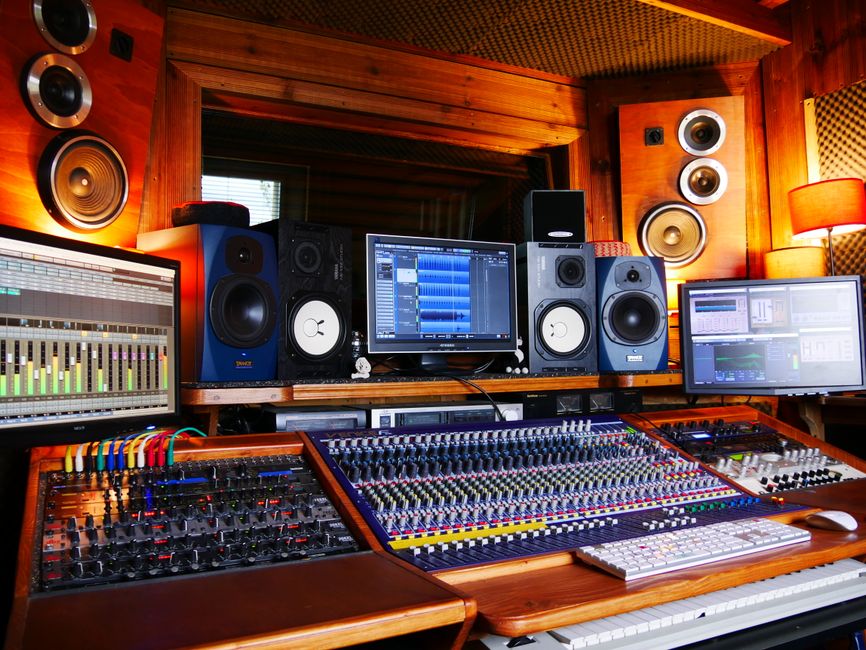
PreSonus Eris speakers are the best-selling studio monitor line for a reason: they deliver honest mixing at a price that doesn't require taking out a loan. The Eris line is purpose-built for bedroom and home studios where budget matters but accuracy doesn't get sacrificed.
Eris monitors offer proper flat frequency response in a compact form factor. They won't blow a professional control room away, but they're genuinely excellent for tracking, overdubs, and mixing. Many full-time producers and engineers use Eris as their secondary nearfield setup or primary monitors in smaller rooms.
Pros:
- Accurate mixing at budget-friendly price point ($250-$400 per unit)
- Compact design works in smaller rooms
- Financing available ($21.94 to $40.29 per month range)
Cons:
- Not ideal for large, commercial studios
- Less extensive room correction options than premium competitors
Precision Compact: Genelec The Ones
Genelec The Ones are engineered for smaller spaces without compromising professional-grade accuracy. If your mixing setup is in a bedroom or compact studio room, these monitors punch way above their size class.
The Ones incorporate Genelec's years of experience in compact monitor design. They use advanced driver technology and precise cabinet tuning to deliver flat response in confined spaces. Many music producers and mastering engineers specifically choose The Ones for nearfield mixing, exactly where they excel.
Pros:
- Exceptional accuracy for compact size
- Built-in DSP Temporal Equalization technology
- Reliable, professional-grade construction
Cons:
- Mid-to-premium pricing ($700-$900 per unit)
- Overkill for purely casual home recording
Detail Masters: ADAM Audio A Series
ADAM Audio has built a reputation on revealing, detail-oriented sound. If you want to hear every nuance in your mix, A Series monitors will show it to you. They're especially favored by mix engineers who prioritize catching subtle problems early.
The A Series uses ADAM's ribbon tweeter design, which translates to exceptional clarity in the high-frequency range. If you're mixing vocals, strings, or anything where top-end precision matters, these monitors earn their investment.
Pros:
- Exceptional high-frequency detail and clarity
- Ribbon tweeter technology reveals subtle mix issues
- Solid build quality and reliability
Cons:
- Premium pricing ($800+ per unit)
- Can sound fatiguing in untreated rooms due to high-frequency emphasis
Hybrid Approach: Barefoot Sound Footprint
Barefoot Sound Footprint monitors are designed with a unique hybrid approach to small and mid-sized rooms. They offer professional accuracy without requiring extensive acoustic treatment, which appeals to producers working in real-world spaces rather than perfect studios.
Pros:
- Works well in partially treated rooms
- Accurate frequency response across small to medium spaces
- Handcrafted quality and attention to detail
Cons:
- Premium pricing ($900+ per unit)
- Longer wait times due to handcrafted manufacturing
The Real Talk: Room Acoustics Beat Speaker Model

Here's something most articles skip: a pair of $800 monitors in an untreated room will sound worse than $400 monitors in a properly treated space. Your room is half the equation, maybe more.
Hard walls bounce sound everywhere, creating bass bloat and frequency peaks that no monitor can hide. Soft furnishings, bass traps, and strategic placement matter enormously. Before you spend another dollar on speakers, spend time on room setup. It costs less and yields bigger results.
When you're ready to upgrade your monitors and want to sell your current pair without losing a chunk to marketplace commissions, OohYeah is where musicians move gear directly to other musicians. No fees. No middleman. Just fair pricing between people who understand what they're buying and selling.
How to Choose the Right Pair for Your Setup
Start with your room size. Larger nearfield monitors (8-inch woofers) work better in bigger spaces and commercial studios. Smaller monitors (5 to 6-inch woofers) excel in compact rooms and bedrooms. Cramming huge monitors in a tiny bedroom creates phase issues and bass problems you can't fix.
Second, check your budget against your actual needs. A touring sound engineer mixing live FOH recordings needs different monitors than a bedroom producer cutting bedroom pop. Be honest about your use case.
Third, evaluate whether you can treat your room. Monitors with built-in room correction (like Neumann KH and Genelec The Ones) are worth the premium if you can't invest in acoustic panels. Monitors without DSP correction require more careful setup.
Finally, think about resale value and long-term use. Premium brands like Neumann and Genelec hold value well. Budget-friendly options depreciate faster but lower your initial investment. Both approaches are valid depending on your situation.
Where to Find Quality Monitors Without Breaking the Budget
New monitors from big retailers often carry markup pricing that inflates costs. Used monitors from trusted sources are the smarter play for most musicians. A pair of 2-to-3-year-old Neumanns or Genelecs in good condition performs identically to new units at 40 to 50% off the retail price.
The challenge is finding them without platform commissions cutting into your savings. That's exactly why OohYeah exists: to let musicians and studios buy and sell gear directly, commission-free. Whether you're upgrading your setup or selling your old pair, you keep what you earn and pay fair prices without marketplace markup.
Setup Tips for Maximum Accuracy
Placement is non-negotiable. Position monitors at ear level when you're seated at your mixing position, forming an equilateral triangle with your head. Angle them slightly inward so drivers aim directly at your ears, not the sides of your head.
Avoid placing monitors directly against walls, especially bass walls. Keep them at least 1 to 2 feet away from corners and solid surfaces. Corners amplify bass frequencies, creating false low-end information that ruins your mixes.
Use monitor stands or isolation pads to decouple speakers from your desk or floor. Vibration transfer muddles clarity. Proper isolation costs $30 to $80 per monitor and yields dramatic improvements in mix accuracy.
Check the documentation for your chosen monitors. Sound on Sound published a comprehensive breakdown of professional monitoring practices that applies across all brands and price points.
What's the difference between studio monitors and regular speakers?
Studio monitors are engineered for flat, accurate frequency response across the entire audio spectrum. Regular consumer speakers use EQ curves that add bass and treble to make music sound "fun" rather than truthful. When you're mixing, you need honest sound so you can actually fix problems instead of chasing phantom issues created by colored speakers.
Do I really need to treat my room before buying monitors?
Not before, but very soon after. You can start mixing with untreated acoustics, but you'll make mixing decisions based on false room response rather than true speaker performance. Even basic acoustic treatment—a few bass traps and wall panels—dramatically improves your ability to make accurate mixes. Room treatment and monitor selection go hand in hand.
Can I use studio monitors for listening to music casually?
You can, but they're not ideal for it. Studio monitors won't flatter your music the way consumer speakers do. They'll reveal harsh production choices or mixing flaws you didn't realize existed. Many producers find this either fascinating or annoying depending on the day. They work, just know that casual listening on studio monitors hits different.
How often should I replace my studio monitors?
Quality monitors last 10 to 15 years or more if properly maintained. There's no hard replacement schedule. Upgrade when your current pair stops meeting your needs, develops issues, or new technology offers a meaningful improvement for your workflow. Plenty of professional studios still use monitors from the 2000s and 2010s. Build quality matters way more than age.